Paper I — Q8
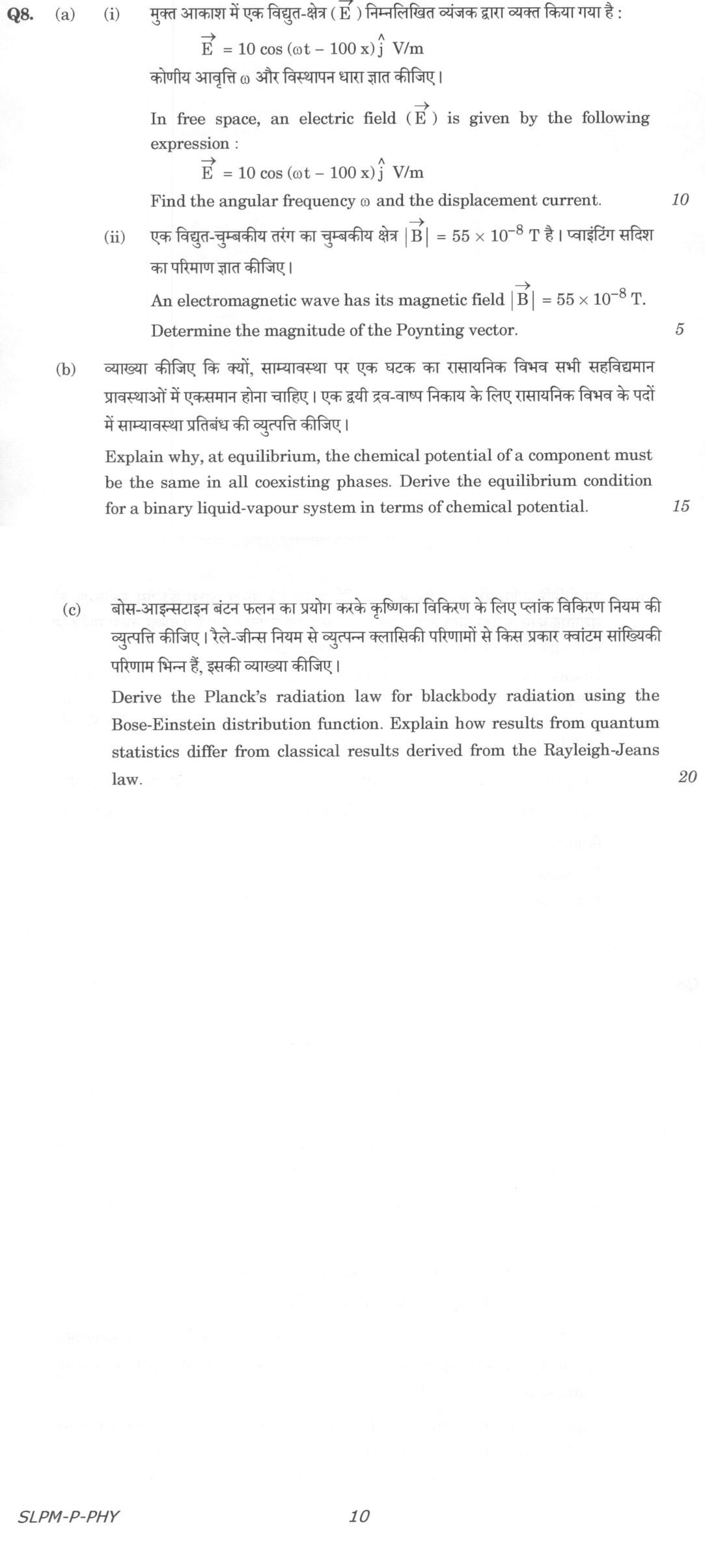
(a) (i) In free space, an electric field (E⃗) is given by the following expression : E⃗ = 10 cos (ω t - 100 x)ĵ V/m Find the…
In free space, an electric field (E⃗) is given by the following expression :
E⃗ = 10 cos (ω t - 100 x)ĵ V/m
Find the angular frequency ω and the displacement current. 10 marks
An electromagnetic wave has its magnetic field |B⃗| = 55 × 10⁻⁸ T. Determine the magnitude of the Poynting vector. 5 marks
Explain why, at equilibrium, the chemical potential of a component must be the same in all coexisting phases. Derive the equilibrium condition for a binary liquid-vapour system in terms of chemical potential. 15 marks
Derive the Planck's radiation law for blackbody radiation using the Bose-Einstein distribution function. Explain how results from quantum statistics differ from classical results derived from the Rayleigh-Jeans law. 20 marks
हिंदी में प्रश्न पढ़ें
मुक्त आकाश में एक विद्युत-क्षेत्र (E⃗) निम्नलिखित व्यंजक द्वारा व्यक्त किया गया है :
E⃗ = 10 cos (ω t - 100 x)ĵ V/m
कोणीय आवृत्ति ω और विस्थापन धारा ज्ञात कीजिए। (10 अंक)
एक विद्युत-चुंबकीय तरंग का चुंबकीय क्षेत्र |B⃗| = 55 × 10⁻⁸ T है। पॉइंटिंग सदिश का परिमाण ज्ञात कीजिए। (5 अंक)
व्याख्या कीजिए कि क्यों, साम्यावस्था पर एक घटक का रासायनिक विभव सभी सहविद्यमान प्रावस्थाओं में एकसमान होना चाहिए। एक द्वयी द्रव-वाष्प निकाय के लिए रासायनिक विभव के पदों में साम्यावस्था प्रतिबंध की व्युत्पत्ति कीजिए। (15 अंक)
बोस-आइंस्टाइन बंटन फलन का प्रयोग करके कृष्णिका विकिरण के लिए प्लांक विकिरण नियम की व्युत्पत्ति कीजिए। रेले-जीन्स नियम से व्युत्पन्न क्लासिकी परिणामों से किस प्रकार क्वांटम सांख्यिकी परिणाम भिन्न हैं, इसकी व्याख्या कीजिए। (20 अंक)
Model answer
Written by UPSC Answer Check against this question's marking rubric, to the expected length. UPSC does not publish answers for Mains — this is one way to score well, not an official key.
(a)(i) Given E = 10 cos(ωt − 100x) ĵ V/m. Comparing with E = E₀ cos(ωt − kx) ĵ, we get k = 100 rad/m. For a free-space plane wave, c = ω/k = 1/√(μ₀ε₀) = 3.00×10⁸ m/s. Hence ω = c k = (3.00×10⁸)(100) = 3.00×10¹⁰ rad/s.
Maxwell–Ampère law in free space gives J_d = ∂D/∂t = ε₀ ∂E/∂t. ∂E/∂t = −10ω sin(ωt − 100x) ĵ. Thus J_d = −ε₀(10)(3.00×10¹⁰) sin(ωt − 100x) ĵ = −2.656 sin(3.00×10¹⁰ t − 100x) ĵ A/m². This is the displacement current density. Through area A, the total displacement current is I_d = J_d A. Validity: free space, no conduction current.
(a)(ii) For a plane electromagnetic wave in free space, |E| = c|B|. The Poynting vector is S = (1/μ₀) E × B, so |S| = |E||B|/μ₀ = cB²/μ₀. Given B = 55×10⁻⁸ T, |S| = (3.00×10⁸)(55×10⁻⁸)²/(4π×10⁻⁷) = 1815/(8π) W/m² ≈ 72.2 W/m². If 55×10⁻⁸ T is the peak amplitude of a sinusoidal wave, the time-averaged magnitude is half, ≈36.1 W/m².
(b) At equilibrium, the Gibbs free energy G of a closed system at fixed T and P is minimum. Consider transfer of δn_i of component i from phase α to phase β. Then δG = μ_i^β δn_i − μ_i^α δn_i = (μ_i^β − μ_i^α)δn_i. At equilibrium δG = 0 for arbitrary small δn_i, hence μ_i^α = μ_i^β. If they were unequal, spontaneous transfer would lower G until equality. Thus every component that can cross a phase boundary has the same chemical potential in all coexisting phases; T and P are also equal at equilibrium.
For a binary liquid–vapour system, let components be 1 and 2, liquid phase L and vapour phase V. The equilibrium conditions are μ₁^L(T,P,x₁) = μ₁^V(T,P,y₁), μ₂^L(T,P,x₂) = μ₂^V(T,P,y₂), with x₁ + x₂ = 1 and y₁ + y₂ = 1, where x_i and y_i are liquid and vapour mole fractions. Writing μ_i^L = μ_i^L,0(T,P) + RT ln a_i^L, μ_i^V = μ_i^V,0(T,P) + RT ln a_i^V, equating gives a_i^V/a_i^L = exp[(μ_i^L,0 − μ_i^V,0)/RT] ≡ K_i. For ideal solution and ideal vapour, a_i^L = x_i and a_i^V = y_i P/P_i^0; using pure-component saturation pressures p_i^sat gives y_i P = x_i p_i^sat, i = 1,2. Combining, P = x₁p₁^sat + x₂p₂^sat. This is Raoult’s law.
(c) Consider blackbody radiation in a cavity of volume V at temperature T. Periodic boundary conditions give allowed wave vectors with spacing 2π/L. The number of wave-vector states in the shell k to k + dk is dN_k = V/(2π)³ · 4πk² dk. Photons have two transverse polarizations, so dN = 2 · V/(2π)³ · 4πk² dk = Vk²/π² dk. Using k = 2πν/c, dk = 2π/c dν, dN = 8πVν²/c³ dν. Thus the mode density per unit volume per unit frequency is g(ν) = 8πν²/c³.
Photons are bosons with chemical potential μ = 0 because photon number is not conserved. The Bose–Einstein occupation number for energy hν is n̄(ν) = 1/[exp(hν/k_B T) − 1]. Therefore the energy density in frequency interval dν is u(ν,T)dν = g(ν) hν n̄(ν)dν, giving u(ν,T) = (8πhν³/c³) · 1/[exp(hν/k_B T) − 1]. This is Planck’s radiation law. The spectral radiance is B(ν,T) = (2hν³/c²) · 1/[exp(hν/k_B T) − 1]. Integrating over all frequencies gives u(T) = ∫₀^∞ u(ν,T)dν = (8π⁵k_B⁴/15h³c³)T⁴ = aT⁴.
The classical Rayleigh–Jeans law treats mode energies as continuous and assigns equipartition energy k_B T per mode: u_RJ(ν,T) = 8πν²k_B T/c³. It agrees with Planck only for hν ≪ k_B T, since then exp(hν/k_B T) − 1 ≈ hν/k_B T. At high frequencies, Rayleigh–Jeans diverges as ν², the ultraviolet catastrophe. Planck’s law is exponentially suppressed as exp(−hν/k_B T), so total energy is finite. Thus quantum statistics introduces energy quantization hν, removes the ultraviolet catastrophe, gives the correct Wien displacement and Stefan–Boltzmann laws, and reduces to the classical limit only at low frequencies.
What "Derive" is asking you to do
Reach the stated expression from a starting relation, justifying every step. The destination is printed in the question, so only the route earns marks, and the assumptions you work under are part of that route.
Structure that answers it
Assumptions and notation defined → starting relation or governing equation → each step with its justification → the required expression → limiting case or boundary check
Where marks are lost
Writing the standard result first and fitting three lines to it, which an examiner reads at a glance. Marks also go on assumptions left unstated — lossless medium, small amplitude, errors independent with zero mean — and on symbols used before they are defined, even when the question says usual notations.
How this answer will be evaluated
Approach
(a(i)) calculate: given > formula > substitution > result with units > interpretation | (a(ii)) calculate: given > formula > substitution > result with units > interpretation | (b) derive: given > assumptions > stepwise derivation > result > check | (c) derive: given > assumptions > stepwise derivation > result > check Full marks: Complete derivations with all steps, correct units, physical interpretation, and clear contrast between quantum and classical results.
Key points expected
- Identify wave number k = 100 rad/m from expression
- Calculate ω using free space relation ω = ck
- State displacement current density formula Jd = ε₀ ∂E/∂t
- Differentiate E(t) to find ∂E/∂t
- State Poynting vector magnitude formula S = E²/μ₀c or S = cB²/μ₀
- Substitute B = 55 × 10⁻⁸ T into formula
- Use correct values for c and μ₀
- State Gibbs free energy minimization criterion
Evaluation rubric
Each sub-part is marked on its own, against the marks and word limit printed on the paper.
- (a(i)) Determine angular frequency and displacement current from the given electric field expression. 10 marks
calculate— given → formula → substitution → result with units → interpretation
Must cover
- Identify wave number k = 100 rad/m from expression
- Calculate ω using free space relation ω = ck
- State displacement current density formula Jd = ε₀ ∂E/∂t
- Differentiate E(t) to find ∂E/∂t
Loses marks
- Using ω = 100 directly without derivation
- Omitting time derivative for displacement current
- Confusing displacement current with conduction current
Earns more
- Substitute c = 3 × 10⁸ m/s explicitly
- Show units for ω (rad/s) and Jd (A/m²)
- Identify propagation direction from phase term
Extra mark
- Mention phase velocity v = ω/k = c
- (a(ii)) Calculate magnitude of Poynting vector from given magnetic field magnitude. 5 marks
calculate— given → formula → substitution → result with units → interpretation
Must cover
- State Poynting vector magnitude formula S = E²/μ₀c or S = cB²/μ₀
- Substitute B = 55 × 10⁻⁸ T into formula
- Use correct values for c and μ₀
Loses marks
- Using S = EB without deriving E from B
- Incorrect unit conversion for B
Earns more
- Show intermediate calculation steps
- State final answer in W/m²
Extra mark
- Mention direction of energy flow is E × B
- (b) Explain chemical potential equality at equilibrium and derive binary liquid-vapour equilibrium condition. 15 marks
derive— given → assumptions → stepwise derivation → result → check
Must cover
- State Gibbs free energy minimization criterion
- Show dG = 0 implies μᵢᵃ = μᵢᵇ for all i
- Define chemical potential for binary system components
- Derive μᵢᴸ = μᵢᵛ for both components i=1,2
Loses marks
- Stating equality without thermodynamic derivation
- Confusing chemical potential with molar Gibbs energy
- Ignoring binary nature (treating as pure substance)
Earns more
- Use Gibbs-Duhem equation in derivation
- Mention phase rule F = C - P + 2
- Define coexisting phases clearly
Extra mark
- Sketch μ vs T or P diagram for binary system
- (c) Derive Planck's law using Bose-Einstein distribution and contrast with Rayleigh-Jeans law. 20 marks
derive— given → assumptions → stepwise derivation → result → check
Must cover
- State Bose-Einstein distribution for photons n(ν) = 1/(e^(hν/kT) - 1)
- Calculate density of states for EM modes in cavity
- Derive energy density u(ν,T) = 8πhν³/c³ / (e^(hν/kT) - 1)
- Show Rayleigh-Jeans limit as hν << kT
Loses marks
- Using classical equipartition without quantization
- Omitting density of states derivation
- Confusing spectral radiance with energy density
Earns more
- Derive photon energy E = hν from quantization
- Show classical limit u(ν,T) = 8πν²kT/c³
- Mention ultraviolet catastrophe in classical result
Extra mark
- Plot u(ν,T) curves for Planck vs Rayleigh-Jeans
- Mention Wien's displacement law from Planck's law
Practice this exact question
Write your answer and it is marked point by point against the model answer above — what you covered, what you missed, what you got wrong.
Evaluate my answer →More from Physics 2025 Paper I
- Q5 (a) Consider a point charge of 5 nC placed at a distance of 1 m from a perfect conducting…
- Q6 (a) Consider a long straight wire of length L carrying a current I. Determine the magneti…
- Q7 (a) A ternary system consists of three components (A, B and C) in equilibrium with two ph…
- Q8 (a) (i) In free space, an electric field (E⃗) is given by the following expression : E⃗ =…