Paper I — Q3
(a) Consider a laser system consisting of an active medium placed between a pair of mirrors forming a resonator. Obtain an…
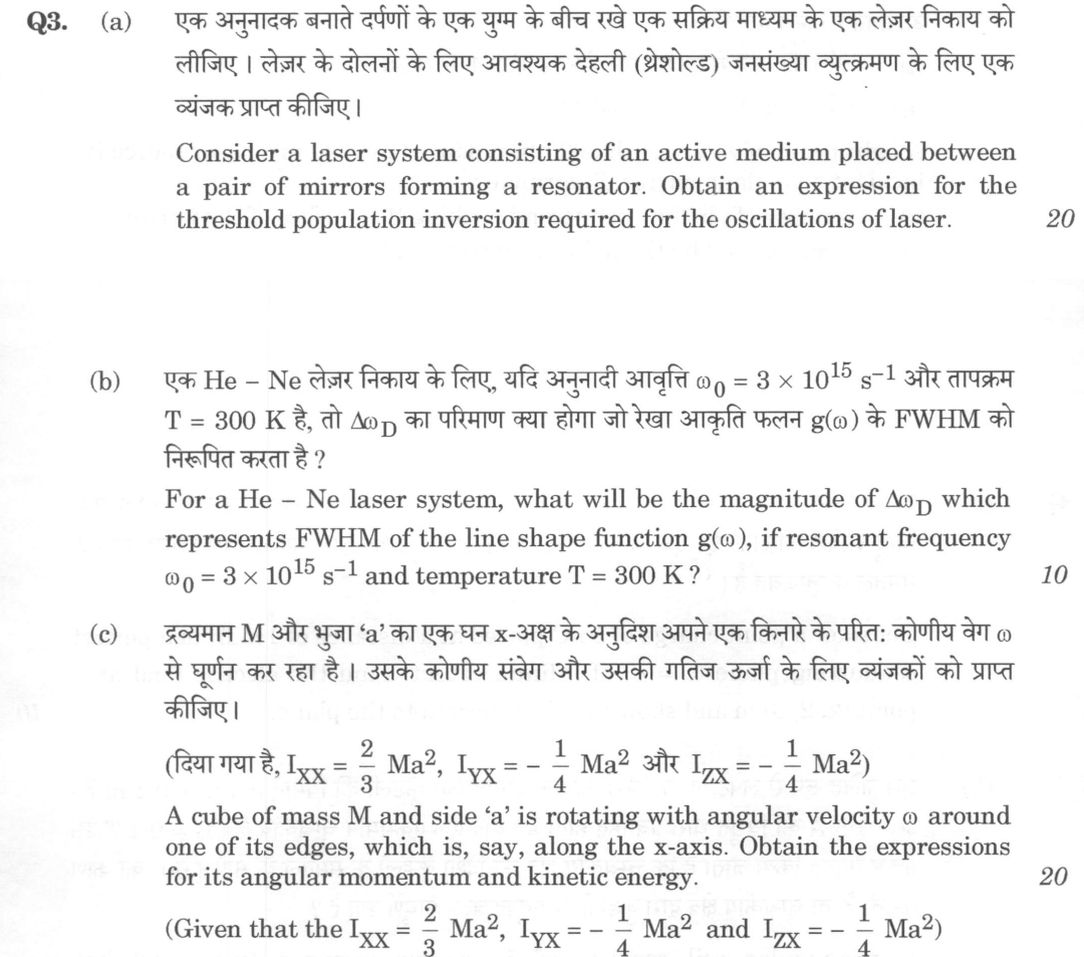
Consider a laser system consisting of an active medium placed between a pair of mirrors forming a resonator. Obtain an expression for the threshold population inversion required for the oscillations of laser. 20 marks
For a He – Ne laser system, what will be the magnitude of Δω_D which represents FWHM of the line shape function g(ω), if resonant frequency ω₀ = 3 × 10¹⁵ s⁻¹ and temperature T = 300 K ? 10 marks
A cube of mass M and side 'a' is rotating with angular velocity ω around one of its edges, which is, say, along the x-axis. Obtain the expressions for its angular momentum and kinetic energy. (Given that the I_XX = 2/3 Ma², I_YX = -1/4 Ma² and I_ZX = -1/4 Ma²) 20 marks
हिंदी में प्रश्न पढ़ें
एक अनुनादक बनाते दर्पणों के एक युग्म के बीच रखे एक सक्रिय माध्यम के एक लेजर निकाय को लीजिए। लेजर के दोलनों के लिए आवश्यक देहली (थ्रेशोल्ड) जनसंख्या व्युत्क्रमण के लिए एक व्यंजक प्राप्त कीजिए। (20 अंक)
एक He – Ne लेज़र निकाय के लिए, यदि अनुनादी आवृत्ति ω₀ = 3 × 10¹⁵ s⁻¹ और तापक्रम T = 300 K है, तो Δω_D का परिमाण क्या होगा जो रेखा आकृति फलन g(ω) के FWHM को निरूपित करता है? (10 अंक)
द्रव्यमान M और भुजा 'a' का एक घन x-अक्ष के अनुदिश अपने एक किनारे के परितः कोणीय वेग ω से घूर्णन कर रहा है। उसके कोणीय संवेग और उसकी गतिज ऊर्जा के लिए व्यंजकों को प्राप्त कीजिए। (दिया गया है, I_XX = 2/3 Ma², I_YX = -1/4 Ma² और I_ZX = -1/4 Ma²) (20 अंक)
Model answer
Written by UPSC Answer Check against this question's marking rubric, to the expected length. UPSC does not publish answers for Mains — this is one way to score well, not an official key.
(a) Let the active medium have length L, mirror reflectivities R₁ and R₂, and distributed loss coefficient α. Let N₂ and N₁ be the upper- and lower-level populations with degeneracies g₂ and g₁. The net stimulated emission per unit volume is proportional to N₂B₂₁ − N₁B₁₂ = B₂₁[N₂ − (g₂/g₁)N₁], because the Einstein relation g₁B₁₂ = g₂B₂₁ gives B₁₂ = (g₂/g₁)B₂₁. Hence the small-signal gain coefficient at angular frequency ω is γ(ω) = σ(ω) ΔN, where ΔN = N₂ − (g₂/g₁)N₁, and σ(ω) is the stimulated-emission cross-section. If g₁ = g₂, ΔN = N₂ − N₁.
For one round trip, the intensity becomes I_after = I_before R₁R₂ exp[2(γ − α)L]. At threshold, steady oscillation begins, so I_after = I_before. Therefore R₁R₂ exp[2(γ_th − α)L] = 1. Solving, γ_th = α + (1/(2L)) ln(1/(R₁R₂)). Since γ_th = σ(ω) ΔN_th, ΔN_th = [α + (1/(2L)) ln(1/(R₁R₂))]/σ(ω). This is the threshold population inversion. If internal loss α = 0, ΔN_th = ln(1/(R₁R₂))/(2Lσ(ω)). If R₁ = R₂ = R, then ΔN_th = −ln R/(Lσ(ω)). The condition is small-signal, uniform gain, and steady-state cavity oscillation.
(b) For Doppler broadening, an atom with velocity component v along the laser axis radiates at ω = ω₀(1 + v/c). Using the Maxwell speed distribution, the line shape is Gaussian. Its FWHM in angular frequency is found by setting the Gaussian equal to half its maximum: exp[−m c²(ω − ω₀)²/(2kTω₀²)] = 1/2. Thus Δω_D = 2ω₀√(2kT ln2/(m c²)) = ω₀√(8kT ln2/(m c²)). For the He–Ne laser, the lasing transition occurs in neon, so take m_Ne ≈ 20.18 u = 20.18 × 1.66054 × 10⁻²⁷ kg = 3.351 × 10⁻²⁶ kg. Given T = 300 K, k = 1.381 × 10⁻²³ J K⁻¹, c = 3.00 × 10⁸ m s⁻¹, ω₀ = 3 × 10¹⁵ s⁻¹. kT = 1.381 × 10⁻²³ × 300 = 4.143 × 10⁻²¹ J. m c² = 3.351 × 10⁻²⁶ × (3.00 × 10⁸)² = 3.016 × 10⁻⁹ J. Therefore √(8kT ln2/(m c²)) = √[8 × 0.6931 × 4.143 × 10⁻²¹/(3.016 × 10⁻⁹)] = √(7.62 × 10⁻¹²) = 2.76 × 10⁻⁶. Hence Δω_D = 3 × 10¹⁵ × 2.76 × 10⁻⁶ = 8.28 × 10⁹ s⁻¹. Δω_D ≈ 8.3 × 10⁹ s⁻¹, i.e. the ordinary-frequency FWHM is Δν_D = Δω_D/(2π) ≈ 1.3 × 10⁹ Hz.
(c) Take the origin at a corner on the edge along the x-axis, with body axes along the cube edges. The angular velocity vector is Ω = ω i. Using the rigid-body relation L = I · Ω, Lₓ = Iₓₓ ω, Lᵧ = Iᵧₓ ω, L_z = I_zₓ ω. Given Iₓₓ = (2/3)Ma², Iᵧₓ = −(1/4)Ma², I_zₓ = −(1/4)Ma², Lₓ = (2/3)Ma²ω, Lᵧ = −(1/4)Ma²ω, L_z = −(1/4)Ma²ω. Thus L = (2/3 Ma²ω)i − (1/4 Ma²ω)j − (1/4 Ma²ω)k. Its magnitude is |L| = Ma²ω√[(2/3)² + (−1/4)² + (−1/4)²] = Ma²ω√(4/9 + 1/16 + 1/16) = Ma²ω√(41/72).
The kinetic energy is T = (1/2)Ω · L = (1/2)ωLₓ = (1/2)ω[(2/3)Ma²ω] = (1/3)Ma²ω². The angular momentum is not along the rotation axis because the edge is not a principal axis of the cube.
What "Derive" is asking you to do
Reach the stated expression from a starting relation, justifying every step. The destination is printed in the question, so only the route earns marks, and the assumptions you work under are part of that route.
Structure that answers it
Assumptions and notation defined → starting relation or governing equation → each step with its justification → the required expression → limiting case or boundary check
Where marks are lost
Writing the standard result first and fitting three lines to it, which an examiner reads at a glance. Marks also go on assumptions left unstated — lossless medium, small amplitude, errors independent with zero mean — and on symbols used before they are defined, even when the question says usual notations.
How this answer will be evaluated
Approach
(a) derive: given > assumptions > stepwise derivation > result > check | (b) calculate: given > formula > substitution > result with units > interpretation | (c) derive: given > assumptions > stepwise derivation > result > check Full marks: Complete derivations with clear steps, correct units, and physical interpretation
Key points expected
- Define resonator losses (mirror transmission, scattering, absorption)
- Relate gain coefficient to population inversion (N2 - N1)
- Equate gain to total loss for threshold condition
- State final expression for (N2 - N1)th
- State formula for Doppler broadening ΔωD
- Identify given values: ω0 = 3×10¹⁵ s⁻¹, T = 300 K
- Substitute values into formula
- Provide final answer with correct units
Evaluation rubric
Each sub-part is marked on its own, against the marks and word limit printed on the paper.
- (a) Derive the expression for threshold population inversion in a laser resonator. 20 marks
derive— given → assumptions → stepwise derivation → result → check
Must cover
- Define resonator losses (mirror transmission, scattering, absorption)
- Relate gain coefficient to population inversion (N2 - N1)
- Equate gain to total loss for threshold condition
- State final expression for (N2 - N1)th
Loses marks
- Writing final formula without derivation steps
- Confusing gain coefficient with population inversion
- Ignoring resonator losses in threshold condition
Earns more
- Include diagram of resonator with mirrors and medium
- Define round-trip gain and loss explicitly
- Mention role of spontaneous emission factor
Extra mark
- Discuss effect of mirror reflectivity on threshold
- Mention specific laser system example
- (b) Calculate the magnitude of ΔωD (FWHM) for a He-Ne laser. 10 marks
calculate— given → formula → substitution → result with units → interpretation
Must cover
- State formula for Doppler broadening ΔωD
- Identify given values: ω0 = 3×10¹⁵ s⁻¹, T = 300 K
- Substitute values into formula
- Provide final answer with correct units
Loses marks
- Using wrong formula for Doppler broadening
- Arithmetic errors in substitution
- Omitting units in final answer
Earns more
- Show intermediate calculation steps
- State the gas constant or mass of Ne used
- Verify dimensional consistency
Extra mark
- Compare with typical He-Ne laser linewidth
- Mention effect of pressure on broadening
- (c) Obtain expressions for angular momentum and kinetic energy of rotating cube. 20 marks
derive— given → assumptions → stepwise derivation → result → check
Must cover
- Write angular momentum vector L = Iω using given moments
- Substitute given Ixx, Iyx, Izx values
- Derive kinetic energy T = ½ω·L
- Express final results in terms of M, a, ω
Loses marks
- Ignoring off-diagonal inertia terms
- Using wrong formula for kinetic energy
- Arithmetic errors in vector multiplication
Earns more
- Show matrix form of inertia tensor
- Calculate each component of L explicitly
- Verify units of angular momentum and energy
Extra mark
- Discuss physical meaning of off-diagonal terms
- Mention principal axes of inertia
Practice this exact question
Write your answer and it is marked point by point against the model answer above — what you covered, what you missed, what you got wrong.
Evaluate my answer →More from Physics 2025 Paper I
- Q1 (a) Consider a large stationary cylinder of inner radius R. A smaller solid cylinder of r…
- Q2 (a) A body moves about a point 'O' under no force, the principal moments of inertia at 'O…
- Q3 (a) Consider a laser system consisting of an active medium placed between a pair of mirro…
- Q4 (a) Consider a thick lens of thickness t made of a material of relative refractive index…
- Q5 (a) Consider a point charge of 5 nC placed at a distance of 1 m from a perfect conducting…
- Q6 (a) Consider a long straight wire of length L carrying a current I. Determine the magneti…