Paper I — Q2
(a) A body moves about a point 'O' under no force, the principal moments of inertia at 'O' being 3A, 5A and 6A. The components of…
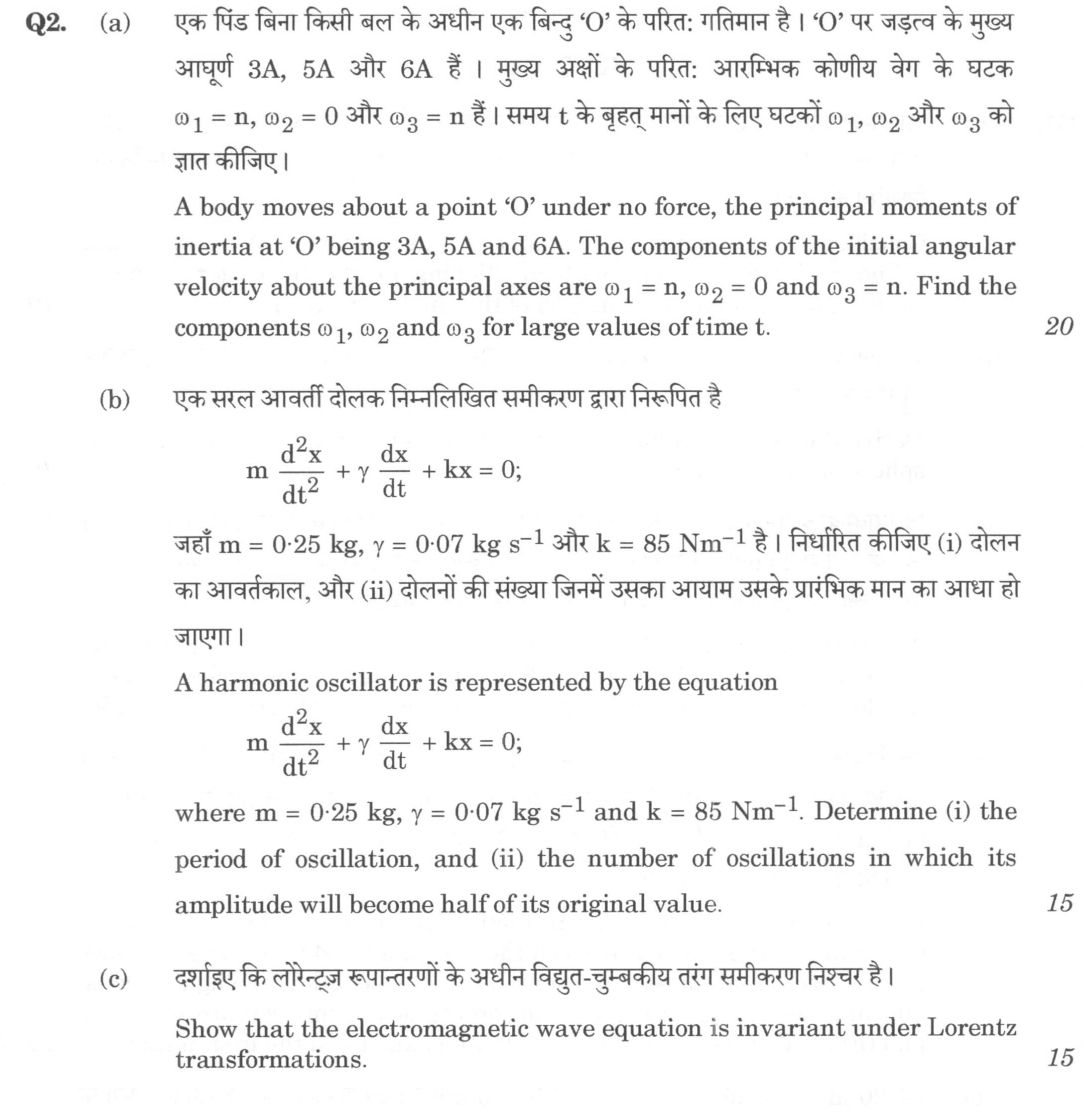
A body moves about a point 'O' under no force, the principal moments of inertia at 'O' being 3A, 5A and 6A. The components of the initial angular velocity about the principal axes are ω₁ = n, ω₂ = 0 and ω₃ = n. Find the components ω₁, ω₂ and ω₃ for large values of time t. 20 marks
A harmonic oscillator is represented by the equation m d²x/dt² + γ dx/dt + kx = 0; where m = 0·25 kg, γ = 0·07 kg s⁻¹ and k = 85 Nm⁻¹. Determine (i) the period of oscillation, and (ii) the number of oscillations in which its amplitude will become half of its original value. 15 marks
Show that the electromagnetic wave equation is invariant under Lorentz transformations. 15 marks
हिंदी में प्रश्न पढ़ें
एक पिण्ड बिना किसी बल के अधीन एक बिन्दु 'O' के परितः गतिमान है। 'O' पर जड़त्व के मुख्य आघूर्ण 3A, 5A और 6A हैं। मुख्य अक्षों के परितः आरम्भिक कोणीय वेग के घटक ω₁ = n, ω₂ = 0 और ω₃ = n हैं। समय t के बहुत मानों के लिए घटकों ω₁, ω₂ और ω₃ को ज्ञात कीजिए। 20
एक सरल आवर्ती दोलक निम्नलिखित समीकरण द्वारा निरूपित है m d²x/dt² + γ dx/dt + kx = 0; जहाँ m = 0·25 kg, γ = 0·07 kg s⁻¹ और k = 85 Nm⁻¹ है। निर्धारित कीजिए (i) दोलन का आवर्तकाल, और (ii) दोलनों की संख्या जिनमें उसका आयाम उसके प्रारम्भिक मान का आधा हो जाएगा। 15
दर्शाइए कि लोरेन्ट्ज रूपान्तरणों के अधीन विद्युत-चुम्बकीय तरंग समीकरण निश्चर है। 15
Model answer
Written by UPSC Answer Check against this question's marking rubric, to the expected length. UPSC does not publish answers for Mains — this is one way to score well, not an official key.
(a) For torque-free motion about a fixed point, Euler’s equations are I₁ dω₁/dt = (I₂ − I₃)ω₂ω₃, I₂ dω₂/dt = (I₃ − I₁)ω₃ω₁, I₃ dω₃/dt = (I₁ − I₂)ω₁ω₂.
Here I₁ = 3A, I₂ = 5A, I₃ = 6A. Hence dω₁/dt = −(1/3)ω₂ω₃, dω₂/dt = (3/5)ω₁ω₃, dω₃/dt = −(1/3)ω₁ω₂.
Initially ω₁ = n, ω₂ = 0, ω₃ = n. Since ω₁ = ω₃ initially, and d(ω₁ − ω₃)/dt = (ω₂/3)(ω₁ − ω₃), the equality ω₁ = ω₃ is preserved for all t. Put ω₁ = ω₃ = x, ω₂ = y. Then dx/dt = −(1/3)xy, dy/dt = (3/5)x².
Use conservation of kinetic energy. Since the body is torque-free, T = 1/2(3A x² + 5A y² + 6A x²) = constant. At t = 0, T = 1/2(3A n² + 6A n²) = (9/2)A n². Therefore 9x² + 5y² = 9n², so x² = n² − (5/9)y².
Substitute this in dy/dt: dy/dt = (3/5)[n² − (5/9)y²] = (3/5)n² − (1/3)y². This is separable: ∫₀ʸ dy/((3/5)n² − (1/3)y²) = t.
Using ∫ du/(a − bu²) = (1/√(ab)) artanh(u√(b/a)), with a = (3/5)n², b = 1/3, √(ab) = n/√5, √(b/a) = √5/(3n), we get t = (√5/n) artanh(√5 y/(3n)). Thus y = (3n/√5) tanh(n t/√5). Then x = √(n² − (5/9)y²) = n sech(n t/√5).
Hence the exact components are ω₁ = n sech(n t/√5), ω₂ = (3n/√5) tanh(n t/√5), ω₃ = n sech(n t/√5). For large t, tanh(n t/√5) → 1 and sech(n t/√5) → 0. Therefore ω₁ → 0, ω₂ → 3n/√5, ω₃ → 0. The components have units of s⁻¹.
(b) Write the equation as d²x/dt² + 2β dx/dt + ω₀²x = 0, where β = γ/(2m) = 0.07/(2 × 0.25) = 0.14 s⁻¹, ω₀² = k/m = 85/0.25 = 340 s⁻². Since β < ω₀, the oscillator is underdamped. The damped angular frequency is ω_d = √(ω₀² − β²) = √(340 − 0.0196) = √339.9804 = 18.4386 s⁻¹.
(i) The period of oscillation is T = 2π/ω_d = 2π/18.4386 = 0.3408 s. Exactly, T = 100π/√849951 s ≈ 0.3408 s.
(ii) The amplitude decays as A(t) = A₀ e^−βt. For half amplitude, e^−βt = 1/2 ⇒ t = ln2/β = 0.693147/0.14 = 4.9511 s. Number of oscillations is N = t/T = 4.9511/0.3408 = 14.53. Exactly, N = (√849951 ln2)/(14π) ≈ 14.53. Thus the amplitude becomes half after about 14.5 oscillations, i.e. during the 15th complete oscillation.
(c) In source-free vacuum, Maxwell’s equations give the electromagnetic wave equation ∇²E − (1/c²) ∂²E/∂t² = 0, and the same for B. Define the d’Alembertian operator □ = ∂²/∂x² + ∂²/∂y² + ∂²/∂z² − (1/c²) ∂²/∂t².
Consider a Lorentz boost along x with speed v: x' = γ(x − vt), y' = y, z' = z, t' = γ(t − vx/c²), where γ = 1/√(1 − v²/c²).
By the chain rule, ∂/∂x = γ(∂/∂x' − (v/c²) ∂/∂t'), ∂/∂t = γ(∂/∂t' − v ∂/∂x').
Therefore ∂²/∂x² = γ²(∂²/∂x'² − 2(v/c²) ∂²/∂x'∂t' + (v²/c⁴) ∂²/∂t'²), ∂²/∂t² = γ²(∂²/∂t'² − 2v ∂²/∂x'∂t' + v² ∂²/∂x'²).
Now compute ∂²/∂x² − (1/c²) ∂²/∂t² = γ²[(1 − v²/c²) ∂²/∂x'² − (1/c²)(1 − v²/c²) ∂²/∂t'²] = ∂²/∂x'² − (1/c²) ∂²/∂t'².
Since y and z coordinates are unchanged, ∂²/∂y² + ∂²/∂z² = ∂²/∂y'² + ∂²/∂z'². Hence □ = □'. Thus □E = 0 ⇒ □'E' = 0, and similarly for B. Therefore the electromagnetic wave equation has the same form in all inertial frames; it is invariant under Lorentz transformations.
What "Solve" is asking you to do
Choose the method, then carry it through to a final answer. Identifying what kind of problem this is and why that method applies is the first thing marked; a correct figure arrived at invisibly earns almost nothing.
Structure that answers it
Given data and what is required → method chosen, with the reason it applies → set-up (equation, circuit, free body, trial balance) → working, step by step → answer with units and any condition of validity
Where marks are lost
Doing the middle steps mentally and writing only the result. In mathematics papers, a further loss comes from giving a decimal where the exact value in surds or fractions was wanted, or from skipping the justification a part explicitly asks for.
How this answer will be evaluated
Approach
(a) calculate: given > formula > substitution > result with units > interpretation | (b) calculate: given > formula > substitution > result with units > interpretation | (c) justify: claim > 3-4 reasons > evidence > conclusion Full marks: Complete derivations with clear physical interpretation and correct units.
Key points expected
- State Euler's equations for torque-free motion
- Substitute given moments of inertia (3A, 5A, 6A)
- Solve differential equations for ω1, ω2, ω3
- Evaluate limit as t approaches infinity
- Identify the damped harmonic oscillator equation
- Calculate the damped angular frequency ω'
- Determine the period T = 2π/ω'
- Use the amplitude decay formula to find the number of oscillations
Evaluation rubric
Each sub-part is marked on its own, against the marks and word limit printed on the paper.
- (a) Determine the components of angular velocity for large time t. 20 marks
calculate— given → formula → substitution → result with units → interpretation
Must cover
- State Euler's equations for torque-free motion
- Substitute given moments of inertia (3A, 5A, 6A)
- Solve differential equations for ω1, ω2, ω3
- Evaluate limit as t approaches infinity
Loses marks
- Assuming steady state without derivation
- Ignoring the initial conditions
- Incorrect application of Euler's equations
Earns more
- Identify the stable axis of rotation
- Show conservation of angular momentum
- Discuss the physical interpretation of the result
Extra mark
- Mention Poinsot's construction
- Relate to the inertia ellipsoid
- (b) Find the period of oscillation and the number of oscillations for amplitude halving. 15 marks
calculate— given → formula → substitution → result with units → interpretation
Must cover
- Identify the damped harmonic oscillator equation
- Calculate the damped angular frequency ω'
- Determine the period T = 2π/ω'
- Use the amplitude decay formula to find the number of oscillations
Loses marks
- Using the undamped frequency for the period
- Incorrectly applying the amplitude decay formula
- Arithmetic errors in the calculations
Earns more
- Show the calculation of the damping factor
- Verify the units of the final answers
- Discuss the effect of damping on the period
Extra mark
- Mention the quality factor Q
- Relate to the logarithmic decrement
- (c) Show the invariance of the electromagnetic wave equation under Lorentz transformations. 15 marks
justify— claim → 3-4 reasons → evidence → conclusion
Must cover
- State the electromagnetic wave equation
- Write down the Lorentz transformation equations
- Apply the transformation to the wave equation
- Show that the form of the equation remains unchanged
Loses marks
- Incorrect application of the Lorentz transformation
- Failing to show the invariance explicitly
- Confusing the wave equation with the field equations
Earns more
- Use the d'Alembertian operator
- Mention the invariance of the speed of light
- Discuss the physical significance of the invariance
Extra mark
- Relate to the principle of relativity
- Mention the four-vector formalism
Practice this exact question
Write your answer and it is marked point by point against the model answer above — what you covered, what you missed, what you got wrong.
Evaluate my answer →More from Physics 2025 Paper I
- Q1 (a) Consider a large stationary cylinder of inner radius R. A smaller solid cylinder of r…
- Q2 (a) A body moves about a point 'O' under no force, the principal moments of inertia at 'O…
- Q3 (a) Consider a laser system consisting of an active medium placed between a pair of mirro…
- Q4 (a) Consider a thick lens of thickness t made of a material of relative refractive index…
- Q5 (a) Consider a point charge of 5 nC placed at a distance of 1 m from a perfect conducting…