Paper I — Q7
(a) A ternary system consists of three components (A, B and C) in equilibrium with two phases. Determine the number of degrees of…
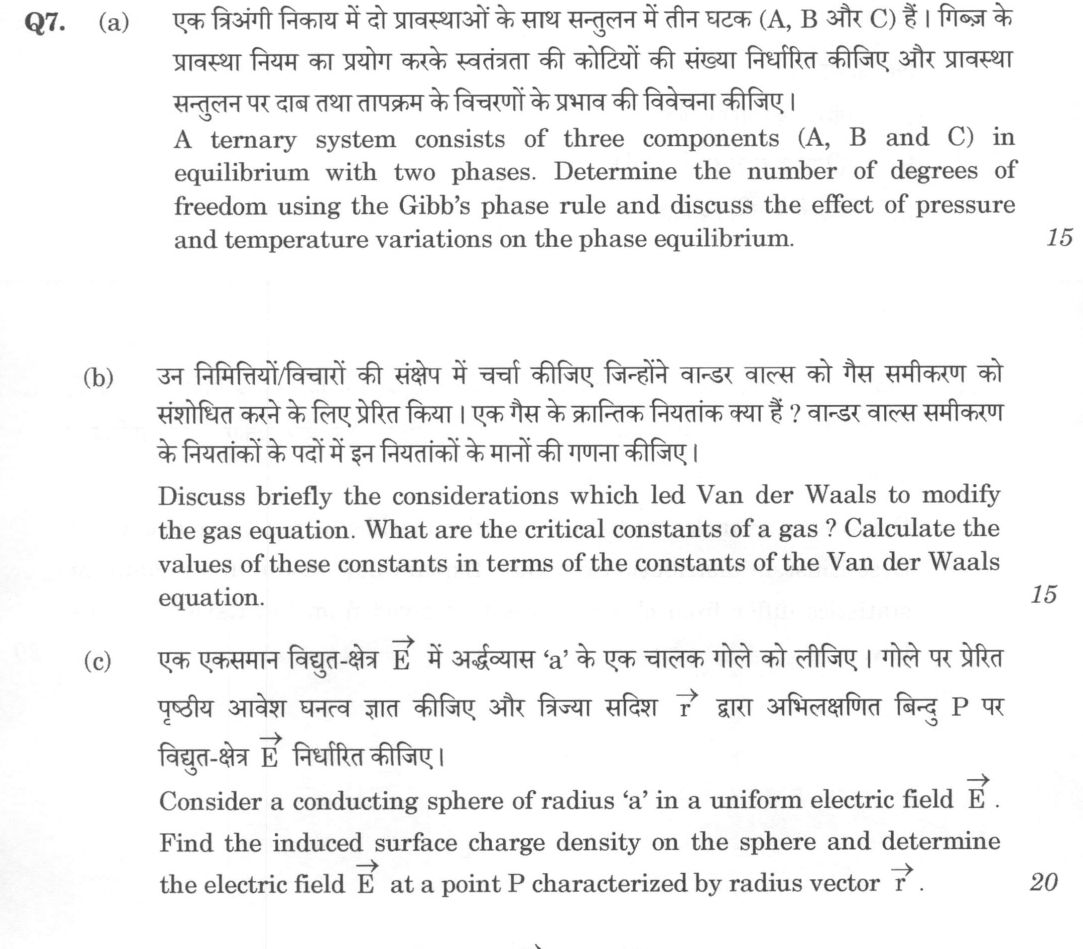
A ternary system consists of three components (A, B and C) in equilibrium with two phases. Determine the number of degrees of freedom using the Gibb's phase rule and discuss the effect of pressure and temperature variations on the phase equilibrium.
Discuss briefly the considerations which led Van der Waals to modify the gas equation. What are the critical constants of a gas ? Calculate the values of these constants in terms of the constants of the Van der Waals equation. 15 marks
Consider a conducting sphere of radius 'a' in a uniform electric field E⃗. Find the induced surface charge density on the sphere and determine the electric field E⃗ at a point P characterized by radius vector r⃗. 20 marks
हिंदी में प्रश्न पढ़ें
एक त्रिभुजी निकाय में दो प्रावस्थाओं के साथ संतुलन में तीन घटक (A, B और C) हैं । गिब्स के प्रावस्था नियम का प्रयोग करके स्वतंत्रता की कोटियों की संख्या निर्धारित कीजिए और प्रावस्था संतुलन पर दाब तथा तापक्रम के विचरणों के प्रभाव की विवेचना कीजिए ।
उन निमित्तियों/विचारों की संक्षेप में चर्चा कीजिए जिन्होंने वान्डर वाल्स को गैस समीकरण को संशोधित करने के लिए प्रेरित किया। एक गैस के क्रांतिक नियतांक क्या हैं ? वान्डर वाल्स समीकरण के नियतांकों के पदों में इन नियतांकों के मानों की गणना कीजिए। (15 अंक)
एक एकसमान विद्युत-क्षेत्र E⃗ में अर्धव्यास 'a' के एक चालक गोले को लीजिए। गोले पर प्रेरित पृष्ठीय आवेश घनत्व ज्ञात कीजिए और त्रिज्या सदिश r⃗ द्वारा अभिलक्षित बिन्दु P पर विद्युत-क्षेत्र E⃗ निर्धारित कीजिए। (20 अंक)
Model answer
Written by UPSC Answer Check against this question's marking rubric, to the expected length. UPSC does not publish answers for Mains — this is one way to score well, not an official key.
(a) Gibbs phase rule is F = C − P + 2. For a ternary system, C = 3. With two phases, P = 2. Therefore F = 3 − 2 + 2 = 3 degrees of freedom.
Thus three intensive variables must be fixed to specify the state. They may be taken as temperature T, pressure P, and one composition variable, e.g. mole fraction of A in one phase. The composition of the other phase is then fixed by the equilibrium tie-line.
If T and P are both fixed, F = 1: one composition variable can still vary, and the two-phase tie-line shifts through the two-phase region. If P is fixed, F = 2; if T is fixed, F = 2. A temperature change alters mutual solubilities and moves the tie-lines; at some temperature the two phases may become identical or one phase may disappear. A pressure change affects equilibrium mainly through the difference in molar volumes of the two phases. High pressure favours the phase of smaller molar volume. In condensed systems the pressure effect is usually small unless pressures are very high. At fixed T and P, varying one phase composition changes the other phase composition along the tie-line.
(b) Van der Waals modified the ideal gas equation because the ideal gas assumptions fail for real gases:
- Molecules are not point particles; they have finite volume. The available volume is reduced from V to V − b per mole.
- Intermolecular attractive forces reduce the pressure exerted on the walls. The pressure correction is proportional to the square of density, a/V².
Hence for one mole, (P + a/V²)(V − b) = RT. For n moles, (P + a n²/V²)(V − n b) = nRT. Here a is the attraction parameter and b is the excluded-volume parameter.
The critical constants are the temperature T_c, pressure P_c and molar volume V_c at the critical point, where liquid and gas phases become identical and the isotherm has a horizontal inflection. Thus at the critical point, (∂P/∂V)_T = 0 and (∂²P/∂V²)_T = 0.
For one mole, P = RT/(V − b) − a/V². First derivative: −RT/(V − b)² + 2a/V³ = 0, so RT = 2a(V − b)²/V³. Second derivative: 2RT/(V − b)³ − 6a/V⁴ = 0, so RT = 3a(V − b)³/V⁴. Equating these gives 2a(V − b)²/V³ = 3a(V − b)³/V⁴, hence 2V = 3(V − b), so V_c = 3b.
Then RT_c = 2a(2b)²/(27b³) = 8a/(27b), so T_c = 8a/(27Rb). Also P_c = RT_c/(V_c − b) − a/V_c² = (8a/(27b))/(2b) − a/(9b²) = 4a/(27b²) − 3a/(27b²) = a/(27b²).
The critical compressibility factor is Z_c = P_c V_c/(R T_c) = 3/8.
(c) Let the applied uniform field be E₀ along the z-axis, so E₀ = E e_z. The sphere is an isolated neutral conductor of radius a.
(i) Induced surface charge density Outside the sphere the potential satisfies Laplace’s equation, ∇²Φ = 0. Far from the sphere, Φ → −E z = −E r cosθ. On the conducting sphere, Φ must be constant; choose Φ(a, θ) = 0.
The axisymmetric solution with the correct far field is Φ(r, θ) = (−E r + B/r²) cosθ. At r = a, Φ = 0, so −E a + B/a² = 0, hence B = E a³. Therefore Φ(r, θ) = −E r cosθ + E a³ cosθ/r².
The surface charge density is σ = ε₀ E_r(a, θ). Now E_r = −∂Φ/∂r = E cosθ + 2E a³ cosθ/r³. At r = a, E_r = 3E cosθ. Thus σ(θ) = 3ε₀ E cosθ = 3ε₀ E₀·e_r on r = a. The net induced charge is zero because ∫σ dA = 0.
(ii) Electric field at point P Using E = −∇Φ, the spherical components outside the sphere are E_r = −∂Φ/∂r = E cosθ(1 + 2a³/r³), E_θ = −(1/r)∂Φ/∂θ = −E sinθ(1 − a³/r³), E_φ = 0. Therefore for r ≥ a, E(r, θ) = E cosθ(1 + 2a³/r³) e_r − E sinθ(1 − a³/r³) e_θ. Inside the conducting sphere, r < a, E = 0.
Equivalently, in vector form, E = E₀ − (a³/r³)E₀ + 3a³(E₀·r)r/r⁵, r ≥ a, where r is the position vector and r = |r|. At the surface r = a, this reduces to E = 3E cosθ e_r, which is normal to the sphere, as required for a conductor. Far away, E → E₀.
What "Derive" is asking you to do
Reach the stated expression from a starting relation, justifying every step. The destination is printed in the question, so only the route earns marks, and the assumptions you work under are part of that route.
Structure that answers it
Assumptions and notation defined → starting relation or governing equation → each step with its justification → the required expression → limiting case or boundary check
Where marks are lost
Writing the standard result first and fitting three lines to it, which an examiner reads at a glance. Marks also go on assumptions left unstated — lossless medium, small amplitude, errors independent with zero mean — and on symbols used before they are defined, even when the question says usual notations.
How this answer will be evaluated
Approach
Framework: Principle > Setup and diagram > Derivation > Result and limiting case. (a) discuss: intro > 3-4 dimensions > example > balanced close | (b) calculate: given > formula > substitution > result with units > interpretation | (c) derive: given > assumptions > stepwise derivation > result > check Full marks: Rigorous derivations with clear physical interpretation and correct limiting cases.
Key points expected
- State Gibbs phase rule F = C - P + 2
- Substitute C=3, P=2 to find F=3
- Discuss effect of pressure variation on equilibrium
- Discuss effect of temperature variation on equilibrium
- State limitations of ideal gas law
- Write Van der Waals equation of state
- Define critical constants (Tc, Pc, Vc)
- Derive Tc, Pc, Vc in terms of a and b
Evaluation rubric
Each sub-part is marked on its own, against the marks and word limit printed on the paper.
- (a) Calculate degrees of freedom for a ternary system and analyze P/T effects. 15 marks
discuss— intro → 3-4 dimensions → example → balanced close
Must cover
- State Gibbs phase rule F = C - P + 2
- Substitute C=3, P=2 to find F=3
- Discuss effect of pressure variation on equilibrium
- Discuss effect of temperature variation on equilibrium
Loses marks
- Omitting pressure or temperature discussion
- Incorrect substitution in phase rule
Earns more
- Mention specific variables (T, P, composition)
- Reference to phase diagram geometry
Extra mark
- Sketch of ternary phase diagram
- (b) Explain Van der Waals modifications and derive critical constants. 15 marks
calculate— given → formula → substitution → result with units → interpretation
Must cover
- State limitations of ideal gas law
- Write Van der Waals equation of state
- Define critical constants (Tc, Pc, Vc)
- Derive Tc, Pc, Vc in terms of a and b
Loses marks
- Writing equation without explaining terms
- Stating constants without derivation
Earns more
- Explanation of 'a' (attraction) and 'b' (volume)
- Use of (dP/dV) = 0 and (d²P/dV²) = 0 conditions
Extra mark
- Mention of compressibility factor Zc = 3/8
- (c) Find induced charge density and electric field for a conducting sphere. 20 marks
derive— given → assumptions → stepwise derivation → result → check
Must cover
- Set up potential solution for sphere in uniform field
- Apply boundary conditions at r=a and infinity
- Derive surface charge density σ(θ)
- Determine electric field vector E at point P
Loses marks
- Missing boundary conditions
- Confusing conducting and dielectric sphere results
Earns more
- Use of Legendre polynomials
- Diagram of sphere in field E
Extra mark
- Mention of dipole moment of induced charge
Practice this exact question
Write your answer and it is marked point by point against the model answer above — what you covered, what you missed, what you got wrong.
Evaluate my answer →More from Physics 2025 Paper I
- Q4 (a) Consider a thick lens of thickness t made of a material of relative refractive index…
- Q5 (a) Consider a point charge of 5 nC placed at a distance of 1 m from a perfect conducting…
- Q6 (a) Consider a long straight wire of length L carrying a current I. Determine the magneti…
- Q7 (a) A ternary system consists of three components (A, B and C) in equilibrium with two ph…
- Q8 (a) (i) In free space, an electric field (E⃗) is given by the following expression : E⃗ =…