Paper II — Q1
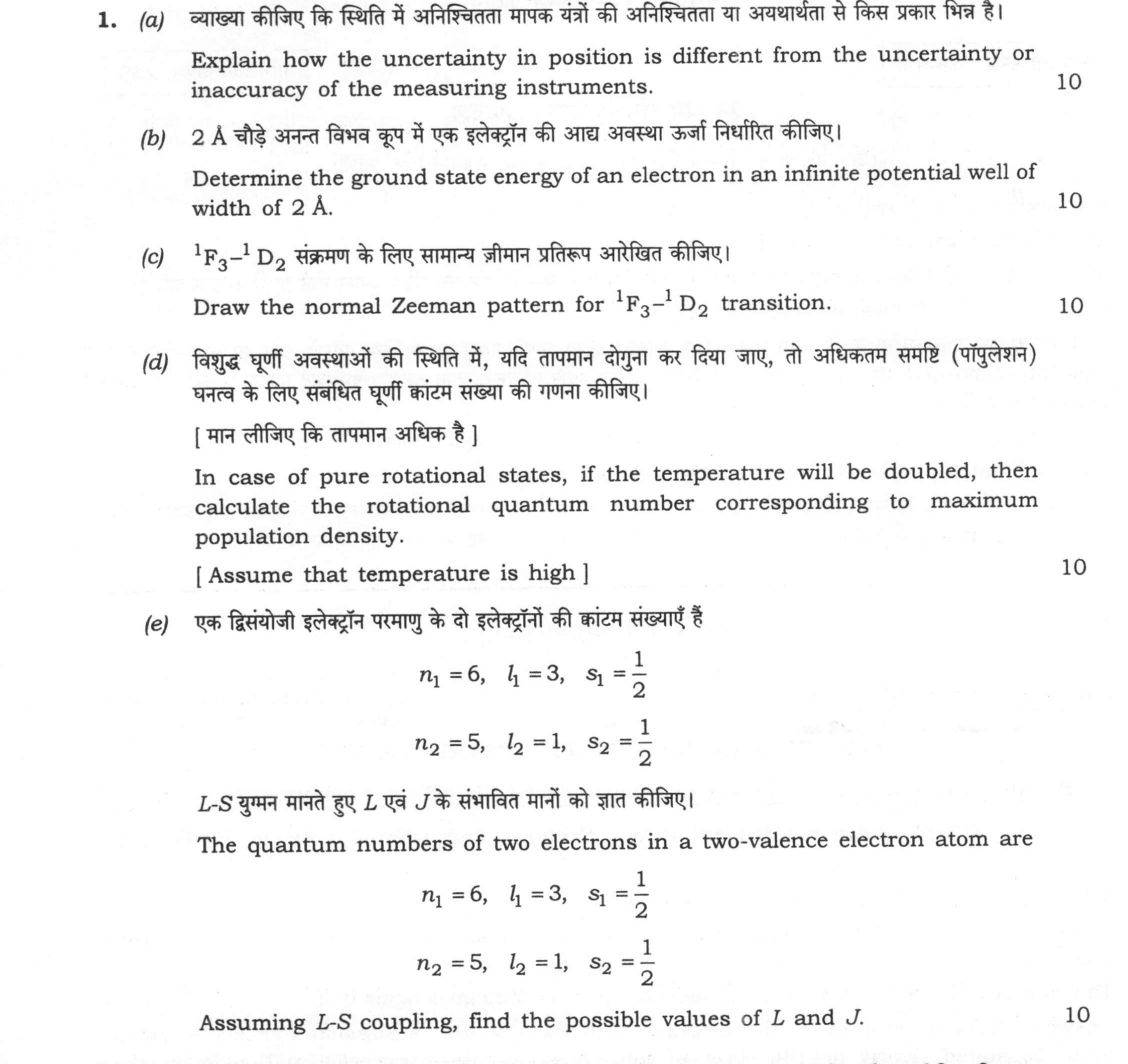
(a) Explain how the uncertainty in position is different from the uncertainty or inaccuracy of the measuring instruments. 10…
Explain how the uncertainty in position is different from the uncertainty or inaccuracy of the measuring instruments. 10 marks
Determine the ground state energy of an electron in an infinite potential well of width of 2 Å. 10 marks
Draw the normal Zeeman pattern for ¹F₃—¹D₂ transition. 10 marks
In case of pure rotational states, if the temperature will be doubled, then calculate the rotational quantum number corresponding to maximum population density. [Assume that temperature is high] 10 marks
The quantum numbers of two electrons in a two-valence electron atom are n₁ = 6, l₁ = 3, s₁ = ½; n₂ = 5, l₂ = 1, s₂ = ½. Assuming L-S coupling, find the possible values of L and J. 10 marks
हिंदी में प्रश्न पढ़ें
व्याख्या कीजिए कि स्थिति में अनिश्चितता मापक यंत्रों की अनिश्चितता या अयथार्थता से किस प्रकार भिन्न है। 10
2 Å चौड़े अनंत विभव कूप में एक इलेक्ट्रॉन की आध्र अवस्था ऊर्जा निर्धारित कीजिए। 10
¹F₃—¹D₂ संक्रमण के लिए सामान्य ज़ीमान प्रतिरूप आरेखित कीजिए। 10
विशुद्ध घूर्णी अवस्थाओं की स्थिति में, यदि तापमान दोगुना कर दिया जाए, तो अधिकतम समष्टि (पॉपुलेशन) घनत्व के लिए संबंधित घूर्णी क्वांटम संख्या की गणना कीजिए। [मान लीजिए कि तापमान अधिक है] 10
एक द्विसंयोजी इलेक्ट्रॉन परमाणु के दो इलेक्ट्रॉनों की क्वांटम संख्याएँ हैं n₁ = 6, l₁ = 3, s₁ = ½; n₂ = 5, l₂ = 1, s₂ = ½। L-S युग्मन मानते हुए L एवं J के संभावित मानों को ज्ञात कीजिए। 10
Model answer
Written by UPSC Answer Check against this question's marking rubric, to the expected length. UPSC does not publish answers for Mains — this is one way to score well, not an official key.
Part (a). The uncertainty in position in quantum mechanics is fundamentally different from the uncertainty or inaccuracy of a measuring instrument. Instrumental uncertainty is a classical, epistemic spread in readings caused by finite resolution, noise, drift, parallax, calibration limits, or imperfect alignment. It is attached to the apparatus and the experimental procedure. A better scale, a more stable detector, repeated averaging, or calibration can reduce random uncertainty; inaccuracy, a systematic offset from the true value, can be reduced by correcting the bias. In neither case is there a universal lower bound imposed by the nature of the object being measured.
The quantum-mechanical uncertainty in position is not a defect of the instrument. It is an intrinsic spread of the state itself. For a particle described by a wavefunction, position and momentum are represented by non-commuting operators, [x,p]=iℏ, and the standard deviations of any state satisfy ΔxΔp≥ℏ/2. This follows from the Fourier relationship between ψ(x) and its momentum-space representation: a wavefunction that is sharply localised in x must contain a broad range of wavelengths, hence a broad range of momenta. If a perfect position measurement is made, the post-measurement state can be made very narrow in x, but the momentum spread necessarily becomes large. Thus even with ideal instruments, one cannot prepare or measure a state with arbitrarily small Δx and Δp simultaneously. The consequence is that quantum uncertainty is a constraint on the state, not merely on the measuring device.
Part (b). For an electron in a one-dimensional infinite potential well, the wavefunction must vanish at the walls. If the full width is L, the allowed wave numbers are kₙ=nπ/L, so pₙ=ℏkₙ and Eₙ=pₙ²/2m=n²π²ℏ²/(2mL²)=n²h²/(8mL²). The ground state corresponds to n=1. Here L=2 Å=2×10⁻¹⁰ m. Therefore
E₁=h²/(8mL²)=(6.626×10⁻³⁴)²/[8(9.109×10⁻³¹)(2×10⁻¹⁰)²] =1.506×10⁻¹⁸ J.
Since 1 eV=1.602×10⁻¹⁹ J, E₁=9.40 eV. Since 1 aJ=10⁻¹⁸ J, this is 1.506 aJ. If the well is written from -a to +a, then a=1 Å and L=2a, so the same result is E₁=h²/[8m(2a)²]; if a is used for the full width, a=2 Å and E₁=h²/(8ma²).
Part (c). The transition ¹F₃—¹D₂ is a singlet transition, so S=0, L=J, and the Landé g-factor is 1. In a magnetic field B, each level splits into 2J+1 equally spaced sublevels with energy shift ΔE=μ_B B M_J, where μ_B=eℏ/(2mₑ). The upper ¹F₃ level has J=3 and M_J=-3,-2,-1,0,+1,+2,+3; the lower ¹D₂ level has J=2 and M_J=-2,-1,0,+1,+2. The electric-dipole selection rule is ΔM_J=0,±1. A schematic of the allowed transitions is:
¹F₃: -3 -2 -1 0 +1 +2 +3 | / | | / ¹D₂: -2 -1 0 +1 +2
All transitions with ΔM_J=0 have the same transition energy hν₀ and form the π component. All transitions with ΔM_J=+1 are shifted upward by μ_B B and form the σ⁺ component; all transitions with ΔM_J=-1 are shifted downward by μ_B B and form the σ⁻ component. In frequency form the normal Zeeman pattern is:
σ⁻ ν₀ - μ_BB/h π ν₀ σ⁺ ν₀ + μ_BB/h
The π line is linearly polarized parallel to the magnetic field. The σ components are circularly polarized when observed along the field, with opposite senses for σ⁺ and σ⁻, and are linearly polarized perpendicular to the field when observed at right angles to it.
Part (d). For a rigid rotor in pure rotational states, the energy is E_J=BJ(J+1), where B is the rotational constant in energy units. The population of level J at temperature T is proportional to the degeneracy times the Boltzmann factor:
N_J∝(2J+1)exp[-BJ(J+1)/kT].
To find the level of maximum population, maximise ln N_J:
f(J)=ln(2J+1)-BJ(J+1)/kT.
Differentiating with respect to J, treating J as continuous, gives
df/dJ=2/(2J+1)-(B/kT)(2J+1)=0.
Hence (2J+1)²=2kT/B, so
J_max=½√(2kT/B)-½=√(kT/2B)-½.
Since J is quantised, the actual level is the nearest non-negative integer to this value. If the temperature is doubled, then
2J_max(2T)+1=√(2k(2T)/B)=√2√(2kT/B)=√2[2J_max(T)+1].
In the high-temperature limit, J_max is large and the -½ term is negligible, so J_max(2T)≈√2 J_max(T). Thus the most populated rotational quantum number shifts to a higher value by a factor of √2 when the temperature is doubled.
Part (e). In L-S coupling the two orbital angular momenta are first coupled to give L, and the two spins are coupled to give S. Here l₁=3 and l₂=1, so
L=|l₁-l₂|, |l₁-l₂|+1, …, l₁+l₂ = 2,3,4.
The two electron spins are each ½, so
S=0 or S=1.
The total angular momentum is then J=|L-S|, |L-S|+1, …, L+S.
For S=0, J=L, giving J=2,3,4. For S=1, the allowed J values are: for L=2, J=1,2,3; for L=3, J=2,3,4; and for L=4, J=3,4,5. In term-symbol form the possible states are ¹D₂, ¹F₃, ¹G₄, ³D₁, ³D₂, ³D₃, ³F₂, ³F₃, ³F₄, ³G₃, ³G₄, and ³G₅.
Together, these results show the same quantum logic: measurement limits are intrinsic to states, energies are quantised by boundary conditions, angular momentum splits according to selection rules, thermal populations follow from degeneracy and Boltzmann weights, and atomic terms arise from vector coupling of angular momenta.
What "Explain" is asking you to do
Make the working of something clear — what sets it off, what follows from what, and what it produces. Explain is the Commission's mechanism word: it dominates the technical papers and the “explain why” stems, where the marks sit in the causal chain and not in the label.
Structure that answers it
State what it is → the initiating condition → the chain of cause, step by step → an instance where it plays out → what the chain produces
Where marks are lost
Describing what something looks like instead of why it works that way. Naming the stages without linking them reads as description too.
How this answer will be evaluated
Approach
(a) explain: definition/context > points in order > small example > short close | (b) calculate: given > formula > substitution > result with units > interpretation | (c) describe: define > structure or process in order > labelled diagram > significance | (d) calculate: given > formula > substitution > result with units > interpretation | (e) calculate: given > formula > substitution > result with units > interpretation Full marks: Rigorous derivation, correct units, clear diagrams, physical interpretation.
Key points expected
- Define Heisenberg Uncertainty Principle (HUP)
- Define instrumental inaccuracy/error
- State HUP is fundamental to nature
- State inaccuracy is technical/measurable
- State infinite potential well energy formula
- Substitute n=1, m_e, h, L=2 Å
- Show unit conversion (Å to m)
- Final answer in Joules or eV
Evaluation rubric
Each sub-part is marked on its own, against the marks and word limit printed on the paper.
- (a) Distinguish intrinsic quantum uncertainty from instrumental error. 10 marks
explain— definition/context → points in order → small example → short close
Must cover
- Define Heisenberg Uncertainty Principle (HUP)
- Define instrumental inaccuracy/error
- State HUP is fundamental to nature
- State inaccuracy is technical/measurable
Loses marks
- Conflating HUP with measurement disturbance
- Treating HUP as a technical limitation
Earns more
- Mention wave-particle duality
- Mention finite resolution of instruments
Extra mark
- Cite specific example of instrument error
- (b) Compute ground state energy for electron in 2 Å infinite well. 10 marks
calculate— given → formula → substitution → result with units → interpretation
Must cover
- State infinite potential well energy formula
- Substitute n=1, m_e, h, L=2 Å
- Show unit conversion (Å to m)
- Final answer in Joules or eV
Loses marks
- Using n=0 for ground state
- Omitting unit conversion for length
Earns more
- Explicitly state value of constants used
Extra mark
- Comparison with thermal energy kT
- (c) Draw normal Zeeman pattern for ¹F₃—¹D₂ transition. 10 marks
describe— define → structure or process in order → labelled diagram → significance
Must cover
- Identify Δm = 0, ±1 selection rules
- Show 3 spectral lines (triplet)
- Label σ⁺, π, σ⁻ components
- Indicate frequency shift relative to center
Loses marks
- Drawing anomalous Zeeman pattern (multiplet)
- Missing selection rules
Earns more
- Mention polarization of components
Extra mark
- Sketch of energy level splitting
- (d) Find rotational quantum number for max population at 2T. 10 marks
calculate— given → formula → substitution → result with units → interpretation
Must cover
- State Boltzmann distribution for rotational states
- Derive or state formula for J_max
- Show J_max ∝ √T
- Conclude J_max(2T) = √2 J_max(T)
Loses marks
- Assuming J_max is constant
- Ignoring degeneracy factor (2J+1)
Earns more
- Explicit differentiation to find maximum
Extra mark
- Mention high temperature approximation validity
- (e) Find possible L and J values for given electron configuration. 10 marks
calculate— given → formula → substitution → result with units → interpretation
Must cover
- Calculate total L from l₁=3, l₂=1
- Calculate total S from s₁=1/2, s₂=1/2
- Calculate J from L and S
- List all valid term symbols
Loses marks
- Incorrect L or S summation
- Missing J values for a given L,S
Earns more
- Show vector addition rules (triangle inequality)
Extra mark
- Identify ground state term (Hund's rules)
Practice this exact question
Write your answer and it is marked point by point against the model answer above — what you covered, what you missed, what you got wrong.
Evaluate my answer →More from Physics 2025 Paper II
- Q1 (a) Explain how the uncertainty in position is different from the uncertainty or inaccura…
- Q2 (a) What is the density of states? For a relativistic particle of rest mass μ, prove that…
- Q3 (a) Find out the difference in frequencies of Lyman-alpha line in hydrogen and deuterium…
- Q4 (a) State how for spin-half particles, the spin (σ) can be expressed by its three compone…