Paper II — Q8
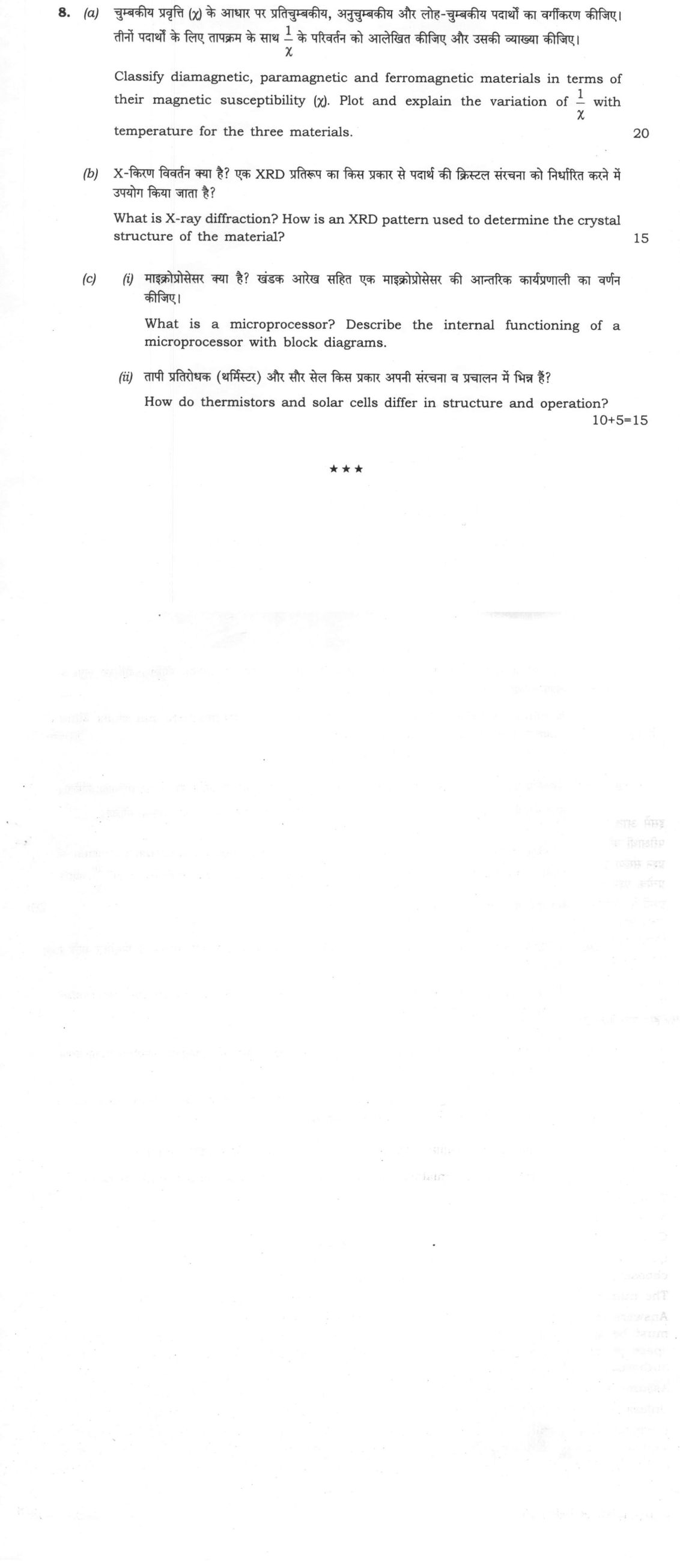
(a) Classify diamagnetic, paramagnetic and ferromagnetic materials in terms of their magnetic susceptibility (χ). Plot and…
Classify diamagnetic, paramagnetic and ferromagnetic materials in terms of their magnetic susceptibility (χ). Plot and explain the variation of 1/χ with temperature for the three materials. 20 marks
What is X-ray diffraction? How is an XRD pattern used to determine the crystal structure of the material? 15 marks
What is a microprocessor? Describe the internal functioning of a microprocessor with block diagrams.
How do thermistors and solar cells differ in structure and operation? 10+5=15
हिंदी में प्रश्न पढ़ें
चुंबकीय प्रवृत्ति (χ) के आधार पर प्रतिचुंबकीय, अनुचुंबकीय और लोह-चुंबकीय पदार्थों का वर्गीकरण कीजिए। तीनों पदार्थों के लिए तापक्रम के साथ 1/χ के परिवर्तन को आलेखित कीजिए और उसकी व्याख्या कीजिए। 20
X-किरण विवर्तन क्या है? एक XRD प्रतिरूप का किस प्रकार से पदार्थ की क्रिस्टल संरचना को निर्धारित करने में उपयोग किया जाता है? 15 marks
माइक्रोप्रोसेसर क्या है? खंडक आरेख सहित एक माइक्रोप्रोसेसर की आंतरिक कार्यप्रणाली का वर्णन कीजिए।
तापी प्रतिरोधक (थर्मिस्टर) और सौर सेल किस प्रकार अपनी संरचना व प्रचालन में भिन्न हैं? 10+5=15
Model answer
Written by UPSC Answer Check against this question's marking rubric, to the expected length. UPSC does not publish answers for Mains — this is one way to score well, not an official key.
Magnetic behaviour of solids is governed by the response of atomic magnetic moments to an applied field, quantified by susceptibility χ = M/H.
Classification by susceptibility. Diamagnetic materials have no permanent atomic moment; the applied field induces a weak opposing moment, so χ is small and negative (χ < 0), typically −10⁻⁵, and is essentially independent of temperature. Paramagnetic materials possess permanent moments that are randomly oriented by thermal agitation; the field partially aligns them, giving a small positive χ (≈10⁻³–10⁻⁵) that falls as temperature rises, following the Curie law χ = C/T. Ferromagnetic materials have strongly coupled moments that align spontaneously below the Curie temperature T_C, giving χ ≫ 0 and very large (10²–10⁶); above T_C they obey the Curie–Weiss law χ = C/(T − T_C).
Variation of 1/χ with T. For a diamagnet, 1/χ is a horizontal line at a negative value, since χ is constant and negative. For a paramagnet, 1/χ = T/C, a straight line passing through the origin with slope 1/C. For a ferromagnet, above T_C, 1/χ = (T − T_C)/C, a straight line extrapolating to intercept T_C on the temperature axis; below T_C the relation breaks down as domains align spontaneously. The intercept thus directly yields the Curie temperature.
X-ray diffraction. When monochromatic X-rays of wavelength λ strike a crystal, they scatter from parallel atomic planes of spacing d; constructive interference occurs when the path difference satisfies Bragg's law, nλ = 2d sinθ. In the powder method, randomly oriented crystallites give cones of diffracted intensity recorded as peaks of 2θ.
Structure determination. Each peak corresponds to a set of planes (hkl). Using Bragg's law, d is obtained from θ; the d-spacings and systematic absences (from the structure factor) reveal the lattice type (SC, BCC, FCC) and, via indexing, the lattice parameter a. Intensities give atomic positions. Comparison with standard JCPDS tables identifies the phase.
Microprocessor. A microprocessor is the CPU fabricated on a single chip. Its blocks are the ALU (arithmetic/logic), control unit (timing and control signals), register array (accumulator, program counter, instruction register), and internal buses, interfaced to memory and I/O through address, data and control buses. It repeatedly executes the fetch–decode–execute cycle: fetch the instruction from memory, decode it in the control unit, execute it in the ALU, and store the result. India's indigenous Shakti processor (IIT-Madras) and ISRO's Vikram series exemplify such design.
Thermistors vs solar cells. A thermistor is a metal-oxide semiconductor whose resistance changes sharply with temperature (usually negative coefficient); it is a two-terminal resistive device. A solar cell is a p–n junction with a depletion region; photons create electron–hole pairs that the built-in field separates, producing a photovoltage (photovoltaic effect). Thermistors sense temperature; solar cells convert light to electricity, as in the National Solar Mission's rural electrification.
Thus susceptibility signatures, diffraction, and device physics together span the solid-state-to-electronics spectrum.
What "Explain" is asking you to do
Make the working of something clear — what sets it off, what follows from what, and what it produces. Explain is the Commission's mechanism word: it dominates the technical papers and the “explain why” stems, where the marks sit in the causal chain and not in the label.
Structure that answers it
State what it is → the initiating condition → the chain of cause, step by step → an instance where it plays out → what the chain produces
Where marks are lost
Describing what something looks like instead of why it works that way. Naming the stages without linking them reads as description too.
How this answer will be evaluated
Approach
Framework: Principle > Setup and diagram > Derivation > Result and limiting case. (a) explain: definition/context > points in order > small example > short close | (b) explain: definition/context > points in order > small example > short close | (c) explain: definition/context > points in order > small example > short close Full marks: Complete plots, clear Bragg's law application, accurate block diagram, distinct contrast in part c.
Key points expected
- Curie Law: χ = C/T
- Curie-Weiss Law: χ = C/(T-θ)
- Bragg's Law: nλ = 2d sinθ
- Microprocessor: ALU, CU, Registers, Bus
- Thermistor: Resistance changes with T
- Solar Cell: p-n junction, photovoltaic effect
Evaluation rubric
Each sub-part is marked on its own, against the marks and word limit printed on the paper.
- (a) Classify materials by susceptibility and plot 1/χ vs T for all three. 20 marks
explain— definition/context → points in order → small example → short close
Must cover
- Classify by sign and magnitude of χ
- Plot 1/χ vs T for all three
- Explain Curie law for paramagnets
- Explain Curie-Weiss law for ferromagnets
Loses marks
- Missing the plot for any material
- Confusing χ with 1/χ in the plot
Earns more
- Mention Curie temperature (Tc)
- Mention Weiss constant (θ)
- Distinguish diamagnetic T-independence
- Label axes clearly
Extra mark
- Mention specific examples (e.g., Cu, Al, Fe)
- (b) Define XRD and explain how the pattern determines crystal structure. 15 marks
explain— definition/context → points in order → small example → short close
Must cover
- Define X-ray diffraction
- State Bragg's Law (nλ = 2d sinθ)
- Explain peak position gives d-spacing
- Explain peak intensity gives structure
Loses marks
- Defining XRD without linking to structure
- Ignoring the role of peak intensity
Earns more
- Mention Miller indices (hkl)
- Mention lattice parameter calculation
- Mention phase identification
Extra mark
- Mention specific crystal systems (e.g., FCC, BCC)
- (c) Define microprocessor, show block diagram, and contrast thermistors vs solar cells. 15 marks
explain— definition/context → points in order → small example → short close
Must cover
- Define microprocessor
- Draw block diagram (ALU, CU, Registers)
- Contrast thermistor vs solar cell structure
- Contrast thermistor vs solar cell operation
Loses marks
- Missing the block diagram
- Confusing thermistor and solar cell functions
Earns more
- Mention specific microprocessor architecture
- Mention p-n junction in solar cell
- Mention NTC/PTC for thermistors
Extra mark
- Mention specific applications
Practice this exact question
Write your answer and it is marked point by point against the model answer above — what you covered, what you missed, what you got wrong.
Evaluate my answer →More from Physics 2025 Paper II
- Q5 (a) Show that the energy of the triplet state (S = 1) is not equal to the energy of the s…
- Q6 (a) The total binding energies of ¹⁵₈O, ¹⁶₈O and ¹⁷₈O are 111·96 MeV, 127·62 MeV and 131·…
- Q7 (a) What is the minimum energy required to break a ₂He⁴ nucleus into free protons and neu…
- Q8 (a) Classify diamagnetic, paramagnetic and ferromagnetic materials in terms of their magn…