Paper II — Q7
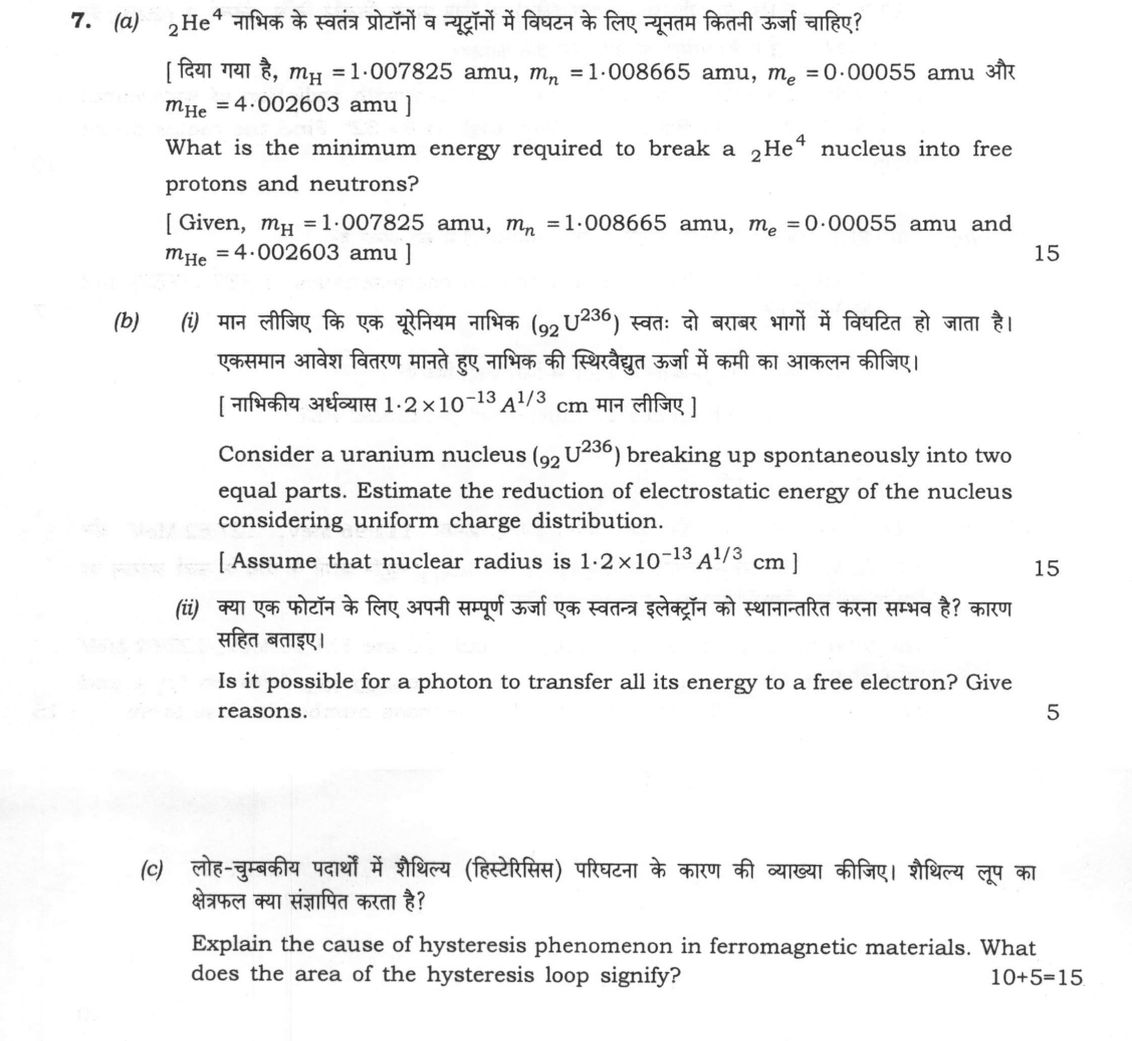
(a) What is the minimum energy required to break a ₂He⁴ nucleus into free protons and neutrons? [ Given, m_H = 1·007825 amu, m_n…
What is the minimum energy required to break a ₂He⁴ nucleus into free protons and neutrons?
[ Given, m_H = 1·007825 amu, m_n = 1·008665 amu, m_e = 0·00055 amu and m_He = 4·002603 amu ] 15
Consider a uranium nucleus (₉₂U²³⁶) breaking up spontaneously into two equal parts. Estimate the reduction of electrostatic energy of the nucleus considering uniform charge distribution.
[ Assume that nuclear radius is 1·2×10⁻¹³ A¹/³ cm ] 15
Is it possible for a photon to transfer all its energy to a free electron? Give reasons. 5 marks
Explain the cause of hysteresis phenomenon in ferromagnetic materials. What does the area of the hysteresis loop signify? 10+5=15
हिंदी में प्रश्न पढ़ें
₂He⁴ नाभिक के स्वतंत्र प्रोटोनों व न्यूट्रोनों में विघटन के लिए न्यूनतम कितनी ऊर्जा चाहिए?
[ दिया गया है, m_H = 1·007825 amu, m_n = 1·008665 amu, m_e = 0·00055 amu और m_He = 4·002603 amu ] 15
मान लीजिए कि एक यूरेनियम नाभिक (₉₂U²³⁶) स्वतः दो बराबर भागों में विघटित हो जाता है। एकसमान आवेश वितरण मानते हुए नाभिक की स्थिरवैद्युत ऊर्जा में कमी का आकलन कीजिए।
[ नाभिकीय अर्धव्यास 1·2×10⁻¹³ A¹/³ cm मान लीजिए ] 15
क्या एक फोटॉन के लिए अपनी सम्पूर्ण ऊर्जा एक स्वतंत्र इलेक्ट्रॉन को स्थानांतरित करना संभव है? कारण सहित बताइए। 5
लोह-चुंबकीय पदार्थों में शैथिल्य (हिस्टेरिसिस) परिघटना के कारण की व्याख्या कीजिए। शैथिल्य लूप का क्षेत्रफल क्या संज्ञापित करता है? 10+5=15
Model answer
Written by UPSC Answer Check against this question's marking rubric, to the expected length. UPSC does not publish answers for Mains — this is one way to score well, not an official key.
(a) The minimum energy to break ₂He⁴ into free protons and neutrons is its nuclear binding energy. Use the mass-defect method.
Let m_H be the atomic hydrogen mass, which includes one proton plus one electron. The helium atomic mass includes two electrons. Hence electron masses cancel in:
Δm = (2 m_H + 2 m_n) − m_He
Substitute:
Δm = 2(1.007825) + 2(1.008665) − 4.002603 amu = 2.015650 + 2.017330 − 4.002603 amu = 0.030377 amu
Using 1 amu = 931.5 MeV/c²,
E_b = Δm c² = 0.030377 × 931.5 MeV = 28.296 MeV ≈ 28.30 MeV
Minimum energy = 28.30 MeV. This is the threshold energy; any extra energy appears as kinetic energy of the free protons and neutrons.
(b)(i) For a uniformly charged sphere of charge Ze and radius R, the electrostatic self-energy is
U = (3/5)(Ze)²/(4π ε₀ R)
Use e²/(4π ε₀) = 1.44 MeV fm. Given R = 1.2×10⁻¹³ ∛A cm = 1.2 ∛A fm.
Initial U-236 nucleus: Z_i = 92, A_i = 236.
R_i = 1.2 ∛236 fm ≈ 1.2 × 6.1797 fm = 7.4157 fm
U_i = (3/5)(1.44)(92²)/(7.4157) MeV = 0.6 × 1.44 × 8464/7.4157 MeV = 986.14 MeV
Each equal fragment has Z_f = 46, A_f = 118.
R_f = 1.2 ∛118 fm ≈ 1.2 × 4.9049 fm = 5.8858 fm
U_f,each = (3/5)(1.44)(46²)/(5.8858) MeV = 0.6 × 1.44 × 2116/5.8858 MeV = 310.61 MeV
Total final electrostatic energy:
U_f = 2 × 310.61 MeV = 621.23 MeV
Reduction:
ΔU = U_i − U_f = 986.14 − 621.23 MeV = 364.91 MeV ≈ 3.65×10² MeV
Equivalently, since A_f = A_i/2, ΔU = U_i(1 − 2^(−2/3)), which gives the same value. This is the self-energy decrease at fission; the subsequent Coulomb repulsion of the separating fragments appears as kinetic energy.
(b)(ii) No. A free electron cannot absorb a photon completely because energy and momentum cannot both be conserved in vacuum.
Assume the electron is initially at rest. If the photon is completely absorbed, energy conservation gives
hν + m_e c² = γ m_e c²
and momentum conservation gives
hν/c = γ m_e v
From momentum, the electron momentum is p = hν/c. Its total energy must then be
E_e = √((hν)² + m_e² c⁴)
But energy conservation requires
E_e = hν + m_e c²
Squaring gives
(hν)² + m_e² c⁴ = (hν)² + 2hν m_e c² + m_e² c⁴
which is impossible unless hν = 0. Hence a free electron cannot absorb all the photon energy. In Compton scattering, the photon transfers only part of its energy and is scattered. Full transfer is possible only in the presence of a third body, such as a nucleus, which takes recoil momentum.
(c) Hysteresis in ferromagnetic materials arises from their domain structure. A ferromagnetic specimen contains many magnetic domains, each spontaneously magnetized in some easy direction. When an external magnetic field H is applied, domains favourably oriented with H grow, while others shrink; domain walls move. The magnetization B therefore increases.
However, domain-wall motion is not perfectly reversible. Impurities, grain boundaries, dislocations, vacancies, residual stresses, and magnetocrystalline anisotropy pin the domain walls. Extra energy is needed to overcome this pinning, so wall motion becomes irreversible. When H is reduced, the domains do not return to their original configuration. Some magnetization remains even at H = 0; this is remanence. To reduce B to zero, a reverse field called the coercive force must be applied. Thus B lags behind H, producing the hysteresis loop.
The area enclosed by the hysteresis loop represents the energy dissipated as heat per unit volume per magnetization cycle. It is given by
W = ∮ H dB
per unit volume. Its unit is J/m³ per cycle. A large area means large hysteresis loss, high coercivity, and a hard magnetic material, useful for permanent magnets. A small area means low hysteresis loss and a soft magnetic material, suitable for transformer cores and electromagnets. Thus the loop area is a direct measure of irreversible magnetic energy loss.
What "Calculate" is asking you to do
Apply the standard formula or schedule to data the question has already supplied — a table of readings, cost records, a balance sheet — and produce the number. The method is rarely in doubt; the marks sit in the named intermediate quantities, each of which has to appear as a labelled line.
Structure that answers it
Data as given → formula or standard treatment, named → substitution → each intermediate, labelled → result with units
Where marks are lost
Omitting an intermediate the marking scheme pays for separately, or rounding at an intermediate line so the final figure drifts. In commerce and accountancy, any figure in a statement that no numbered working note supports is treated as unearned.
How this answer will be evaluated
Approach
(a) calculate: given > formula > substitution > result with units > interpretation | (b(i)) calculate: given > formula > substitution > result with units > interpretation | (b(ii)) justify: claim > 3-4 reasons > evidence > conclusion | (c) explain: definition/context > points in order > small example > short close Full marks: All parts answered with correct derivations, clear reasoning, and accurate final values.
Key points expected
- Identify constituent masses (2 protons, 2 neutrons)
- Calculate mass defect (Δm)
- Convert mass defect to energy (E=mc²)
- State final answer in MeV
- State initial electrostatic energy formula
- State final electrostatic energy formula
- Calculate energy difference (reduction)
- Use given nuclear radius formula
Evaluation rubric
Each sub-part is marked on its own, against the marks and word limit printed on the paper.
- (a) Calculate the minimum energy required to break a ₂He⁴ nucleus into free protons and neutrons. 15 marks
calculate— given → formula → substitution → result with units → interpretation
Must cover
- Identify constituent masses (2 protons, 2 neutrons)
- Calculate mass defect (Δm)
- Convert mass defect to energy (E=mc²)
- State final answer in MeV
Loses marks
- Using wrong constituent masses
- Forgetting to convert mass to energy
Earns more
- Explicitly use given atomic masses
- Show unit conversion (amu to MeV)
Extra mark
- Mention binding energy per nucleon
- (b(i)) Estimate the reduction of electrostatic energy of a uranium nucleus breaking into two equal parts. 15 marks
calculate— given → formula → substitution → result with units → interpretation
Must cover
- State initial electrostatic energy formula
- State final electrostatic energy formula
- Calculate energy difference (reduction)
- Use given nuclear radius formula
Loses marks
- Incorrect application of electrostatic energy formula
- Ignoring the 'equal parts' condition
Earns more
- Show step-by-step calculation
- State assumptions clearly
Extra mark
- Discuss physical significance of energy reduction
- (b(ii)) Justify whether a photon can transfer all its energy to a free electron. 5 marks
justify— claim → 3-4 reasons → evidence → conclusion
Must cover
- State conservation of energy and momentum
- Show that simultaneous conservation is impossible
- Conclude that full transfer is not possible
Loses marks
- Ignoring momentum conservation
- Vague reasoning without mathematical support
Earns more
- Provide mathematical proof of impossibility
Extra mark
- Mention Compton scattering as partial transfer
- (c) Explain the cause of hysteresis in ferromagnetic materials and the significance of the hysteresis loop area. 15 marks
explain— definition/context → points in order → small example → short close
Must cover
- Define hysteresis phenomenon
- Explain domain wall movement and pinning
- Describe the hysteresis loop
- State that area signifies energy loss per cycle
Loses marks
- Confusing hysteresis with other magnetic phenomena
- Failing to link loop area to energy loss
Earns more
- Include a labelled hysteresis loop diagram
- Mention coercivity and remanence
Extra mark
- Give an example of hysteresis in practical applications
Practice this exact question
Write your answer and it is marked point by point against the model answer above — what you covered, what you missed, what you got wrong.
Evaluate my answer →More from Physics 2025 Paper II
- Q4 (a) State how for spin-half particles, the spin (σ) can be expressed by its three compone…
- Q5 (a) Show that the energy of the triplet state (S = 1) is not equal to the energy of the s…
- Q6 (a) The total binding energies of ¹⁵₈O, ¹⁶₈O and ¹⁷₈O are 111·96 MeV, 127·62 MeV and 131·…
- Q7 (a) What is the minimum energy required to break a ₂He⁴ nucleus into free protons and neu…
- Q8 (a) Classify diamagnetic, paramagnetic and ferromagnetic materials in terms of their magn…