Paper II — Q2
(a) What is the density of states? For a relativistic particle of rest mass μ, prove that the density of states in the extreme…
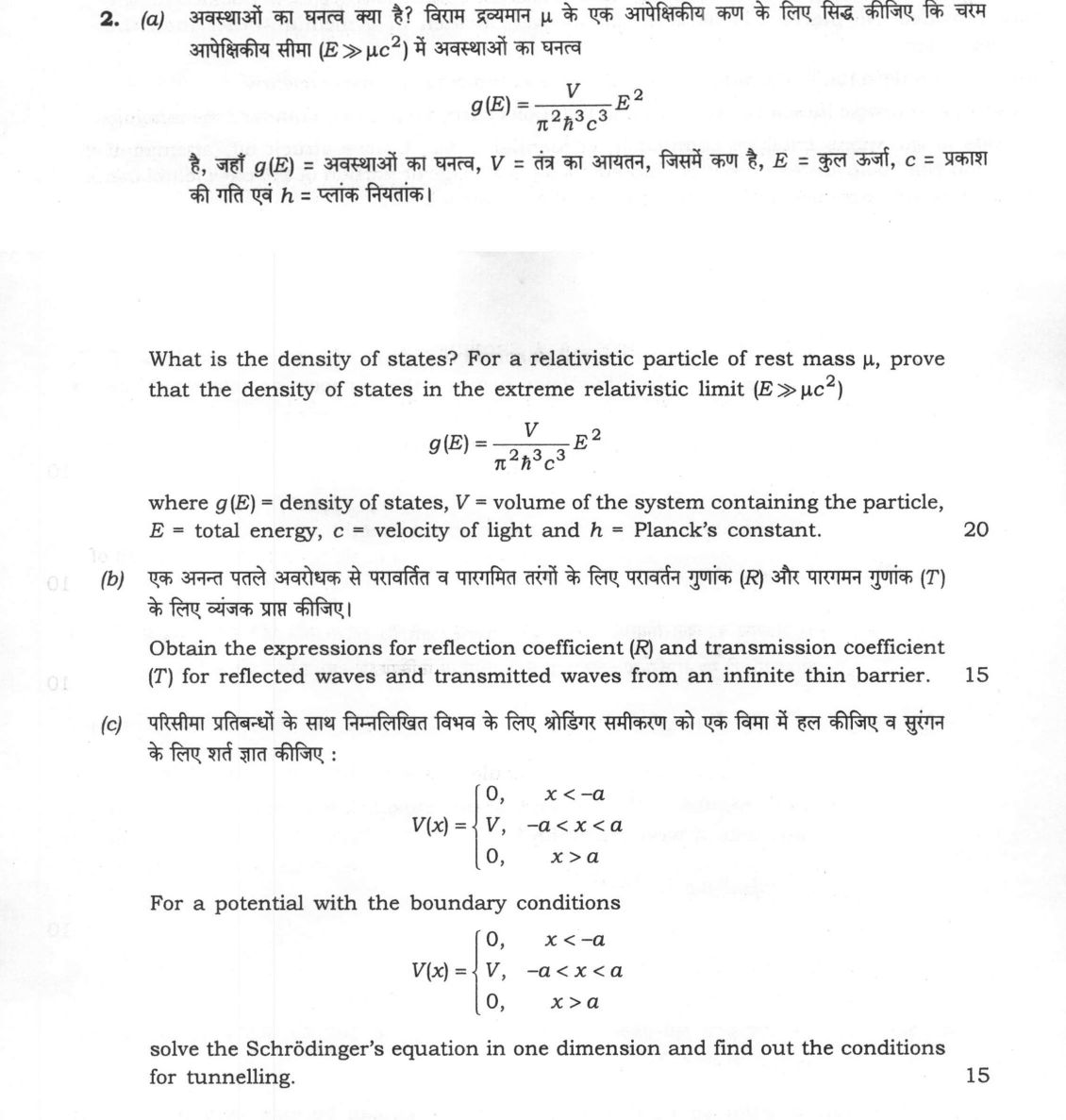
What is the density of states? For a relativistic particle of rest mass μ, prove that the density of states in the extreme relativistic limit (E ≫ μc²) is g(E) = V/π²ℏ³c³ E² where g(E) = density of states, V = volume of the system containing the particle, E = total energy, c = velocity of light and h = Planck's constant. 20 marks
Obtain the expressions for reflection coefficient (R) and transmission coefficient (T) for reflected waves and transmitted waves from an infinite thin barrier. 15 marks
For a potential with the boundary conditions V(x) = {0, x < -a; V, -a < x < a; 0, x > a}, solve the Schrödinger's equation in one dimension and find out the conditions for tunnelling. 15 marks
हिंदी में प्रश्न पढ़ें
अवस्थाओं का घनत्व क्या है? विराम द्रव्यमान μ के एक आपेक्षिकीय कण के लिए सिद्ध कीजिए कि चरम आपेक्षिकीय सीमा (E >> μc²) में अवस्थाओं का घनत्व g(E) = V/π²ℏ³c³ E² है, जहाँ g(E) = अवस्थाओं का घनत्व, V = तंत्र का आयतन, जिसमें कण है, E = कुल ऊर्जा, c = प्रकाश की गति एवं h = प्लांक नियतांक। 20
एक अनंत पतले अवरोधक से परावर्तित व परार्मित तरंगों के लिए परावर्तन गुणांक (R) और पारगमन गुणांक (T) के लिए व्यंजक प्राप्त कीजिए। 15
परिसीमा प्रतिबंधों के साथ निम्नलिखित विभव के लिए श्रोडिंगर समीकरण को एक विमा में हल कीजिए व सुरंगन के लिए शर्त ज्ञात कीजिए: V(x) = {0, x < -a; V, -a < x < a; 0, x > a} 15
Model answer
Written by UPSC Answer Check against this question's marking rubric, to the expected length. UPSC does not publish answers for Mains — this is one way to score well, not an official key.
(a) The density of states g(E) is the number of single-particle quantum states per unit energy interval in a system of volume V, i.e. g(E)=dN/dE. For a free relativistic particle, allowed momentum states are counted in phase space. One translational state occupies volume h³=(2πℏ)³ in momentum space. Thus, including a spin degeneracy factor g_s, the number of states in the momentum shell p to p+dp is
dN = g_s V/(2πℏ)³ · 4πp² dp = g_s V p² dp/(2π²ℏ³).
The relativistic energy relation is
E² = p²c² + μ²c⁴.
In the extreme relativistic limit E ≫ μc², the rest-energy term is negligible, so E ≈ pc, giving p=E/c and dp=dE/c. Therefore
dN = g_s V (E/c)² (dE/c)/(2π²ℏ³) = g_s V E² dE/(2π²ℏ³c³).
Hence
g(E)=dN/dE = g_s V E²/(2π²ℏ³c³).
For a particle with two spin or polarization states, g_s=2, so
g(E)=V E²/(π²ℏ³c³).
This holds for E ≫ μc², large V, and negligible boundary effects. For spin s, multiply by (2s+1); for a spinless particle, the result is half of the quoted value.
(b) An infinite thin barrier is represented by the delta potential V(x)=V₀δ(x). The Schrödinger equation for E>0 is
−ℏ²/(2m) d²ψ/dx² + V₀δ(x)ψ = Eψ.
Let k=√(2mE)/ℏ and γ=mV₀/ℏ². Take an incident wave from the left:
ψ₁(x)=exp(ikx)+r exp(−ikx), x<0,
ψ₂(x)=t exp(ikx), x>0.
At x=0, continuity of ψ gives
1+r=t.
Integrating the Schrödinger equation across x=0 gives the derivative jump
ψ₂'(0)−ψ₁'(0)=(2mV₀/ℏ²)ψ(0)=2γt.
Now ψ₁'(0)=ik(1−r), ψ₂'(0)=ikt. Therefore
ikt−ik(1−r)=2γt.
Using t=1+r, this becomes 2ikr=2γt, so
r=γ/(ik−γ), t=ik/(ik−γ).
The reflection and transmission coefficients are
R=|r|²=γ²/(k²+γ²),
T=|t|²=k²/(k²+γ²).
Thus
R=(mV₀/ℏ²)²/[k²+(mV₀/ℏ²)²],
T=k²/[k²+(mV₀/ℏ²)²],
and R+T=1. For an attractive barrier, V₀ changes sign but R and T depend on V₀², so the probability coefficients are unchanged.
(c) For V(x)=0 for x<−a; V for −a<x<a; 0 for x>a, the time-independent Schrödinger equation is
−ℏ²/(2m) d²ψ/dx² + V(x)ψ = Eψ.
Let k=√(2mE)/ℏ. For tunnelling, E<V. Put κ=√(2m(V−E))/ℏ. The wavefunctions are
ψ₁=A exp(ikx)+B exp(−ikx), x<−a,
ψ₂=C exp(κx)+D exp(−κx), −a<x<a,
ψ₃=F exp(ikx), x>a.
Continuity of ψ and ψ' at x=−a and x=a gives four equations:
A exp(−ika)+B exp(ika)=C exp(−κa)+D exp(κa),
ik[A exp(−ika)−B exp(ika)]=κ[C exp(−κa)−D exp(κa)],
C exp(κa)+D exp(−κa)=F exp(ika),
κ[C exp(κa)−D exp(−κa)]=ikF exp(ika).
Eliminating B, C and D and solving for F/A gives the transmission coefficient
T=|F/A|²=[1 + V² sinh²(2κa)/(4E(V−E))]⁻¹, E<V.
The condition for tunnelling is therefore E<V, i.e. the particle energy lies below the barrier height. Since the barrier width is finite, T is nonzero even though E<V; the wavefunction decays exponentially as exp(−κ|x|) inside the barrier. For a thick or high barrier, 2κa≫1, so
T ≈ (16E(V−E)/V²) exp(−4κa).
Thus tunnelling is exponentially suppressed by increasing barrier width 2a or by increasing √(2m(V−E)). If V→∞ or a→∞, then κa→∞ and T→0. If E>V, the barrier is no longer classically forbidden; replacing κ by iq, q=√(2m(E−V))/ℏ, gives
T=[1 + V² sin²(2qa)/(4E(E−V))]⁻¹,
with resonant perfect transmission T=1 when 2qa=nπ, n=1,2,3,… .
What "Prove" is asking you to do
Establish that the statement holds for every case it claims, not for one representative case. The argument must be closed: each line follows from a definition, a hypothesis, or a named theorem you are entitled to use.
Structure that answers it
Given and to prove, restated → theorem or construction to be used, named → the argument line by line → conclusion stated as proved
Where marks are lost
Testing one example, which illustrates but proves nothing. On an if and only if claim, proving one direction and stopping forfeits that half outright, and degenerate cases — zero, the empty set, the equality case — have to be disposed of rather than assumed away.
How this answer will be evaluated
Approach
(a) derive: given > assumptions > stepwise derivation > result > check | (b) derive: given > assumptions > stepwise derivation > result > check | (c) derive: given > assumptions > stepwise derivation > result > check Full marks: Complete derivations with clear steps, correct boundary conditions, and physical interpretation.
Key points expected
- Define density of states g(E) clearly.
- State relativistic energy-momentum relation E² = p²c² + μ²c⁴.
- Apply extreme relativistic limit E ≫ μc².
- Derive g(E) = V/π²ℏ³c³ E².
- Set up wave functions for all regions.
- Apply boundary conditions at interfaces.
- Derive expression for reflection coefficient R.
- Derive expression for transmission coefficient T.
Evaluation rubric
Each sub-part is marked on its own, against the marks and word limit printed on the paper.
- (a) Definition of density of states and derivation of g(E) for relativistic particles. 20 marks
derive— given → assumptions → stepwise derivation → result → check
Must cover
- Define density of states g(E) clearly.
- State relativistic energy-momentum relation E² = p²c² + μ²c⁴.
- Apply extreme relativistic limit E ≫ μc².
- Derive g(E) = V/π²ℏ³c³ E².
Loses marks
- Formula substitution without derivation steps.
- Dropping units or dimensional analysis.
Earns more
- Show phase space volume calculation.
- Explicitly state assumptions for the limit.
- Check dimensions of the final result.
Extra mark
- One line on physical interpretation of g(E).
- (b) Expressions for reflection (R) and transmission (T) coefficients for a thin barrier. 15 marks
derive— given → assumptions → stepwise derivation → result → check
Must cover
- Set up wave functions for all regions.
- Apply boundary conditions at interfaces.
- Derive expression for reflection coefficient R.
- Derive expression for transmission coefficient T.
Loses marks
- Missing boundary condition application.
- No diagram or setup provided.
Earns more
- Draw labelled diagram of the barrier.
- Show intermediate algebraic steps clearly.
Extra mark
- Discuss limiting case for barrier width.
- (c) Solve 1D Schrödinger equation for the given potential and find tunnelling conditions. 15 marks
derive— given → assumptions → stepwise derivation → result → check
Must cover
- Write Schrödinger equation for each region.
- Solve for wave functions in all regions.
- Apply continuity conditions at x = ±a.
- State conditions for tunnelling (E < V).
Loses marks
- Incorrect wave function in barrier region.
- Missing boundary condition application.
Earns more
- Show explicit wave function forms.
- Derive the transmission probability expression.
Extra mark
- One line on physical meaning of tunnelling.
Practice this exact question
Write your answer and it is marked point by point against the model answer above — what you covered, what you missed, what you got wrong.
Evaluate my answer →More from Physics 2025 Paper II
- Q1 (a) Explain how the uncertainty in position is different from the uncertainty or inaccura…
- Q2 (a) What is the density of states? For a relativistic particle of rest mass μ, prove that…
- Q3 (a) Find out the difference in frequencies of Lyman-alpha line in hydrogen and deuterium…
- Q4 (a) State how for spin-half particles, the spin (σ) can be expressed by its three compone…
- Q5 (a) Show that the energy of the triplet state (S = 1) is not equal to the energy of the s…