Paper II — Q4
(a) State how for spin-half particles, the spin (σ) can be expressed by its three components σ_x, σ_y and σ_z. 20 marks (b) By…
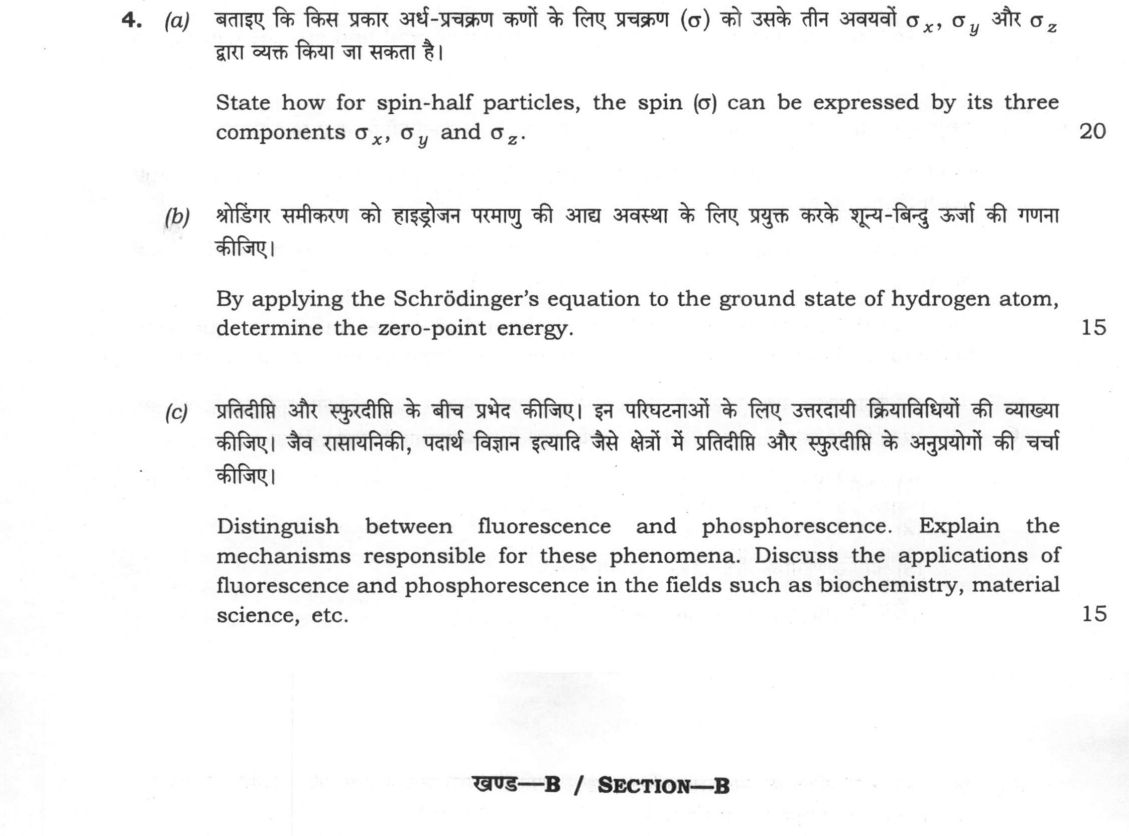
State how for spin-half particles, the spin (σ) can be expressed by its three components σ_x, σ_y and σ_z. 20 marks
By applying the Schrödinger's equation to the ground state of hydrogen atom, determine the zero-point energy. 15 marks
Distinguish between fluorescence and phosphorescence. Explain the mechanisms responsible for these phenomena. Discuss the applications of fluorescence and phosphorescence in the fields such as biochemistry, material science, etc. 15 marks
हिंदी में प्रश्न पढ़ें
बताइए कि किस प्रकार अर्ध-प्रचक्रण कणों के लिए प्रचक्रण (σ) को उसके तीन अवयवों σ_x, σ_y और σ_z द्वारा व्यक्त किया जा सकता है। 20 अंक
श्रोडिंगर समीकरण को हाइड्रोजन परमाणु की आध अवस्था के लिए प्रयुक्त करके शून्य-बिंदु ऊर्जा की गणना कीजिए। 15 अंक
प्रतिदीप्ति और स्कुरदीप्ति के बीच प्रभेद कीजिए। इन परिघटनाओं के लिए उत्तरदायी क्रियाविधियों की व्याख्या कीजिए। जैव रासायनिकी, पदार्थ विज्ञान इत्यादि जैसे क्षेत्रों में प्रतिदीप्ति और स्कुरदीप्ति के अनुप्रयोगों की चर्चा कीजिए। 15 अंक
Model answer
Written by UPSC Answer Check against this question's marking rubric, to the expected length. UPSC does not publish answers for Mains — this is one way to score well, not an official key.
Spin-half algebra. For a spin-half particle the intrinsic spin is represented by the dimensionless Pauli vector σ = σₓ î + σ_y ĵ + σ_z k̂, where σₓ = [[0,1],[1,0]], σ_y = [[0,-i],[i,0]], σ_z = [[1,0],[0,-1]]. In the standard spinor basis, σ_z is diagonal, σₓ changes |↑> into |↓> and vice versa, and σ_y does the same with a relative phase i. The physical spin operator is S = (ℏ/2)σ, so Sᵢ=(ℏ/2)σᵢ. Each σᵢ has eigenvalues ±1, hence Sᵢ eigenvalues ±ℏ/2. The components satisfy [σᵢ,σⱼ]=2iε_ijkσₖ, σᵢ,σⱼ=2δ_ij I, and σᵢ²=I; equivalently σᵢσⱼ=δ_ij I+iε_ijkσₖ. Since they do not commute, only one component can be sharply defined at a time. Therefore [Sᵢ,Sⱼ]=iℏ ε_ijk Sₖ. For any unit direction n, n·σ = nₓσₓ+n_yσ_y+n_zσ_z is also Hermitian with eigenvalues ±1, so the three matrices encode all possible spin projections. The total spin magnitude is S²=Sₓ²+S_y²+S_z²=s(s+1)ℏ²=3ℏ²/4 for s=1/2. This is the spin-1/2 representation of SU(2), the double cover of the rotation group, and it is the complete statement of how spin is expressed through its three components.
Hydrogen ground state and zero-point energy. For an electron of reduced mass μ in the Coulomb field of a proton, the time-independent Schrödinger equation is [-ℏ²/(2μ)∇² - e²/(4πε₀r)]ψ=Eψ. Separation in spherical coordinates gives angular spherical harmonics and a radial equation. For the ground state n=1, l=0, Y00 is constant and the radial equation reduces to -ℏ²/(2μ)(1/r² d/dr(r² dR/dr)) - e²/(4πε₀r)R=ER. Its solution is R(r)∝e^-r/a₀, with a₀=4πε₀ℏ²/(μe²); the normalized wavefunction is ψ100=(πa₀³)^-1/2e^-r/a₀. Substitution gives E₁=-μe⁴/(32π²ε₀²ℏ²)=-13.6 eV. Using μ≈mₑ gives the familiar 13.6 eV; the reduced-mass correction is small. This total ground-state energy is the zero-point energy of the hydrogen atom; its magnitude, 13.6 eV, is the binding or ionization energy. The expectation values obey the virial theorem: ⟨T⟩=+13.6 eV and ⟨V⟩=-27.2 eV, so ⟨T⟩+⟨V⟩=-13.6 eV. The positive kinetic term reflects confinement expressed by ΔrΔp≥ℏ/2; minimizing T~ℏ²/(2μa₀²) and V~-e²/(4πε₀a₀) gives the same a₀ and energy, showing the ground state is a balance of kinetic and potential terms. The zero-point energy is therefore the total ground-state energy, not merely the kinetic contribution.
Fluorescence and phosphorescence. In a Jablonski diagram, absorption promotes a molecule from the singlet ground state S₀ to an excited singlet S₁. The diagram thus contains both radiative transitions, S₁→S₀ and T₁→S₀, and non-radiative transitions, vibrational relaxation, internal conversion, and ISC. Fluorescence is prompt radiative decay S₁→S₀ with no change in spin multiplicity; it is spin-allowed, has lifetimes of about 10⁻⁹–10⁻⁷ s, and follows vibrational relaxation and internal conversion. The emitted fluorescence is usually at longer wavelength than the absorbed light because of this relaxation, producing a Stokes shift. Phosphorescence begins with intersystem crossing (ISC), a non-radiative S₁→T₁ transition mediated by spin-orbit coupling, followed by delayed radiative decay T₁→S₀. Because this is a singlet-triplet, spin-forbidden transition, phosphorescence has much longer lifetimes, typically 10⁻³–10³ s, and can persist after the excitation source is removed; the forbidden transition is made weakly allowed by spin-orbit coupling, especially in heavier atoms. Fluorescence is therefore useful for real-time imaging, while phosphorescence is useful where afterglow or long-lived emission is needed.
Applications follow these mechanisms. In biochemistry, fluorescence is used in green fluorescent protein (GFP) tagging, flow cytometry, fluorescence microscopy at IISc Bengaluru, and biomedical research at CCMB Hyderabad. In material science, phosphorescence is exploited in organic light-emitting diodes (OLEDs), persistent luminescent materials, phosphorescent safety signage in Indian Railways, and security inks in Indian currency. These applications rely on controlled selection rules and relaxation pathways. Thus the question moves from the SU(2) spin algebra of a single particle to the quantized bound state of hydrogen and to molecular selection rules, showing how quantum states and transition probabilities underlie atomic and material phenomena.
What "State" is asking you to do
Give the formulation itself — the theorem, rule, statutory provision or position — worded accurately. Precision of wording is the whole of the mark; no background or justification is being asked for.
Structure that answers it
The statement in full, complete in itself → the conditions under which it holds → an illustration only where the stem asks for one
Where marks are lost
Approximating the wording. A theorem or a provision stated loosely forfeits the mark that exact statement would have carried.
How this answer will be evaluated
Approach
Framework: Principle > Setup and diagram > Derivation > Result and limiting case. (a) explain: definition/context > points in order > small example > short close | (b) calculate: given > formula > substitution > result with units > interpretation | (c) compare: paired headings or table > key differences > significance > conclusion Full marks: Complete derivations with all steps, correct units, physical interpretation, and relevant applications
Key points expected
- Define Pauli matrices σx, σy, σz explicitly
- State spin operator S = (ħ/2)σ
- Show commutation relations [σi, σj] = 2iεijkσk
- Verify eigenvalues are ±ħ/2
- Write time-independent Schrödinger equation for H atom
- Solve radial equation for n=1, l=0
- Apply boundary conditions for normalizability
- Calculate E1 = -13.6 eV
Evaluation rubric
Each sub-part is marked on its own, against the marks and word limit printed on the paper.
- (a) Derive the vector expression for spin in terms of Pauli matrices. 20 marks
explain— definition/context → points in order → small example → short close
Must cover
- Define Pauli matrices σx, σy, σz explicitly
- State spin operator S = (ħ/2)σ
- Show commutation relations [σi, σj] = 2iεijkσk
- Verify eigenvalues are ±ħ/2
Loses marks
- Confusing spin with orbital angular momentum
- Missing the ħ/2 factor
- Treating σ as a classical vector
Earns more
- Mention spinor representation
- Link to SU(2) group
- Show action on basis states |↑>, |↓>
Extra mark
- Mention spin-statistics theorem
- (b) Derive ground state energy of hydrogen using Schrödinger equation. 15 marks
calculate— given → formula → substitution → result with units → interpretation
Must cover
- Write time-independent Schrödinger equation for H atom
- Solve radial equation for n=1, l=0
- Apply boundary conditions for normalizability
- Calculate E1 = -13.6 eV
Loses marks
- Using Bohr model without derivation
- Missing boundary condition step
- Incorrect sign for ground state energy
Earns more
- Show Bohr radius derivation
- Discuss zero-point energy concept
- Mention virial theorem check
Extra mark
- Compare with Bohr model result
- (c) Distinguish fluorescence and phosphorescence with mechanisms and applications. 15 marks
compare— paired headings or table → key differences → significance → conclusion
Must cover
- Define both phenomena clearly
- Explain spin-allowed vs spin-forbidden transitions
- Compare lifetimes (ns vs ms-s)
- Give 2+ applications in biochemistry/materials
Loses marks
- Confusing emission mechanisms
- No mention of spin states
- Applications without field context
Earns more
- Draw Jablonski diagram
- Mention triplet state mechanism
- Discuss quantum yield differences
Extra mark
- Mention specific fluorescent dyes
- Reference OLED technology
Practice this exact question
Write your answer and it is marked point by point against the model answer above — what you covered, what you missed, what you got wrong.
Evaluate my answer →More from Physics 2025 Paper II
- Q1 (a) Explain how the uncertainty in position is different from the uncertainty or inaccura…
- Q2 (a) What is the density of states? For a relativistic particle of rest mass μ, prove that…
- Q3 (a) Find out the difference in frequencies of Lyman-alpha line in hydrogen and deuterium…
- Q4 (a) State how for spin-half particles, the spin (σ) can be expressed by its three compone…
- Q5 (a) Show that the energy of the triplet state (S = 1) is not equal to the energy of the s…
- Q6 (a) The total binding energies of ¹⁵₈O, ¹⁶₈O and ¹⁷₈O are 111·96 MeV, 127·62 MeV and 131·…
- Q7 (a) What is the minimum energy required to break a ₂He⁴ nucleus into free protons and neu…