Paper II — Q3
(a) Find out the difference in frequencies of Lyman-alpha line in hydrogen and deuterium atoms. 15 marks (b) The Stern-Gerlach…
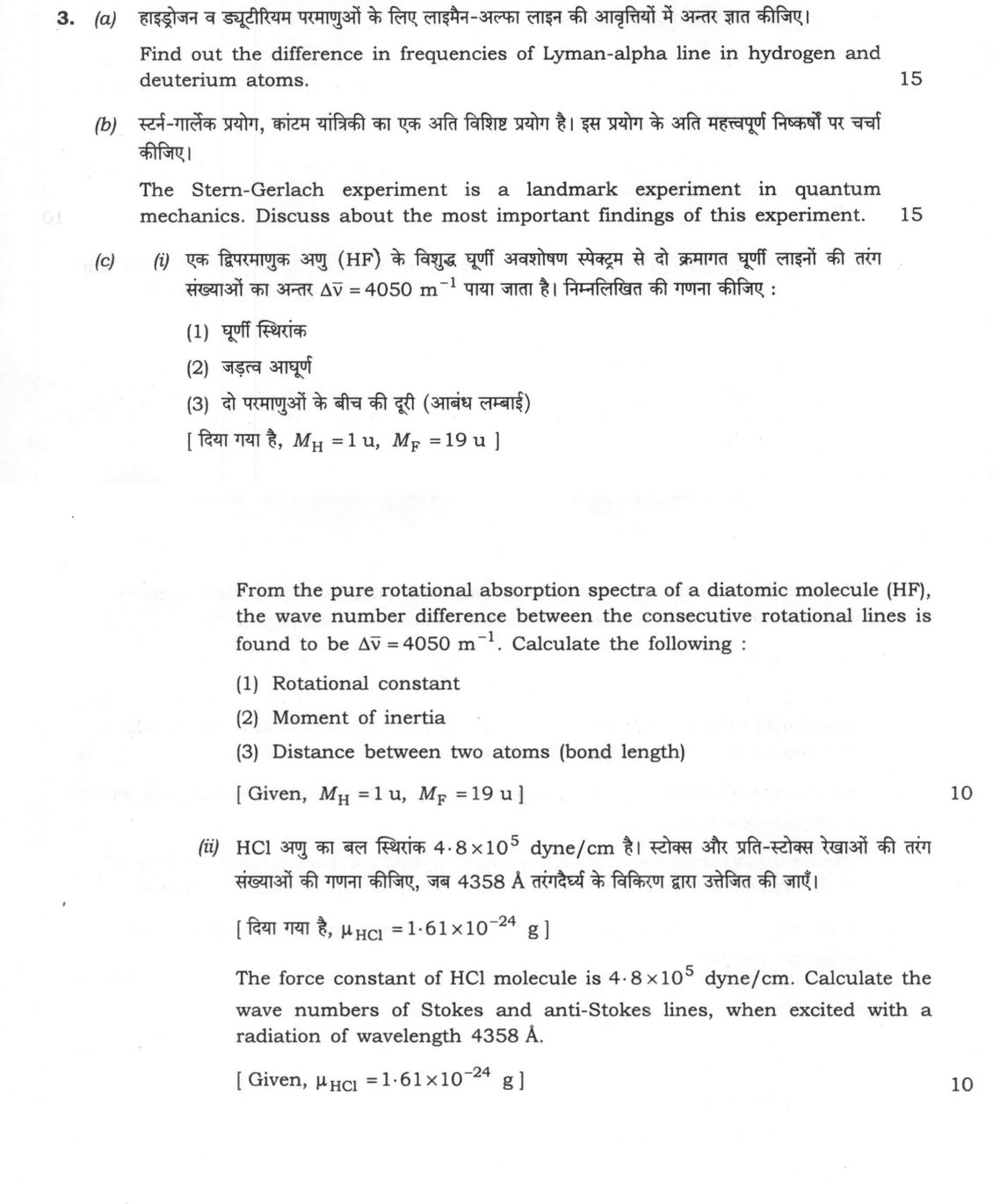
Find out the difference in frequencies of Lyman-alpha line in hydrogen and deuterium atoms. 15 marks
The Stern-Gerlach experiment is a landmark experiment in quantum mechanics. Discuss about the most important findings of this experiment. 15 marks
From the pure rotational absorption spectra of a diatomic molecule (HF), the wave number difference between the consecutive rotational lines is found to be Δν̄ = 4050 m⁻¹. Calculate the following: (1) Rotational constant (2) Moment of inertia (3) Distance between two atoms (bond length) [Given, M_H = 1 u, M_F = 19 u] 10 marks
The force constant of HCl molecule is 4.8×10⁵ dyne/cm. Calculate the wave numbers of Stokes and anti-Stokes lines, when excited with a radiation of wavelength 4358 Å. [Given, μ_HCl = 1.61×10⁻²⁴ g] 10 marks
हिंदी में प्रश्न पढ़ें
हाइड्रोजन व ड्यूटीरियम परमाणुओं के लिए लाइमेन-अल्फा लाइन की आवृत्तियों में अंतर ज्ञात कीजिए। 15 अंक
स्टर्न-गार्लेक प्रयोग, क्वांटम यांत्रिकी का एक अति विशिष्ट प्रयोग है। इस प्रयोग के अति महत्वपूर्ण निष्कर्षों पर चर्चा कीजिए। 15 अंक
एक डाइपरमाणुक अणु (HF) के विद्युद् घुर्णी अवशोषण स्पेक्ट्रम से दो क्रमागत घुर्णी लाइनों की तरंग संख्याओं का अंतर Δν̄ = 4050 m⁻¹ पाया जाता है। निम्नलिखित की गणना कीजिए: (1) घुर्णी स्थिरांक (2) जड़त्व आघूर्ण (3) दो परमाणुओं के बीच की दूरी (आबंध लंबाई) [दिया गया है, M_H = 1 u, M_F = 19 u] 10 अंक
HCl अणु का बल स्थिरांक 4.8×10⁵ dyne/cm है। स्टोक्स और प्रति-स्टोक्स रेखाओं की तरंग संख्याओं की गणना कीजिए, जब 4358 Å तरंगदैर्घ्य के विकिरण द्वारा उत्तेजित की जाएं। [दिया गया है, μ_HCl = 1.61×10⁻²⁴ g] 10 अंक
Model answer
Written by UPSC Answer Check against this question's marking rubric, to the expected length. UPSC does not publish answers for Mains — this is one way to score well, not an official key.
(a) The Lyman-alpha transition is n = 2 → 1. For a hydrogen-like atom, isotope shift arises because the Rydberg constant depends on the reduced mass μ. ν = (3/4)cR∞ / (1 + mₑ/M), where M is the nuclear mass. Thus ν_H = (3/4)cR∞ / (1 + mₑ/M_p), ν_D = (3/4)cR∞ / (1 + mₑ/M_d). Therefore, Δν = ν_D − ν_H = (3/4)cR∞ [1/(1 + mₑ/M_d) − 1/(1 + mₑ/M_p)]. Using R∞ = 1.0973731568×10⁷ m⁻¹, c = 2.99792458×10⁸ m s⁻¹, mₑ/M_p = 1/1836.15 = 5.44617×10⁻⁴, mₑ/M_d = 1/3670.48 = 2.72444×10⁻⁴, the bracket is approximately 2.71951×10⁻⁴. Hence Δν = (3/4)(2.99792458×10⁸)(1.0973731568×10⁷)(2.71951×10⁻⁴) = 6.71×10¹¹ Hz. The deuterium Lyman-alpha frequency is higher than that of hydrogen by this amount.
(b) The Stern-Gerlach experiment passed a beam of silver atoms through a strongly inhomogeneous magnetic field. Classically, randomly oriented atomic magnetic moments should give a continuous spread on the plate. Instead, the beam split into two distinct traces. This established space quantization: the component of angular momentum along the field direction takes discrete values.
For silver, the ground-state valence electron has zero orbital angular momentum, so the observed magnetic moment could not arise from orbital motion. The two beams correspond to the two spin orientations of the electron: m_s = +1/2 and m_s = −1/2. Thus the experiment gave direct evidence for electron spin and spin magnetic moment.
The force on an atom is F_z = μ_z ∂B_z/∂z = −m_s g_s μ_B ∂B_z/∂z. For an electron, g_s ≈ 2, so two equal and opposite deflections occur. The experiment also showed that only certain spin components can be measured. Sequential Stern-Gerlach experiments along different axes demonstrate that spin components along different directions do not commute, so they cannot be simultaneously definite. This became the basis of spinor quantum mechanics, Pauli matrices, quantum state preparation, and qubits.
(c)(i) For a rigid diatomic rotor, rotational term is F(J) = B J(J+1), where B is the rotational constant in wavenumber units. Selection rule: ΔJ = ±1. Absorption line: ν̄(J → J+1) = 2B(J+1). So the difference between consecutive rotational lines is Δν̄ = 2B. Given Δν̄ = 4050 m⁻¹, (1) B = 4050/2 = 2025 m⁻¹ = 20.25 cm⁻¹.
(2) The moment of inertia is I = h/(8π²cB). Using h = 6.62607015×10⁻³⁴ J s, c = 2.99792458×10⁸ m s⁻¹, B = 2025 m⁻¹, I = 6.62607015×10⁻³⁴/(8π²×2.99792458×10⁸×2025) = 1.38236×10⁻⁴⁷ kg m².
(3) Reduced mass of HF: μ = M_H M_F/(M_H + M_F) = (1×19)/20 u = 0.95 u = 0.95×1.660539×10⁻²⁷ kg = 1.57751×10⁻²⁷ kg. Now I = μr², so r = √(I/μ) = √(1.38236×10⁻⁴⁷/1.57751×10⁻²⁷) = √(8.7629×10⁻²¹) = 9.361×10⁻¹¹ m = 0.9361 Å. Valid under rigid-rotor approximation, neglecting centrifugal distortion.
(c)(ii) For a harmonic oscillator, vibrational wavenumber is ν̄_vib = (1/(2πc))√(k/μ). Given k = 4.8×10⁵ dyne/cm = 4.8×10⁵ g s⁻², μ = 1.61×10⁻²⁴ g, c = 3.0×10¹⁰ cm s⁻¹. k/μ = 4.8×10⁵/1.61×10⁻²⁴ = 2.98137×10²⁹ s⁻². √(k/μ) = 5.46019×10¹⁴ s⁻¹. Thus ν̄_vib = 5.46019×10¹⁴/(2π×3.0×10¹⁰) = 2.8967×10³ cm⁻¹.
Incident radiation: λ = 4358 Å = 4.358×10⁻⁵ cm. ν̄_ex = 1/λ = 1/(4.358×10⁻⁵) = 2.29463×10⁴ cm⁻¹.
Stokes line: ν̄_S = ν̄_ex − ν̄_vib = 2.29463×10⁴ − 2.8967×10³ = 2.00496×10⁴ cm⁻¹.
Anti-Stokes line: ν̄_A = ν̄_ex + ν̄_vib = 2.29463×10⁴ + 2.8967×10³ = 2.58430×10⁴ cm⁻¹. Result valid in harmonic approximation.
What "Calculate" is asking you to do
Apply the standard formula or schedule to data the question has already supplied — a table of readings, cost records, a balance sheet — and produce the number. The method is rarely in doubt; the marks sit in the named intermediate quantities, each of which has to appear as a labelled line.
Structure that answers it
Data as given → formula or standard treatment, named → substitution → each intermediate, labelled → result with units
Where marks are lost
Omitting an intermediate the marking scheme pays for separately, or rounding at an intermediate line so the final figure drifts. In commerce and accountancy, any figure in a statement that no numbered working note supports is treated as unearned.
How this answer will be evaluated
Approach
(a) compare: paired headings or table > key differences > significance > conclusion | (b) discuss: intro > 3-4 dimensions > example > balanced close | (c(i)) calculate: given > formula > substitution > result with units > interpretation | (c(ii)) calculate: given > formula > substitution > result with units > interpretation Full marks: Complete derivations with correct units, clear physical interpretation, and accurate numerical results.
Key points expected
- State Rydberg formula with reduced mass μ
- Define μ for H and D explicitly
- Derive frequency difference Δν
- Calculate numerical value of Δν
- Describe inhomogeneous magnetic field setup
- Explain beam splitting into discrete spots
- Link to space quantization of angular momentum
- Mention spin-1/2 nature of electron
Evaluation rubric
Each sub-part is marked on its own, against the marks and word limit printed on the paper.
- (a) Derive and compare Lyman-alpha frequencies for H and D using reduced mass. 15 marks
compare— paired headings or table → key differences → significance → conclusion
Must cover
- State Rydberg formula with reduced mass μ
- Define μ for H and D explicitly
- Derive frequency difference Δν
- Calculate numerical value of Δν
Loses marks
- Using infinite mass approximation
- Missing reduced mass definition
Earns more
- Mention isotope shift origin
- Show mass ratio m_p/m_d
Extra mark
- Cite specific experimental value
- (b) Explain Stern-Gerlach setup and its implications for spin quantization. 15 marks
discuss— intro → 3-4 dimensions → example → balanced close
Must cover
- Describe inhomogeneous magnetic field setup
- Explain beam splitting into discrete spots
- Link to space quantization of angular momentum
- Mention spin-1/2 nature of electron
Loses marks
- Confusing with Zeeman effect
- Ignoring the inhomogeneous field requirement
Earns more
- Draw labelled diagram of apparatus
- Discuss historical context (1922)
Extra mark
- Mention modern applications in quantum info
- (c(i)) Calculate rotational constant, moment of inertia, and bond length for HF. 10 marks
calculate— given → formula → substitution → result with units → interpretation
Must cover
- Use Δν̄ = 2B to find B
- Calculate I from B = h/(8π²cI)
- Determine bond length r from I = μr²
- Show unit conversions for mass
Loses marks
- Using wrong value for Δν̄
- Unit errors in mass or length
Earns more
- State rigid rotor assumption
- Show intermediate calculation steps
Extra mark
- Compare with experimental bond length
- (c(ii)) Calculate wave numbers of Stokes and anti-Stokes lines for HCl. 10 marks
calculate— given → formula → substitution → result with units → interpretation
Must cover
- Calculate vibrational frequency from force constant
- Determine Raman shift Δν̄
- Calculate Stokes line wave number
- Calculate anti-Stokes line wave number
Loses marks
- Confusing Stokes and anti-Stokes
- Incorrect unit conversion for force constant
Earns more
- Show formula for vibrational frequency
- State excitation wavelength clearly
Extra mark
- Mention selection rules for Raman
Practice this exact question
Write your answer and it is marked point by point against the model answer above — what you covered, what you missed, what you got wrong.
Evaluate my answer →More from Physics 2025 Paper II
- Q1 (a) Explain how the uncertainty in position is different from the uncertainty or inaccura…
- Q2 (a) What is the density of states? For a relativistic particle of rest mass μ, prove that…
- Q3 (a) Find out the difference in frequencies of Lyman-alpha line in hydrogen and deuterium…
- Q4 (a) State how for spin-half particles, the spin (σ) can be expressed by its three compone…
- Q5 (a) Show that the energy of the triplet state (S = 1) is not equal to the energy of the s…
- Q6 (a) The total binding energies of ¹⁵₈O, ¹⁶₈O and ¹⁷₈O are 111·96 MeV, 127·62 MeV and 131·…