Paper II — Q6
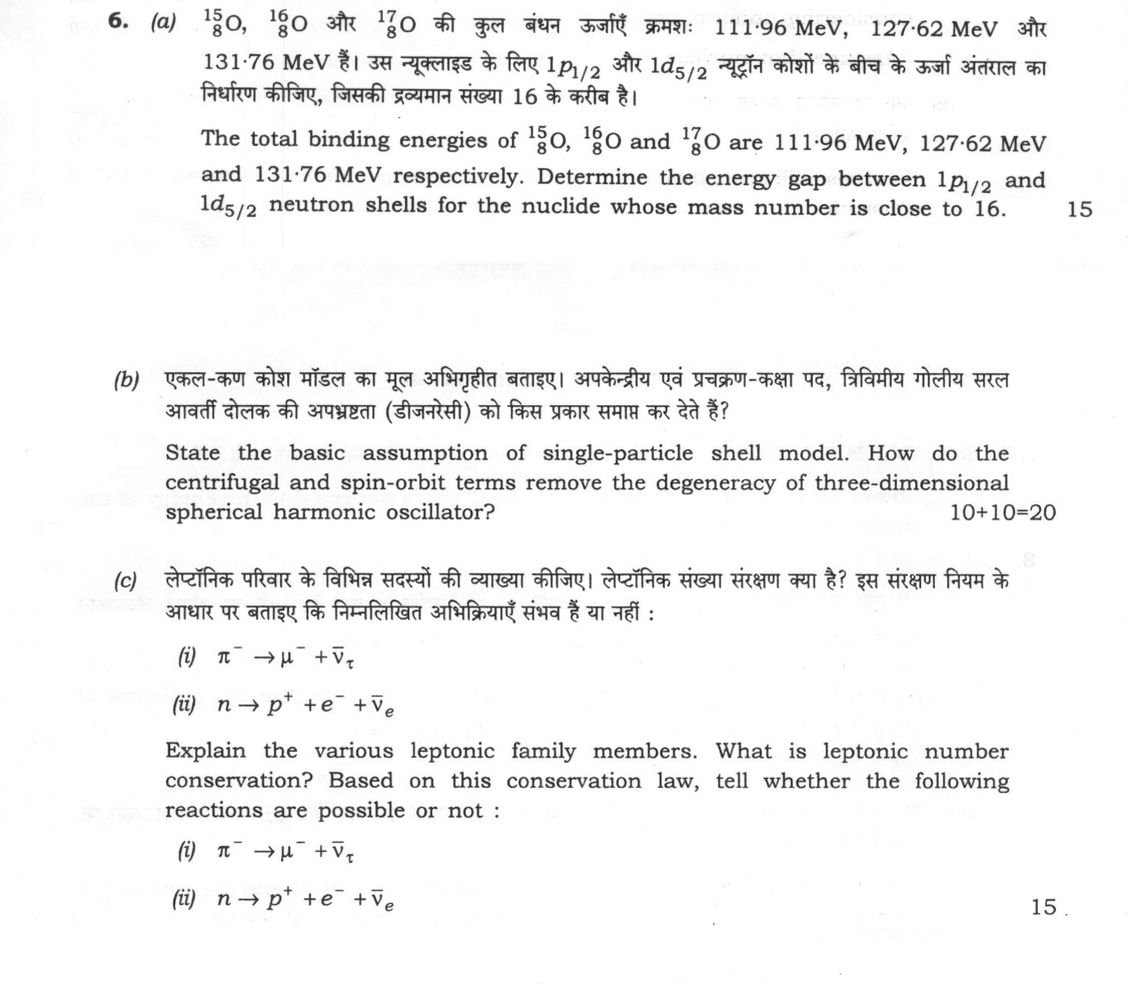
(a) The total binding energies of ¹⁵₈O, ¹⁶₈O and ¹⁷₈O are 111·96 MeV, 127·62 MeV and 131·76 MeV respectively. Determine the…
The total binding energies of ¹⁵₈O, ¹⁶₈O and ¹⁷₈O are 111·96 MeV, 127·62 MeV and 131·76 MeV respectively. Determine the energy gap between 1p₁/₂ and 1d₅/₂ neutron shells for the nuclide whose mass number is close to 16. 15 marks
State the basic assumption of single-particle shell model. How do the centrifugal and spin-orbit terms remove the degeneracy of three-dimensional spherical harmonic oscillator? 10+10=20 marks
Explain the various leptonic family members. What is leptonic number conservation? Based on this conservation law, tell whether the following reactions are possible or not: π⁻ → μ⁻ + ν̄ₜ
n → p⁺ + e⁻ + ν̄ₑ 15 marks
हिंदी में प्रश्न पढ़ें
¹⁵₈O, ¹⁶₈O और ¹⁷₈O की कुल बंधन ऊर्जाएँ क्रमशः: 111·96 MeV, 127·62 MeV और 131·76 MeV हैं। उस न्यूक्लाइड के लिए 1p₁/₂ और 1d₅/₂ न्यूट्रॉन कोशों के बीच के ऊर्जा अंतराल का निर्धारण कीजिए, जिसकी द्रव्यमान संख्या 16 के करीब है। 15
एकल-कण कोश मॉडल का मूल अभिगृहीत बताइए। अपकेन्द्रीय एवं प्रचक्रण-क्ष पद, त्रिविमीय गोलीय सरल आवर्ती दोलक की अपभ्रष्टता (डीजेनेरेसी) को किस प्रकार समाप्त कर देते हैं? 10+10=20
लेप्टोनिक परिवार के विभिन्न सदस्यों की व्याख्या कीजिए। लेप्टोनिक संख्या संरक्षण क्या है? इस संरक्षण नियम के आधार पर बताइए कि निम्नलिखित अभिक्रियाएँ संभव हैं या नहीं: π⁻ → μ⁻ + ν̄ₜ
n → p⁺ + e⁻ + ν̄ₑ 15
Model answer
Written by UPSC Answer Check against this question's marking rubric, to the expected length. UPSC does not publish answers for Mains — this is one way to score well, not an official key.
(a) Let B(¹⁵O)=111.96 MeV, B(¹⁶O)=127.62 MeV and B(¹⁷O)=131.76 MeV. The neutron separation energy is Sₙ(ᴬZ) = B(ᴬZ) − B(ᴬ⁻¹Z).
For ¹⁶O: Sₙ(¹⁶O) = 127.62 − 111.96 = 15.66 MeV. In ¹⁶O the 8th neutron occupies the 1p₁/₂ shell.
For ¹⁷O: Sₙ(¹⁷O) = 131.76 − 127.62 = 4.14 MeV. In ¹⁷O the extra neutron occupies the 1d₅/₂ shell.
Therefore the energy gap between the 1p₁/₂ and 1d₅/₂ neutron shells is ΔE = Sₙ(¹⁶O) − Sₙ(¹⁷O) = 15.66 − 4.14 = 11.52 MeV. Equivalently, ΔE = 2B(¹⁶O) − B(¹⁵O) − B(¹⁷O) = 11.52 MeV. This assumes single-particle shell energies dominate and residual interactions are small. Final answer: 11.52 MeV.
(b) The basic assumption of the single-particle shell model is the independent-particle approximation. Each nucleon moves independently in an average central potential produced by all the other nucleons. The short-range nucleon-nucleon interaction is replaced by a smooth mean field. Nucleons occupy single-particle states labelled by n, l, j, mⱼ, obey the Pauli exclusion principle, and fill levels from the bottom upward. Closed shells occur at magic numbers, and residual interactions are treated as perturbations.
A three-dimensional spherical harmonic oscillator has potential V(r) = ½ mω²r² and energies E_N = (N + 3/2)ℏω, where N = 2n + l. For fixed N, states with different l are degenerate, e.g. 2s and 1d. The centrifugal term ℏ²l(l+1)/(2mr²) is already present in the radial equation, but in the pure oscillator its effect is compensated by the radial node number, so alone it does not lift the N degeneracy. In the nuclear shell model an additional l-dependent centrifugal/orbit term, often D l², is introduced. This makes the effective potential depend on l and shifts different l states within the same oscillator shell, thereby removing the l-degeneracy.
The spin-orbit term is ΔV_ls = −V_ls(r) L·S. For a single nucleon, s = 1/2, so L·S = ½ℏ²[j(j+1) − l(l+1) − s(s+1)]. For j = l + 1/2: L·S = +lℏ²/2. For j = l − 1/2: L·S = −(l+1)ℏ²/2. Because the nuclear spin-orbit interaction is attractive, the j = l + 1/2 member is lowered relative to j = l − 1/2. Thus each l level splits into two j levels, removing the j-degeneracy. Together, the l-dependent and spin-orbit terms remove the degeneracy of the spherical harmonic oscillator and produce the observed shell structure and magic numbers.
(c) Leptons are spin-1/2 fermions that do not feel the strong interaction. They occur in three families: the first contains e⁻ and νₑ; the second contains μ⁻ and ν_μ; the third contains τ⁻ and ν_τ. Their antiparticles are e⁺, ν̄ₑ; μ⁺, ν̄_μ; τ⁺, ν̄_τ. Charged leptons have electric charge −1, and neutrinos are neutral.
Lepton number is assigned as L = +1 for leptons, L = −1 for antileptons, and L = 0 for non-leptons. Total lepton number is conserved. In the Standard Model, the separate family lepton numbers Lₑ, L_μ and L_τ are also conserved in ordinary weak interactions, except for small neutrino-oscillation effects.
(i) π⁻ → μ⁻ + ν̄_τ Initial state: L = 0, L_μ = 0, L_τ = 0. Final state: μ⁻ has L_μ = +1, while ν̄_τ has L_τ = −1. Total lepton number is +1 − 1 = 0, so total L is conserved. However, muon lepton number changes from 0 to +1 and tau lepton number changes from 0 to −1. Therefore this reaction violates separate muon and tau lepton-number conservation. Under the usual family lepton-number conservation, it is not possible as a normal weak decay. The allowed decay is π⁻ → μ⁻ + ν̄_μ. If only total lepton number were imposed, it would be allowed, but separate family conservation forbids it.
(ii) n → p⁺ + e⁻ + ν̄ₑ Initial state: neutron is not a lepton, so L = 0 and Lₑ = 0. Final state: e⁻ has Lₑ = +1, and ν̄ₑ has Lₑ = −1. Thus Lₑ = (+1) + (−1) = 0, and total L = 0. Both total and electron lepton number are conserved. This is the usual β⁻ decay of the neutron. Therefore this reaction is possible.
What "Calculate" is asking you to do
Apply the standard formula or schedule to data the question has already supplied — a table of readings, cost records, a balance sheet — and produce the number. The method is rarely in doubt; the marks sit in the named intermediate quantities, each of which has to appear as a labelled line.
Structure that answers it
Data as given → formula or standard treatment, named → substitution → each intermediate, labelled → result with units
Where marks are lost
Omitting an intermediate the marking scheme pays for separately, or rounding at an intermediate line so the final figure drifts. In commerce and accountancy, any figure in a statement that no numbered working note supports is treated as unearned.
How this answer will be evaluated
Approach
Framework: Principle > Setup and diagram > Derivation > Result and limiting case. (a) calculate: given > formula > substitution > result with units > interpretation | (b) explain: definition/context > points in order > small example > short close | (c) explain: definition/context > points in order > small example > short close Full marks: Correct calculations with clear reasoning, accurate shell model explanation, and proper lepton number checks.
Key points expected
- Calculate neutron separation energies S_n for O-16 and O-17
- Identify O-16 as a doubly magic closed shell nuclide
- Relate S_n(O-17) to the 1d5/2 shell energy
- Relate S_n(O-16) to the 1p1/2 shell energy
- State the independent particle assumption (mean field)
- Define the 3D spherical harmonic oscillator potential
- Explain the role of the centrifugal term (l(l+1))
- Explain the role of the spin-orbit term (l.s)
Evaluation rubric
Each sub-part is marked on its own, against the marks and word limit printed on the paper.
- (a) Determine the energy gap between 1p1/2 and 1d5/2 neutron shells for O-16. 15 marks
calculate— given → formula → substitution → result with units → interpretation
Must cover
- Calculate neutron separation energies S_n for O-16 and O-17
- Identify O-16 as a doubly magic closed shell nuclide
- Relate S_n(O-17) to the 1d5/2 shell energy
- Relate S_n(O-16) to the 1p1/2 shell energy
Loses marks
- Using proton separation energies instead of neutron
- Failing to identify the specific shells involved
- Arithmetic errors in binding energy subtraction
Earns more
- Explicitly state the shell model configuration of O-16
- Show the subtraction of binding energies clearly
- Mention the specific magic numbers 8 and 8
- State the final result in MeV with correct sign
Extra mark
- Mention the specific value of the gap (approx 4.14 MeV)
- Reference the experimental neutron resonance data
- (b) State the basic assumption of the shell model and explain how terms remove degeneracy. 20 marks
explain— definition/context → points in order → small example → short close
Must cover
- State the independent particle assumption (mean field)
- Define the 3D spherical harmonic oscillator potential
- Explain the role of the centrifugal term (l(l+1))
- Explain the role of the spin-orbit term (l.s)
Loses marks
- Confusing spin-orbit with centrifugal effects
- Failing to mention the mean field approximation
- Incorrectly describing the degeneracy removal
Earns more
- Show the energy level formula for the oscillator
- Describe the splitting of degenerate levels
- Mention the specific splitting of the 1d shell
- Draw a simple energy level diagram
Extra mark
- Mention the specific sign of the spin-orbit coupling
- Reference the Nilsson model
- (c) Explain leptonic family members and conservation, then check reaction validity. 15 marks
explain— definition/context → points in order → small example → short close
Must cover
- List the three leptonic families (e, mu, tau)
- Define the conservation of individual lepton numbers
- Check lepton number conservation for reaction (i)
- Check lepton number conservation for reaction (ii)
Loses marks
- Confusing lepton number with baryon number
- Failing to check individual lepton family numbers
- Incorrectly identifying the neutrino types
Earns more
- Identify the specific lepton numbers for each particle
- Show the calculation of lepton number balance
- State clearly if the reaction is possible or not
- Mention the specific neutrino types involved
Extra mark
- Mention the experimental evidence for lepton flavor conservation
- Reference the specific decay modes of pions
Practice this exact question
Write your answer and it is marked point by point against the model answer above — what you covered, what you missed, what you got wrong.
Evaluate my answer →More from Physics 2025 Paper II
- Q3 (a) Find out the difference in frequencies of Lyman-alpha line in hydrogen and deuterium…
- Q4 (a) State how for spin-half particles, the spin (σ) can be expressed by its three compone…
- Q5 (a) Show that the energy of the triplet state (S = 1) is not equal to the energy of the s…
- Q6 (a) The total binding energies of ¹⁵₈O, ¹⁶₈O and ¹⁷₈O are 111·96 MeV, 127·62 MeV and 131·…
- Q7 (a) What is the minimum energy required to break a ₂He⁴ nucleus into free protons and neu…
- Q8 (a) Classify diamagnetic, paramagnetic and ferromagnetic materials in terms of their magn…