Paper I — Q1
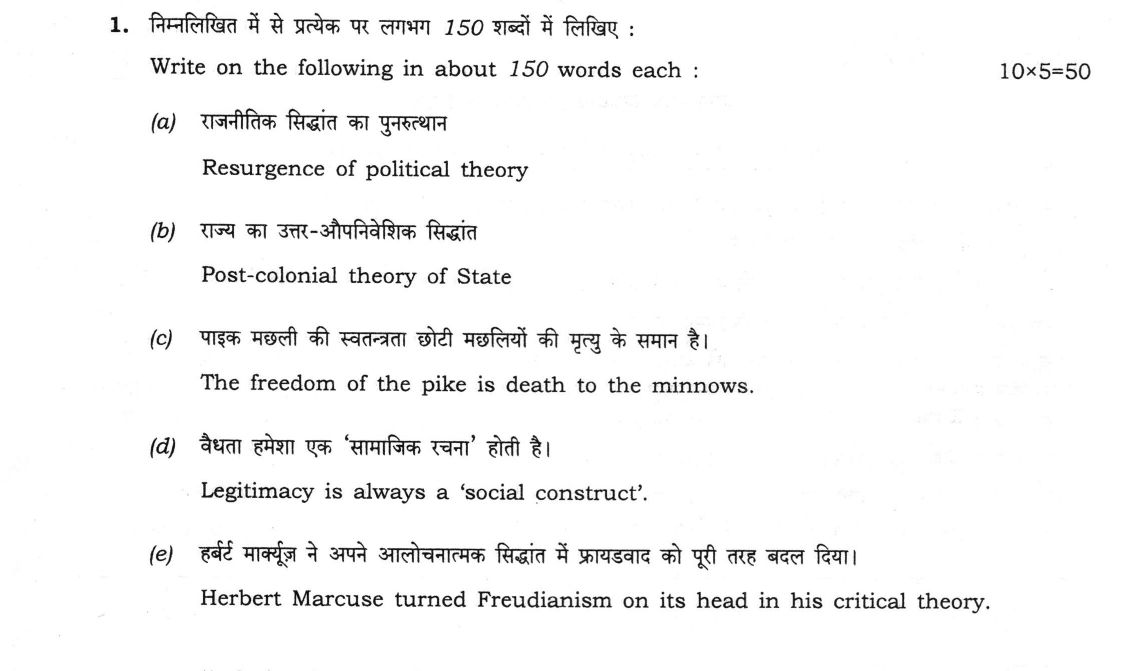
(a) Resurgence of political theory (10 marks) (b) Post-colonial theory of State (10 marks) (c) The freedom of the pike is death…
Write on the following in about 150 words each :
Resurgence of political theory 10 marks
Post-colonial theory of State 10 marks
The freedom of the pike is death to the minnows. 10 marks
Legitimacy is always a ‘social construct’. 10 marks
Herbert Marcuse turned Freudianism on its head in his critical theory. 10 marks
हिंदी में प्रश्न पढ़ें
निम्नलिखित में से प्रत्येक पर लगभग 150 शब्दों में लिखिए :
राजनीतिक सिद्धांत का पुनरुत्थान (10 अंक)
राज्य का उत्तर-औपनिवेशिक सिद्धांत (10 अंक)
पाइक मछली की स्वतन्त्रता छोटी मछलियों की मृत्यु के समान है। (10 अंक)
वैधता हमेशा एक ‘सामाजिक रचना’ होती है। (10 अंक)
हर्बर्ट मार्कूज़ ने अपने आलोचनात्मक सिद्धांत में फ्रायडवाद को पूरी तरह उलट दिया। (10 अंक)
Model answer
Drafted with AI by UPSC Answer Check against this question's marking rubric, to the 150-word length. UPSC does not publish answers for Mains — this is one way to score well, not an official key. How we build rubrics and answers.
(a) Resurgence of political theory
The mid-twentieth-century "decline" thesis, articulated by Alfred Cobban (1953) and Peter Laslett (1956), argued that the rise of logical positivism and the behavioural revolution had rendered normative political theory obsolete. David Easton’s behaviouralism demanded empirical, value-free science and dismissed traditional theory as mere historicism. However, a resurgence began with an anti-positivist recovery: Isaiah Berlin’s Two Concepts of Liberty (1958), Hannah Arendt’s The Human Condition (1958), and Leo Strauss’s What is Political Philosophy? (1959) challenged the fact-value dichotomy. Easton himself conceded the point in 1969, announcing a "post-behavioural revolution" built on a "credo of relevance".
The definitive revival came with John Rawls’s A Theory of Justice (1971), which restored normative inquiry through the "original position" and "difference principle," sparking a debate with Robert Nozick’s Anarchy, State and Utopia (1974). This resurgence broadened significantly beyond liberal justice to include communitarian critiques (MacIntyre, Sandel), feminist theory (Pateman), and the Cambridge School’s contextual history (Skinner). Political theory thus returned as a pluralistic, normative discipline.
(b) Post-colonial theory of State
Post-colonial theory argues that the state in ex-colonial societies cannot be understood through classical liberal or Marxist frameworks. Hamza Alavi (1972) introduced the concept of the "overdeveloped state," describing a military-bureaucratic oligarchy that is "overdeveloped" relative to the indigenous social base. This state possesses "relative autonomy," mediating between three competing propertied classes rather than serving a single dominant class.
In the Indian context, this theory is applied through Pranab Bardhan’s analysis of "dominant proprietary classes" and Sudipta Kaviraj’s use of Gramsci’s "passive revolution" to explain the state's role in modernisation. Partha Chatterjee distinguishes between "civil society" (elite) and "political society" (subaltern), while Ranajit Guha’s Dominance without Hegemony (1997) shows that the colonial state ruled by coercion without winning consent, a legacy the post-colonial elite inherited. Frantz Fanon further critiques the "national bourgeoisie" as a parasitic class. These theories emphasise the state's unique, derivative structure in the post-colonial world.
(c) The freedom of the pike is death to the minnows.
This aphorism, originating from R. H. Tawney’s Equality (1931), critiques unregulated negative liberty. In a society of unequal power, the "freedom" of the strong (the pike) destroys that of the weak (the minnows). Isaiah Berlin quoted it in Two Concepts of Liberty (1958) and later coined the parallel line that "freedom for the wolves has often meant death to the sheep" (Introduction, Four Essays on Liberty, 1969).
The image targets the negative-liberty view (Hobbes, Bentham, laissez-faire liberals) that liberty is merely the absence of interference. T. H. Green and L. T. Hobhouse defended "positive" or effective freedom secured by state intervention. Amartya Sen’s capability approach further reframes liberty as the actual ability to function. Yet Berlin warned that positive liberty can be perverted into coercion (e.g., Rousseau’s "forced to be free"). The lesson is not the abolition of liberty but its regulation under the rule of law.
(d) Legitimacy is always a ‘social construct’.
The claim that legitimacy is "always" a social construct rests on the idea that authority is not inherent but manufactured. Max Weber defined legitimacy as a "belief" in the right to rule, categorised into traditional, charismatic, and rational-legal types. Antonio Gramsci expanded this through "hegemony," where the ruling class manufactures consent, and Habermas views it as the result of discursive justification.
However, the word "always" is the hinge of the debate. While legitimacy is socially constructed, it is not reducible to belief alone. David Beetham argues that legitimacy requires three elements: legality (rules), justifiability (beliefs), and expressed consent. For instance, India's 1975 Emergency was legally proclaimed under Article 352 but lacked justifiability and expressed consent, and was repudiated in the 1977 general election. Thus legitimacy is socially produced, but it can fail against standards of law and justification.
(e) Herbert Marcuse turned Freudianism on its head in his critical theory.
Sigmund Freud argued that civilisation requires the repression of instinctual drives (Eros and Thanatos) to maintain social order. Herbert Marcuse, in Eros and Civilization (1955), used Freud’s own categories to reach the opposite conclusion. Marcuse distinguished between "basic repression" (necessary for survival) and "surplus repression" (excessive control imposed by specific historical societies).
Marcuse argued that under the "performance principle" of advanced industrial society, surplus repression is unnecessary and serves only to maintain domination. He proposed that a "non-repressive civilisation" is possible, where sublimation is not repressive but creative. By inverting Freud’s thesis, Marcuse suggested that the conflict between the individual and society is not natural but historically produced. This "critical theory" posits that liberation from surplus repression could lead to a society where Eros is not suppressed but integrated into culture, fundamentally challenging the Freudian view of inevitable repression.
How this answer will be evaluated
Evaluation rubric
Each sub-part is marked on its own, against the marks and word limit printed on the paper.
- (a) A 150-word note on the revival of normative political theory after the mid-twentieth-century 'decline' thesis. The answer must first state what was said to have declined and why, and then account for the resurgence with named texts and thinkers; a narrative of the behavioural revolution alone will not do. 10 marks · 150 words
Must cover
- Alfred Cobban, 'The Decline of Political Theory' (1953)
- Peter Laslett, 'Philosophy, Politics and Society' (1956) preface
- David Easton and the behavioural revolution; his 1969 post-behavioural 'credo of relevance'
- John Rawls, 'A Theory of Justice' (1971)
- Robert Nozick, 'Anarchy, State and Utopia' (1974)
- Isaiah Berlin, 'Two Concepts of Liberty' (1958)
- Hannah Arendt, Leo Strauss, Sheldon Wolin
- logical positivism and the fact-value dichotomy
- communitarian, feminist and multicultural extensions; Quentin Skinner and the Cambridge School
Loses marks
- Describing only the behavioural revolution and post-behaviouralism, without ever showing how normative theory itself came back
- Naming Rawls but no date, no concept (original position, veil of ignorance, difference principle) and no interlocutor
- Attributing the 'political philosophy is dead' line to the wrong author - it is Laslett (1956); Cobban wrote of the 'decline' in 1953
- Treating the resurgence as purely Anglo-American liberal, ignoring communitarian, feminist, multicultural and Cambridge School strands
- Writing 300 words of intellectual history when the printed instruction is about 150 words
Earns more
- Names the earlier anti-positivist recovery that preceded Rawls: Hannah Arendt's 'The Human Condition' (1958), Isaiah Berlin's 'Two Concepts of Liberty' (1958), Leo Strauss's 'What is Political Philosophy?' (1959), Sheldon Wolin's 'Politics and Vision' (1960) and his 'Political Theory as a Vocation' (1969), and Dante Germino's 'Beyond Ideology: The Revival of Political Theory' (1967)
- Shows that the resurgence broadened beyond liberal justice: communitarian critiques (MacIntyre's 'After Virtue' 1981, Sandel's 'Liberalism and the Limits of Justice' 1982, Walzer's 'Spheres of Justice' 1983, Charles Taylor), feminist theory (Susan Moller Okin, Carole Pateman's 'The Sexual Contract' 1988), multiculturalism (Kymlicka, Bhikhu Parekh), Habermas's discourse ethics, and the Cambridge School's contextual history of ideas (Quentin Skinner, J.G.A. Pocock)
- (b) A 150-word note on the post-colonial theory of the State: why the state in ex-colonial societies is theorised differently from the classical liberal or the classical Marxist state. The answer must carry Alavi's 'overdeveloped state' thesis and at least one Indian application. 10 marks · 150 words
Must cover
- Hamza Alavi (1972), 'overdeveloped' post-colonial state, military-bureaucratic oligarchy
- relative autonomy of the state; three competing propertied classes
- Pranab Bardhan (1984), dominant proprietary classes
- Sudipta Kaviraj, passive revolution (after Gramsci)
- Partha Chatterjee, derivative discourse, civil society vs political society
- Ranajit Guha, 'Dominance without Hegemony'
- Frantz Fanon, national bourgeoisie
- Colin Leys (1976) as critic; John Saul (1974) extending the thesis to Tanzania
Loses marks
- Writing a general note on theories of the state (liberal, Marxist, pluralist) with a single line on post-colonialism at the end
- Naming Alavi without the key term 'overdeveloped' or without saying what it is overdeveloped in relation to - the indigenous social base
- Confusing 'relative autonomy' as used by Alavi with Poulantzas's use for the advanced capitalist state, without noticing the difference in the class configuration
- Offering no Indian application at all, when Bardhan, Kaviraj and Chatterjee are the standard syllabus references
- Conflating post-colonial theory of the state with post-colonial literary theory (Said, Spivak) without connecting it to state structure
Earns more
- Adds the culturalist and subaltern strand: Partha Chatterjee's 'Nationalist Thought and the Colonial World: A Derivative Discourse?' (1986) and his distinction between civil society and 'political society' in 'The Politics of the Governed' (2004); Ranajit Guha's 'Dominance without Hegemony' (1997); and Frantz Fanon's 'The Wretched of the Earth' (1961) on the pitfalls of national consciousness and the parasitic national bourgeoisie
- Offers a critique: Colin Leys (1976) questioned the coherence of the 'overdeveloped' concept and whether it travels beyond South Asia, while John Saul's (1974) Tanzanian study had to modify it; the thesis understates the state's developmental achievements, democratic deepening and the agency of subordinate classes; and the label risks treating a very diverse set of states as one type
- (c) A 150-word note decoding the aphorism as a critique of unregulated negative liberty: unlimited freedom for the strong destroys the freedom of the weak. The answer must identify the source of the image, locate it in the negative-positive liberty debate, and judge the claim rather than merely paraphrase it. 10 marks · 150 words
Must cover
- R. H. Tawney, 'Equality' (1931)
- Isaiah Berlin quoted it in 'Two Concepts of Liberty' (1958); 'freedom for the wolves... death to the sheep' (Introduction, 'Four Essays on Liberty', 1969)
- negative liberty: Hobbes, Bentham, laissez-faire and freedom of contract
- T. H. Green, 'Liberal Legislation and Freedom of Contract' (1881); positive/effective freedom
- L. T. Hobhouse; Rousseau's 'forced to be free'
- Marx on formal vs real freedom; C. B. Macpherson
- Amartya Sen, capability as real freedom
- Rawls: priority of liberty plus the difference principle
Loses marks
- Treating the line as Berlin's own coinage - Berlin quoted it in 'Two Concepts of Liberty' and later coined the wolves-and-sheep version; the pike-and-minnows image is Tawney's
- Writing a textbook account of negative and positive liberty without ever interpreting the metaphor or taking a position
- Reading the aphorism as an argument against liberty as such, instead of against unregulated liberty in conditions of unequal power
- Omitting the counter-argument, so that the note becomes a one-sided defence of state intervention with no awareness of Berlin's warning about positive liberty
- Padding with the full list of Berlin's arguments on monism and value pluralism and overshooting 150 words
Earns more
- Extends the critique radically: Marx on the merely formal freedom of the wage labourer who is free to sell his labour and free of the means of production; C. B. Macpherson's possessive individualism; Anatole France's irony that the law majestically forbids rich and poor alike to sleep under bridges; Amartya Sen's capability approach reframing liberty as real, effective freedom
- Supplies the counter-balance so that the note is evaluative: Berlin's warning that positive liberty can be perverted into coercion by an authority claiming to know the individual's 'real' will (Rousseau's 'forced to be free'), so the correct lesson is regulation of liberty within the rule of law, not its subordination to a collective purpose; Rawls's priority of equal basic liberties combined with the difference principle is the standard modern settlement
- (d) A 150-word note testing the claim that legitimacy is 'always' a social construct. The word 'always' is the hinge: the answer must both establish the constructivist case (Weber, Gramsci, Habermas) and register Beetham's objection that legitimacy is not reducible to belief alone. 10 marks · 150 words
Must cover
- Max Weber: traditional, charismatic and rational-legal legitimate domination; legitimacy as belief
- Antonio Gramsci, hegemony and manufactured consent
- Berger and Luckmann, 'The Social Construction of Reality' (1966)
- Jurgen Habermas, 'Legitimation Crisis' (1973)
- David Beetham, 'The Legitimation of Power' (1991) and its three dimensions
- David Easton, diffuse support
- Rousseau, 'The Social Contract', on converting strength into right
- S. M. Lipset on legitimacy and effectiveness
Loses marks
- Reproducing Weber's three types as a list without ever addressing the 'social construct' claim in the question
- Treating legitimacy as identical with legality, so that any law-made government is by definition legitimate
- Ignoring the word 'always' and therefore offering no evaluation - the examiner is testing whether the candidate can qualify a universal claim
- Omitting Beetham, who is the standard corrective to the purely belief-based reading of legitimacy
- Illustrating only with Western examples when Indian material (the Emergency of 1975-77 and the 1977 verdict, Gandhi's moral authority, constitutional morality) is readily available
Earns more
- Uses Jurgen Habermas's 'Legitimation Crisis' (1973): late-capitalist states face rationality, legitimation and motivation crises when administrative steering outruns socially produced meaning; legitimacy must ultimately rest on reasons that can survive free public discourse, which makes it discursively constructed but not merely manipulated
- Delivers an explicit verdict on 'always', citing Rousseau ('the strongest is never strong enough to be always master unless he transforms his strength into right and obedience into duty') and Lipset's pairing of legitimacy with effectiveness: legitimacy is always socially mediated, but claims to legitimacy can be rationally assessed and can fail, as revolutions, mass protests and electoral routs demonstrate
- (e) A 150-word note on how Marcuse used Freud's own categories to reach the opposite of Freud's conclusion. The answer must explain Freud's thesis, then Marcuse's inversion through surplus repression, the performance principle and non-repressive civilisation, and name 'Eros and Civilization' (1955). 10 marks · 150 words
Must cover
- Herbert Marcuse, 'Eros and Civilization' (1955)
- Freud, 'Civilization and Its Discontents' (1930); pleasure principle vs reality principle; Eros and Thanatos
- basic repression vs surplus repression
- performance principle
- non-repressive sublimation; Orpheus and Narcissus vs Prometheus
- 'One-Dimensional Man' (1964); repressive desublimation; false needs
- Frankfurt School / critical theory; Marx-Freud synthesis
- 'Repressive Tolerance' (1965), 'An Essay on Liberation' (1969); new revolutionary subjects
Loses marks
- Writing a general note on the Frankfurt School (Horkheimer, Adorno, Habermas) with only a passing line on Marcuse and none on Freud
- Confusing basic repression with surplus repression, or defining the performance principle as Freud's own term rather than Marcuse's historical specification of the reality principle
- Attributing 'repressive desublimation' to 'Eros and Civilization' - it belongs to 'One-Dimensional Man' (1964)
- Saying Marcuse rejected Freud - the point of the question is that he accepted Freud's categories and reversed the conclusion
- Offering no critical assessment at all, so the note reads as exposition rather than as the critical theory it describes
Earns more
- Draws the utopian conclusion: a non-repressive civilisation is possible through non-repressive sublimation and 'libidinal rationality', with Orpheus and Narcissus replacing Prometheus as culture-heroes, work becoming play, and Eros prevailing over Thanatos - the exact reversal of Freud's verdict
- Situates and evaluates: Marcuse as a Frankfurt School critical theorist synthesising Marx and Freud, extending the argument in 'One-Dimensional Man' (1964) through 'repressive desublimation' (sexual liberation that reinforces rather than threatens the system), false needs and one-dimensional thought, and in 'Repressive Tolerance' (1965) and 'An Essay on Liberation' (1969) where students, minorities and outcasts replace the integrated proletariat; critics charge utopianism, elitism, a dubious biologising of Marx, and Marcuse's own dispute with the neo-Freudian revisionism of Erich Fromm
What "Discuss" is asking you to do
Lay the issue out from more than one side — how it arose, what is claimed for it, what is held against it, and where it now stands. UPSC attaches discuss to broad topics with several live dimensions, so coverage of the dimensions earns more than the strength of your opinion.
Structure that answers it
Set the issue up → the case as it is made → the case against → the dimension both sides leave out → where the balance now lies
Where marks are lost
Listing facts with no thread between them, or arguing one side throughout and calling it a discussion.
Practice this exact question
Write your answer and it is marked point by point against the model answer above — what you covered, what you missed, what you got wrong.
Evaluate my answer →More from Political Science & IR 2026 Paper I
- Q1 Write on the following in about 150 words each : (a) Resurgence of political theory (10 m…
- Q2 (a) “Rights of the man are separate and independent of the State.” Critically analyze the…
- Q3 (a) Mill’s work was crucial to the development of liberalism, because it straddled the di…
- Q4 (a) “Representative democracy is not an absolute principle, rather a question of time, pl…