Paper I — Q2
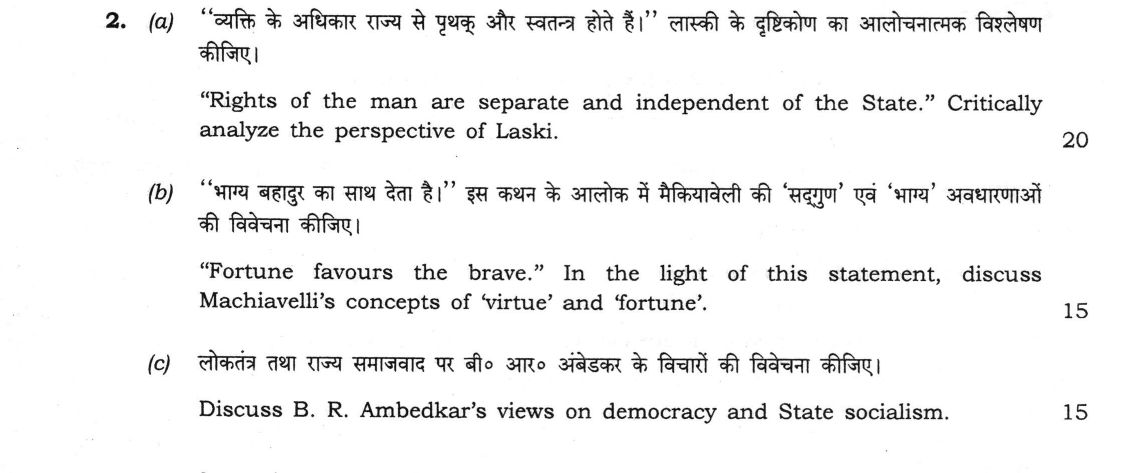
(a) “Rights of the man are separate and independent of the State.” Critically analyze the perspective of Laski. (20 marks) (b)…
“Rights of the man are separate and independent of the State.” Critically analyze the perspective of Laski. 20 marks
“Fortune favours the brave.” In the light of this statement, discuss Machiavelli’s concepts of ‘virtue’ and ‘fortune’. 15 marks
Discuss B. R. Ambedkar’s views on democracy and State socialism. 15 marks
हिंदी में प्रश्न पढ़ें
“व्यक्ति के अधिकार राज्य से पृथक् और स्वतन्त्र होते हैं।” लास्की के दृष्टिकोण का आलोचनात्मक विश्लेषण कीजिए। (20 अंक)
“भाग्य बहादुर का साथ देता है।” इस कथन के आलोक में मैकियावेली की ‘सद्गुण’ एवं ‘भाग्य’ अवधारणाओं की विवेचना कीजिए। (15 अंक)
लोकतंत्र तथा राज्य समाजवाद पर बी० आर० अंबेडकर के विचारों की विवेचना कीजिए। (15 अंक)
Model answer
Drafted with AI by UPSC Answer Check against this question's marking rubric, to the expected length. UPSC does not publish answers for Mains — this is one way to score well, not an official key. How we build rubrics and answers.
(a) Laski on rights and the State Harold J. Laski, in A Grammar of Politics (1925), argues that rights are not gifts of the state but are "conditions of social life without which no man can seek, in general, to be himself at his best." He posits that rights are correlative to social function and are pre-state in their moral origin. Laski famously asserts that "every state is known by the rights that it maintains." This perspective is grounded in his pluralism, where the state is merely one association among many (such as churches, unions, and municipalities). Consequently, he rejects Austinian monistic sovereignty and the Hegelian identification of the state with the "real will." In his Grammar, Laski lists concrete rights, including the right to work, an adequate wage, reasonable hours, and education.
Critically, Laski’s position faces internal and external tensions. Internally, his later Marxist turn in Democracy in Crisis (1933) and The State in Theory and Practice (1935) suggests the state is an instrument of the dominant class, making rights conditional on class power rather than universal social conditions. Externally, critics like Bentham dismissed natural rights as "nonsense upon stilts," while T.H. Green and Bosanquet argued that a right must be socially recognized to exist. Furthermore, the "enforcement objection" remains: if rights are independent of the state, the state is still the sole entity capable of enforcing them. Despite these critiques, Laski’s view is vindicated by the Universal Declaration of Human Rights (1948) and Part III of the Indian Constitution, where Article 32 provides a constitutional remedy, treating rights as limits on the state rather than its concessions.
(b) Machiavelli: virtù and fortuna The maxim "Fortune favours the brave" (Virgil’s audentes fortuna iuvat) captures Niccolo Machiavelli’s argument in The Prince (1513), specifically Chapter XXV. Across the work, Machiavelli defines virtù not as Christian moral virtue, but as prowess, adaptability, and the ability to "learn how not to be good" (Chapter XV). He describes the ideal ruler as a combination of the lion (strength) and the fox (cunning) (Chapter XVIII). Fortuna is the arbiter of half of our actions, but the other half is left to our own agency.
Machiavelli uses the metaphor of a river: fortuna is the flood, and virtù is the construction of dykes and dams. While one cannot stop the flood, one can prepare for it. Chapter XXV also stresses riscontro: a ruler prospers when his mode of proceeding suits the times, and since men rarely change their nature, Machiavelli concludes that it is better to be impetuous than cautious. He also characterizes fortuna as a woman who favors the bold and the young. Examples include Pope Julius II, whose boldness allowed him to succeed, and Cesare Borgia (Duke Valentino), who acquired his state through his father’s fortuna but lost it when that fortuna shifted. In contrast, the "armed prophets" like Moses and Romulus owed their success to their own virtù, whereas the "unarmed prophet" Savonarola was ruined.
In the Discourses on the First Decade of Titus Livy (1531), Machiavelli expands virtù to the "civic" level, where it is dispersed through a citizen body and sustained by buoni ordini (good laws). This republican virtù allows states to resist fortuna more effectively than individual princes. Ultimately, Machiavelli refuses both fatalism and omnipotence, establishing a secular, autonomous politics where boldness is the primary tool for mastering the unpredictable.
(c) Ambedkar on democracy and State socialism B.R. Ambedkar’s views on democracy and State socialism are inextricably linked by his belief that political democracy is unsustainable without economic and social democracy. In Annihilation of Caste (1936), he defined democracy as a "mode of associated living, of conjoint communicated experience." In a 1952 address at Poona ("Conditions Precedent for the Successful Working of Democracy"), he described it as a form and method of government whereby "revolutionary changes in the economic and social life of the people are brought about without bloodshed."
Ambedkar argued in his Constituent Assembly speech (25 November 1949) that political equality amid social and economic inequality would be a "life of contradictions" and that unconstitutional methods like civil disobedience are the "grammar of anarchy." To achieve true liberty, equality, and fraternity, he advocated for "constitutional morality" (4 November 1948) to replace the "bhakti" or hero-worship of the past.
His remedy for social and economic inequality was State socialism, as outlined in States and Minorities (1947). He proposed that the Constitution should establish State socialism by making key industries and insurance a State monopoly, and by treating agriculture as a State industry through collective farming. Ambedkar explicitly rejected the Marxist "dictatorship of the proletariat" and the use of violence, preferring a peaceful, constitutional path. While the final Constitution only included a diluted residue of his ideas in Articles 38 and 39 of the Directive Principles, his vision remains a foundational critique of the gap between political and social equality in India.
How this answer will be evaluated
Evaluation rubric
Each sub-part is marked on its own, against the marks and word limit printed on the paper.
- (a) 'Critically analyze' requires both exposition and judgement. The answer must reconstruct Laski's argument that rights are pre-state, socially grounded and functional - not gifts of the state - and must then assess it, including the tension between Laski's early pluralism and his later Marxism. 20 marks
Must cover
- Harold J. Laski, 'A Grammar of Politics' (1925)
- 'conditions of social life without which no man can seek, in general, to be himself at his best'
- 'every state is known by the rights that it maintains'
- rights as correlative to function; no absolute right of property
- pluralism: 'Studies in the Problem of Sovereignty' (1917), 'Authority in the Modern State' (1919), 'Liberty in the Modern State' (1930)
- rejection of Austinian monistic sovereignty; right of resistance
- Marxist turn: 'Democracy in Crisis' (1933), 'The State in Theory and Practice' (1935)
- critics: Bentham's 'nonsense upon stilts', Austin, T. H. Green, Bosanquet, Barker, MacIver
- modern echo: Universal Declaration of Human Rights (1948); Part III and Article 32 of the Indian Constitution
Loses marks
- Writing a general essay on theories of rights (natural, legal, historical, social) with Laski appearing only as one school among several
- Reducing Laski to 'he was a pluralist' without the definition of rights, the functional theory, or the maxim about the state being known by the rights it maintains
- Assimilating Laski to the natural-rights tradition of Locke - Laski rejected abstract, pre-social natural rights and grounded rights in social function and social conditions
- Ignoring 'critically' and producing pure exposition with no objections and no verdict
- Omitting the Marxist turn of the 1930s, which is the most telling internal criticism available
- Attributing 'nonsense upon stilts' to the wrong thinker - it is Bentham, on natural and imprescriptible rights
Earns more
- Grounds the argument in Laski's pluralism: 'Studies in the Problem of Sovereignty' (1917), 'Authority in the Modern State' (1919), 'Liberty in the Modern State' (1930) - the state is one association among churches, unions and municipalities, its authority is federative and must be won, so Austinian monistic sovereignty and the Hegelian-idealist identification of state with the real will are both rejected; and lists his concrete catalogue in the 'Grammar' - the right to work, to an adequate wage, to reasonable hours, to education, to be consulted in the governance of one's industry, and political rights of speech, association and franchise
- Supplies the critical assessment. (i) Laski's own shift: in 'Democracy in Crisis' (1933) and 'The State in Theory and Practice' (1935) he moved to a Marxist position in which the state is an instrument of the dominant class, which makes rights conditional on class power and sits awkwardly with the earlier pluralism. (ii) The enforcement objection - if rights are independent of the state, the state alone can still enforce them, so the practical distinction between moral and legal rights blurs. (iii) The idealist reply of T. H. Green and Bosanquet that a right must be socially recognised to exist at all, and the positivist reply of Bentham ('nonsense upon stilts') and Austin. (iv) Barker's and MacIver's charge of eclecticism and inconsistency. (v) The enduring vindication - post-1945 constitutional bills of rights and the Universal Declaration (1948) embody Laski's claim that rights limit, and are not conferred by, the state; Part III of the Indian Constitution with Article 32 is a direct institutional expression of it
- (b) 'Discuss in the light of this statement' means the whole answer must be organised around the virtu-fortuna relationship: define both terms in Machiavelli's own non-moral sense, establish their proportion and interaction, use his examples, and assess whether boldness really is his prescription. 15 marks
Must cover
- Niccolo Machiavelli, 'The Prince' (1513, published 1532), Chapter XXV; 'Discourses on the First Decade of Titus Livy' (1531)
- virtu as prowess/adaptability, not Christian virtue; lion and fox; 'learn how not to be good'
- fortuna as arbiter of half our actions; the river and the dykes; fortune as a woman who favours the bold and the young
- riscontro - matching one's mode of proceeding to the times; Pope Julius II
- Cesare Borgia (Duke Valentino); Agathocles of Syracuse
- armed prophets - Moses, Cyrus, Romulus, Theseus - and Savonarola the unarmed prophet
- occasione and necessita
- civic virtu, buoni ordini and corruption in the Discourses
- audentes fortuna iuvat (Virgil)
Loses marks
- Translating virtu as moral virtue or as 'goodness', which destroys the entire argument
- Treating virtu and fortuna as two unrelated topics answered in sequence, instead of analysing their interaction, which is what the question asks
- Getting the famous proportion wrong - Machiavelli says fortune governs about one half of our actions, not all or most of them
- Omitting Chapter XXV altogether and relying only on the lion-and-fox and ends-and-means material from Chapters XVII-XVIII
- Reducing the answer to the cliche that Machiavelli said the end justifies the means - a phrase he never wrote in that form
- Ignoring the Discourses, and therefore missing civic virtu and the republican Machiavelli that UPSC answers are expected to cover
Earns more
- Illustrates with Machiavelli's own cases: Cesare Borgia (Duke Valentino), who acquired his state by his father's fortune and lost it to fortune - Alexander VI's death coinciding with his own illness - yet is held up as a model of what virtu can build; Agathocles of Syracuse, whose criminal energy wins power but not glory; the 'armed prophets' Moses, Cyrus, Romulus and Theseus who owed their states to their own arms and virtu and needed only occasione, against the unarmed prophet Savonarola who was ruined
- Widens and evaluates: in the 'Discourses on the First Decade of Titus Livy' (1531) virtu becomes civic virtu, dispersed through a citizen body and sustained by good laws and orders (buoni ordini), religion as civil discipline and periodic return to first principles, so republics resist fortune better than princes because they contain diverse temperaments and can adapt; and note the tension between his claim that fortune governs half our actions and his insistence that men can master her - Machiavelli refuses both fatalism and omnipotence, which is why he is read as the founder of modern secular, autonomous politics (Skinner, Pocock's 'The Machiavellian Moment') rather than the mere teacher of evil of the 'Old Nick' caricature
- (c) Two linked sub-parts must both be answered: (i) Ambedkar's conception of democracy, and (ii) his scheme of State socialism. A strong answer connects them - for Ambedkar, political democracy without economic and social democracy is unsustainable, and State socialism is the constitutional remedy. 15 marks
Must cover
- 'Annihilation of Caste' (1936); democracy as a mode of associated living, of conjoint communicated experience
- 'Conditions Precedent for the Successful Working of Democracy' (Poona, 1952); revolutionary change without bloodshed
- Constituent Assembly speech, 25 November 1949: life of contradictions; grammar of anarchy; bhakti/hero-worship; social democracy as liberty, equality and fraternity
- constitutional morality (Grote), speech of 4 November 1948
- 'States and Minorities' (1947); State Socialism established by the law of the Constitution
- key industries and insurance as State monopoly; agriculture as a State industry; collective farming
- 'Buddha or Karl Marx'; rejection of violence and of the dictatorship of the proletariat
- Articles 38 and 39 of the Directive Principles as the diluted residue
- 'Small Holdings in India and their Remedies' (1918)
Loses marks
- Writing only on caste and the Constitution, with nothing at all on State socialism, so half the question is unanswered
- Attributing 'States and Minorities' to the wrong year or describing it vaguely as 'a book' rather than as a 1947 memorandum to the Constituent Assembly's Fundamental Rights Sub-Committee
- Claiming Ambedkar was a Marxist or that he endorsed the dictatorship of the proletariat - he explicitly rejected both violence and dictatorship
- Reproducing the 25 November 1949 warnings inaccurately, for example omitting the 'grammar of anarchy' or attributing 'bhakti in politics' to Nehru
- Treating democracy and State socialism as two unconnected halves instead of showing that the second was Ambedkar's answer to the fragility of the first
- Confusing Ambedkar's constitutional entrenchment of State socialism with the insertion of the word 'socialist' in the Preamble by the 42nd Amendment in 1976, which came long after his death in 1956
Earns more
- Adds his functional definition from the 22 December 1952 Poona District Law Library address 'Conditions Precedent for the Successful Working of Democracy' - democracy is a form and a method of government whereby revolutionary changes in the economic and social life of the people are brought about without bloodshed - which makes peaceful, constitutional social transformation the test of a democracy
- Explains and evaluates the linkage: Ambedkar believed private enterprise combined with parliamentary democracy would deliver the Dalit into the dictatorship of the private employer, so economic equality had to be constitutionally guaranteed rather than left to elections; he rejected the Marxist route of violent revolution and the dictatorship of the proletariat in 'Buddha or Karl Marx', preferring constitutional means and the Buddhist path; his proposals survive only in diluted form as non-justiciable Directive Principles, especially Articles 38 and 39; and critics note the tension between his own advocacy of collective farming and state ownership and his insistence on individual rights, while others (Bardhan, the land-reform literature) argue his 1918 essay 'Small Holdings in India and their Remedies' correctly located the agrarian problem in surplus labour and want of capital rather than in holding size
What "Analyse" is asking you to do
Break the subject into its working parts and show how they act on each other. The marks are in the interconnections — which factor drives which, and what the resulting structure explains — not in the inventory of factors.
Structure that answers it
Define the whole → separate it into its parts → show which part drives which → what that interaction produces → what the structure implies
Where marks are lost
A flat list of causes with no account of which drives which. An answer of neatly separated headings, each self-contained, scores as description.
Practice this exact question
Write your answer and it is marked point by point against the model answer above — what you covered, what you missed, what you got wrong.
Evaluate my answer →More from Political Science & IR 2026 Paper I
- Q1 Write on the following in about 150 words each : (a) Resurgence of political theory (10 m…
- Q2 (a) “Rights of the man are separate and independent of the State.” Critically analyze the…
- Q3 (a) Mill’s work was crucial to the development of liberalism, because it straddled the di…
- Q4 (a) “Representative democracy is not an absolute principle, rather a question of time, pl…
- Q5 Answer the following in about 150 words each : (a) How did Swadeshi grow into a demand fo…