Paper I — Q4
(a) “Representative democracy is not an absolute principle, rather a question of time, place and circumstances.” Analyze the…
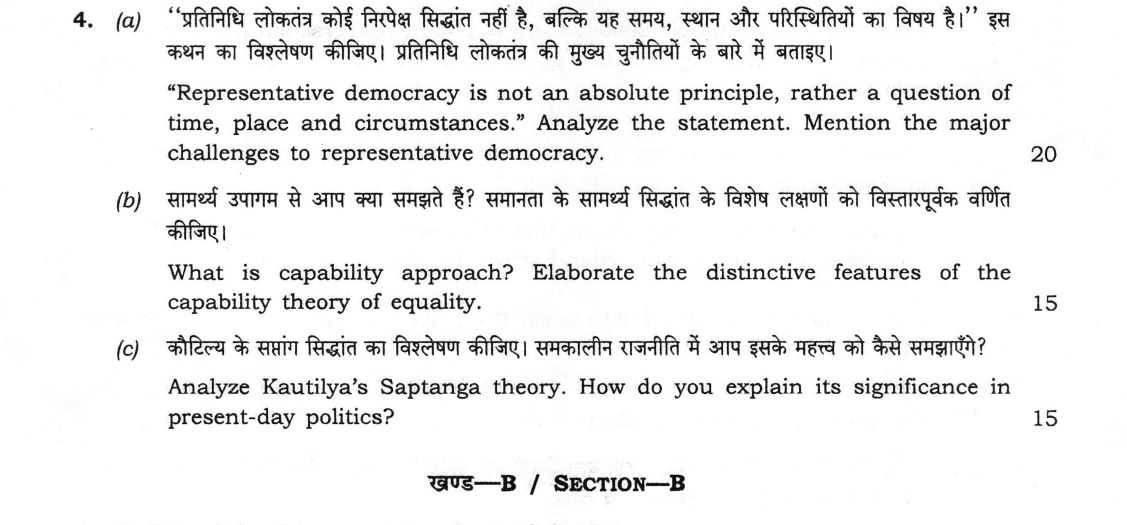
“Representative democracy is not an absolute principle, rather a question of time, place and circumstances.” Analyze the statement. Mention the major challenges to representative democracy. 20 marks
What is capability approach? Elaborate the distinctive features of the capability theory of equality. 15 marks
Analyze Kautilya’s Saptanga theory. How do you explain its significance in present-day politics? 15 marks
हिंदी में प्रश्न पढ़ें
‘‘प्रतिनिधि लोकतंत्र कोई निरपेक्ष सिद्धांत नहीं है, बल्कि यह समय, स्थान और परिस्थितियों का विषय है।’’ इस कथन का विश्लेषण कीजिए। प्रतिनिधि लोकतंत्र की मुख्य चुनौतियों के बारे में बताइए। (20 अंक)
सामर्थ्य उपागम से आप क्या समझते हैं? समानता के सामर्थ्य सिद्धांत के विशेष लक्षणों को विस्तारपूर्वक वर्णित कीजिए। (15 अंक)
कौटिल्य के सप्तांग सिद्धांत का विश्लेषण कीजिए। समकालीन राजनीति में आप इसके महत्त्व को कैसे समझाएँगे? (15 अंक)
Model answer
Drafted with AI by UPSC Answer Check against this question's marking rubric, to the expected length. UPSC does not publish answers for Mains — this is one way to score well, not an official key. How we build rubrics and answers.
(a) Representative democracy: contingency and challenges The assertion that representative democracy is not an absolute principle but a matter of time, place, and circumstance reflects a contingent view of political institutions. J.S. Mill, in Considerations on Representative Government (1861), argued that representative government is the best form only where the population possesses the requisite "fitness" and education. Robert Dahl’s Polyarchy (1971) and Arend Lijphart’s Patterns of Democracy (1999) further suggest that institutional design must adapt to specific societal divisions and historical contexts. The very meaning of representation varies: Burke's trustee model (Speech to the Electors of Bristol, 1774) against the delegate model, Hanna Pitkin's formalistic, descriptive, symbolic and substantive views (1967), and Schumpeter's minimalist "competitive struggle for the people's vote" (1942).
However, this contingency argument is contested. Amartya Sen argues that democracy is a universal value with intrinsic and instrumental worth, noting that no substantial famine has occurred in a functioning democracy with a free press. India’s adoption of universal adult suffrage under Article 326 at independence serves as a decisive empirical refutation of the "preconditions" literature, proving that democracy can thrive without Western-style economic development.
Major challenges to representative democracy today include:
- Populism and Backsliding: As noted by Levitsky and Ziblatt in How Democracies Die (2018), elected leaders subvert democracy through its own institutions, eroding the norms of mutual toleration and institutional forbearance.
- Post-Democracy: Colin Crouch (Post-Democracy, 2004) argues that democratic forms survive while decisions pass to elites, corporate lobbies and unelected bodies; Bernard Manin (1997) describes a shift to "audience democracy" in which politics is organised around media image.
- Money Power: Opaque political finance skews representation; the Supreme Court struck down the electoral bond scheme in Association for Democratic Reforms v. Union of India (2024).
- Disinformation: The use of bots and micro-targeting distorts the electoral process.
Correctives include deliberative democracy (Habermas), decentralization via India’s 73rd and 74th Amendments, and descriptive representation, such as the Constitution (106th Amendment) Act, 2023. Representative democracy is a technology that must be redesigned, but the underlying claim of political equality is not negotiable.
(b) The capability approach and equality The capability approach, pioneered by Amartya Sen in Equality of What? (1979), defines development and equality in terms of "real freedoms"—the substantive opportunities individuals have to lead lives they have reason to value. It distinguishes between "functionings" (what a person actually achieves) and the "capability set" (the range of possible functionings).
The distinctive features of capability as a theory of equality are:
- Critique of Resourcism and Utility: Unlike Rawls’s "primary goods" or utilitarian "utility," the approach focuses on human diversity. It recognizes that the same resources (e.g., income) yield different results for different people due to "conversion factors" (personal, social, and environmental).
- Adaptive Preferences: It critiques the utilitarian reliance on stated preferences, which may be distorted by long-term deprivation.
- Value Pluralism: Sen refuses to provide a fixed list of capabilities, favoring "incomplete ordering" and democratic public reasoning. In contrast, Martha Nussbaum specifies ten "central capabilities" (e.g., life, bodily integrity, practical reason) as constitutional entitlements.
- Operationalisation: The approach is reflected in the UNDP’s Human Development Index (HDI) and the Multidimensional Poverty Index (MPI).
While criticized for methodological complexity and the "indexing problem," the capability approach uniquely shifts the focus from the means of living (income, resources) to the ends of human life.
(c) Kautilya's Saptanga theory Kautilya’s Saptanga (Seven-Limbed) theory, outlined in Book VI of the Arthashastra, presents the state as an organic entity composed of seven prakritis (elements):
- Svami: The King, the head of the state.
- Amatya: Ministers or administrators.
- Janapada: The people and the territory.
- Durga: The fortress or defense.
- Kosha: The treasury or economic resources.
- Danda: The army or the instrument of force.
- Mitra: Allies or friends.
The logic is that the state is a "body" where the failure of any single limb leads to vyasana (ruin). Later texts such as the Shukranitisara extend the organic analogy: the Svami as head, the Amatya as eyes, the Mitra as ears, the Kosha as mouth, the Danda (army) as mind, the Durga as hands and the Janapada as feet.
Its significance in present-day politics is profound:
- National Power: It provides a holistic framework for "national power," emphasizing that military strength (Danda) is useless without economic stability (Kosha) and public support (Janapada).
- Strategic Autonomy: The concept of Mitra (allies) remains central to modern foreign policy and strategic partnerships; read with the mandala theory, in which the neighbour's neighbour is a natural ally, it anticipates balance-of-power thinking.
- Welfare State: Kautilya’s emphasis on the state’s duty to ensure yoga-kshema (welfare and security) of the people is a precursor to the modern welfare state.
- Institutional Balance: It warns against the over-reliance on any single element, such as the military, at the expense of the economy or the people.
- Limits: Saptanga presupposes monarchy and treats the people as objects of welfare rather than as a sovereign citizenry, so it cannot be read as a theory of the modern democratic state.
How this answer will be evaluated
Evaluation rubric
Each sub-part is marked on its own, against the marks and word limit printed on the paper.
- (a) Two explicit tasks: (i) analyse the claim that representative democracy is contingent on time, place and circumstance rather than an absolute principle, and (ii) set out the major challenges facing it. Both must be attempted; an answer that lists challenges without engaging the contingency claim is incomplete. 20 marks
Must cover
- J. S. Mill, 'Considerations on Representative Government' (1861) on fitness and the conditions of applicability
- Robert Dahl, 'Polyarchy' (1971) and its institutional conditions
- Arend Lijphart, consociational democracy (1977); 'Patterns of Democracy' (1999)
- Edmund Burke, Speech to the Electors of Bristol (1774) - trustee vs delegate
- Hanna Pitkin, 'The Concept of Representation' (1967) - formalistic, descriptive, symbolic, substantive
- Joseph Schumpeter, 'Capitalism, Socialism and Democracy' (1942) - competitive struggle for the people's vote
- Amartya Sen, democracy as a universal value; famine and free press
- Colin Crouch, 'Post-Democracy' (2004); Bernard Manin, 'audience democracy' (1997)
- Levitsky and Ziblatt, 'How Democracies Die' (2018)
- Article 326 (universal adult suffrage); Association for Democratic Reforms v. Union of India (2024) on electoral bonds; 73rd and 74th Amendments; 106th Amendment (2023)
- Carole Pateman, 'Participation and Democratic Theory' (1970); Habermas and deliberative democracy
Loses marks
- Answering only the second half - listing challenges - and never analysing the contingency claim in the quotation
- Treating the quoted statement as an attack on democracy itself rather than on the absoluteness of one institutional form
- Confusing Burke's trustee model with the delegate model, or attributing the Bristol speech to the wrong thinker
- Listing challenges as bullet points with no theorist, no country and no data - 'money power, media, corruption' without specification
- Omitting Indian material altogether, when the Indian case is the strongest counter-example to the preconditions literature
- Ignoring the remedies, so the answer ends in undifferentiated pessimism rather than analysis
- Overrunning 300 words by narrating the history of democracy from Athens
Earns more
- Supplies the counter-argument so that the analysis is balanced: Amartya Sen's contention that democracy is a universal value with intrinsic, instrumental and constructive worth, and his argument that no substantial famine has occurred in a functioning democracy with a free press; the rejection of the 'Asian values' and 'a people not yet ready for democracy' arguments as the historic alibi of colonialism and authoritarianism, of which Mill's own defence of despotism over 'barbarians' is the cautionary example; India's own adoption of universal adult suffrage under Article 326 at independence, against all the prevailing preconditions literature, is the decisive empirical refutation of strong contingency
- Sets out the systemic and contemporary challenges: populism and plebiscitary leadership that claim to embody the people directly and treat institutions and opposition as illegitimate; majoritarianism in plural societies; Colin Crouch's 'Post-Democracy' (2004) and the transfer of decisions to unelected central banks, regulators, courts and international bodies - the democratic deficit; Bernard Manin's argument in 'The Principles of Representative Government' (1997) that we have moved from parliamentarianism through party democracy to 'audience democracy' organised around media image; disinformation, micro-targeting, bots and deepfakes; and documented democratic backsliding (Levitsky and Ziblatt's 'How Democracies Die', 2018; Larry Diamond's democratic recession)
- Offers correctives and closes analytically: deliberative democracy (Habermas's public sphere, Joshua Cohen, James Fishkin's deliberative polling and citizens' assemblies), participatory democracy (Carole Pateman, 1970) and sortition; proportional representation, state funding and transparency of political finance, right to information and social audit; decentralisation - India's 73rd and 74th Amendments, the gram sabha and the Right to Information Act 2005 - and reservation as descriptive representation, including the Constitution (106th Amendment) Act, 2023 on women's reservation; the conclusion being that representative democracy is a historically specific institutional technology that must keep being redesigned, while the underlying claim of political equality is not negotiable
- (b) Two parts: (i) define the capability approach, and (ii) elaborate what is distinctive about capability as a theory of equality. The second part requires contrast with rival answers to 'equality of what?' - income, resources, primary goods, utility - not merely a restatement of the definition. 15 marks
Must cover
- Amartya Sen, 'Equality of What?' (1979); 'Development as Freedom' (1999); 'Inequality Reexamined' (1992)
- functionings, capability set, agency
- conversion factors - personal, social, environmental
- adaptive preferences as the critique of utilitarian metrics
- critique of Rawlsian primary goods as 'fetishist' / resourcism
- poverty as capability deprivation
- Martha Nussbaum's ten central capabilities; 'Creating Capabilities' (2011)
- public reasoning; Sen's refusal of a fixed list; incomplete/partial ordering
- UNDP Human Development Reports (from 1990), Mahbub ul Haq, HDI, MPI (2010, Alkire-Foster)
Loses marks
- Defining capability loosely as 'ability' or 'skill' and never distinguishing it from achieved functioning - the distinction between the set and the chosen element is the whole point
- Describing the HDI at length as though it were the theory, rather than one operationalisation of it
- Failing to contrast capability equality with income, utility and primary goods, which is precisely what makes it distinctive
- Attributing the ten central capabilities to Sen - the list is Nussbaum's, and Sen explicitly declines to give one
- Ignoring conversion factors, so the treatment of human diversity - the sharpest edge against Rawls - is lost
- Offering no criticism of the approach in a 250-word 'elaborate' answer
Earns more
- Establishes the remaining distinctive features: value pluralism and incompleteness - capabilities are irreducibly multiple and cannot be collapsed into one cardinal index, so the approach yields partial orderings and deliberately leaves weighting to democratic public reasoning, which is why Sen refuses to lay down a canonical list; Martha Nussbaum by contrast specifies ten central capabilities in 'Women and Human Development' (2000) and 'Creating Capabilities' (2011) - life; bodily health; bodily integrity; senses, imagination and thought; emotions; practical reason; affiliation; other species; play; and control over one's environment, political and material - as threshold constitutional entitlements, with practical reason and affiliation architectonic; and the approach values the process of choosing, not only the outcome
- Shows operationalisation and criticism: the UNDP Human Development Reports from 1990, designed with Mahbub ul Haq, and the Human Development Index combining life expectancy, education and income, followed by the Gender Inequality Index and the global Multidimensional Poverty Index launched in 2010 with OPHI using the Alkire-Foster method, and India's own National MPI by NITI Aayog; criticisms include the indexing and weighting problem, heavy informational and data demands, methodological individualism that neglects collective capabilities and structural power, vagueness about which capabilities count, the charge of paternalism and universalism against Nussbaum's list, and the Rawlsian reply that primary goods remain more workable for institutional design
- (c) Two tasks: (i) analyse the Saptanga theory - name and explain all seven elements and the logic that binds them, and (ii) explain its significance for present-day politics. Naming fewer than seven prakritis, or offering relevance without analysis, will not satisfy the question. 15 marks
Must cover
- Arthashastra, Book VI; Saptanga - seven prakritis
- Swami, Amatya, Janapada, Durga, Kosha, Danda (Bala), Mitra
- organic analogy; sampat (excellences); vyasana (calamities), Book VIII
- rajamandala (circle of states); vijigishu
- shadgunya: sandhi, vigraha, asana, yana, samsraya, dvaidhibhava
- upayas: sama, dana, danda, bheda; dandaniti; matsyanyaya
- 'in the happiness of his subjects lies the king's happiness'; yogakshema
- R. Shamasastry's recovery of the text (1904, published 1909); disputed dating and authorship (Kangle, Trautmann)
- modern parallel: elements of national power; Morgenthau; the Indian strategic culture debate and George Tanham (1992)
Loses marks
- Listing only five or six prakritis, or substituting a wrong term - Kosha and Danda are frequently confused or merged, and Mitra is the one most often dropped
- Translating Janapada as territory alone; it denotes the territory together with its settled, productive population
- Treating Danda only as punishment and forgetting that as a state element it denotes the army and coercive force, while dandaniti is the wider science of governance
- Giving the list with no analysis of interdependence, ranking or the vyasana framework, so the 'analyse' directive is unmet
- Asserting a precise date or single authorship for the Arthashastra when both are academically disputed
- Reading Saptanga anachronistically as a theory of the modern nation-state with sovereignty, rights and popular legitimacy
- Offering the relevance section as three vague lines about 'good governance' instead of mapping each element to a contemporary equivalent
Earns more
- Connects Saptanga to the rest of Kautilya's system: the rajamandala or circle of states in which the immediate neighbour is the natural enemy and the neighbour's neighbour the natural friend; the shadgunya or sixfold policy of sandhi (peace), vigraha (war), asana (neutrality or waiting), yana (marching), samsraya (seeking shelter or alliance) and dvaidhibhava (dual policy); the four upayas of sama, dana, danda and bheda; dandaniti as the science of governance; matsyanyaya, the law of the fish, as the justification of state authority; and the normative anchor that in the happiness of his subjects lies the king's happiness and in their welfare his welfare, with yogakshema as the ruler's obligation
- Adds the scholarly frame and the caveats: the text was recovered by R. Shamasastry from a Mysore manuscript in 1904 and published in 1909 with an English translation in 1915; its authorship and dating are disputed, with R. P. Kangle defending Kautilya's authorship around the fourth century BCE and Thomas Trautmann's statistical analysis suggesting composite authorship and later redaction, so a candidate should say 'traditionally ascribed to Kautilya' rather than assert; Saptanga is invoked in the debate over Indian strategic culture, against George Tanham's 1992 claim that India lacks a strategic tradition, and in current discussions of strategic autonomy and multi-alignment (Mitra), self-reliance in defence and economy (Kosha, Danda); but it presupposes monarchy, treats the praja as objects of welfare rather than as a sovereign people, and contains no notion of rights, representation or constitutional limitation, so it must not be read as a theory of the modern democratic state
What "Analyse" is asking you to do
Break the subject into its working parts and show how they act on each other. The marks are in the interconnections — which factor drives which, and what the resulting structure explains — not in the inventory of factors.
Structure that answers it
Define the whole → separate it into its parts → show which part drives which → what that interaction produces → what the structure implies
Where marks are lost
A flat list of causes with no account of which drives which. An answer of neatly separated headings, each self-contained, scores as description.
Practice this exact question
Write your answer and it is marked point by point against the model answer above — what you covered, what you missed, what you got wrong.
Evaluate my answer →More from Political Science & IR 2026 Paper I
- Q1 Write on the following in about 150 words each : (a) Resurgence of political theory (10 m…
- Q2 (a) “Rights of the man are separate and independent of the State.” Critically analyze the…
- Q3 (a) Mill’s work was crucial to the development of liberalism, because it straddled the di…
- Q4 (a) “Representative democracy is not an absolute principle, rather a question of time, pl…
- Q5 Answer the following in about 150 words each : (a) How did Swadeshi grow into a demand fo…
- Q6 (a) From passive resistors to armed revolutionaries, the Indian Freedom Struggle has a st…
- Q7 (a) Elucidate the prominent trends in voting behaviour in contemporary India, and discuss…