Paper I — Q6
(a) From passive resistors to armed revolutionaries, the Indian Freedom Struggle has a strong imprint of women freedom fighters…
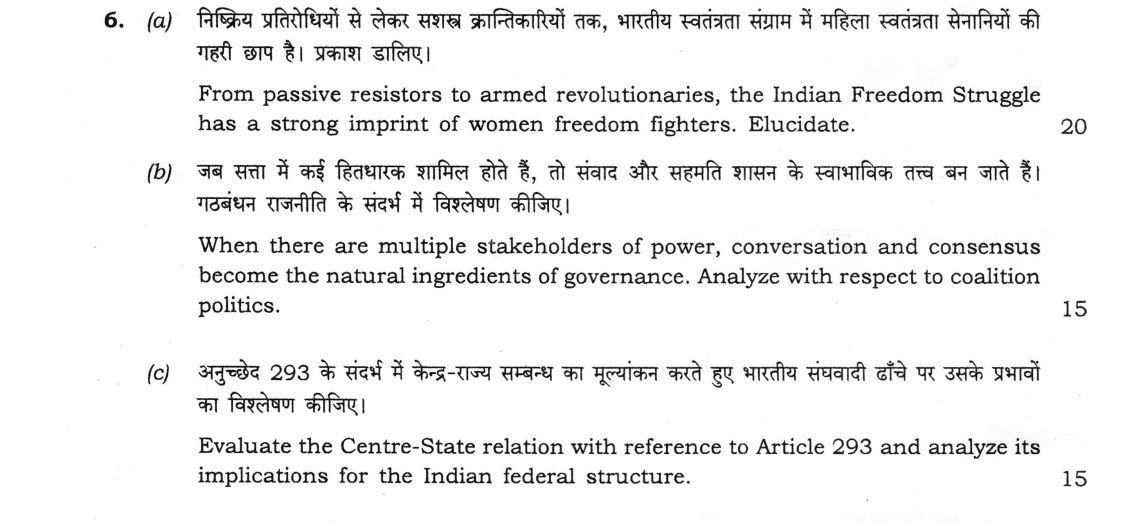
From passive resistors to armed revolutionaries, the Indian Freedom Struggle has a strong imprint of women freedom fighters. Elucidate. 20 marks
When there are multiple stakeholders of power, conversation and consensus become the natural ingredients of governance. Analyze with respect to coalition politics. 15 marks
Evaluate the Centre-State relation with reference to Article 293 and analyze its implications for the Indian federal structure. 15 marks
हिंदी में प्रश्न पढ़ें
निष्क्रिय प्रतिरोधियों से लेकर सशस्त्र क्रान्तिकारियों तक, भारतीय स्वतंत्रता संग्राम में महिला स्वतंत्रता सेनानियों की गहरी छाप है। प्रकाश डालिए। (20 अंक)
जब सत्ता में कई हितधारक शामिल होते हैं, तो संवाद और सहमति शासन के स्वाभाविक तत्व बन जाते हैं। गठबंधन राजनीति के संबंध में विश्लेषण कीजिए। (15 अंक)
अनुच्छेद 293 के संदर्भ में केंद्र-राज्य सम्बन्ध का मूल्यांकन करते हुए भारतीय संघवादी ढाँचे पर उसके प्रभावों का विश्लेषण कीजिए। (15 अंक)
Model answer
Drafted with AI by UPSC Answer Check against this question's marking rubric, to the expected length. UPSC does not publish answers for Mains — this is one way to score well, not an official key. How we build rubrics and answers.
(a) Women in the Indian freedom struggle The Indian Freedom Struggle was not merely a male narrative but a collective effort where women transitioned from passive resistors to armed revolutionaries, leaving an indelible imprint on the nation's history. This spectrum of participation can be elucidated through a typology of their engagement across different phases.
The revolutionary spirit was first visible in 1857, where Rani Lakshmibai of Jhansi and Begum Hazrat Mahal of Lucknow led armed resistance against the British. In the late 19th and early 20th centuries, the struggle shifted toward social and political reform. Savitribai Phule challenged social orthodoxies, while Annie Besant’s Home Rule League (1916) and the Women’s Indian Association (1917) provided platforms for political mobilization. Sarojini Naidu, Congress president in 1925, who led the Dharasana salt raid in 1930, Kamaladevi Chattopadhyay and Kasturba Gandhi became central figures in the Gandhian movement, while thousands of women picketed liquor and foreign-cloth shops during Civil Disobedience.
The "armed revolutionaries" phase saw women like Pritilata Waddedar (Pahartali, 1932), Kalpana Datta (Surya Sen's Chittagong group), Santi Ghose and Suniti Choudhury (Comilla, 1931), and Bina Das (1932) challenging colonial authority with weapons. During the Quit India Movement (1942), Aruna Asaf Ali hoisted the flag at Gowalia Tank on 9 August, Usha Mehta ran the Congress Radio, and Matangini Hazra was shot dead leading a procession at Tamluk. The most significant military contribution was the Rani of Jhansi Regiment of the Azad Hind Fauj (1943), commanded by Captain Lakshmi Sahgal. Beyond the elite, tribal and peasant women like Rani Gaidinliu, Chakali Ailamma, and Ila Mitra led regional uprisings.
This participation helps explain why universal adult suffrage and equality of rights were adopted without a separate suffrage struggle; fifteen women, including Hansa Mehta and Dakshayani Velayudhan, sat in the Constituent Assembly. However, as Partha Chatterjee argues, nationalism often resolved the "women's question" by confining them to the "inner domain" of the home. The post-1947 demobilization of women was a gap finally documented by the Towards Equality report (1974).
(b) Coalition politics: conversation and consensus When multiple stakeholders of power exist, governance is forced to rely on conversation and consensus rather than unilateral decree. In the Indian context, this proposition is best analyzed through the lens of coalition politics, which has become the norm since the 1990s.
Theoretical frameworks such as Arend Lijphart’s consensus democracy and William Riker’s minimum winning coalition theory help explain this dynamic. In India, the National Front (1989) and the United Front (1996-98) demonstrated that no single party could govern alone. This necessitated the "Common Minimum Programme" (CMP), a mechanism where diverse parties agreed on a limited set of priorities to maintain a fragile consensus. Similarly, the NDA (1998-2004) and UPA (2004-2014) relied on portfolio bargaining and the "coalition dharma" to keep allies satisfied. After single-party majorities in 2014 and 2019, the 2024 verdict (BJP 240 of 543 seats) again made the government dependent on allies such as the TDP and JD(U).
However, this consensus is often arithmetical rather than deliberative. The "blackmail power" of small allies can lead to policy paralysis or the extraction of disproportionate concessions. A critical counter-evidence is the 2008 withdrawal of Left support over the India-US nuclear deal, which showed that consensus is fragile when core interests diverge. Furthermore, the collapses of 1979, 1990, 1997 and 1999 highlight the risks of such arrangements, and horse-trading necessitated the anti-defection law (52nd Amendment, 1985; tightened by the 91st Amendment, 2003).
To manage this, the Indian system has evolved mechanisms like the GST Council (Article 279A) and the Inter-State Council (Article 263). The Supreme Court’s ruling in S. R. Bommai v. Union of India (1994) also reinforced that the floor of the House is the only test for a government's survival. Thus, while coalitions deepen federalism and institutionalize negotiation, the resulting consensus is a product of survival and arithmetic rather than deep ideological alignment.
(c) Article 293 and Centre-State fiscal relations Article 293 of the Indian Constitution is a critical provision for evaluating Centre-State relations, as it regulates the borrowing powers of the States. It serves as a primary tool for the Centre to maintain fiscal discipline and manage the vertical imbalance in the federal structure.
The substance of Article 293 is as follows:
- Clause (1): A State may borrow within India, on the security of its Consolidated Fund, within limits fixed by its own Legislature by law. States therefore cannot borrow abroad directly.
- Clause (2): The Union may, subject to conditions laid down by Parliament, make loans to a State or guarantee its loans.
- Clause (3): A State shall not raise any loan without the consent of the Union Government if any part of a loan made to it by the Union (or guaranteed by it) is still outstanding.
- Clause (4): The Union may grant such consent subject to such conditions as it thinks fit.
The implications of these clauses for the Indian federal structure are profound. By requiring Union consent, the Centre effectively acts as a "fiscal gatekeeper," ensuring that State-level borrowing does not lead to a macroeconomic crisis or crowd out the Centre's own borrowing capacity. This creates a "quasi-unitary" fiscal arrangement where the federal structure is maintained in political terms but centralized in financial terms.
This arrangement is further reinforced by the Fiscal Responsibility and Budget Management (FRBM) Act and the Net Borrowing Ceiling (NBC). Conditional extra borrowing - 2% of GSDP in 2020 tied to reforms, and power-sector-linked headroom - shows how clause (4) conditions become policy levers. While this prevents a debt spiral, it also limits the fiscal autonomy of States, particularly those with high developmental needs. Kerala's original suit under Article 131 against the net borrowing ceiling, referred to a five-judge Constitution Bench in April 2024 after interim relief was declined, highlights the tension between the Centre's control and the States' demand for greater fiscal space. In essence, Article 293 ensures that the Indian federal structure remains "cooperative" in theory but "centralized" in fiscal practice.
How this answer will be evaluated
Evaluation rubric
Each sub-part is marked on its own, against the marks and word limit printed on the paper.
- (a) 'Elucidate' the full spectrum named in the statement - from passive resistance to armed revolution - so the answer must be organised as a typology of women's participation across phases and forms, naming individuals and their specific acts, and must close with an assessment of what participation achieved and what it did not. 20 marks
Must cover
- Rani Lakshmibai, Begum Hazrat Mahal (1857); Savitribai Phule
- Annie Besant - Home Rule League 1916, Congress president 1917; Women's Indian Association 1917; All India Women's Conference 1927
- Sarojini Naidu - Congress president at Kanpur 1925; Dharasana salt raid 1930
- Kamaladevi Chattopadhyay; Kasturba Gandhi; Hansa Mehta
- Pritilata Waddedar (Pahartali, 1932); Kalpana Datta (Surya Sen's Chittagong group); Bina Das (1932); Santi Ghose and Suniti Choudhury (Comilla, 1931); Durgawati Devi
- Aruna Asaf Ali (Gowalia Tank, 9 August 1942); Usha Mehta (Congress Radio); Matangini Hazra (Tamluk, 1942)
- Rani of Jhansi Regiment, Azad Hind Fauj (1943); Captain Lakshmi Sahgal; Subhas Chandra Bose
- Rani Gaidinliu; Chakali Ailamma (Telangana); Ila Mitra (Tebhaga/Nachole)
- fifteen women in the Constituent Assembly; Dakshayani Velayudhan; Rajkumari Amrit Kaur; Durgabai Deshmukh; Begum Aizaz Rasul
- Partha Chatterjee on the nationalist resolution of the women's question; Geraldine Forbes; Radha Kumar, 'The History of Doing' (1993); 'Towards Equality' (1974)
Loses marks
- Naming only Sarojini Naidu, Kasturba Gandhi and Aruna Asaf Ali, so the 'armed revolutionaries' half of the statement goes unanswered
- Listing names without their specific acts, dates or organisations - the question says 'elucidate', so each name must carry content
- Confusing the Chittagong figures: Pritilata Waddedar led the Pahartali European Club attack in 1932; Kalpana Datta was part of Surya Sen's group; Bina Das fired at the Governor at the Calcutta University convocation
- Attributing the Rani of Jhansi Regiment to the Congress or to the 1857 revolt rather than to Bose's Azad Hind Fauj of 1943 under Captain Lakshmi Sahgal
- Ignoring tribal, peasant and Muslim women, so the account is confined to elite Congress women
- Offering pure celebration with no critical historiography, which a 300-word answer at this level is expected to include
- Getting the Gowalia Tank date wrong - the Quit India resolution was passed on 8 August 1942 and the flag was hoisted on 9 August 1942
Earns more
- Covers Quit India, the underground and the INA: Aruna Asaf Ali, who hoisted the national flag at Gowalia Tank Maidan in Bombay on 9 August 1942 after the leadership was arrested and then went underground; Usha Mehta, who ran the Congress Radio, the secret transmitter of the Quit India movement, from August 1942 until her arrest; Sucheta Kripalani as an organiser of the underground; Matangini Hazra, shot dead at Tamluk in Midnapore in September 1942 while leading a procession with the flag; and the Rani of Jhansi Regiment of Subhas Chandra Bose's Azad Hind Fauj, raised in Singapore in 1943 and commanded by Captain Lakshmi Sahgal - the first all-women combat regiment of its kind in Asia
- Covers the tribal, peasant and regional strands that a Congress-centred account omits: Rani Gaidinliu, the Zeliangrong Naga leader of the Heraka movement, arrested in 1932 and sentenced to life imprisonment; Chakali Ailamma in the Telangana armed struggle against the Nizam's landlords; Ila Mitra in the Tebhaga and Nachole peasant uprisings; Bi Amman (Abadi Bano Begum) and Begum Nishatunnisa Mohani in the Khilafat and nationalist campaigns; and the women of the Bardoli satyagraha of 1928, whose conferring of the title Sardar on Vallabhbhai Patel is itself a marker of their political presence
- Assesses outcome and historiography: fifteen women sat in the Constituent Assembly, among them Sarojini Naidu, Hansa Mehta, Rajkumari Amrit Kaur, Durgabai Deshmukh, Vijaya Lakshmi Pandit, Sucheta Kripalani, Renuka Ray, Begum Aizaz Rasul, Ammu Swaminathan, Annie Mascarene and Dakshayani Velayudhan, the only Dalit woman member, and they secured equality of rights rather than special privileges, with Hansa Mehta presenting the national flag to the Assembly on behalf of the women of India in August 1947; the participation explains why universal adult suffrage was adopted without a separate suffrage struggle; but the historiography is critical - Partha Chatterjee's 'The Nationalist Resolution of the Women's Question' argues that nationalism resolved the question by assigning women the inner, spiritual domain of the home; Geraldine Forbes, Radha Kumar's 'The History of Doing' (1993) and Kumkum Sangari and Sudesh Vaid's 'Recasting Women' (1989) show that mobilisation operated within patriarchal limits, that women were valorised as embodiments of sacrifice and suffering, and that they were largely demobilised after 1947 - a gap the Committee on the Status of Women's report 'Towards Equality' (1974) finally documented
- (b) 'Analyze with respect to coalition politics' means the proposition - that multiple power-holders force dialogue and consensus - must be tested against the Indian experience of coalition government, with named coalitions, mechanisms and counter-evidence. 15 marks
Must cover
- 1967 SVD governments; Janata Party 1977; National Front 1989; United Front 1996-98; NDA 1998-2004; UPA 2004-2014; 2014 and 2019 majorities; 2024 (BJP 240 seats)
- National Agenda for Governance (1998); National Common Minimum Programme (2004); UPA-Left Coordination Committee; 'coalition dharma'
- Inter-State Council under Article 263, constituted 1990; Sarkaria Commission
- S. R. Bommai v. Union of India (1994) - floor test, Article 356
- GST Council, Article 279A, 101st Amendment (2016)
- Tenth Schedule and the 52nd Amendment (1985); Kihoto Hollohan v. Zachillhu (1992); 91st Amendment (2003), Articles 75(1A) and 164(1A)
- William Riker, minimum winning coalition (1962); Arend Lijphart, consociational/consensus democracy; Giovanni Sartori, polarised pluralism
- Yogendra Yadav and Suhas Palshikar - federalisation of the party system; E. Sridharan
- Left withdrawal of support over the India-US nuclear deal (2008)
Loses marks
- Narrating a chronology of coalition governments with no analysis of whether and how they produced conversation and consensus
- Asserting that coalitions produce consensus without identifying a single mechanism - CMP, coordination committee, portfolio bargain or coalition dharma
- Ignoring the counter-evidence of instability, blackmail power and corruption, so the answer is not an analysis but an endorsement
- Confusing the 52nd Amendment (1985, anti-defection) with the 91st (2003, which removed the one-third split exception and capped ministry size)
- Getting the phases wrong - the first non-Congress government at the Centre was Janata in 1977, and the coalition era at the Centre properly begins in 1989
- Missing the federal dimension, which is where coalition politics had its most durable institutional effect
Earns more
- Supplies the theoretical apparatus: William Riker's size principle and minimum winning coalitions ('The Theory of Political Coalitions', 1962), whose office-seeking logic explains portfolio bargaining but not India's frequently oversized coalitions; Arend Lijphart's consociational and consensus models - grand coalition, mutual veto, proportionality and segmental autonomy - which fit a plural society like India better than the Westminster majoritarian model; Giovanni Sartori on polarised pluralism and the difference between ideological and pragmatic coalitions; and E. Sridharan's work on coalition formation and party-system change in India
- Presents the counter-evidence and delivers a verdict: coalitions also produced instability (1979, 1990, 1997, 1999), 'blackmail power' by small allies extracting disproportionate concessions, policy paralysis and delayed reform, allocation scandals in ally-held ministries, the withdrawal of Left support in 2008 over the India-United States civil nuclear agreement showing that consensus lasts only while interests coincide, and horse-trading that required the anti-defection law of the Tenth Schedule, inserted by the 52nd Amendment in 1985, upheld in 'Kihoto Hollohan v. Zachillhu' (1992) and tightened by the 91st Amendment in 2003, which also capped the Council of Ministers at fifteen per cent of the House under Articles 75(1A) and 164(1A); the Governor's discretion in government formation remained contentious despite Bommai's rule that the floor of the House is the only test, as later cases on Arunachal Pradesh, Uttarakhand and Maharashtra showed; so the correct verdict is that coalitions institutionalise negotiation and deepen federalism, but the consensus they produce is arithmetical rather than deliberative
- (c) Two linked tasks: evaluate Centre-State relations through the specific lens of Article 293 (borrowing by States), and analyse what the resulting arrangement implies for Indian federalism. The answer must reproduce the substance of the four clauses of Article 293 accurately, not merely discuss fiscal federalism in general. 15 marks
Must cover
- Article 293(1), (2), (3) and (4) - borrowing by States; Consolidated Fund of the State
- 'within the territory of India' - States cannot borrow abroad directly
- Article 292 - Union borrowing; no parliamentary limit has ever been fixed
- Net Borrowing Ceiling fixed annually under Article 293(3)
- FRBM Act 2003 and State FRBM laws; Twelfth Finance Commission
- Fifteenth Finance Commission fiscal-deficit path and power-sector-linked extra borrowing
- Covid additional borrowing of 2 per cent of GSDP (May 2020) with reform conditionalities
- off-budget borrowings counted against the ceiling
- 101st Amendment (2016), GST Council under Article 279A; end of compensation in June 2022; cesses and surcharges outside the divisible pool under Article 270
- Kerala's Article 131 suit on the borrowing ceiling, referred to a larger bench in 2024
- Sarkaria and Punchhi Commissions; Inter-State Council under Article 263; the Loan Council proposal
Loses marks
- Writing a general essay on fiscal federalism, Finance Commissions and GST without reproducing what Article 293 actually says
- Citing the wrong article - Article 292 is Union borrowing, Article 293 is State borrowing; Article 266 is the Consolidated Fund and Article 280 the Finance Commission
- Missing clause (3), which is the operative restriction, or clause (4), which is the source of conditionality
- Failing to notice that States may borrow only within India, which is a major and often-overlooked federal restriction
- Presenting only the States' grievance, with no acknowledgement of the macroeconomic and moral-hazard rationale for Union control
- Asserting an outcome in the pending Kerala litigation instead of describing its status accurately
Earns more
- Presents both sides of the federal argument. For the Union: aggregate public debt is a macroeconomic externality, since one State's fiscal indiscretion raises borrowing costs for all and for the sovereign; the Union ultimately underwrites State debt, creating moral hazard; and the Constituent Assembly deliberately gave the Union this coordinating role. For the States: their share of combined government expenditure is far larger than their share of revenue, so the vertical fiscal imbalance is structural; the 101st Amendment of 2016 surrendered most independent indirect-tax handles to the GST Council and the compensation mechanism ended in June 2022; the growing use of cesses and surcharges, which under Article 270 are excluded from the divisible pool, shrinks shareable revenue; and conditions attached under Article 293(4) allow the Union to direct policy in State subjects, converting a fiscal safeguard into a lever of policy control
- Adds the current legal and reform context: Kerala's original suit against the Union under Article 131, challenging the net borrowing ceiling and the inclusion of public-account and State-enterprise borrowings within it, was referred by the Supreme Court in 2024 to a larger bench, with questions framed on whether a State has an enforceable right to borrow and on the permissible scope of conditions under Article 293(4), interim relief having been declined - so the constitutional boundary is presently sub judice and candidates should state it as such; reform proposals include the Twelfth Finance Commission's recommendation of an independent Loan Council and of Union disintermediation from State borrowing, statutory and formula-based determination of borrowing ceilings with reasons recorded, consultation through the Inter-State Council under Article 263 or the GST Council model, and giving effect to the long-standing recommendations of the Sarkaria and Punchhi Commissions on consultative Centre-State fiscal practice
What "Elucidate" is asking you to do
Make a stated proposition plain and then prove it with instances. Elucidate stems almost always carry a claim or a named concept, and very often the words “with examples” or “with suitable diagrams” — the illustration is part of the directive, not decoration.
Structure that answers it
Plain-language statement of what the proposition means → the part that is obscure, resolved → first illustration → second illustration → why the proposition holds
Where marks are lost
Adding terminology; elucidate rewards removing it. The commoner loss is a clean explanation with no example, when the stem asked for examples.
Practice this exact question
Write your answer and it is marked point by point against the model answer above — what you covered, what you missed, what you got wrong.
Evaluate my answer →More from Political Science & IR 2026 Paper I
- Q3 (a) Mill’s work was crucial to the development of liberalism, because it straddled the di…
- Q4 (a) “Representative democracy is not an absolute principle, rather a question of time, pl…
- Q5 Answer the following in about 150 words each : (a) How did Swadeshi grow into a demand fo…
- Q6 (a) From passive resistors to armed revolutionaries, the Indian Freedom Struggle has a st…
- Q7 (a) Elucidate the prominent trends in voting behaviour in contemporary India, and discuss…
- Q8 (a) Discuss the causes and consequences of inter-State water disputes in India. (20 marks…