Paper I — Q7
(a) Elucidate the prominent trends in voting behaviour in contemporary India, and discuss how astroturfing affects the scenario…
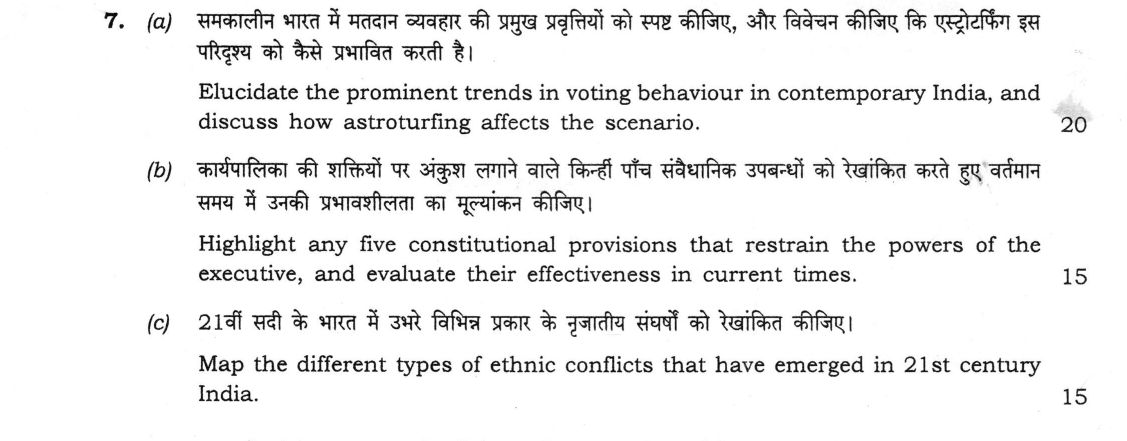
Elucidate the prominent trends in voting behaviour in contemporary India, and discuss how astroturfing affects the scenario. 20 marks
Highlight any five constitutional provisions that restrain the powers of the executive, and evaluate their effectiveness in current times. 15 marks
Map the different types of ethnic conflicts that have emerged in 21st century India. 15 marks
हिंदी में प्रश्न पढ़ें
समकालीन भारत में मतदान व्यवहार की प्रमुख प्रवृत्तियों को स्पष्ट कीजिए, और विवेचन कीजिए कि एस्ट्रोटर्फिंग इस परिदृश्य को कैसे प्रभावित करती है। (20 अंक)
कार्यपालिका की शक्तियों पर अंकुश लगाने वाले किन्हीं पाँच संवैधानिक उपबंधों को रेखांकित करते हुए, वर्तमान समय में उनकी प्रभावशीलता का मूल्यांकन कीजिए। (15 अंक)
21वीं सदी के भारत में उभरे विभिन्न प्रकार के नृजातीय संघर्षों को रेखांकित कीजिए। (15 अंक)
Model answer
Drafted with AI by UPSC Answer Check against this question's marking rubric, to the expected length. UPSC does not publish answers for Mains — this is one way to score well, not an official key. How we build rubrics and answers.
(a) Voting behaviour and astroturfing Contemporary Indian voting behaviour is characterised by a complex interplay of social, economic, and technological shifts. Lokniti-CSDS National Election Studies (NES) document Yogendra Yadav's "second democratic upsurge" of lower castes and, more recently, the reversal of the gender gap in turnout: 67.18 per cent of women voted against 67.01 per cent of men in 2019, and 65.78 against 65.55 per cent in 2024 (ECI). While Rajni Kothari (1970) and M. N. Srinivas established caste as a mobilisational resource and "vote bank" rather than a mechanical bloc, Christophe Jaffrelot’s "India's Silent Revolution" traces the rise of intermediate castes. Recently, class has re-entered through "new welfarism" or the labharthi (beneficiary) vote, where direct-benefit transfers create identifiable constituencies. Politically, the "presidentialisation" of elections has made leader preference an independent predictor of the vote since 2014. Furthermore, the shift from routine anti-incumbency to performance-based pro-incumbency and the prevalence of split-ticket voting—where voters choose different parties for Lok Sabha and Vidhan Sabha—define the current landscape.
Astroturfing, defined as manufactured, sponsored mobilisation disguised as spontaneous grassroots opinion (a term coined by Lloyd Bentsen), significantly distorts this scenario. Through IT cells, bots, and coordinated inauthentic behaviour, astroturfing creates "echo chambers" and "filter bubbles" that trigger a "bandwagon effect" and Noelle-Neumann’s "spiral of silence." This digital manipulation, often involving deepfakes, bypasses the traditional Model Code of Conduct. While the Supreme Court struck down the Electoral Bonds Scheme in Association for Democratic Reforms v. Union of India (15 February 2024) to protect the voter's right to information under Article 19(1)(a), the legal framework—such as Section 126 of the Representation of the People Act, 1951—remains lagging behind the speed of digital astroturfing.
(b) Five constitutional restraints on the executive The Indian Constitution incorporates several provisions to restrain the powers of the executive, ensuring a balance of power. First, collective responsibility under Articles 75(3) and 164(2) mandates that the Council of Ministers be collectively responsible to the legislature. However, its effectiveness is often diluted by the "whip" under the Tenth Schedule, which forces party discipline and blunts legislators' scrutiny of the executive. Second, financial control via Articles 265, 266, and 110-117 ensures the executive cannot spend without legislative sanction. While the "guillotine" and Departmentally Related Standing Committees (introduced in 1993) provide oversight, the effectiveness is limited by the executive's control over the legislative agenda and the "Money Bill" route, as seen in the Aadhaar case.
Third, judicial review under Articles 13, 32, and 226 is the most potent restraint. Landmark judgments like Kesavananda Bharati (1973), which established the "basic structure" doctrine, and Maneka Gandhi (1978), which required "just, fair and reasonable" procedure, have firmly entrenched judicial review, preventing the executive from arbitrarily violating fundamental rights. Fourth, independent audit by the Comptroller and Auditor-General (CAG) under Articles 148-151 provides post-facto checks. While the CAG is a constitutional authority, its effectiveness is hindered by the delay in tabling reports and the non-implementation of Public Accounts Committee recommendations. Fifth, limits on emergency and ordinances were strengthened by the 44th Amendment (1978). S. R. Bommai (1994) curtailed the misuse of Article 356, and Krishna Kumar Singh (2017) held that re-promulgation of ordinances is unconstitutional. Despite these checks, the executive remains the dominant branch, particularly when a stable majority and the Tenth Schedule coincide.
(c) Types of ethnic conflict in 21st-century India In 21st-century India, ethnic conflicts have evolved into distinct typologies, often driven by identity, resource, and political marginalisation. The first type is communal conflict, where religious identity intersects with ethnic tension. Examples include the Muzaffarnagar riots (2013) and the Delhi violence (2020), where religious polarisation turned local disputes into large-scale violence. The second type is ethnic conflict in the Northeast, characterised by demands for autonomy and protection of indigenous identity. This includes the Bodoland Territorial Area Districts (BTAD) violence (2012), the Naga Framework Agreement (2015), and the Manipur conflict (2023), a Meitei-Kuki-Zo conflict that erupted on 3 May 2023 after a tribal solidarity march against a Manipur High Court direction on Scheduled Tribe status for the Meiteis, leading to President's Rule in February 2025.
The third type involves inter-State border disputes, where ethnic groups in one state clash with those in a neighbouring state over territorial control, such as the Assam-Mizoram border conflict (2021). The fourth type is resource and tribal conflicts, where ethnic groups resist developmental projects that threaten their land and ecology, exemplified by the protests in Niyamgiri against mining. The fifth type is caste-based ethnicisation, where caste agitations take on an ethnic character, as seen in the Jat, Patidar and Maratha reservation agitations. A sixth type is nativist or linguistic conflict, from the 2008 campaigns against North Indian migrants in Mumbai to the contest over "illegal migrants" around Assam's NRC (final list, 31 August 2019).
Analytically, these conflicts can be understood through the frames of Horowitz (ethnic groups in conflict) and Varshney (inter-communal civic networks as a check on riots). Institutional responses have included the Sixth Schedule, special provisions under Article 371A, and various peace accords. However, the persistence of these conflicts suggests that while the state has managed the "symptoms" through security and political accommodation, the underlying "structural" grievances of identity and economic exclusion remain unresolved.
How this answer will be evaluated
Evaluation rubric
Each sub-part is marked on its own, against the marks and word limit printed on the paper.
- (a) Two explicit tasks: (i) elucidate the prominent trends in voting behaviour in contemporary India, and (ii) discuss how astroturfing affects that scenario. Astroturfing must be defined correctly as manufactured, sponsored mobilisation disguised as spontaneous grassroots opinion, and its effects must be traced to specific mechanisms. 20 marks
Must cover
- Lokniti-CSDS National Election Studies; Yogendra Yadav's second democratic upsurge
- reversal of the gender gap in turnout (2019: about 67.18 per cent women against 67.01 per cent men; 2024: 65.78 against 65.55 per cent)
- Mukulika Banerjee, 'Why India Votes?' (2014)
- Rajni Kothari, 'Caste in Indian Politics' (1970); M. N. Srinivas - dominant caste, vote bank; Christophe Jaffrelot
- new welfarism / the labharthi or beneficiary vote; direct benefit transfers
- personalisation of leadership; pro-incumbency; split-ticket voting across the two arenas
- Association for Democratic Reforms v. Union of India (15 February 2024) - electoral bonds struck down, Article 19(1)(a)
- astroturfing - definition as manufactured grassroots; Lloyd Bentsen's coinage; IT cells, bots, sockpuppets, coordinated inauthentic behaviour, deepfakes
- bandwagon effect; Noelle-Neumann's spiral of silence; echo chambers and filter bubbles
- Model Code of Conduct and social media; Voluntary Code of Ethics (2019); section 126 of the Representation of the People Act, 1951; Shreya Singhal v. Union of India (2015)
Loses marks
- Defining astroturfing loosely as 'fake news' or 'misinformation' - the distinguishing feature is the concealment of the sponsor and the simulation of spontaneous grassroots support
- Answering only the trends half and adding two lines on social media at the end, which forfeits a quarter of the marks
- Listing voting-behaviour theories from Western literature (Michigan model, Columbia school, rational choice) without applying them to Indian data
- Claiming caste determines the vote mechanically, when the evidence shows caste as a resource for mobilisation within multi-caste coalitions
- Citing no survey, court case or data, so the answer is impressionistic
- Confusing the electoral bonds judgment with earlier campaign-finance rulings, or misdating it
- Overshooting 300 words by narrating individual election results
Earns more
- Sets out the social determinants accurately: caste operates as a political resource and a mobilisational network rather than as a bloc command - Rajni Kothari's 'Caste in Indian Politics' (1970) and M. N. Srinivas's notions of the dominant caste and the vote bank - and Christophe Jaffrelot's 'India's Silent Revolution' traces the resulting rise of intermediate and lower castes; since the 1990s a counter-consolidation across caste lines on religious identity has become a major variable; and class has re-entered through what scholars call new welfarism or the labharthi vote, in which direct-benefit transfers and targeted schemes such as housing, cooking gas, toilets and food transfers generate identifiable beneficiary constituencies that cut across caste
- Sets out the political and institutional determinants: the personalisation or presidentialisation of parliamentary elections, with leader preference becoming an independent predictor of the vote in NES data since 2014; the shift from routine anti-incumbency towards performance-based pro-incumbency at both State and national level since roughly 2009; differentiated or split-ticket voting across the two arenas, with voters choosing distinct parties for Lok Sabha and Vidhan Sabha, so that national consolidation coexists with regional-party dominance in the States; and the continuing importance of candidate, local networks and booth-level organisation
- Identifies the conditioning factors of money, criminality and media: opaque political finance, with the Supreme Court striking down the Electoral Bonds Scheme in 'Association for Democratic Reforms v. Union of India' on 15 February 2024 as violating the voter's right to information under Article 19(1)(a) and invalidating the related amendments permitting unlimited corporate donations; criminalisation, with the Association for Democratic Reforms reporting that about forty-six per cent of the members elected to the Lok Sabha in 2024 had declared criminal cases; and the migration of campaigning to social media, WhatsApp and regional-language digital platforms, which sets up the second half of the question
- (b) Two tasks with a numerical instruction: highlight any FIVE constitutional provisions that restrain executive power, and evaluate how effective each is today. Fewer than five provisions, or five provisions listed without evaluation, will not satisfy the question. 15 marks
Must cover
- Articles 75(3) and 164(2) - collective responsibility; Articles 75(1A) and 164(1A) and the 91st Amendment (2003)
- Articles 265, 266, 110, 112-117 - financial control; guillotine; Departmentally Related Standing Committees (1993)
- Articles 13, 32, 226, 136 - judicial review; Kesavananda Bharati (1973); Minerva Mills (1980); Maneka Gandhi (1978)
- Articles 148-151 - Comptroller and Auditor-General; Public Accounts Committee
- Article 324 - Election Commission; Anoop Baranwal v. Union of India (2023) and the 2023 appointments Act
- Articles 352, 356 and 359 as amended by the 44th Amendment (1978); S. R. Bommai (1994)
- Articles 123 and 213 - ordinances; D. C. Wadhwa (1987); Krishna Kumar Singh v. State of Bihar (2017)
- Tenth Schedule and the whip as the practical solvent of legislative restraint
- Money Bill route and the Aadhaar case; Rojer Mathew v. South Indian Bank (2019) reference
- Article 93 and the vacancy in the office of Deputy Speaker
Loses marks
- Highlighting fewer than five provisions, when the question specifies five
- Listing provisions without any evaluation of effectiveness, which is half the question
- Citing articles inaccurately - Article 75(3) is collective responsibility, Article 74 is the aid and advice of the Council of Ministers, Article 78 is the Prime Minister's duty to furnish information to the President
- Treating the Tenth Schedule as a restraint on the executive when in practice it disciplines legislators in the executive's favour
- Describing the CAG as an agency that can punish; it audits and reports, and the sanction is parliamentary
- Confusing the 42nd and 44th Amendments on emergency provisions - the safeguards, including the substitution of 'armed rebellion' and the protection of Articles 20 and 21, come from the 44th Amendment of 1978
- Choosing statutory rather than constitutional restraints, such as the Right to Information Act or the Lokpal Act, when the question asks for constitutional provisions
Earns more
- Provision four - independent audit and constitutional authorities: Articles 148 to 151 establish the Comptroller and Auditor-General, with security of tenure, expenditure charged on the Consolidated Fund, and audit reports laid before Parliament under Article 151, feeding the Public Accounts Committee - Ambedkar described this office as probably the most important officer under the Constitution; alongside it stand the Election Commission under Article 324, the Union Public Service Commission under Articles 315 to 323, and the Finance Commission under Article 280. Evaluation: CAG audit is post-facto and depends on Parliament acting on it; reports are often tabled long after the events audited; a substantial share of the Public Accounts Committee's recommendations is not acted upon; and the appointment process for the Election Commission, which the Supreme Court sought to insulate in 'Anoop Baranwal v. Union of India' (2023) by prescribing a committee of the Prime Minister, the Leader of the Opposition and the Chief Justice until Parliament legislated, was then governed by the Act of 2023 which substituted a Union Cabinet Minister for the Chief Justice
- Provision five - limits on emergency and law-making by decree: Article 352 as amended by the 44th Amendment in 1978 substitutes 'armed rebellion' for 'internal disturbance', requires the written recommendation of the Cabinet, approval by both Houses by a special majority within one month and renewal every six months, and permits revocation on a simple-majority Lok Sabha resolution moved by one-tenth of its members; Article 359 as amended bars suspension of Articles 20 and 21 even during an emergency; Article 356 requires parliamentary approval within two months and is now controlled by 'S. R. Bommai v. Union of India' (1994), which held the floor of the House to be the only test of majority and made the proclamation justiciable; and the ordinance powers under Articles 123 and 213 are limited by 'D. C. Wadhwa v. State of Bihar' (1987), which held re-promulgation a fraud on the Constitution, and by the seven-judge bench in 'Krishna Kumar Singh v. State of Bihar' (2017), which held re-promulgation unconstitutional, made ordinances subject to judicial review and held that laying before the legislature is mandatory. Evaluation: the emergency safeguards have held since 1978 and Article 356 misuse has declined sharply since Bommai, but repeated ordinance-making persists, and gubernatorial discretion over government formation and assent to bills remains a live source of friction
- Delivers an integrated evaluation rather than five disconnected verdicts: the restraints are least effective where a cohesive single-party majority, party discipline under the Tenth Schedule and a shrinking legislative calendar coincide, since almost every parliamentary control presupposes an assertive legislature; they are most effective where an independent institution can act without legislative cooperation, as with judicial review and, latterly, the striking down of the electoral bonds scheme in 2024; structural lapses such as the prolonged vacancy in the office of Deputy Speaker contrary to Article 93, and the recourse to voice votes on contested legislation, illustrate that the deficit lies in convention and political culture rather than in the text; the remedies commonly proposed are a fixed minimum number of sittings, mandatory pre-legislative consultation and committee reference, a statutory parliamentary budget office, timely tabling and action on CAG reports, and insulated appointments to constitutional authorities
- (c) 'Map the different types' demands a typology, not a narrative. The answer must classify twenty-first-century ethnic conflicts in India into distinct categories, illustrate each with a dated Indian example, and close with the analytical frame and the institutional responses. 15 marks
Must cover
- Bodo-Muslim and Bodo-Adivasi violence, BTAD 2012; Bodo Accord 2020 and the Bodoland Territorial Region
- Assam NRC final list, 31 August 2019; Assam Accord 1985 and section 6A of the Citizenship Act
- Manipur Meitei-Kuki-Zo violence from 3 May 2023; the ST-status trigger; President's Rule, February 2025
- Naga Framework Agreement, 3 August 2015, NSCN (IM); ULFA settlement, December 2023; Greater Tipraland and TIPRA Motha; AFSPA withdrawal since 2022
- Telangana - Andhra Pradesh Reorganisation Act 2014, State formed 2 June 2014; Gorkhaland and the GTA (2011)
- Gujarat 2002; Kandhamal 2008; Muzaffarnagar 2013; Delhi 2020
- Khairlanji 2006; Bhima Koregaon 2018; Gujjar, Patidar, Jat and Maratha reservation agitations
- Assam-Mizoram clash, 26 July 2021; Mukroh, Assam-Meghalaya, November 2022; Belagavi dispute
- Niyamgiri and the Dongria Kondh gram sabha consent (2013); PESA 1996; Forest Rights Act 2006; Nandini Sundar v. State of Chhattisgarh (2011)
- Horowitz (1985); Weiner, 'Sons of the Soil' (1978); Varshney (2002); Brass (2003); Wilkinson (2004); Baruah (1999, 2005)
- Fifth and Sixth Schedules; Articles 371A and 371G; autonomous councils; holding-together federalism
Loses marks
- Producing a chronological narrative of incidents instead of the typology the word 'map' requires
- Confining the answer to the Northeast, or conversely to communal violence, so that most types are missed
- Misstating the Manipur trigger - the violence from May 2023 followed a tribal solidarity march against a High Court direction concerning Scheduled Tribe status for Meiteis, and is a Meitei-Kuki-Zo conflict, not a Naga-Kuki one
- Using twentieth-century examples - Punjab in the 1980s, the 1984 or 1992-93 violence, the 1980s Assam movement - when the question specifies the twenty-first century
- Citing no scholar, so the answer has no analytical frame
- Omitting caste, which in the Indian context functions as an ethnic cleavage and generates its own conflict type
- Asserting casualty figures with false precision; approximate and hedged figures are safer and are all that is required
Earns more
- Maps the linguistic-nativist, inter-State and resource types: nativist mobilisation against internal migrants, as in the Shiv Sena and Maharashtra Navnirman Sena campaigns against North Indian migrants in Mumbai in 2008, and the recurrent politics of Hindi imposition and the three-language formula in Tamil Nadu; inter-State boundary conflicts with an ethnic edge, including the Assam-Mizoram clash of 26 July 2021 in which six Assam policemen were killed, the Assam-Meghalaya firing at Mukroh in November 2022, and the long-running Belagavi dispute between Karnataka and Maharashtra; and resource, land and displacement conflicts in Scheduled Areas, where tribal identity fuses with claims over land, forest and minerals - the Niyamgiri case, in which the Supreme Court in 2013 required the consent of the Dongria Kondh gram sabhas, the framework of PESA 1996 and the Forest Rights Act 2006, and the judicial disbanding of Salwa Judum in 'Nandini Sundar v. State of Chhattisgarh' (2011)
- Supplies the analytical frame and the institutional response: Donald Horowitz's 'Ethnic Groups in Conflict' (1985) on ranked and unranked ethnic systems; Myron Weiner's 'Sons of the Soil' (1978) on nativist competition for jobs; Ashutosh Varshney's 'Ethnic Conflict and Civic Life' (2002) showing that associational inter-communal civic engagement, not merely everyday contact, insulates cities from riots; Paul Brass's 'The Production of Hindu-Muslim Violence in Contemporary India' (2003) on institutionalised riot systems; Steven Wilkinson's 'Votes and Violence' (2004) on the electoral incentives that determine whether States prevent violence; Sanjib Baruah's 'India Against Itself' (1999) and 'Durable Disorder' (2005) on the Northeast; and the Indian repertoire of accommodation - Alfred Stepan's holding-together federalism, linguistic reorganisation, the Fifth and Sixth Schedules, autonomous district and territorial councils, the special provisions of Articles 371A for Nagaland and 371G for Mizoram, reservation, and negotiated accords - which contains conflict without dissolving its causes
What "Elucidate" is asking you to do
Make a stated proposition plain and then prove it with instances. Elucidate stems almost always carry a claim or a named concept, and very often the words “with examples” or “with suitable diagrams” — the illustration is part of the directive, not decoration.
Structure that answers it
Plain-language statement of what the proposition means → the part that is obscure, resolved → first illustration → second illustration → why the proposition holds
Where marks are lost
Adding terminology; elucidate rewards removing it. The commoner loss is a clean explanation with no example, when the stem asked for examples.
Practice this exact question
Write your answer and it is marked point by point against the model answer above — what you covered, what you missed, what you got wrong.
Evaluate my answer →More from Political Science & IR 2026 Paper I
- Q4 (a) “Representative democracy is not an absolute principle, rather a question of time, pl…
- Q5 Answer the following in about 150 words each : (a) How did Swadeshi grow into a demand fo…
- Q6 (a) From passive resistors to armed revolutionaries, the Indian Freedom Struggle has a st…
- Q7 (a) Elucidate the prominent trends in voting behaviour in contemporary India, and discuss…
- Q8 (a) Discuss the causes and consequences of inter-State water disputes in India. (20 marks…