Paper I — Q8
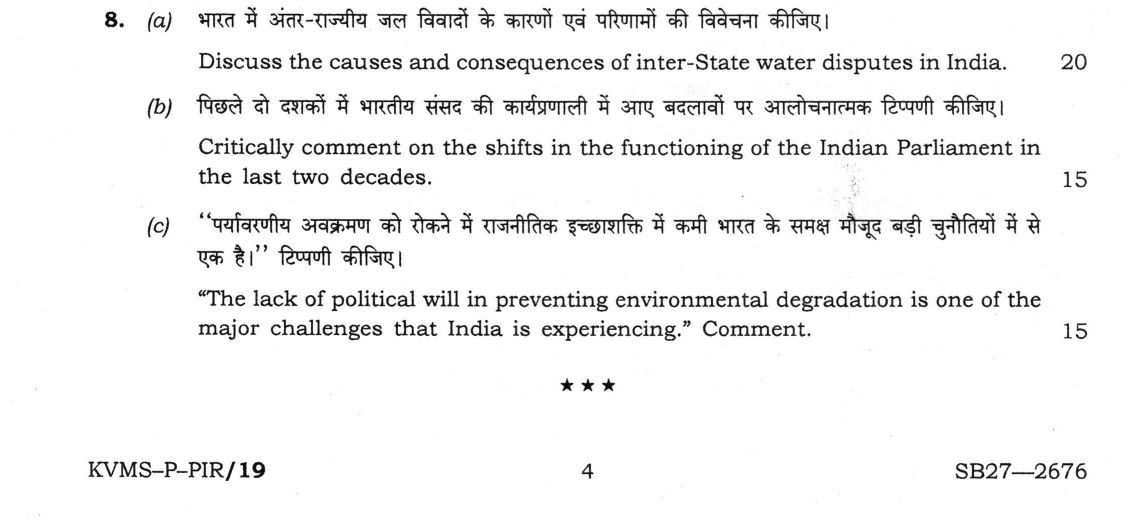
(a) Discuss the causes and consequences of inter-State water disputes in India. (20 marks) (b) Critically comment on the shifts…
Discuss the causes and consequences of inter-State water disputes in India. 20 marks
Critically comment on the shifts in the functioning of the Indian Parliament in the last two decades. 15 marks
"The lack of political will in preventing environmental degradation is one of the major challenges that India is experiencing." Comment. 15 marks
हिंदी में प्रश्न पढ़ें
भारत में अंतर-राज्यीय जल विवादों के कारणों एवं परिणामों की विवेचना कीजिए। (20 अंक)
पिछले दो दशकों में भारतीय संसद की कार्यप्रणाली में आए बदलावों पर आलोचनात्मक टिप्पणी कीजिए। (15 अंक)
‘‘पर्यावरणीय अवक्रमण को रोकने में राजनीतिक इच्छाशक्ति में कमी भारत के समक्ष मौजूद बड़ी चुनौतियों में से एक है।’’ टिप्पणी कीजिए। (15 अंक)
Model answer
Drafted with AI by UPSC Answer Check against this question's marking rubric, to the expected length. UPSC does not publish answers for Mains — this is one way to score well, not an official key. How we build rubrics and answers.
(a) Inter-State water disputes: causes and consequences
The causes of inter-State water disputes in India are fundamentally rooted in the constitutional division of powers, where water is Entry 17 of the State List, while Entry 56 of the Union List empowers the Centre to regulate and develop inter-State rivers. Article 262 mandates the establishment of tribunals, but the River Boards Act, 1956, has never been used to create cooperative basin-level bodies. Adjudication under the Inter-State River Water Disputes Act, 1956 relies on ad hoc tribunals that take decades, and upstream States invoke territorial sovereignty while downstream States claim prior appropriation, against the accepted norm of equitable apportionment (Helsinki Rules, 1966). This legal vacuum, combined with rising demand and "electoral water nationalism," has fueled conflicts. Key disputes include the Cauvery (tribunal 1990, award 2007, Supreme Court 2018), the Krishna, the Sutlej-Yamuna Link (where the Punjab Termination of Agreements Act 2004 was voided in 2016), and the Mahadayi.
The consequences of these disputes are severe and multifaceted. They lead to public disorder, such as the Cauvery riots of 1991 and 2016, and non-compliance with tribunal orders, which erodes judicial authority. Furthermore, they result in the stalling of irrigation projects and the growth of regional parties around water grievances. To resolve these, India needs a permanent tribunal with strict timelines, genuine river basin organisations, and an independent telemetry-based data agency. Furthermore, the Inter-State Council should be revived for mediation, and demand must be reduced through crop diversification and micro-irrigation under the Pradhan Mantri Krishi Sinchayee Yojana.
(b) Shifts in the functioning of Parliament
The functioning of the Indian Parliament has undergone a significant shift toward executive dominance, characterized by a decline in sittings to roughly sixty a year and a falling rate of bill referrals to Departmentally Related Standing Committees. Recent years have seen the "guillotining" of demands for grants, the curtailment of Question Hour, and the mass suspension of 146 opposition MPs in December 2023. Legislative technique has also shifted, with major laws like the farm laws (2020) and the Farm Laws Repeal Act (2021) being passed by voice vote, and the frequent use of the Money Bill route under Article 110, as seen in the Aadhaar Act.
However, a critical comment must also register the gains. Parliament has moved to a new building (2023) and improved visibility through Sansad TV (2021). The social composition has broadened, and the Constitution (106th Amendment) Act, 2023, reserved one-third of Lok Sabha and Assembly seats for women, effective after the next delimitation. As B. L. Shankar and Valerian Rodrigues argue, while representation has deepened, deliberative quality has eroded. The 2024 return of a recognised Leader of the Opposition may partially reverse this trend, as historical evidence suggests scrutiny revives when the executive's majority is not assured.
(c) Political will and environmental degradation
The claim that a deficit of political will is the primary obstacle to arresting environmental degradation in India is largely supported by evidence of policy reversals. Political will often fails where economic growth collides with protection, as seen in the draft EIA Notification 2020, the Forest (Conservation) Amendment Act 2023, and the Western Ghats eco-sensitive area notification left unfinalised since the Gadgil (2011) and Kasturirangan (2013) reports. Diffuse, deferred environmental costs and the low electoral salience of environmental issues further weaken the incentive for strict enforcement.
However, the claim is not absolute. India has demonstrated will through its "Panchamrit" climate targets, the goal of 500 GW of non-fossil capacity by 2030 (half of installed capacity was already non-fossil by mid-2025), and the success of Project Tiger. The National Green Tribunal, Articles 48A and 51A(g), and Article 21 jurisprudence (including M. K. Ranjitsinh v. Union of India, 2024, on a right against the adverse effects of climate change) have also provided a judicial push. Therefore, while political will is a major challenge, it is compounded by a lack of regulatory capacity in State Pollution Control Boards and the complexities of the federal structure. A holistic approach combining political will, stronger regulators, and laws like the PESA and FRA is required to address these challenges.
How this answer will be evaluated
Evaluation rubric
Each sub-part is marked on its own, against the marks and word limit printed on the paper.
- (a) Two explicit halves: causes and consequences of inter-State water disputes in India. The constitutional and statutory framework must be stated accurately, at least three or four named disputes must be used as evidence, and the answer should end with a way forward. 20 marks
Must cover
- Entry 17 of the State List; Entry 56 of the Union List; Article 262 and 262(2)
- Inter-State River Water Disputes Act, 1956; River Boards Act, 1956 (never used); 2002 amendment timelines; 2019 amendment Bill (not enacted)
- Cauvery: tribunal 1990, award February 2007, Supreme Court judgment February 2018, Cauvery Water Management Authority
- Krishna (Bachawat 1969, Brijesh Kumar 2004); Godavari; Narmada award 1979
- Ravi-Beas and the Sutlej-Yamuna Link; Punjab Termination of Agreements Act 2004 held unconstitutional on Presidential Reference (2016)
- Mahadayi award (2018); Vansadhara and Mahanadi tribunals; Mullaperiyar; Andhra Pradesh-Telangana after 2014
- equitable apportionment versus territorial sovereignty and prior appropriation; Helsinki Rules 1966
- Mihir Shah Committee (2016) and the proposed National Water Commission
- Cauvery riots of 1991 and 2016; non-compliance with tribunal and Supreme Court orders
- Inter-State Council under Article 263; the proposal to move water to the Concurrent List
Loses marks
- Citing the wrong constitutional provisions - water is Entry 17 of the State List and Entry 56 of the Union List, and the adjudication article is 262, not 263, which concerns the Inter-State Council
- Forgetting that the River Boards Act, 1956 has never been used, which is itself a central cause
- Asserting that the 2019 amendment Bill has become law
- Naming disputes without the States party to them, or attributing a tribunal to the wrong river
- Getting the Cauvery chronology wrong - the tribunal was constituted in 1990, the final award came in 2007, and the Supreme Court modified it in February 2018
- Answering only the causes half and treating consequences in two lines
- Treating the disputes as purely technical or hydrological, and missing the electoral incentives that make settlement politically costly
- Ending without any way forward, which a 300-word analytical answer at this level is expected to include
Earns more
- Sets out the consequences: public disorder and violence, most notably the Cauvery riots in Bengaluru and Tamil Nadu in 1991 and again in 2016, with attacks on persons and property and heavy economic loss; the strain on cooperative federalism and on inter-State comity, including the refusal of transit and the retaliatory politics of neighbouring States; judicialisation combined with non-compliance, seen in Karnataka's resistance to interim orders and in Punjab's non-implementation of the Sutlej-Yamuna Link directions despite the 2016 Presidential Reference, which erodes the authority of both tribunals and the Supreme Court; the growth of regional and sub-regional parties around water grievances and the consequent polarisation of State politics; economic costs through stalled irrigation projects, deferred investment, farmer distress and urban water insecurity; ecological cost, since bargaining over allocated quantities neglects environmental flows, river health and groundwater; and, positively, the emergence of institutional innovation such as basin-level management authorities
- Offers a way forward: enact a single permanent tribunal with multiple benches and strict timelines, with a dispute resolution committee for prior negotiation as the 2019 Bill proposes; use Entry 56 to legislate genuine river basin organisations, as the draft river basin management legislation contemplates, replacing the dormant River Boards Act; establish an independent, telemetry-based data agency whose measurements both parties accept, on the lines of the Mihir Shah Committee's National Water Commission; consider the National Commission to Review the Working of the Constitution's suggestion of moving water to the Concurrent List, while recognising the political difficulty; revive the Inter-State Council under Article 263 and the zonal councils as negotiation forums so that disputes are mediated before they are litigated; and reduce the underlying demand through crop diversification, micro-irrigation under the Pradhan Mantri Krishi Sinchayee Yojana, groundwater regulation, urban reuse and rational power pricing, since no allocation formula can survive indefinitely rising demand
- (b) 'Critically comment on the shifts' over roughly the last twenty years. The answer must identify specific, evidenced changes in how Parliament works - time, scrutiny, legislative technique, disruption, institutional change - and must be critical, which means registering the gains as well as the decline. 15 marks
Must cover
- decline in sittings - well over a hundred a year in the 1950s against roughly sixty or fewer recently
- Departmentally Related Standing Committees (1993, expanded 2004); falling rate of reference of bills
- guillotining of demands for grants; curtailment and suspension of Question Hour (monsoon session 2020)
- mass suspension of about 146 opposition MPs in December 2023
- farm laws passed by voice vote, September 2020; J&K Reorganisation Act 2019; the three criminal law codes, December 2023
- Money Bill route under Article 110; Aadhaar Act 2016; Rojer Mathew v. South Indian Bank (2019) reference
- ordinances under Article 123; Krishna Kumar Singh v. State of Bihar (2017)
- Tenth Schedule and the whip; private members' bills
- new Parliament building (2023); Sansad TV (2021); Constitution (106th Amendment) Act, 2023
- B. L. Shankar and Valerian Rodrigues, 'The Indian Parliament: A Democratic Transformation' (2011); Kapur and Mehta on public institutions
- Article 93 and the Deputy Speaker vacancy; return of a Leader of the Opposition in 2024
Loses marks
- Writing a description of Parliament's powers and functions instead of identifying shifts over the last two decades
- Offering an unrelieved lament, with no acknowledgement of increased representativeness, transparency or the continuing technical work of committees - the word 'critically' requires both sides
- Using no data at all; a comment on parliamentary decline without sittings, referral rates or suspension figures is unevidenced assertion
- Getting the standing committee system wrong - it was created in 1993, not by the Constitution, and there are twenty-four departmentally related committees
- Confusing the money bill controversy with an ordinary bill passed by both Houses, or misattributing the Aadhaar dissent
- Blaming disruption solely on the opposition or solely on the government, when the literature treats disruption as a rational response to the absence of guaranteed floor time
- Exceeding 250 words by narrating individual sessions
Earns more
- Records the institutional, procedural and representational changes, so the comment is not one-directional: Parliament moved to a new building inaugurated on 28 May 2023 and shifted to it during the special session of September 2023, at which the Constitution (106th Amendment) Act, 2023 reserving one-third of seats in the Lok Sabha and State Assemblies for women was passed, though contingent on the census and delimitation; Lok Sabha Television and Rajya Sabha Television were merged into Sansad TV in 2021 and proceedings are streamed, and the Digital Sansad platform has opened data and documents to the public; the Right to Information Act, 2005 has increased the evidentiary material available to members; and the social composition of the House has broadened, with a record seventy-eight women members elected in 2019 and about seventy-four in 2024 - though the proportion remains under fifteen per cent - while the Association for Democratic Reforms reports that about forty-six per cent of those elected in 2024 declared criminal cases against themselves
- Delivers a critical, balanced verdict with a scholarly frame: B. L. Shankar and Valerian Rodrigues in 'The Indian Parliament: A Democratic Transformation' (2011) argue that Indian Parliament has succeeded as an engine of social transformation and representation even as its deliberative quality has eroded, while Devesh Kapur and Pratap Bhanu Mehta's work on Indian public institutions traces the instrumentalisation of the legislature by the executive; so the honest verdict is divergence - representation has deepened and visibility has increased, but deliberation and accountability have weakened, the decisive variable being executive dominance rather than any constitutional change; the prolonged vacancy in the office of Deputy Speaker in the Seventeenth Lok Sabha, contrary to the mandate of Article 93, epitomises the erosion of convention; and the 2024 result, which restored a coalition Centre and returned a recognised Leader of the Opposition after a decade, may partially reverse the trend, since the historical evidence is that parliamentary scrutiny revives when the executive's majority is not assured; the standard reform agenda follows - a statutorily guaranteed minimum number of sittings, mandatory pre-legislative consultation and committee reference, an independent parliamentary budget office, a fixed and protected Question Hour, and rules preventing the use of suspension to clear the House for legislation
- (c) 'Comment' on a strong causal claim - that the principal obstacle to arresting environmental degradation in India is a deficit of political will. The answer must test the claim: establish the evidence of degradation, show where political will is genuinely absent, but also weigh the counter-evidence and the alternative explanations of capacity, federal structure and political economy. 15 marks
Must cover
- Articles 48A and 51A(g), inserted by the 42nd Amendment (1976); Article 21 jurisprudence
- Environment (Protection) Act 1986 (after Bhopal, 1984); Water Act 1974; Air Act 1981; Forest (Conservation) Act 1980 and its 2023 amendment; Wild Life (Protection) Act 1972; Forest Rights Act 2006; National Green Tribunal Act 2010
- Subhash Kumar (1991); M. C. Mehta Oleum case (1987); Vellore Citizens Welfare Forum (1996); M. C. Mehta v. Kamal Nath (1997); T. N. Godavarman (1996); M. K. Ranjitsinh v. Union of India (2024)
- draft EIA Notification 2020; post-facto clearance barred in Common Cause (2017) and Alembic Pharmaceuticals (2020)
- Western Ghats: Gadgil report (2011) and Kasturirangan report (2013); unfinalised ESA notification
- National Clean Air Programme (2019); Commission for Air Quality Management (2021); Lancet Planetary Health (2020) estimate of about 1.67 million deaths
- Panchamrit at COP26 (2021); net zero by 2070; 500 GW non-fossil by 2030; International Solar Alliance; Mission LiFE; National Green Hydrogen Mission
- Project Tiger and the 2022 all-India estimation; Namami Gange
- Ramachandra Guha and Juan Martinez-Alier, 'Varieties of Environmentalism' (1997); Gadgil and Guha, 'This Fissured Land' (1992); Amita Baviskar; Elinor Ostrom, 'Governing the Commons' (1990); Hardin's tragedy of the commons
- Chipko (1973), Silent Valley, Narmada Bachao Andolan; Niyamgiri and gram sabha consent; PESA 1996
Loses marks
- Writing a general essay on environmental problems in India with no political science content and no engagement with the 'political will' claim
- Accepting the claim without testing it, so no counter-evidence on climate commitments, renewables or conservation appears
- Citing no statute, article or case, when Indian environmental governance is overwhelmingly a legal-institutional subject
- Attributing Articles 48A and 51A(g) to the original Constitution - both were inserted by the 42nd Amendment in 1976
- Confusing the Gadgil and Kasturirangan reports on the Western Ghats, or their sequence - Gadgil reported in 2011 and Kasturirangan in 2013 diluting it
- Treating enforcement failure as identical with absence of will, when under-capacity, vacancies and absent monitoring data are separate and often decisive causes
- Using no scholarship, when Guha, Gadgil, Baviskar and Ostrom supply the standard analytical frame for this question
Earns more
- Weighs the counter-evidence, without which the comment is one-sided: India's Panchamrit commitments announced at COP26 in Glasgow in November 2021 - net zero by 2070, five hundred gigawatts of non-fossil capacity by 2030, half of energy requirements from renewables by 2030, a reduction of a billion tonnes in projected emissions by 2030, and a forty-five per cent cut in the emissions intensity of GDP by 2030 against 2005 levels - with the non-fossil share of installed capacity reaching fifty per cent by mid-2025, well ahead of the 2030 target; the International Solar Alliance (2015), the Coalition for Disaster Resilient Infrastructure (2019), Mission LiFE (2022), the National Green Hydrogen Mission (2023) and the carbon credit trading scheme under the Energy Conservation (Amendment) Act, 2022; conservation successes including Project Tiger, with the all-India estimation of 2022 reporting about three thousand six hundred and eighty-two tigers, and the recovery of several other species; the Namami Gange programme; and the continuing activism of the National Green Tribunal and of the higher judiciary
- Offers the alternative explanations and the theoretical frame, then a verdict: the deficit is partly one of state capacity rather than of will - understaffed and technically weak pollution control boards, absent monitoring data, and the absence of the independent environmental regulator that the Supreme Court directed be established in the 'Lafarge Umiam Mining' matter (2011); partly structural, since environment is a Concurrent subject while land, water and police are largely with the States, so responsibility is diffused, as the interstate character of Delhi's air pollution and stubble burning shows, addressed only in 2021 by the Commission for Air Quality Management in the National Capital Region and Adjoining Areas; partly political-economic, since growth, employment and revenue accrue visibly and immediately while environmental costs are diffuse and deferred, and since the environment remains a low-salience voting issue for most of the electorate; and partly distributive, since as Ramachandra Guha and Juan Martinez-Alier argue in 'Varieties of Environmentalism' (1997), India's environmentalism is an environmentalism of the poor over livelihood resources rather than of post-material amenity, while Madhav Gadgil and Guha's 'This Fissured Land' (1992) distinguishes omnivores from ecosystem people and ecological refugees, and Amita Baviskar's work identifies a bourgeois environmentalism that displaces the poor in the name of clean cities; against Hardin's tragedy of the commons, Elinor Ostrom's 'Governing the Commons' (1990) shows that community institutions can manage common resources, which is the case for genuine devolution under PESA 1996 and the Forest Rights Act 2006; so the fair verdict is that political will is indeed deficient wherever protection collides with growth, but that capacity, federal fragmentation and low electoral salience are co-equal causes, and the remedy lies in an independent regulator, adequately resourced boards, transparent monitoring data, environmental accounting and gram sabha empowerment
What "Discuss" is asking you to do
Lay the issue out from more than one side — how it arose, what is claimed for it, what is held against it, and where it now stands. UPSC attaches discuss to broad topics with several live dimensions, so coverage of the dimensions earns more than the strength of your opinion.
Structure that answers it
Set the issue up → the case as it is made → the case against → the dimension both sides leave out → where the balance now lies
Where marks are lost
Listing facts with no thread between them, or arguing one side throughout and calling it a discussion.
Practice this exact question
Write your answer and it is marked point by point against the model answer above — what you covered, what you missed, what you got wrong.
Evaluate my answer →More from Political Science & IR 2026 Paper I
- Q5 Answer the following in about 150 words each : (a) How did Swadeshi grow into a demand fo…
- Q6 (a) From passive resistors to armed revolutionaries, the Indian Freedom Struggle has a st…
- Q7 (a) Elucidate the prominent trends in voting behaviour in contemporary India, and discuss…
- Q8 (a) Discuss the causes and consequences of inter-State water disputes in India. (20 marks…