Paper I — Q5
(a) How did Swadeshi grow into a demand for Swaraj? (10 marks) (b) The Constitution of India was secular even before the word…
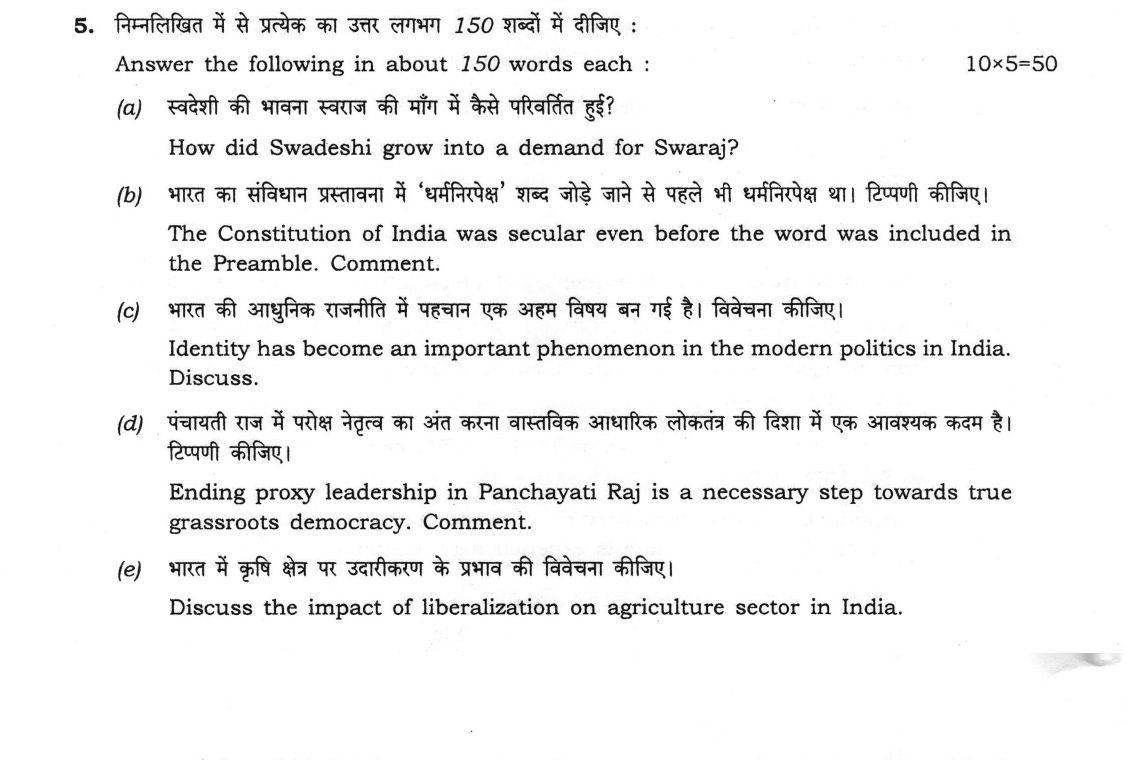
Answer the following in about 150 words each :
How did Swadeshi grow into a demand for Swaraj? 10 marks
The Constitution of India was secular even before the word was included in the Preamble. Comment. 10 marks
Identity has become an important phenomenon in the modern politics in India. Discuss. 10 marks
Ending proxy leadership in Panchayati Raj is a necessary step towards true grassroots democracy. Comment. 10 marks
Discuss the impact of liberalization on agriculture sector in India. 10 marks
हिंदी में प्रश्न पढ़ें
निम्नलिखित में से प्रत्येक का उत्तर लगभग 150 शब्दों में दीजिए :
स्वदेशी की भावना स्वराज की माँग में कैसे परिवर्तित हुई? (10 अंक)
भारत का संविधान प्रस्तावना में ‘धर्मनिरपेक्ष’ शब्द जोड़े जाने से पहले भी धर्मनिरपेक्ष था। टिप्पणी कीजिए। (10 अंक)
भारत की आधुनिक राजनीति में पहचान एक अहम विषय बन गई है। विवेचना कीजिए। (10 अंक)
पंचायती राज में परोक्ष नेतृत्व का अंत करना वास्तविक आधारिक लोकतंत्र की दिशा में एक आवश्यक कदम है। टिप्पणी कीजिए। (10 अंक)
भारत में कृषि क्षेत्र पर उदारीकरण के प्रभाव की विवेचना कीजिए। (10 अंक)
Model answer
Drafted with AI by UPSC Answer Check against this question's marking rubric, to the 150-word length. UPSC does not publish answers for Mains — this is one way to score well, not an official key. How we build rubrics and answers.
(a) From Swadeshi to Swaraj Economic boycott steadily turned into a political claim to self-rule. Following Lord Curzon’s Partition of Bengal (1905), the movement began with the boycott of British goods and the promotion of atmashakti (self-reliance) through national education (e.g., Bengal National College) and indigenous production. Extremists such as Aurobindo Ghose and Tilak reframed a protest against one administrative act. Aurobindo’s Doctrine of Passive Resistance (1907) presented boycott as a weapon for political freedom, and Tilak’s later slogan (1916), "Swaraj is my birthright", crystallised the link between economic self-reliance and political sovereignty. This shift was formalized at the Calcutta Congress in 1906, where Dadabhai Naoroji’s presidential address declared Swaraj as the Congress goal. Although this initially meant self-government within the Empire, the Extremist-Moderate divergence (culminating in the Surat split of 1907) and subsequent repression pushed the demand further. Gandhi’s Hind Swaraj (1909) redefined Swaraj as self-mastery, not just the removal of the British. This trajectory culminated in the Lahore Congress of 1929, where the demand was finally upgraded to Purna Swaraj (complete independence).
(b) Secular before the word: the Constitution before 1976 The proposition is correct; the Constitution was substantively secular before the 42nd Amendment (1976) inserted the word "secular" into the Preamble. The omission was deliberate: replying to K. T. Shah on 15 November 1948, Ambedkar said the Constitution should provide the machinery of government, not prescribe social organisation. Secularism was embedded in the text through Articles 14, 15, and 16 (equality), Articles 25–28 (freedom of religion), and Article 44 (Uniform Civil Code). A single electoral roll (Articles 325-326) replaced separate electorates, so religious communities are not political units. The Supreme Court in S. R. Bommai v. Union of India (1994) confirmed that secularism is part of the Constitution’s basic structure, and in Dr. Balram Singh v. Union of India (2024) it dismissed challenges to the 1976 insertion. Indian secularism is distinct from the American "wall of separation"; it is often described as sarva dharma sambhava and theorised by Rajeev Bhargava as "principled distance", allowing the State to intervene in religious practices for social reform (e.g., temple entry) while maintaining neutrality among faiths.
(c) Identity in modern Indian politics Identity has become a central axis of Indian politics, shifting the focus from class-based redistribution to claims of recognition. This salience intensified after 1989, marked by the implementation of the Mandal Commission (1990) and the Indra Sawhney judgment (1992), which institutionalized caste-based reservation. Rajni Kothari and M.N. Srinivas identified how caste and religion function as "vote banks," while Christophe Jaffrelot’s India’s Silent Revolution (2003) documented the rise of identity-based parties. Theoretical frameworks like Charles Taylor’s "politics of recognition" and Nancy Fraser’s distinction between redistribution and recognition explain this shift. Concrete evidence includes the Bihar caste survey (2023) and the decision (2025) to enumerate caste in the next Census, the creation of Telangana (2014), and the 103rd Amendment (2019) for EWS. While this has deepened democratic representation for marginalized groups, it risks "recognition without redistribution" (Fraser) and can lead to the "identity and violence" (Amartya Sen) that polarizes society.
(d) Ending proxy leadership in Panchayati Raj Ending proxy leadership, or the sarpanch-pati phenomenon, is a necessary step toward true grassroots democracy. The 73rd Constitutional Amendment (Article 243D) mandates that at least one-third of panchayat seats, including the chairpersonship, be reserved for women. However, in many cases, elected women leaders act as proxies for their male relatives, who retain actual decision-making power. This voids the intent of descriptive representation. Research by Duflo et al. demonstrates that when women hold genuine power, public investment shifts toward goods women prioritise, such as drinking water (Chattopadhyay and Duflo, 2004). Therefore, the sarpanch-pati system undermines the devolution of the "3 Fs" (Functions, Funds, Functionaries) and the "people's power" envisioned by the Panchayati Raj system. While ending proxy leadership is necessary, it is not sufficient; it must be accompanied by capacity building, penalties for proven proxy leadership (as recommended by the Ministry of Panchayati Raj's Sushil Kumar committee in February 2025), and the strengthening of Gram Sabhas to ensure that women’s participation translates into substantive democratic outcomes.
(e) Liberalisation and Indian agriculture The impact of liberalization on Indian agriculture since 1991 has been mixed, characterized by both modernization and increased vulnerability. The removal of quantitative restrictions (2001) and WTO commitments (AoA 1995) exposed Indian farmers to global competition. This led to a surge in high-value exports like horticulture and dairy, benefiting surplus irrigated farms. However, the import shock in sectors like edible oils and the lack of public investment in infrastructure have disadvantaged smallholders. NSS Situation Assessment Surveys found about half of agricultural households indebted (50.2% in 2019), a marker of persistent distress. Politically, this has fueled movements like the Samyukta Kisan Morcha (SKM) and the demand for a legal guarantee of MSP. The 2020 farm laws, which sought to liberalize trade further, were repealed in 2021 due to massive farmer protests. Thus, while liberalization integrated India into global supply chains, it has exacerbated regional disparities and increased the political salience of the agricultural sector.
How this answer will be evaluated
Evaluation rubric
Each sub-part is marked on its own, against the marks and word limit printed on the paper.
- (a) 'How did' asks for a causal account, not a chronology. The answer must trace the transformation of a boycott-and-indigenous-goods campaign after the 1905 Partition of Bengal into an explicit political demand for self-rule, and must date the moment the Congress adopted Swaraj as its goal. 10 marks · 150 words
Must cover
- Partition of Bengal - announced 19 July 1905, effective 16 October 1905; Lord Curzon
- Calcutta Town Hall boycott resolution, 7 August 1905
- National Council of Education (1906); Bengal National College; Aurobindo Ghose
- samitis - Swadesh Bandhab Samiti, Ashwini Kumar Dutta; atmashakti
- Lal-Bal-Pal; Tilak's 'Swaraj is my birthright'
- Aurobindo, 'The Doctrine of Passive Resistance' (1907)
- Dadabhai Naoroji's presidential address, Calcutta Congress 1906 - Swaraj as the Congress goal
- Surat split, December 1907; Morley-Minto reforms 1909; annulment of partition 1911
- Gandhi's 'Hind Swaraj' (1909); Lahore Congress 1929 and Purna Swaraj
Loses marks
- Narrating the Swadeshi movement chronologically without ever explaining the causal mechanism by which an economic boycott became a political demand
- Getting the Congress session wrong - Swaraj was declared the goal at Calcutta in 1906 under Dadabhai Naoroji, not at Surat in 1907 or at Lahore
- Confusing the 1906 Swaraj (self-government within the Empire) with Purna Swaraj (complete independence, 1929) as though they were the same demand
- Omitting the Extremist-Moderate divergence, which is the political core of the transformation
- Attributing 'Swaraj is my birthright' to Gandhi or Gokhale rather than to Tilak
- Exceeding 150 words by describing the revolutionary movement in detail
Earns more
- Dates the formal adoption of the goal: Dadabhai Naoroji's presidential address to the Calcutta session of the Indian National Congress in 1906 declared Swaraj or self-government on the model of the United Kingdom or the self-governing colonies to be the goal of the Congress - the first official use of the word by the Congress - with Swadeshi, boycott and national education adopted alongside it; and notes that this compromise did not hold, producing the Surat split of December 1907
- Traces the consequences and the legacy: the partition was annulled in 1911 at the Delhi Durbar and the capital moved to Delhi, but the demand did not subside; the repression drove a section to revolutionary action through the Anushilan Samiti and Jugantar, the Muzaffarpur bombing by Khudiram Bose and Prafulla Chaki in April 1908 and the Alipore Bomb Case; the Morley-Minto reforms of 1909 conceded representation with separate electorates rather than self-rule; and the Swadeshi repertoire of boycott, picketing, national education and indigenous production was taken over and nationalised by Gandhi in Non-Cooperation from 1920, while Gandhi in 'Hind Swaraj' (1909) redefined Swaraj itself as self-rule and self-mastery, not merely English rule without the Englishman - a trajectory that culminated in the Purna Swaraj resolution at Lahore in 1929 and its observance on 26 January 1930
- (b) 'Comment' on the proposition that the Constitution was already secular before 1976. The answer must date the insertion of the word, then demonstrate the pre-existing secular provisions by article number, cite the judicial confirmation, and register the debate about what Indian secularism means. 10 marks · 150 words
Must cover
- Constitution (Forty-second Amendment) Act, 1976; in force 3 January 1977
- Articles 14, 15, 16, 17
- Articles 25, 26, 27, 28
- Articles 29 and 30; Article 44
- Articles 325 and 326; rejection of separate electorates
- K. T. Shah's rejected amendment; Ambedkar's reply in the Constituent Assembly
- S. R. Bommai v. Union of India (1994) - secularism as basic structure
- Kesavananda Bharati v. State of Kerala (1973)
- sarva dharma sambhava; 'principled distance' (Rajeev Bhargava)
Loses marks
- Getting the amendment wrong - it is the 42nd Amendment of 1976, not the 44th of 1978, which in fact reversed several other 42nd Amendment changes
- Arguing the case with no article numbers, which is fatal in a question of this kind
- Confusing Article 25(2)(b) (throwing open Hindu religious institutions) with Article 44 (uniform civil code), or citing Article 44 as though it were justiciable
- Assuming Indian secularism means a strict separation of religion and State on the American model, when the Constitution expressly authorises State intervention in religious practice
- Omitting Bommai, the standard authority for secularism as a basic feature
- Turning the answer into a debate about the uniform civil code or about a particular political controversy rather than commenting on the constitutional text
Earns more
- Adds the framers' intention: K. T. Shah's amendments seeking to describe India as a secular, federal, socialist union in Article 1 were rejected, Ambedkar replying on 15 November 1948 that the Constitution should lay down only the machinery of government and not prescribe the social and economic organisation of society, which must be left to the people themselves to decide - so the omission of the word was deliberate and not an oversight about the content
- Supplies judicial confirmation and the interpretive nuance: the nine-judge bench in 'S. R. Bommai v. Union of India' (1994) held secularism to be part of the basic structure of the Constitution and a ground for invoking Article 356 against a State government acting against it, and secularism figures among the basic features identified in 'Kesavananda Bharati v. State of Kerala' (1973); in 'Dr. Balram Singh v. Union of India' (2024) the Court dismissed challenges to the 1976 insertion of 'socialist' and 'secular'; the Supreme Court has repeatedly observed that the Indian State is neither anti-religious nor theocratic; and Indian secularism is not the American wall of separation but sarva dharma sambhava, or in Rajeev Bhargava's formulation 'principled distance', which permits the State to intervene in religion for reform - temple entry, abolition of untouchability, the outlawing of triple talaq - while treating all faiths equally
- (c) 'Discuss' the rise of identity as a central axis of Indian politics. The answer must map the main identity cleavages with concrete Indian evidence, explain why identity became salient when it did, and evaluate the consequences for democracy. 10 marks · 150 words
Must cover
- Mandal Commission (1979-80), implemented 1990; Indra Sawhney v. Union of India (1992); creamy layer; fifty per cent ceiling
- 102nd Amendment (2018), Article 338B; 103rd Amendment (2019) EWS, Articles 15(6) and 16(6); Janhit Abhiyan (2022)
- Bihar caste survey 2023; the 2025 decision to enumerate caste in the next Census
- Rajni Kothari, 'Caste in Indian Politics' (1970); M. N. Srinivas - Sanskritisation, dominant caste, vote bank
- Yogendra Yadav's second democratic upsurge; Christophe Jaffrelot, 'India's Silent Revolution' (2003)
- Kanchan Chandra, 'Why Ethnic Parties Succeed' (2004) - patronage democracy
- Charles Taylor, politics of recognition; Nancy Fraser, redistribution vs recognition; Will Kymlicka
- Telangana (2014); Sixth Schedule and PESA 1996; Forest Rights Act 2006
- Constitution (106th Amendment) Act, 2023 - women's reservation
- Amartya Sen, 'Identity and Violence' (2006)
Loses marks
- Writing only about caste and ignoring religion, language, region, tribe and gender, when the question says identity has become 'an important phenomenon' across modern politics
- Listing cleavages without explaining why identity became salient after 1989 - the analytical core of the answer
- Getting Mandal wrong: the commission was appointed in 1979 and reported in 1980; implementation came in 1990; Indra Sawhney was decided in 1992
- Treating identity politics as wholly negative or wholly positive instead of evaluating both faces
- Citing no scholar at all, so the answer reads as current affairs rather than political science
- Overshooting 150 words by narrating particular episodes of communal violence in detail
Earns more
- Supplies the theoretical vocabulary of recognition: Charles Taylor's 'The Politics of Recognition' (1992) on misrecognition as a form of oppression, Nancy Fraser's distinction between claims of redistribution and claims of recognition and her warning that the second can displace the first, Will Kymlicka's 'Multicultural Citizenship' (1995) on group-differentiated rights, and Bhikhu Parekh's dialogical multiculturalism - with the Indian Constitution's own accommodation of group identity through reservation, minority educational rights under Article 30, personal laws and Articles 371A to 371J
- Evaluates both ways: identity politics has deepened democracy by giving historically excluded groups descriptive representation, dignity and access to state resources, and by making the political class socially far more representative than it was in 1952; but it also fragments the polity, encourages polarisation and majoritarianism, substitutes symbolic recognition for redistribution, sustains dynastic and patronage networks, and can shade into violence - and Amartya Sen's 'Identity and Violence' (2006) warns against the illusion of a singular identity, since every person belongs simultaneously to many groups, which is the strongest argument for a citizenship that recognises difference without freezing it
- (d) 'Comment' on the claim that ending proxy leadership - the sarpanch-pati phenomenon - is necessary for genuine grassroots democracy. The answer must define proxy leadership, give the constitutional context of women's reservation in panchayats, assess the evidence on both sides, and take a position on 'necessary'. 10 marks · 150 words
Must cover
- Constitution (Seventy-third Amendment) Act, 1992, in force 24 April 1993; Part IX; Eleventh Schedule
- Article 243D - not less than one-third reservation for women in seats and chairperson offices; States raising it to fifty per cent
- sarpanch-pati / pradhan-pati / mukhiya-pati - proxy leadership
- descriptive versus substantive representation (Hanna Pitkin)
- Chattopadhyay and Duflo, 'Women as Policy Makers' (Econometrica, 2004)
- Beaman, Duflo, Pande and Topalova on reduced bias and raised aspirations
- Article 243G - devolution is enabling, not mandatory; funds, functions, functionaries
- Second Administrative Reforms Commission, sixth report 'Local Governance' (2007)
- Rajbala v. State of Haryana (2015) on qualification restrictions
Loses marks
- Getting the amendment number or date wrong - it is the 73rd Amendment of 1992, effective 24 April 1993; the 74th deals with urban local bodies
- Citing Article 243D loosely as 'thirty-three per cent' when the constitutional text says 'not less than one-third', and failing to note the State extensions to fifty per cent
- Treating the whole scheme as a failure because of proxy rule, and ignoring the substantial evidence that women pradhans change policy outcomes and social attitudes
- Offering no empirical study at all, so the comment rests on anecdote
- Answering only the women's-reservation half and forgetting the wider requirement of devolution, which is what makes 'necessary but not sufficient' the correct verdict
- Confusing the panchayat quota with the Constitution (106th Amendment) Act, 2023, which concerns the Lok Sabha and State Assemblies
Earns more
- Takes a position on 'necessary': proxy rule must end because representation that is exercised by someone else is not representation at all - it deceives the electorate, defeats the constitutional purpose of Article 243D, and denies the transformative effect that the evidence shows real women leaders produce; but it is not a sufficient condition, because the panchayat itself is weak - Article 243G merely enables and does not oblige States to devolve, so funds, functions and functionaries remain with the State government and the line departments, parallel bodies and district administration retain control, as the Second Administrative Reforms Commission's sixth report 'Local Governance' (2007) documented
- Sets out remedies: capacity building and training of elected women representatives, as under the Rashtriya Gram Swaraj Abhiyan; recording and publicising attendance so that only the elected member may attend and sign, with disqualification or removal where a relative usurps the office, an approach several States have adopted by executive order; the Ministry of Panchayati Raj advisory committee chaired by Sushil Kumar (report, February 2025) recommending exemplary penalties for proven proxy leadership, public swearing-in of women representatives and women panchayat federations; strengthening the gram sabha and mahila sabha so that accountability runs to the village rather than the block office; longer and less rotational reservation so that experience accumulates; genuine activity mapping and devolution of the three Fs; and a caution that exclusionary qualification rules, such as the minimum-education and toilet conditions upheld in 'Rajbala v. State of Haryana' (2015), disproportionately disqualify the very women and Dalits the reservation was meant to empower
- (e) 'Discuss the impact' requires a balanced assessment of what liberalisation since 1991, including India's WTO commitments, has done to Indian agriculture - positive and negative - and its political consequences. A one-sided denunciation or celebration will not score. 10 marks · 150 words
Must cover
- New Economic Policy 1991; WTO Agreement on Agriculture (in force 1 January 1995); market access, domestic support, export subsidies; de minimis
- removal of quantitative restrictions by April 2001
- edible oil import dependence; plantation crops and the ASEAN-India FTA (2009)
- declining public investment in agriculture; subsidy-versus-investment trade-off
- NSS Situation Assessment Surveys - about 48 per cent (2003) and about 50 per cent (2019) of farm households indebted; NCRB farmer suicide data
- growth of agri-exports; horticulture, dairy, poultry and fisheries diversification
- APMC reform, e-NAM (2016), Model Contract Farming Act 2018
- three farm laws 2020 and the Farm Laws Repeal Act, 2021; the MSP legal guarantee demand
- M. S. Swaminathan National Commission on Farmers (2004-06)
- Samyukta Kisan Morcha; Bharatiya Kisan Union; Sharad Joshi's Shetkari Sanghatana
Loses marks
- Writing a general essay on the 1991 reforms with only two lines on agriculture
- Presenting a wholly negative account with no mention of export growth or diversification, which the examiner reads as an ideological rather than an analytical answer
- Getting the WTO chronology wrong - the Agreement on Agriculture took effect on 1 January 1995 and quantitative restrictions were removed by April 2001
- Attributing farmer suicides to liberalisation as a single cause, when the literature identifies indebtedness, crop failure, input costs, the collapse of institutional credit and social factors together
- Confusing the three 2020 farm laws with each other or misnaming them, or forgetting that they were repealed in 2021
- Citing no data or committee at all
Earns more
- Covers domestic market liberalisation and its politics: the Model APMC Act 2003, the National Agriculture Market (e-NAM) launched in 2016, the Model Contract Farming Act 2018; the three farm laws of 2020 - the Farmers' Produce Trade and Commerce (Promotion and Facilitation) Act, the Farmers (Empowerment and Protection) Agreement on Price Assurance and Farm Services Act, and the Essential Commodities (Amendment) Act - which sought to create trade outside the mandi, legalise contract farming and remove stockholding limits; the year-long farmers' protest from November 2020; and their repeal by the Farm Laws Repeal Act, 2021, with the continuing demand for a legal guarantee of minimum support price, against the background of the M. S. Swaminathan National Commission on Farmers (2004-06) recommendation of an MSP at fifty per cent above the comprehensive cost of production
- Delivers the assessment: gains accrued mainly to irrigated, market-connected and larger farmers in surplus regions, while small and marginal holders - about eighty-six per cent of all operational holdings - bore the risk of price volatility without adequate insurance, credit or extension; India simultaneously defends its public stockholding for food security at the WTO, invoking the Bali peace clause of 2013; and the political consequence has been the emergence of a powerful farmers' movement, from the earlier Bharatiya Kisan Union and Sharad Joshi's Shetkari Sanghatana, with its Bharat-versus-India framing, to the Samyukta Kisan Morcha, making agrarian policy a first-order electoral issue
What "How" is asking you to do
Set out the route by which the outcome comes about, step by step. Many how stems ask how one thing affects another, and there the channel of transmission is precisely what is being marked.
Structure that answers it
Starting condition → step → step → outcome reached → the conditions the route depends on
Where marks are lost
Answering why it happens instead of how, the commonest single misread in the paper. An answer full of causes and significance that never traces the mechanism has answered a different question.
Practice this exact question
Write your answer and it is marked point by point against the model answer above — what you covered, what you missed, what you got wrong.
Evaluate my answer →More from Political Science & IR 2026 Paper I
- Q2 (a) “Rights of the man are separate and independent of the State.” Critically analyze the…
- Q3 (a) Mill’s work was crucial to the development of liberalism, because it straddled the di…
- Q4 (a) “Representative democracy is not an absolute principle, rather a question of time, pl…
- Q5 Answer the following in about 150 words each : (a) How did Swadeshi grow into a demand fo…
- Q6 (a) From passive resistors to armed revolutionaries, the Indian Freedom Struggle has a st…
- Q7 (a) Elucidate the prominent trends in voting behaviour in contemporary India, and discuss…
- Q8 (a) Discuss the causes and consequences of inter-State water disputes in India. (20 marks…