Paper I — Q3
(a) Mill’s work was crucial to the development of liberalism, because it straddled the divide between classical and modern…
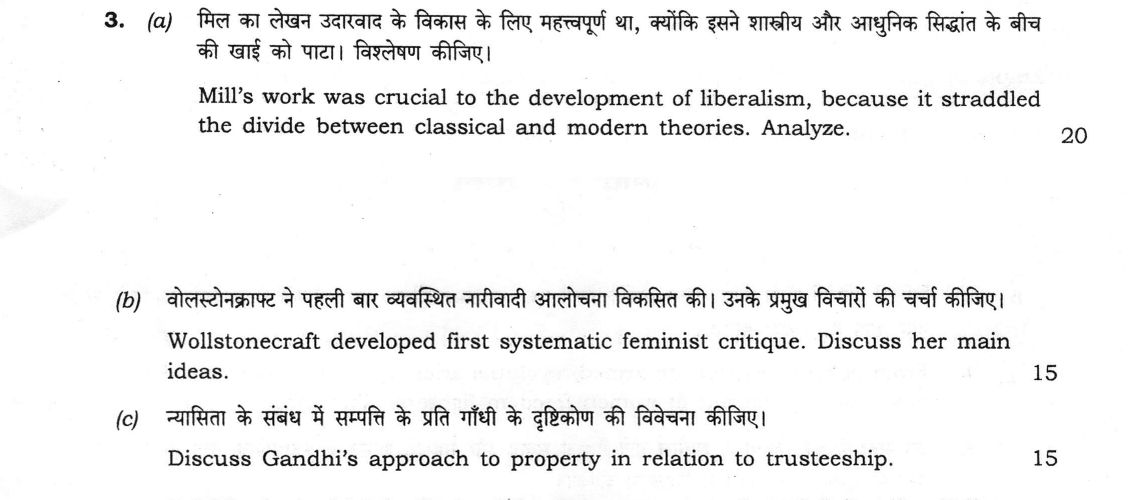
Mill’s work was crucial to the development of liberalism, because it straddled the divide between classical and modern theories. Analyze. 20 marks
Wollstonecraft developed first systematic feminist critique. Discuss her main ideas. 15 marks
Discuss Gandhi’s approach to property in relation to trusteeship. 15 marks
हिंदी में प्रश्न पढ़ें
मिल का लेखन उदारवाद के विकास के लिए महत्त्वपूर्ण था, क्योंकि इसने शास्त्रीय और आधुनिक सिद्धांत के बीच की खाई को पाटा। विश्लेषण कीजिए। (20 अंक)
वोलस्टोनक्राफ्ट ने पहली बार व्यवस्थित नारीवादी आलोचना विकसित की। उनके प्रमुख विचारों की चर्चा कीजिए। (15 अंक)
न्यासिता के संबंध में सम्पत्ति के प्रति गाँधी के दृष्टिकोण की विवेचना कीजिए। (15 अंक)
Model answer
Drafted with AI by UPSC Answer Check against this question's marking rubric, to the expected length. UPSC does not publish answers for Mains — this is one way to score well, not an official key. How we build rubrics and answers.
(a) Mill as the bridge between classical and modern liberalism
John Stuart Mill is the pivotal figure in liberal thought because his work synthesizes the classical emphasis on individual liberty with the modern focus on social development and welfare. His "classical" face is most visible in On Liberty (1859), where he articulates the "harm principle"—the idea that power can only be rightfully exercised over an individual to prevent harm to others. This framework, which distinguishes between "self-regarding" and "other-regarding" actions, provides the bedrock for negative liberty and the defense of free speech against the "tyranny of the majority."
However, Mill’s "modern" face emerges in his qualitative utilitarianism and political theory. In Utilitarianism (1861), he argues for "higher and lower pleasures," famously stating that "it is better to be Socrates dissatisfied than a fool satisfied." On Liberty (Chapter III) likewise treats individuality as "one of the elements of well-being", human nature being "not a machine... but a tree" that must grow on all sides. In Principles of Political Economy (1848) he kept laissez-faire as "the general practice" but admitted wide exceptions, and in later editions and writings moved towards workers' cooperatives, trade unions (recanting the wage-fund doctrine in 1869) and taxation of the unearned increment of land. Furthermore, Considerations on Representative Government (1861) presents a "developmental" view of democracy, where participation is an educative process, a model C.B. Macpherson later classified as "developmental democracy" (The Life and Times of Liberal Democracy, 1977).
The "straddle" is best understood as a coherent indirect utilitarianism: liberty is the condition for the "permanent interests of man as a progressive being." While critics like Gertrude Himmelfarb see "two Mills," the bridge is evident in his advocacy for women’s rights in The Subjection of Women (1869) and his 1867 amendment to the Reform Bill to substitute "person" for "man". Yet, the transition is not seamless; his proposal for plural voting and his defense of "despotism" for "barbarians" reveal illiberal residues within his liberalism. Ultimately, Mill is the hinge because his premises remained classical while his conclusions became developmental and social.
(b) Wollstonecraft's main ideas
Mary Wollstonecraft’s A Vindication of the Rights of Woman (1792) stands as the first systematic feminist critique because it moved beyond isolated complaints to a theoretical argument based on reason. Her central thesis is that reason is not sex-specific; the perceived inferiority of women is not a natural fact but the product of "miseducation." She explicitly targets the conduct writers of her day, such as Dr. John Gregory and Lord Chesterfield, and the philosophy of Rousseau, whose character "Sophie" in Emile (1762) represents the ideal of a woman trained to be a "toy" or "spaniel" for a man.
Wollstonecraft’s positive programme is radical for its time. She argues that women must be educated to be rational partners in the republic, not just "feminine" ornaments. This requires a national system of free, co-educational day schools where boys and girls learn together. She insists that "virtue is one and the same for both sexes," rejecting the idea of a lesser "feminine virtue." Furthermore, she argues for economic independence, suggesting that women should be allowed to enter the professions—medicine, business, and farm management—so they are not forced into marriage, which she called "legal prostitution", for financial survival.
While she tentatively calls for a "revolution in female manners" and representation, her primary focus remains on the capacity for reason. The claim of her being "first" is qualified by precursors like Christine de Pizan (1405) and Mary Astell (1694), but Wollstonecraft’s work was the first to be sustained and theoretically grounded in the Enlightenment. Her arguments were carried forward by J.S. Mill and Harriet Taylor, though later feminists have critiqued her middle-class frame and her suspicion of the body and sexual desire.
(c) Gandhi on property and trusteeship
Gandhi’s approach to property is a moral and spiritual critique of private ownership, grounded in the concept of "trusteeship." His moral premises are drawn from the Isha Upanishad ("One should enjoy one's possessions by renouncing them") and the vows of aparigraha (non-possession) and asteya (non-stealing). Influenced by John Ruskin’s Unto This Last and Leo Tolstoy, Gandhi argued that one may hold property but never own it absolutely.
The doctrine of trusteeship posits that the rich are merely "trustees" of their surplus wealth. They have a moral duty to use their resources for the benefit of the poor, much like a trustee manages a fund for a beneficiary. In this view, rights flow from duties; one has no right to property beyond what is necessary for one's own sustenance and the service of others. This is a "means-end unity" where the economic structure must reflect the moral goal of ahimsa (non-violence).
The "sanction" behind this doctrine was not state force but satyagraha (truth-force). The 1918 Ahmedabad mill strike, in which Gandhi backed the workers' demand for a 35% wage increase and his fast brought the dispute to arbitration, anticipated this sanction. The Practical Trusteeship Formula drafted by his associates in the 1940s went further, accepting legislative regulation of ownership and a statutory minimum and maximum income, and the Constructive Programme (1941) called economic equality "the master key to non-violent independence". However, the approach has been criticized as utopian by figures like Nehru and Ambedkar, who argued that property is a legal and political power that cannot be resolved by moral appeals alone. Despite this, the concept of trusteeship remains a cornerstone of Gandhian economics, providing a non-revolutionary path toward economic equality and social justice.
How this answer will be evaluated
Evaluation rubric
Each sub-part is marked on its own, against the marks and word limit printed on the paper.
- (a) 'Analyze' the proposition that Mill is the hinge between classical and modern liberalism. The answer must show both faces - the classical, negative-liberty, laissez-faire Mill and the developmental, welfarist, democratic Mill - and then judge whether he is a bridge, a hybrid or an inconsistency. 20 marks
Must cover
- 'On Liberty' (1859); the harm principle; self-regarding vs other-regarding; tyranny of the majority
- four grounds for freedom of speech; 'dead dogma'
- 'Utilitarianism' (1861); higher and lower pleasures; Socrates dissatisfied
- individuality as an element of well-being; the tree, not the machine
- 'Principles of Political Economy' (1848); laissez-faire as the general practice; later revisions
- cooperatives, trade unions, inheritance and land taxation; 'Chapters on Socialism' (1879)
- 'Considerations on Representative Government' (1861); plural voting; C. B. Macpherson's developmental democracy
- 'The Subjection of Women' (1869); the 1867 Reform Bill amendment ('person' for 'man')
- the 'barbarians' passage and the imperialism critique (Bhikhu Parekh, Uday Singh Mehta)
- Bentham and James Mill as the classical baseline; T. H. Green and Hobhouse as the modern successors
Loses marks
- Summarising 'On Liberty' alone, which shows only the classical Mill and cannot establish the 'straddle' the question asks about
- Confusing Mill's qualitative utilitarianism with Bentham's felicific calculus, or crediting the higher-lower pleasures distinction to Bentham
- Asserting Mill was a socialist without qualification - he rejected revolutionary and centralised socialism and favoured voluntary cooperatives and gradual reform
- Ignoring the illiberal side (plural voting, the 'barbarians' passage, the East India Company career), which a genuine analysis must confront
- Naming no text or date, so that the answer reads as a general essay on liberalism
- Failing to state a verdict on whether the straddle is a synthesis or an inconsistency
Earns more
- Reconstructs his defence of liberty of thought and discussion on its four grounds - the silenced opinion may be true; if false it may contain part of the truth; even a wholly true opinion, if not contested, is held as a 'dead dogma' rather than a living truth; and its very meaning is lost - together with his insistence that we may silence no opinion even if all mankind minus one held the contrary
- Adds representation, gender and the illiberal residues: 'Considerations on Representative Government' (1861) makes participation educative and representative government the ideally best polity while conceding it is inapplicable where a people lacks the will or capacity - hence Macpherson's classification of Mill as 'developmental democracy' against the Bentham-James Mill 'protective' model; 'The Subjection of Women' (1869) attacks the legal subordination of one sex as a relic of force and, as MP for Westminster, he moved the 1867 Reform Bill amendment to substitute 'person' for 'man', the first parliamentary bid for women's suffrage; yet he also proposed plural voting weighted by education, favoured open voting, and defended despotism as a legitimate mode of government in dealing with 'barbarians' provided the end be their improvement - a passage that anchors the Parekh-Uday Mehta critique of liberalism's complicity with empire, sharpened by his career in the East India Company
- Delivers the analytical verdict: Mill straddles the divide because his premises remained utilitarian and classical while his conclusions became developmental and social; Gertrude Himmelfarb's 'two Mills' reading treats this as inconsistency and Isaiah Berlin called him a reluctant or inconsistent utilitarian, whereas John Gray and others read it as a coherent indirect utilitarianism in which liberty is the condition of the permanent interests of man as a progressive being; either way, classical liberals claim 'On Liberty' and modern liberals claim the 'Principles' and 'Representative Government', which is precisely the evidence that he is the bridge
- (b) 'Discuss her main ideas' - the answer must set out Wollstonecraft's substantive arguments from 'A Vindication of the Rights of Woman' (1792), not merely praise her. The premise that hers was the first systematic feminist critique may be accepted, but a strong answer qualifies it and assesses the limits of her position. 15 marks
Must cover
- 'A Vindication of the Rights of Woman' (1792); 'A Vindication of the Rights of Men' (1790)
- dedication to Talleyrand and his 1791 report on national education
- reason as unsexed; inferiority as the product of miseducation
- critique of Rousseau's Sophie in 'Emile' (1762)
- conduct writers: Dr John Gregory, James Fordyce, Lord Chesterfield
- critique of sensibility; women as toys/spaniels; marriage as legal prostitution
- national co-educational day schools; economic independence and the professions; representation for women
- virtue is the same for both sexes; 'revolution in female manners'
- precursors: Christine de Pizan (1405), Mary Astell (1694), Olympe de Gouges (1791)
- influence on J. S. Mill and Harriet Taylor; liberal/equality feminism
Loses marks
- Writing a biography (her life, Godwin, Mary Shelley) instead of her ideas
- Producing a general survey of feminist waves - liberal, radical, socialist, postmodern - with only a line on Wollstonecraft
- Failing to name Rousseau, whose Sophie is the explicit antagonist of the 'Vindication'
- Claiming she demanded the vote as her central plank; her primary demands were education, rationality and economic independence, with representation raised more tentatively
- Accepting the 'first systematic' claim uncritically when de Pizan, Astell and de Gouges can be cited to qualify it
- Offering no criticism of her position, which is expected in a 250-word discussion at this level
Earns more
- Sets out her positive programme: a national system of free, co-educational day schools so that boys and girls learn together; the opening of trades and professions - medicine, business, farm management - so that women may earn and be independent rather than marry for bread; her remark that it may excite laughter, but that women ought to have representatives rather than being arbitrarily governed without any direct share in the deliberations of government; and her insistence that virtue is one and the same for both sexes, so there can be no separate, lesser 'feminine' virtue, capped by her call for a revolution in female manners
- Assesses her place and her limits: 'A Vindication of the Rights of Men' (1790) against Burke's 'Reflections' preceded the 1792 'Vindication of the Rights of Woman', and the unfinished 'Maria: or, The Wrongs of Woman' (1798) extended the argument to law and class; she had precursors - Christine de Pizan's 'Book of the City of Ladies' (1405), Mary Astell's 'A Serious Proposal to the Ladies' (1694) and her contemporary Olympe de Gouges's 'Declaration of the Rights of Woman and of the Female Citizen' (1791) - so 'first systematic' is best defended as the first sustained, theoretically argued critique rather than the first feminist text; and later feminists criticise her middle-class frame, her acceptance of a gendered domestic role and republican motherhood, and her suspicion of sexual desire and the body (Cora Kaplan), though Barbara Taylor's 'Mary Wollstonecraft and the Feminist Imagination' (2003) recovers the radical and religious roots of her thought
- (c) The question is narrow and specific: Gandhi's view of property, framed through trusteeship. The answer must explain his moral premises about ownership, the doctrine of trusteeship and its mechanics, the sanction behind it, and a critical evaluation - not a general essay on Gandhian thought. 15 marks
Must cover
- Isha Upanishad, first verse; aparigraha and asteya
- Ruskin's 'Unto This Last'; Gandhi's 'Sarvodaya' (1908); Tolstoy
- trusteeship: possession without absolute ownership; the rich as trustees of surplus wealth
- rights flowing from duties; means-end unity and ahimsa
- 'Economic equality is the master key to non-violent independence' - 'Constructive Programme' (1941)
- non-violent non-cooperation and satyagraha by workers as the sanction; Ahmedabad 1918, Majoor Mahajan Sangh
- Practical Trusteeship Formula (1942); minimum and maximum income; legislative regulation
- critics: Nehru, Jayaprakash Narayan and the Congress socialists, Ambedkar, Marxists
- Vinoba Bhave, Bhoodan (Pochampally, 1951) and Gramdan
- Articles 39(b) and 39(c) of the Directive Principles
Loses marks
- Writing a general essay on Gandhi (satyagraha, swaraj, Hind Swaraj, village republics) with only two lines on trusteeship
- Claiming Gandhi wanted to abolish private property - he explicitly refused expropriation and reinterpreted ownership as stewardship
- Presenting trusteeship as purely voluntary and moral, omitting the 1942 formula's acceptance of legislative regulation and income ceilings and the sanction of non-violent non-cooperation
- Confusing Gandhian trusteeship with Vinoba's Bhoodan, or dating Bhoodan wrongly - it began at Pochampally in 1951, after Gandhi's death
- Offering no criticism, when the utopianism objection is the standard and expected evaluation
- Citing the Upanishadic and Ruskin sources vaguely ('Indian philosophy', 'Western thinkers') instead of naming them
Earns more
- Identifies the sanction and the practical scheme, correcting the common belief that trusteeship was purely voluntary: if the trustee failed, the remedy was non-violent non-cooperation, strikes and satyagraha by workers, as in the Ahmedabad mill workers' struggle of 1918 and the Majoor Mahajan Sangh he helped found; and the Practical Trusteeship Formula - drafted by Narahari Parikh and Kishorelal Mashruwala, refined by M. L. Dantwala, placed before Gandhi in 1942 and published in Harijan in 1952 - accepted legislative regulation of ownership and use of wealth, denied any right of private ownership except as permitted by society for its own welfare, and prescribed a statutory minimum and maximum income with the difference reasonable, equitable and variable, production being determined by social necessity rather than personal whim
- Evaluates: Nehru and the Congress socialists (Jayaprakash Narayan, Narendra Deva) and Marxists dismissed trusteeship as utopian because it makes the exploiter the judge of his own trusteeship and lacks any legal enforceability; Ambedkar rejected moral appeals to those whose interest lies in inequality; supporters point to Vinoba Bhave's Bhoodan movement, begun at Pochampally in 1951, and Gramdan as its practical extension, to J. R. D. Tata and the trust-based structure of some Indian business houses, and to the resonance of trusteeship with modern corporate social responsibility and stewardship of environmental commons; and the constitutional echo in Article 39(b) and (c), which direct the State to ensure that ownership and control of material resources are so distributed as best to subserve the common good and that the operation of the economic system does not result in the concentration of wealth to the common detriment
What "Analyse" is asking you to do
Break the subject into its working parts and show how they act on each other. The marks are in the interconnections — which factor drives which, and what the resulting structure explains — not in the inventory of factors.
Structure that answers it
Define the whole → separate it into its parts → show which part drives which → what that interaction produces → what the structure implies
Where marks are lost
A flat list of causes with no account of which drives which. An answer of neatly separated headings, each self-contained, scores as description.
Practice this exact question
Write your answer and it is marked point by point against the model answer above — what you covered, what you missed, what you got wrong.
Evaluate my answer →More from Political Science & IR 2026 Paper I
- Q1 Write on the following in about 150 words each : (a) Resurgence of political theory (10 m…
- Q2 (a) “Rights of the man are separate and independent of the State.” Critically analyze the…
- Q3 (a) Mill’s work was crucial to the development of liberalism, because it straddled the di…
- Q4 (a) “Representative democracy is not an absolute principle, rather a question of time, pl…
- Q5 Answer the following in about 150 words each : (a) How did Swadeshi grow into a demand fo…
- Q6 (a) From passive resistors to armed revolutionaries, the Indian Freedom Struggle has a st…