Paper II — Q1
(a) Criticism of the institutional approach in comparative political analysis has come up in successive waves. Comment. (10…
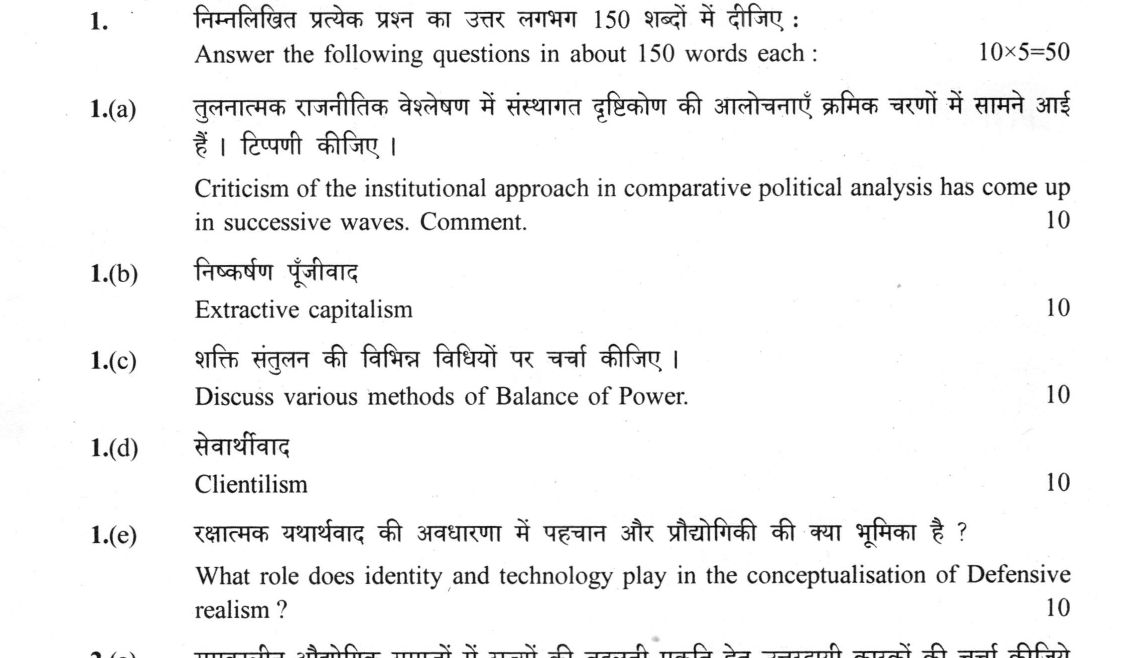
Answer the following questions in about 150 words each :
Criticism of the institutional approach in comparative political analysis has come up in successive waves. Comment. 10 marks
Extractive capitalism 10 marks
Discuss various methods of Balance of Power. 10 marks
Clientilism 10 marks
What role does identity and technology play in the conceptualisation of Defensive realism ? 10 marks
हिंदी में प्रश्न पढ़ें
निम्नलिखित प्रत्येक प्रश्न का उत्तर लगभग 150 शब्दों में दीजिए :
तुलनात्मक राजनीतिक विश्लेषण में संस्थागत दृष्टिकोण की आलोचनाएँ क्रमिक चरणों में सामने आई हैं । टिप्पणी कीजिए । (10 अंक)
निष्कर्षण पूँजीवाद (10 अंक)
शक्ति संतुलन की विभिन्न विधियों पर चर्चा कीजिए । (10 अंक)
सेवार्थीवाद (10 अंक)
रक्षात्मक यथार्थवाद की अवधारणा में पहचान और प्रौद्योगिकी की क्या भूमिका है ? (10 अंक)
Model answer
Drafted with AI by UPSC Answer Check against this question's marking rubric, to the 150-word length. UPSC does not publish answers for Mains — this is one way to score well, not an official key. How we build rubrics and answers.
(a) Successive waves of criticism of institutionalism The claim is accurate: criticism of the institutional approach came in successive waves. The first wave was the behavioural revolution (1950s–60s), where scholars like Roy Macridis (1955) and David Easton attacked legal-formal institutionalism for being static and descriptive. Almond and Powell’s structural-functionalism further marginalized formal structures in favor of social processes.
The second wave was the Marxist and political-economy critique (1970s–80s), which viewed institutions as mere superstructures of class power. Evans, Rueschemeyer and Skocpol’s Bringing the State Back In (1985) answered such society-centred views by insisting on state autonomy.
The third wave was the new-institutionalist self-critique: March and Olsen (1984) revived institutions, and Hall and Taylor (1996) distinguished between rational-choice, historical, and sociological institutionalism, addressing the "black box" problem.
The fourth wave is the post-colonial and informal-institutions critique (2000s–present). Scholars like O’Donnell and Helmke and Levitsky (2004) argue that formal rules often misdescribe reality, necessitating a study of informal institutions. Thus, the approach has been refined, not discarded.
(b) Extractive capitalism Extractive capitalism is a mode of accumulation defined by the extraction of resources, rents, or labor from specific populations or territories, often through coercive or unequal institutional frameworks. Theoretically, it is anchored in Acemoglu and Robinson’s (2012) distinction between extractive and inclusive institutions, and David Harvey’s concept of accumulation by dispossession (2003), which describes how capital expands by seizing assets.
In political economy, it is linked to the resource curse (Auty, 1993) and the rentier state (Beblawi and Luciani), where reliance on external rents weakens the social contract and fosters authoritarian resilience. Contemporary forms include neo-extractivism (Gudynas, Svampa) and data extractivism (Zuboff, 2019).
In the Indian context, the tension is visible in the conflict between development and rights, anchored in the PESA Act (1996) and Forest Rights Act (2006). The Niyamgiri case (2013), where the Supreme Court recognised the right of the Dongria Kondh gram sabhas to decide on mining, exemplifies the political consequences of extractive capitalism: the mobilization of local communities against state-corporate extraction.
(c) Methods of balance of power The Balance of Power is a system of international relations where states adjust their capabilities and alliances to prevent any single state from achieving preponderance. Hans Morgenthau (Politics Among Nations) identified several classical methods for maintaining this equilibrium:
- Divide and Rule: Preventing the unification of rival states to avoid a stronger adversary.
- Compensations: Granting territory to one state to satisfy its ambitions and prevent war, as seen in the Partitions of Poland (1772, 1793, 1795).
- Armaments: Maintaining a credible military deterrent.
- Alliances: Forming coalitions to counter a rising power, such as NATO (1949) and the Warsaw Pact (1955).
Kenneth Waltz further categorized these into internal balancing (building one's own capabilities) and external balancing (alliances). Stephen Walt (1987) refined this into the balance of threat, arguing states balance against perceived threats rather than just power.
Additionally, the buffer state and the "holder of the balance" (e.g., 19th-century Britain) are critical methods, where a state remains neutral or intervenes only to preserve the status quo.
(d) Clientelism Clientilism (or clientelism) is a political linkage where a patron (politician) provides material benefits to clients (voters) in exchange for political support. Unlike programmatic politics, which is based on policy platforms, clientelism is defined by contingency and monitoring. James C. Scott (1972) and Kitschelt and Wilkinson (2007) highlight that this exchange is relational and recurring, not a one-off transaction.
It is distinct from plain corruption or bribery because it involves a continuing relationship and a "quid pro quo" that is often monitored by the patron to ensure loyalty. Susan Stokes (Perverse Accountability, 2005) shows that monitoring inverts accountability, as parties hold voters to account; defenders note it still gives the poor access to resources.
In India, this is central to the political landscape. M.N. Srinivas (1955) described the vote bank system, while Kanchan Chandra (2004) analyzed patronage democracy, where local brokers (Anirudh Krishna's naya netas) use state resources to build personal followings. Partha Chatterjee (2004) links this to political society, where the urban poor use clientelistic networks to access the state.
(e) Identity and technology in defensive realism Defensive realism, associated with Kenneth Waltz and Robert Jervis, posits that states seek security rather than power maximisation, unlike Mearsheimer's offensive realism.
Technology plays a constitutive role through the offence-defence balance. Offence-dominant technology (e.g., blitzkrieg) encourages aggressive strategies; defence-dominant technology (e.g., trenches, secure second-strike nuclear forces) encourages restraint. Jervis (1978) adds distinguishability: where offensive and defensive weapons can be told apart, security-seekers can signal benign intent. Technology determines the cost of conquest and the feasibility of deterrence.
Identity plays a more oblique role. Defensive realism assumes states are "unit actors" with similar interests (survival). However, identity influences how states perceive intentions and threats. A state’s identity (e.g., as a revisionist or status-quo power) shapes its perception of others.
Here constructivists such as Alexander Wendt ("anarchy is what states make of it") attack: shared identities and norms can build security communities that dissolve the security dilemma.
How this answer will be evaluated
Evaluation rubric
Each sub-part is marked on its own, against the marks and word limit printed on the paper.
- (a) 'Comment' on a specific claim: that criticism of the institutional approach in comparative politics arrived in successive waves, not as one attack. The answer must therefore periodise the critique (behavioural, Marxist/political-economy, new-institutionalist self-critique, post-colonial/informal-institutions), not merely list defects of legal-formal institutionalism. 10 marks · 150 words
Must cover
- Roy Macridis, The Study of Comparative Government (1955)
- Behavioural revolution; David Easton; Almond and Powell's structural-functionalism
- March and Olsen, 'The New Institutionalism' (1984) / Rediscovering Institutions (1989)
- Hall and Taylor (1996): historical, rational-choice and sociological institutionalism
- Evans, Rueschemeyer and Skocpol, Bringing the State Back In (1985)
- Informal institutions - Helmke and Levitsky (2004); O'Donnell on illusions about consolidation (1996)
Loses marks
- Listing defects of legal-formal institutionalism in one undifferentiated block, ignoring the word 'successive waves' - the periodisation IS the question
- Confusing old institutionalism with new institutionalism, or treating new institutionalism only as a defence and never as itself a target of criticism
- Writing a general essay on approaches to comparative politics (systems, structural-functional, political economy) without anchoring each to a critique of institutionalism
- Attributing the behavioural critique to no one in particular; a 10-marker still needs at least two named scholars
- Concluding that the institutional approach is dead - the examiner expects the post-1980s revival to be acknowledged
Earns more
- Wave 2 - Marxist/political-economy and state-society critique; institutions as superstructure; 'Bringing the State Back In' (1985)
- Wave 4 - informal institutions and post-colonial critique (O'Donnell; Helmke and Levitsky), i.e. formal rules misdescribe politics outside the West
- (b) A 150-word conceptual note on 'extractive capitalism': define it, locate it theoretically (extractive institutions, accumulation by dispossession, neo-extractivism, rentier/resource-curse literature), give concrete cases and state its political consequences. 10 marks · 150 words
Must cover
- Acemoglu and Robinson, Why Nations Fail (2012) - extractive vs inclusive institutions
- David Harvey, accumulation by dispossession (The New Imperialism, 2003)
- Resource curse (Auty, 1993) / Paradox of Plenty (Terry Lynn Karl, 1997) / rentier state (Beblawi and Luciani)
- Neo-extractivism and the 'commodities consensus' (Gudynas, Svampa)
- An Indian statutory/judicial anchor: PESA 1996, Forest Rights Act 2006, Niyamgiri (Orissa Mining Corporation v. MoEF, 2013)
- Shoshana Zuboff, The Age of Surveillance Capitalism (2019) for data extractivism
Loses marks
- Treating 'extractive capitalism' as a synonym for capitalism as such, or simply as 'exploitation' - the note must turn on extraction of resources/rents
- Reproducing Acemoglu and Robinson's institutional argument alone, without the political-ecology and dispossession strand (or vice versa)
- Giving no case at all; abstract definition plus theory but zero empirical anchoring caps the answer at about half marks
- Confusing the resource curse (a macroeconomic-political outcome) with extractive capitalism (a mode of accumulation) and using them interchangeably without noting the link
- Writing 200-plus words on colonial drain theory and leaving no space for the contemporary form
Earns more
- Resource-curse / rentier-state dimension: Auty (1993), Karl's Paradox of Plenty (1997), Beblawi-Luciani, Dutch disease, weak taxation and authoritarian resilience
- Contemporary extension beyond minerals - data/surveillance capitalism (Zuboff, 2019) or the critical-minerals and green-transition scramble
- (c) 'Discuss the various methods' - the question asks specifically for the DEVICES or techniques by which balance of power is created and maintained, not for a definition essay or an evaluation. A brief definition then the classical Morgenthau methods plus modern additions is what earns marks. 10 marks · 150 words
Must cover
- Hans Morgenthau, Politics Among Nations - methods: divide and rule, compensations, armaments, alliances
- Partitions of Poland (1772, 1793, 1795) as compensation
- Buffer state and the 'holder of the balance'/balancer - Britain in the nineteenth century
- Kenneth Waltz - internal balancing (capabilities) vs external balancing (alliances)
- Stephen Walt, The Origins of Alliances (1987) - balance of threat; bandwagoning
- NATO (1949) and Warsaw Pact (1955) as alliance balancing
Loses marks
- Answering the wrong question - writing on the meaning, assumptions, types or criticisms of balance of power instead of the METHODS asked for
- Listing methods as bare bullet words with no example; 'compensation' without Poland, or 'alliance' without NATO, earns little
- Omitting the balancer/holder of the balance, which examiners treat as a standard component of the method list
- Confusing balance of power with collective security or with balance of terror without saying so explicitly
- Spending the whole note on Morgenthau's criticisms of balance of power (uncertainty, unreality, inadequacy) - relevant only as a one-line close
Earns more
- States a workable definition of balance of power (equilibrium preventing preponderance) before listing methods
- Intervention and non-intervention treated as deliberate balancing devices
- (d) A conceptual note on clientelism (printed as 'Clientilism'): define the patron-client linkage and its defining properties, distinguish it from programmatic politics and from plain corruption, name the core scholarship, and illustrate it - Indian illustration is strongly expected in this paper. 10 marks · 150 words
Must cover
- Patron-client dyad; contingency and monitoring as the defining mechanism
- James C. Scott, 'Patron-Client Politics and Political Change in Southeast Asia' (1972)
- Kitschelt and Wilkinson (2007) - clientelistic vs programmatic citizen-politician linkage
- Susan Stokes, 'Perverse Accountability' (2005) - vote buying and monitoring
- Indian anchor: vote bank (M.N. Srinivas, 1955) / Kanchan Chandra's patronage democracy (2004) / Partha Chatterjee's political society (2004)
Loses marks
- Equating clientelism with corruption or bribery; the examiner looks for the continuing, relational and contingent character that distinguishes it
- Writing only a moral condemnation with no definition, no scholar and no mechanism
- Ignoring the Indian empirical field altogether in a paper whose Section B is India-centred
- Confusing clientelism with patrimonialism or neo-patrimonialism (Weber, Eisenstadt) without noting that the latter concerns rule and administration, not electoral linkage
- Claiming clientelism is confined to poor or 'traditional' societies - urban machine politics such as Tammany Hall is a Western instance
Earns more
- Indian illustration named specifically - vote banks (M.N. Srinivas, 1955), Krishna's naya netas, Chandra's patronage democracy, Chatterjee's political society
- Balanced consequences: responsiveness and access for the poor versus erosion of programmatic accountability and citizenship
- (e) Two variables are named and both must be addressed: the role of TECHNOLOGY and the role of IDENTITY in how defensive realism is conceptualised. The honest answer is asymmetric - technology is constitutive through the offence-defence balance, while identity enters only obliquely through perceptions, intentions and state 'types', and is the point at which constructivists attack defensive realism. 10 marks · 150 words
Must cover
- Robert Jervis, 'Cooperation Under the Security Dilemma' (World Politics, 1978) - offence-defence balance and distinguishability
- Kenneth Waltz, Theory of International Politics (1979) - security, not power, is the end
- Stephen Van Evera, Causes of War (1999) and the 'cult of the offensive'
- Charles Glaser - security-seeking vs greedy states; Jack Snyder, Myths of Empire (1991)
- Contrast with Mearsheimer's offensive realism (The Tragedy of Great Power Politics, 2001)
- Alexander Wendt, 'Anarchy is What States Make of It' (1992) for the identity critique
Loses marks
- Answering on realism in general, or on the security dilemma alone, without naming defensive realism's distinctive claim about restraint
- Claiming identity is a central pillar of defensive realism - it is not; the sophisticated answer shows it enters only as perception, intention and state type
- Omitting 'distinguishability' and reducing technology to the offence-defence balance alone - Jervis's framework needs both axes
- Confusing defensive with offensive realism, or attributing Mearsheimer's power-maximisation to Waltz
- Giving no example of a technology that shifts the balance, leaving the answer purely abstract
Earns more
- Concrete technological illustration: trench/machine gun defence-dominance, blitzkrieg offence-dominance, or secure second-strike nuclear deterrence producing stability; Van Evera's cult of the offensive and 1914
- Notes the constructivist critique (Wendt, 1992) that identity, not technology, determines whether anarchy is threatening
What "Comment" is asking you to do
Take a position on the statement and support it. Comment usually attaches to a quoted line in the short slots, so the reasoning must be compressed — an opening view, a few load-bearing reasons, and the limit of the claim.
Structure that answers it
Unpack what the statement asserts → your stance → two or three supporting reasons → the qualification that limits it
Where marks are lost
Neutral summary; a comment without a stance has not answered. Equally costly is accepting the quoted line wholesale and never testing where it fails.
Practice this exact question
Write your answer and it is marked point by point against the model answer above — what you covered, what you missed, what you got wrong.
Evaluate my answer →More from Political Science & IR 2026 Paper II
- Q1 Answer the following questions in about 150 words each : (a) Criticism of the institution…
- Q2 (a) Discuss the factors responsible for the changing nature of states in contemporary ind…
- Q3 (a) NATO, the oldest surviving collective security system, is facing challenge of transac…
- Q4 (a) QUAD requires more robust architecture than the summit driven mode to tide over the c…