Paper II — Q3
(a) NATO, the oldest surviving collective security system, is facing challenge of transactional coercion from its own biggest…
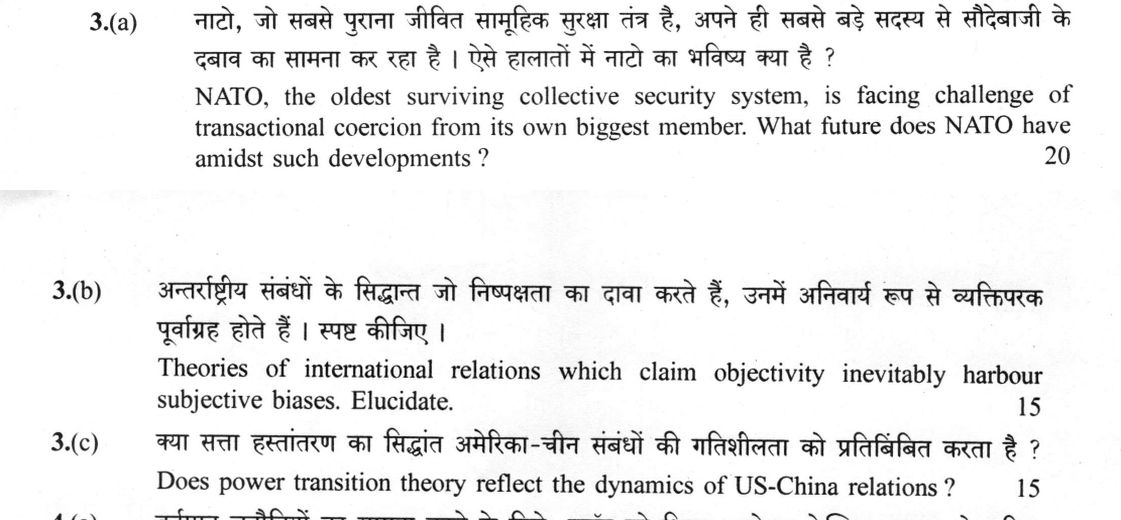
NATO, the oldest surviving collective security system, is facing challenge of transactional coercion from its own biggest member. What future does NATO have amidst such developments ? 20 marks
Theories of international relations which claim objectivity inevitably harbour subjective biases. Elucidate. 15 marks
Does power transition theory reflect the dynamics of US-China relations ? 15 marks
हिंदी में प्रश्न पढ़ें
नाटो, जो सबसे पुराना जीवित सामूहिक सुरक्षा तंत्र है, अपने ही सबसे बड़े सदस्य से सौदेबाजी के दबाव का सामना कर रहा है । ऐसे हालातों में नाटो का भविष्य क्या है ? (20 अंक)
अन्तर्राष्ट्रीय संबंधों के सिद्धान्त जो निष्पक्षता का दावा करते हैं, उनमें अनिवार्य रूप से व्यक्तिपरक पूर्वग्रह होते हैं । स्पष्ट कीजिए । (15 अंक)
क्या सत्ता हस्तांतरण का सिद्धांत अमेरिका-चीन संबंधों की गतिशीलता को प्रतिबिंबित करता है ? (15 अंक)
Model answer
Drafted with AI by UPSC Answer Check against this question's marking rubric, to the expected length. UPSC does not publish answers for Mains — this is one way to score well, not an official key. How we build rubrics and answers.
(a) NATO's future amid transactional coercion Strictly, NATO is a collective defence alliance, not a collective security system (a role reserved for the UN). Established in Washington on 4 April 1949 with twelve founding members, the alliance now comprises 32 states, following the accession of Finland (4 April 2023) and Sweden (7 March 2024). Its core mechanism, Article 5, has been invoked only once, after 11 September 2001.
The "transactional coercion" from the United States manifests primarily through the burden-sharing dispute: Washington has publicly tied its protection to allies' spending and, in 2025, pressed Denmark over Greenland. The 2014 Wales Summit pledged 2 per cent of GDP for defence, while the 2025 The Hague Summit raised the target to 5 per cent by 2035 (3.5 per cent core plus 1.5 per cent related). This pressure, combined with the 2022 Madrid Strategic Concept identifying Russia as the "most significant and direct threat," has triggered European hedging. Responses, foreshadowed by Macron's 2019 "brain death" remark, include Germany’s Zeitenwende, the EU Strategic Compass (2022), and PESCO.
NATO’s future is one of conditional survival rather than collapse. While the alliance’s value flows back to the US through extended deterrence, the credibility of Article 5 depends on the perceived political will of its members. Three futures are plausible: a Europeanised NATO with a stronger European pillar; a hollowed alliance if US guarantees become openly conditional; or renewed cohesion driven by the Russian threat. The first is the most likely, with NATO persisting within a more transactional framework.
(b) Objectivity and bias in IR theory The claim that International Relations (IR) theories harbour subjective biases challenges the positivist assertion of value-freedom. Robert Cox’s seminal 1981 argument that "theory is always for someone and for some purpose" distinguishes "problem-solving" theory—which manages the status quo—from "critical" theory, which questions the underlying social forces.
This bias is evident across multiple traditions. Stanley Hoffmann’s "An American Social Science" (1977) demonstrated that the discipline’s focus on the nation-state reflected American hegemony. Feminist scholars like J. Ann Tickner (1988) and Cynthia Enloe (1989) revealed that "objective" principles, such as Morgenthau’s, were constructed through gendered assumptions. Furthermore, post-colonial critiques, including Edward Said’s Orientalism (1978) and Amitav Acharya’s "Global IR," argue that the discipline’s "objectivity" is a Western-centric bias that marginalises non-Western ontologies.
Even constructivists like Alexander Wendt (1992) argue that "anarchy is what states make of it," suggesting that the social world is constituted by intersubjective ideas rather than existing objectively. A fair reading concedes the positivist reply that method and intersubjective testing reduce, though they cannot eliminate, bias. The appropriate response is therefore not relativism, but reflexivity: scholars must disclose their standpoints and engage in theoretical pluralism to achieve a more robust understanding of global politics.
(c) Power transition theory and US-China relations Power Transition Theory, formulated by A.F.K. Organski in 1958 and refined with Jacek Kugler in The War Ledger (1980), posits that war is most likely when a rising challenger reaches parity with a dominant hegemon and is "dissatisfied" with the status quo. In the US-China context, China overtook the US in GDP at purchasing power parity around 2014, though its nominal GDP remains lower. China’s rejection of the 2016 South China Sea arbitral award and the launch of the Belt and Road Initiative (2013) and AIIB suggest a dissatisfied challenger challenging the existing hierarchy.
However, the theory does not fully reflect the current dynamics. Unlike Organski’s historical cases, the US-China relationship is constrained by nuclear deterrence and deep economic interdependence; even the 2025 tariff escalation was followed by a negotiated truce rather than rupture. Furthermore, the "peaking-power thesis" (Brands and Beckley, 2022) suggests China's relative power is peaking, which may make it more risk-acceptant in a near-term "danger zone". While Graham Allison’s "Thucydides's Trap" (2017) highlights the risk of miscalculation, the theory’s determinism is limited by the measurement problem of "dissatisfaction."
In conclusion, Power Transition Theory provides a useful analytical frame for identifying the structural risks of US-China parity. However, it is not a destiny; the presence of nuclear weapons and the high costs of conflict suggest that the "dynamics" of the relationship are more complex than a simple transition to war.
How this answer will be evaluated
Evaluation rubric
Each sub-part is marked on its own, against the marks and word limit printed on the paper.
- (a) The question asserts that NATO faces 'transactional coercion from its own biggest member' (the United States) and asks what future the alliance has. The answer must establish NATO's basis and record, analyse the burden-sharing and credibility crisis, and then argue a reasoned set of futures. A sharp answer also corrects the premise - NATO is a collective DEFENCE alliance, not a collective security system. 20 marks
Must cover
- North Atlantic Treaty, 4 April 1949, Washington; twelve founding members; 32 members today
- Article 5 - invoked only once, after 11 September 2001; Article 4 consultations
- Finland acceded 4 April 2023; Sweden acceded 7 March 2024
- Wales Summit 2014 Defence Investment Pledge (2 per cent of GDP); The Hague Summit 2025 target of 5 per cent by 2035 (3.5 per cent core plus 1.5 per cent defence-related)
- 2022 Madrid Strategic Concept - Russia the most significant and direct threat; China a systemic challenge
- Macron's 'brain death' comment (2019); EU Strategic Compass (2022); PESCO; Germany's Zeitenwende
- Collective defence versus collective security distinction
Loses marks
- Accepting the question's phrase 'collective security system' uncritically; the best answers note that NATO is a collective defence alliance and that the UN is the collective security system
- Claiming Article 5 has been invoked in Ukraine, Kosovo, Libya or Afghanistan - it has been invoked exactly once, after 9/11
- Writing a chronological history of NATO from 1949 to the present and never reaching the 'what future' question, which carries independent weight
- Naming no spending figure or summit; the burden-sharing dispute is the core of the question and needs the 2 per cent and 5 per cent benchmarks
- Predicting NATO's collapse or its unchanged continuity in absolute terms, instead of setting out conditional scenarios
- Getting the member count wrong (it is 32) or dating Sweden's accession to 2023 rather than 7 March 2024
Earns more
- Explains the credibility mechanism: Article 5 is politically conditional ('such action as it deems necessary'), so extended deterrence depends on perceived will; alliance value also flows back to the United States
- European hedging responses: Macron's 2019 'brain death' remark, EU Strategic Compass (2022), PESCO and the European Defence Fund, Germany's Zeitenwende, and the 2025 European rearmament instruments
- Notes the 2022 Madrid Strategic Concept (Russia as the most significant and direct threat, China as a systemic challenge) and the Ukraine membership question from Bucharest 2008 to the NATO-Ukraine Council of 2023
- (b) 'Elucidate' a meta-theoretical claim: that IR theories claiming objectivity necessarily carry subjective bias. The answer must explain the positivist objectivity claim, then demonstrate bias through at least three critical traditions (critical theory, feminist, post-colonial/Global IR), and close with what follows - reflexivity rather than nihilism. 15 marks
Must cover
- Robert Cox, 'Social Forces, States and World Orders' (Millennium, 1981) - 'theory is always for someone and for some purpose'; problem-solving vs critical theory
- J. Ann Tickner's feminist reformulation of Morgenthau's principles (1988); Cynthia Enloe, Bananas, Beaches and Bases (1989)
- Edward Said, Orientalism (1978)
- Amitav Acharya and Barry Buzan, Non-Western International Relations Theory (2010); Acharya's 'Global IR'
- Stanley Hoffmann, 'An American Social Science: International Relations' (1977)
- Alexander Wendt, 'Anarchy is What States Make of It' (1992)
- The fact-value dichotomy and the positivist claim to value-freedom
Loses marks
- Listing IR theories and their criticisms one by one instead of addressing the meta-theoretical claim about objectivity and bias
- Quoting Cox's sentence without explaining the problem-solving/critical distinction that gives it force
- Covering only one critical tradition; the 15 marks are spread across critical, feminist and post-colonial lines of attack
- Sliding into total relativism - 'all theory is opinion' - without acknowledging method, evidence and intersubjective testing
- Confusing Cox's critical theory with Marxist structuralism or with constructivism, or attributing 'problem-solving theory' to Waltz's own vocabulary
Earns more
- Disciplinary sociology and the positivism debate - Hoffmann's 'An American Social Science' (1977), the Bull-Kaplan second debate (1966), Habermas's knowledge-constitutive interests
- Constructivist/post-structural reinforcement - Wendt (1992) that anarchy has no objective logic; discourse constituting its object
- Reaches a resolution rather than relativism: reflexivity, disclosure of standpoint and theoretical pluralism as the response, with a fair statement of the positivist defence
- (c) A yes/no analytical question requiring a verdict. State power transition theory accurately (Organski), apply each of its components - hierarchy, parity, dissatisfaction, war risk - to the US-China case, present the evidence that does not fit, and answer the question asked. 15 marks
Must cover
- A.F.K. Organski, World Politics (1958) - power transition theory; hierarchy rather than anarchy
- Organski and Kugler, The War Ledger (1980)
- Satisfied versus dissatisfied challenger; war risk maximal at parity/overtaking
- Graham Allison, Destined for War: Can America and China Escape Thucydides's Trap? (2017)
- China overtook the US in GDP at purchasing power parity around 2014; nominal GDP still substantially lower
- South China Sea arbitral award, 12 July 2016, rejected by China; Belt and Road Initiative (2013); AIIB
- Counter-arguments: nuclear deterrence, economic interdependence, the peaking-power thesis (Brands and Beckley, 2022)
Loses marks
- Confusing power transition theory with balance-of-power or hegemonic stability theory, or attributing it to Gilpin or Modelski without distinguishing their long-cycle and hegemonic-war variants
- Treating 'Thucydides's Trap' as the theory itself; Allison popularised it, Organski formulated the theory in 1958
- Omitting the dissatisfaction variable and arguing only from Chinese growth rates - parity alone does not predict war in the theory
- Quoting GDP or military figures without distinguishing purchasing power parity from nominal terms, which reverses the conclusion
- Ducking the verdict; the question begins with 'Does', so an answer without a clear position loses marks
- Ignoring nuclear weapons, the single most important disanalogy with Organski's historical cases
Earns more
- Explicit contrast with balance-of-power theory - equilibrium means peace in balance of power but danger in power transition; preponderance is pacifying
- Cites Graham Allison's Destined for War (2017) and the Thucydides's Trap framing (sixteen cases, twelve wars) as the contemporary application
- Presents the counter-evidence and theoretical limits - nuclear deterrence, interdependence, China as partial stakeholder, the peaking-power thesis (Brands and Beckley, 2022), determinism and the measurement problem - and delivers a clear verdict
What "Explain" is asking you to do
Make the working of something clear — what sets it off, what follows from what, and what it produces. Explain is the Commission's mechanism word: it dominates the technical papers and the “explain why” stems, where the marks sit in the causal chain and not in the label.
Structure that answers it
State what it is → the initiating condition → the chain of cause, step by step → an instance where it plays out → what the chain produces
Where marks are lost
Describing what something looks like instead of why it works that way. Naming the stages without linking them reads as description too.
Practice this exact question
Write your answer and it is marked point by point against the model answer above — what you covered, what you missed, what you got wrong.
Evaluate my answer →More from Political Science & IR 2026 Paper II
- Q1 Answer the following questions in about 150 words each : (a) Criticism of the institution…
- Q2 (a) Discuss the factors responsible for the changing nature of states in contemporary ind…
- Q3 (a) NATO, the oldest surviving collective security system, is facing challenge of transac…
- Q4 (a) QUAD requires more robust architecture than the summit driven mode to tide over the c…
- Q5 Answer the following questions in about 150 words each : (a) Describe India's objections…
- Q6 (a) Accelerating of Chinese influence across South Asia is fundamentally reshaping the re…