Paper II — Q5
(a) Describe India's objections to agricultural negotiations at the World Trade Organisation. (10 marks) (b) What strategic…
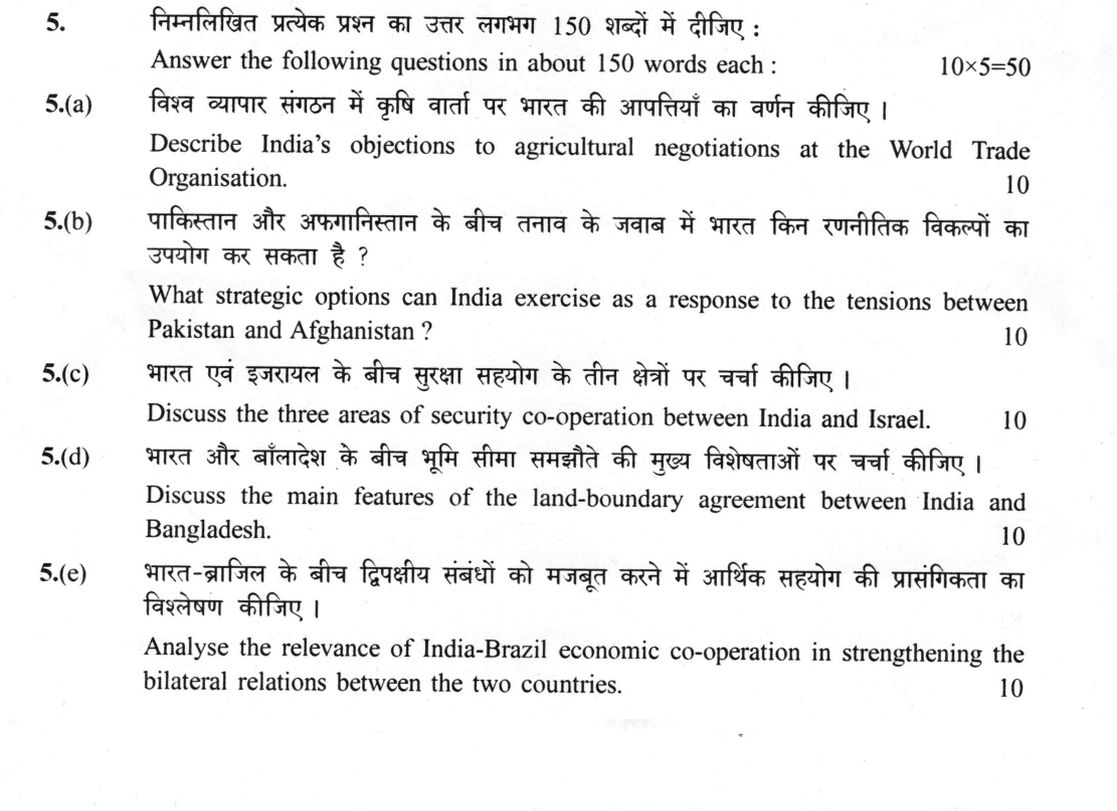
Answer the following questions in about 150 words each :
Describe India's objections to agricultural negotiations at the World Trade Organisation. 10 marks
What strategic options can India exercise as a response to the tensions between Pakistan and Afghanistan ? 10 marks
Discuss the three areas of security co-operation between India and Israel. 10 marks
Discuss the main features of the land-boundary agreement between India and Bangladesh. 10 marks
Analyse the relevance of India-Brazil economic co-operation in strengthening the bilateral relations between the two countries. 10 marks
हिंदी में प्रश्न पढ़ें
निम्नलिखित प्रत्येक प्रश्न का उत्तर लगभग 150 शब्दों में दीजिए :
विश्व व्यापार संगठन में कृषि वार्ता पर भारत की आपत्तियों का वर्णन कीजिए । (10 अंक)
पाकिस्तान और अफगानिस्तान के बीच तनाव के जवाब में भारत किन रणनीतिक विकल्पों का उपयोग कर सकता है ? (10 अंक)
भारत एवं इजरायल के बीच सुरक्षा सहयोग के तीन क्षेत्रों पर चर्चा कीजिए । (10 अंक)
भारत और बांग्लादेश के बीच भूमि सीमा समझौते की मुख्य विशेषताओं पर चर्चा कीजिए । (10 अंक)
भारत-ब्राज़ील के बीच द्विपक्षीय संबंधों को मजबूत करने में आर्थिक सहयोग की प्रासंगिकता का विश्लेषण कीजिए । (10 अंक)
Model answer
Drafted with AI by UPSC Answer Check against this question's marking rubric, to the 150-word length. UPSC does not publish answers for Mains — this is one way to score well, not an official key. How we build rubrics and answers.
(a) India's objections in WTO agriculture negotiations
India's objections stem from the structural asymmetry of the Agreement on Agriculture (AoA), in force from 1 January 1995. Across its three pillars (market access, domestic support, export competition), developed members kept large Aggregate Measurement of Support entitlements from historical subsidies, while most developing members are confined to a de minimis of 10 per cent of the value of production (5 per cent for developed members), and much rich-country support has moved into the Green Box. First, the External Reference Price is frozen at 1986-88 and not inflation-adjusted, inflating India's measured support. Second, India, with the G-33, wants procurement at minimum support prices for public stockholding under the National Food Security Act, 2013 kept out of the Amber Box; the Bali "peace clause" (December 2013) and the General Council decision of 27 November 2014 are only interim. Third, it seeks a Special Safeguard Mechanism and Special Products, since the Special Safeguard (Article 5) is available mainly to developed members. Fourth, it defends Special and Differential Treatment and the Doha mandate against "graduation"; MC13 (Abu Dhabi, 2024) ended without an agriculture outcome.
(b) India's options amid Pakistan-Afghanistan tensions
The tensions stem from the Durand Line (1893), never accepted by any Afghan government including the Taliban, Tehrik-i-Taliban Pakistan sanctuaries, Pakistani cross-border strikes, refugee deportations and the October 2025 border clashes. India has four options. First, engagement without recognition: the technical mission reopened in June 2022 was restored to embassy status in October 2025. Second, connectivity and development: Chabahar (ten-year Shahid Beheshti terminal agreement, 13 May 2024), the INSTC and the Afghan-India Friendship (Salma) Dam, 2016, reduce Afghan dependence on Pakistani transit. Third, humanitarian and capacity-building leverage: the Zaranj-Delaram highway, the Parliament building, food and medical aid, and scholarships. Fourth, counter-terrorism red lines through regional coordination: UNSC Resolution 2593 (30 August 2021, under India's presidency), the 1267 listings, the Moscow Format and the Delhi Regional Security Dialogue (November 2021). The trade-offs are legitimation of the Taliban, sanctions exposure of Chabahar, displaced militancy and a possible Pakistan-Taliban reconciliation; military involvement is neither feasible nor wise.
(c) Three areas of India-Israel security co-operation
Since full diplomatic relations on 29 January 1992, and a strategic partnership from 2017, co-operation has run in three domains. First, defence procurement and co-development: the Barak-8/MRSAM system co-developed by DRDO and Israel Aerospace Industries, Phalcon AWACS on IL-76 aircraft, Heron and Searcher UAVs, Harop loitering munitions and SPICE-2000 guided bombs. Second, counter-terrorism and intelligence: the Joint Working Group on Counter-Terrorism (2000) and continuing intelligence and homeland-security exchanges. Third, space and surveillance: the PSLV launch of Israel's TecSAR (2008), the IAI-built RISAT-2 (2009), and Israeli sensors in India's border-surveillance systems such as the CIBMS. This is a strategic partnership, not an alliance or mutual-defence treaty. India balances it through a de-hyphenated policy, continued support for a two-state solution for Palestine, and its equities in the Gulf and Iran.
(d) The India-Bangladesh Land Boundary Agreement
The settlement rests on the Indira-Mujib Land Boundary Agreement of 16 May 1974 and its Protocol of 6 September 2011, operationalised by the Constitution (One Hundredth Amendment) Act, 2015, which amended the First Schedule for Assam, West Bengal, Meghalaya and Tripura. Its main features are: first, the exchange of enclaves with effect from midnight of 31 July 2015 - 111 Indian enclaves (about 17,160 acres) to Bangladesh and 51 Bangladeshi enclaves (about 7,110 acres) to India; second, regularisation of adverse possessions on an as-is basis, about 2,777 acres to India and 2,268 acres to Bangladesh; third, demarcation of about 6.1 km of undemarcated boundary in Daikhata-56 (West Bengal), Muhuri River-Belonia (Tripura) and Lathitila-Dumabari (Assam); and fourth, a choice of citizenship for about 51,500 enclave residents, ending decades of statelessness. It stabilised India's longest land border (about 4,096.7 km), though it is separate from the Teesta water issue and the 2014 maritime award.
(e) India-Brazil economic co-operation
With no geographic proximity or security interdependence, economic co-operation is the ballast that can give the strategic partnership (since 2006) material depth. The India-MERCOSUR Preferential Trade Agreement (signed 2004, in force 2009) covers only a narrow range of tariff lines, yet trade is complementary: Indian petroleum products, pharmaceuticals and agrochemicals against Brazilian crude, soya oil and sugar. During the July 2025 state visit the leaders set a target of US$20 billion in trade by 2030, up from about US$12 billion. Energy and technology deepen it: ONGC Videsh in Brazilian offshore blocks, the Global Biofuels Alliance launched at the G20 New Delhi Summit (9 September 2023) with both as founders, and the PSLV launch of Amazonia-1 (February 2021). This substance underpins their alignment in BRICS, IBSA, the G4 and BASIC. Constraints remain - distance, thin shipping and banking links, Brazil's WTO challenge to Indian sugar subsidies, and non-tariff barriers - so economics is the weakest pillar and the most consequential to build.
How this answer will be evaluated
Evaluation rubric
Each sub-part is marked on its own, against the marks and word limit printed on the paper.
- (a) 'Describe India's objections' - the answer must set out India's specific negotiating grievances at the WTO on agriculture: the structural asymmetry of the Agreement on Agriculture, the frozen 1986-88 external reference price, the unresolved public stockholding question, the demand for a Special Safeguard Mechanism, and the defence of Special and Differential Treatment. It is India's positions, not a general account of the WTO, that earn marks. 10 marks · 150 words
Must cover
- Agreement on Agriculture, in force 1 January 1995; three pillars - market access, domestic support, export competition
- Amber Box / Aggregate Measurement of Support; de minimis 10 per cent for developing and 5 per cent for developed members; Green Box (Annex 2) and Blue Box
- External reference price fixed at the 1986-88 base period, not inflation-adjusted
- Public stockholding; National Food Security Act, 2013; Bali 'peace clause' (MC9, December 2013) and the General Council decision of 27 November 2014
- Special Safeguard Mechanism (SSM) and Special Products; the G-33 coalition
- Special and Differential Treatment; Doha Development Agenda (2001); MC13, Abu Dhabi (2024) ended without an agriculture outcome
Loses marks
- Writing a general description of the WTO, the Doha Round or the AoA without stating India's objections, which is what the question asks
- Confusing the boxes - placing MSP in the Green Box, or describing the Blue Box as a developing-country flexibility
- Omitting the 1986-88 external reference price point, which is the single most distinctive technical element of India's case
- Treating the Bali peace clause as a permanent solution; it is an interim due-restraint mechanism that India continues to seek to replace
- Confusing the Special Safeguard (SSG, Article 5, retained mainly by developed members) with the Special Safeguard Mechanism (SSM, demanded by developing members)
- Mixing up the WTO agriculture dispute with the separate fisheries-subsidies negotiation without distinguishing them
Earns more
- Demand for a Special Safeguard Mechanism and Special Products for developing members, contrasted with the Special Safeguard retained by developed members under Article 5 of the AoA; the G-33 coalition
- Defence of Special and Differential Treatment and of the Doha Development Agenda mandate; resistance to graduation and to new issues displacing unfinished agriculture business
- (b) The question asks what STRATEGIC OPTIONS India can exercise in response to Pakistan-Afghanistan tensions. A brief statement of the sources of that tension is needed as context, but the bulk of the answer must be a set of distinct, argued policy options with their trade-offs. 10 marks · 150 words
Must cover
- Durand Line (1893) - never accepted by any Afghan government, including the Taliban
- Tehrik-i-Taliban Pakistan sanctuaries; Pakistani cross-border strikes; Torkham and Chaman closures; deportation of Afghan refugees; the October 2025 border clashes
- India's technical mission reopened in Kabul, June 2022, restored to embassy status in October 2025; engagement without recognition
- Chabahar port - ten-year Shahid Beheshti terminal agreement signed 13 May 2024; INSTC
- Afghan-India Friendship Dam (Salma Dam), inaugurated 2016; Zaranj-Delaram highway; Afghan Parliament building
- UN Security Council Resolution 2593 of 30 August 2021, adopted under India's presidency
- Regional formats: Moscow Format; Delhi Regional Security Dialogue on Afghanistan, November 2021
Loses marks
- Spending the whole answer narrating Pakistan-Afghanistan history and never listing India's options, which is the actual demand
- Recommending recognition of the Taliban government as settled policy, or asserting that India has recognised it - India has not
- Proposing covert or military intervention in Afghanistan as a serious option; India has no contiguity and no such capability posture
- Confusing Chabahar (Iran, developed with Indian participation) with Gwadar (Pakistan, Chinese-operated)
- Omitting the trade-offs entirely, producing a wish-list rather than a strategic assessment
- Overstating the durability of the Pakistan-Taliban rift; ideological and Pashtun linkages allow for reconciliation
Earns more
- Development, humanitarian and capacity-building leverage with named assets - Afghan-India Friendship (Salma) Dam 2016, Zaranj-Delaram highway, the Parliament building, wheat and medicines, ITEC scholarships
- Counter-terrorism red lines and regional coordination: UNSC Resolution 2593 (30 August 2021) adopted under India's presidency, the 1267 listing process, the Moscow Format and the Delhi Regional Security Dialogue of November 2021
- States the trade-offs and the case for restraint - legitimation risk, reversibility if Kabul and Rawalpindi reconcile, sanctions exposure of Chabahar, and the danger of displaced militancy
- (c) The question specifies a number: discuss THREE areas of India-Israel security co-operation. The answer must identify three distinct domains - not three weapons - and substantiate each with named platforms, agreements or mechanisms. Answering with one area, or with an undifferentiated list, loses marks. 10 marks · 150 words
Must cover
- Diplomatic relations established 29 January 1992; strategic partnership 2017
- Barak-8 / MRSAM co-developed by DRDO and Israel Aerospace Industries
- Phalcon AWACS on IL-76; Heron and Searcher UAVs; Harop loitering munitions; SPICE-2000 guided bombs
- Joint Working Group on Counter-Terrorism (2000); intelligence and homeland-security co-operation
- Space and surveillance: PSLV launch of TecSAR (2008); RISAT-2 from IAI; CIBMS-linked border sensing
- India's de-hyphenated policy and continued support for a two-state solution
Loses marks
- Listing weapons only, so that all three 'areas' collapse into defence procurement - the question expects three distinct domains
- Omitting counter-terrorism and intelligence, the least tangible but most consistently cited area
- Giving no platform, agreement or mechanism by name; generic claims about 'strong defence ties' earn little
- Asserting a formal military alliance or mutual-defence treaty between India and Israel - none exists
- Ignoring India's Palestine position altogether, which examiners treat as an expected caveat in this paper
- Dating diplomatic relations to 1950 (that was India's recognition of Israel) rather than to the establishment of full relations in January 1992
Earns more
- Establishes the frame: full diplomatic relations 29 January 1992; strategic partnership from the July 2017 prime ministerial visit
- Notes the balancing constraint - de-hyphenation of Israel and Palestine, continued Indian support for a two-state solution, and Gulf and Iranian equities
- (d) 'Discuss the main features' of the India-Bangladesh land boundary agreement. This is a precision question: the 1974 agreement and its 2011 protocol, the constitutional amendment that operationalised it in 2015, the exchange of enclaves, adverse possessions, the un-demarcated stretches and the citizenship option are the features that carry marks. 10 marks · 150 words
Must cover
- Indira-Mujib Land Boundary Agreement, 16 May 1974; Protocol of 6 September 2011
- Constitution (One Hundredth Amendment) Act, 2015; amended the First Schedule for Assam, West Bengal, Meghalaya and Tripura; exchange effective 31 July 2015
- 111 Indian enclaves (about 17,160 acres) to Bangladesh; 51 Bangladeshi enclaves (about 7,110 acres) to India
- Adverse possessions regularised - approximately 2,777 acres to India and 2,268 acres to Bangladesh
- 6.1 km of un-demarcated boundary in three sectors: Daikhata-56 (West Bengal), Muhuri River/Belonia (Tripura), Lathitila-Dumabari (Assam)
- Right of choice of citizenship for enclave residents (about 51,500 people: 37,334 in Indian enclaves in Bangladesh, 14,215 in Bangladeshi enclaves in India)
- India-Bangladesh land boundary length 4,096.7 km - India's longest land border
Loses marks
- Attributing the settlement to 2015 alone and omitting the 1974 agreement and the 2011 Protocol of which the 2015 amendment was merely the ratification
- Naming the wrong constitutional amendment; it is the One Hundredth Amendment Act, 2015, not the 119th Bill number as introduced or any other
- Reversing the enclave figures - 111 Indian enclaves went to Bangladesh and 51 Bangladeshi enclaves came to India, not the other way round
- Confusing the land boundary settlement with the maritime boundary award of 7 July 2014, which was a separate Annex VII arbitration
- Claiming that India 'lost' large territory; the net reduction was about 9,500 acres, almost all of it enclave territory India never administered, so the exchange regularised de facto possession rather than surrendering governed land
- Asserting that the agreement resolved illegal migration or the Teesta dispute - it did not
Earns more
- Right of choice of citizenship for about 51,500 enclave residents (37,334 in Indian enclaves in Bangladesh, 14,215 in Bangladeshi enclaves in India), with resettlement of those opting for India and no forced displacement
- Significance and limits: ends statelessness and enables cooperative border management on the 4,096.7 km boundary, is a model settlement, but leaves Teesta, illegal migration and border killings unresolved
- (e) 'Analyse the relevance' of India-Brazil economic co-operation for strengthening bilateral relations. The answer must go beyond describing trade: it must argue why economic ties matter as ballast for a relationship without geographic proximity or security interdependence, evidence this with trade, energy and investment specifics, and identify the constraints. 10 marks · 150 words
Must cover
- Strategic partnership since 2006; diplomatic relations since 1948; July 2025 state visit and the US$20 billion trade target for 2030
- India-MERCOSUR Preferential Trade Agreement - signed 25 January 2004, in force 1 June 2009, narrow tariff-line coverage
- Trade composition - Indian petroleum products, pharmaceuticals and agrochemicals; Brazilian crude, soya and vegetable oils, sugar, gold, cotton
- Global Biofuels Alliance, launched at the G20 New Delhi Summit, 9 September 2023, with India, Brazil and the United States as founding members
- ONGC Videsh participation in Brazilian offshore hydrocarbon blocks
- PSLV launch of Brazil's Amazonia-1 satellite, 28 February 2021
- Multilateral convergence: BRICS, IBSA (Brasilia Declaration, 2003), G4, BASIC, WTO agricultural coalitions
Loses marks
- Producing a general 'India-Brazil relations' answer covering culture, sport and diaspora while neglecting the economic focus the question sets
- Giving no figures at all, or quoting a trade number without a year, so that the scale of the relationship is left undefined
- Omitting the India-MERCOSUR PTA, which is the central institutional fact of the economic relationship
- Ignoring the divergence in agricultural trade interests and Brazil's WTO complaint against Indian sugar subsidies, which the word 'analyse' requires
- Confusing MERCOSUR with the Pacific Alliance or treating a MERCOSUR agreement as concluded bilaterally with Brazil alone
- Asserting that economic ties are already the strongest pillar; the honest analysis is that they are the weakest and therefore the most consequential to build
Earns more
- Energy, biofuels and technology substance: ONGC Videsh in Brazilian offshore blocks, the Global Biofuels Alliance launched at the G20 New Delhi Summit on 9 September 2023, and the PSLV launch of Amazonia-1 in February 2021
- Connects economics to political alignment - BRICS, IBSA (2003), the G4 on UNSC reform, BASIC in climate talks and WTO coalitions - and explains why economic content is what makes such alignment durable
- Analyses constraints candidly: distance and logistics costs, absent shipping and banking links, Brazil's offensive versus India's defensive agricultural interests including the sugar dispute, and non-tariff barriers
What "Describe" is asking you to do
Give a full, ordered account of the thing named — its parts, stages or mechanism — in the sequence in which it actually exists or occurs. Most describe questions come from the science optionals, where the marks sit in correct technical detail and, where the stem says so, a labelled diagram.
Structure that answers it
One-line identification of the subject → the parts or stages in their real order, each with its defining detail → labelled diagram where the subject is structural → closing line on function or significance
Where marks are lost
Loose general prose where the examiner is ticking named parts, correct terminology and their sequence; and in the General Studies papers, turning to evaluation before the description is finished.
Practice this exact question
Write your answer and it is marked point by point against the model answer above — what you covered, what you missed, what you got wrong.
Evaluate my answer →More from Political Science & IR 2026 Paper II
- Q2 (a) Discuss the factors responsible for the changing nature of states in contemporary ind…
- Q3 (a) NATO, the oldest surviving collective security system, is facing challenge of transac…
- Q4 (a) QUAD requires more robust architecture than the summit driven mode to tide over the c…
- Q5 Answer the following questions in about 150 words each : (a) Describe India's objections…
- Q6 (a) Accelerating of Chinese influence across South Asia is fundamentally reshaping the re…
- Q7 (a) How does illegal cross border migration pose challenges to India's security? Discuss…
- Q8 (a) Critically evaluate India-Russia relations in the 21st century. How have both the cou…