Paper II — Q7
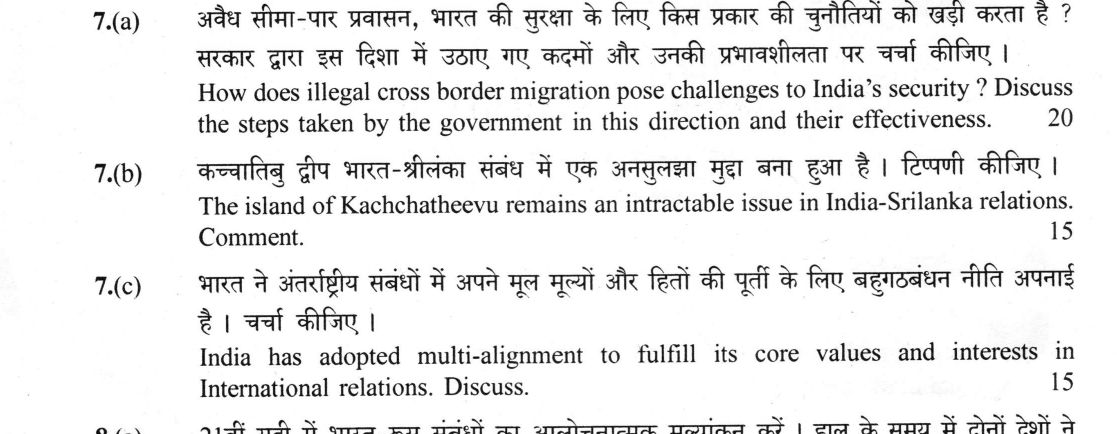
(a) How does illegal cross border migration pose challenges to India's security? Discuss the steps taken by the government in…
How does illegal cross border migration pose challenges to India's security? Discuss the steps taken by the government in this direction and their effectiveness. 20 marks
The island of Kachchatheevu remains an intractable issue in India-Srilanka relations. Comment. 15 marks
India has adopted multi-alignment to fulfill its core values and interests in International relations. Discuss. 15 marks
हिंदी में प्रश्न पढ़ें
अवैध सीमा-पार प्रवासन, भारत की सुरक्षा के लिए किस प्रकार की चुनौतियों को खड़ी करता है? सरकार द्वारा इस दिशा में उठाए गए कदमों और उनकी प्रभावशीलता पर चर्चा कीजिए। (20 अंक)
कच्चातिवु द्वीप भारत-श्रीलंका संबंध में एक अनसुलझा मुद्दा बना हुआ है। टिप्पणी कीजिए। (15 अंक)
भारत ने अंतर्राष्ट्रीय संबंधों में अपने मूल मूल्यों और हितों की पूर्ति के लिए बहु-संरेखण (मल्टी-अलाइनमेंट) नीति अपनाई है। चर्चा कीजिए। (15 अंक)
Model answer
Drafted with AI by UPSC Answer Check against this question's marking rubric, to the expected length. UPSC does not publish answers for Mains — this is one way to score well, not an official key. How we build rubrics and answers.
(a) Illegal migration: security challenges, government steps and effectiveness
Illegal cross-border migration poses a multifaceted threat to India’s security, which the Supreme Court in Sarbananda Sonowal v. Union of India (2005) described as "external aggression" under Article 355 of the Constitution. The security challenges are both internal and external. Internally, it facilitates infiltration, the creation of sleeper modules, and the trafficking of fake Indian currency notes (FICN), arms, and narcotics. It also leads to fraudulent identity documents that corrupt electoral rolls and welfare delivery systems. Furthermore, it exacerbates ethnic conflicts and resource competition, as seen in the Bodoland violence of 2012 and the interaction of post-2021 cross-border movement from Myanmar with the Manipur violence from 2023.
To address these challenges, the government has implemented a multi-pronged strategy. Legally, the Assam Accord (15 August 1985) set a cut-off date of 24 March 1971, given statutory form in Section 6A of the Citizenship Act (upheld by the Supreme Court in October 2024), leading to the final Assam NRC list of 31 August 2019. The Foreigners Act, 1946 and allied laws have been consolidated into the Immigration and Foreigners Act, 2025, administered by Foreigners Tribunals. The Citizenship (Amendment) Act, 2019 separately provides a fast-track citizenship pathway for specified non-Muslim minorities from Afghanistan, Bangladesh and Pakistan who entered before 31 December 2014, while the Coordinated Border Management Plan (2011) with Bangladesh and the Border Area Development Programme (BADP) address developmental gaps.
On the physical front, the Comprehensive Integrated Border Management System (CIBMS) and BOLD-QIT riverine surveillance are deployed along the 4,096.7 km Bangladesh border. A significant recent shift is the decision to curtail the Free Movement Regime with Myanmar and fence the 1,643 km border (2024).
The effectiveness of these measures is mixed. Fencing has reduced crossings on many stretches, but the riverine and hilly stretches remain difficult to secure, and the Assam NRC, which left out about 19 lakh people, has yet to be notified by the Registrar General and remains contested. India’s lack of a domestic refugee law and its non-participation in the 1951 Refugee Convention create a legal vacuum. Furthermore, the Vibrant Villages Programme (2023), extended to other land borders as VVP-II in 2025, is still in its early stages, and the sheer length of the borders makes complete containment a persistent challenge.
(b) Kachchatheevu in India-Sri Lanka relations
Kachchatheevu, an uninhabited island of about 285 acres in the Palk Strait near Rameswaram, is a point of contention between India and Sri Lanka. The island's status was settled by the 1974 agreement between Indira Gandhi and Sirimavo Bandaranaike, which placed it on the Sri Lankan side of the boundary in historic waters. This was followed by the 1976 agreement on the Gulf of Mannar and Bay of Bengal boundary, which barred fishing in each other's Exclusive Economic Zones (EEZ) and historic waters.
The issue remains intractable due to a combination of legal, constitutional, and economic factors. Legally, the Berubari Union advisory opinion (1960) suggests that cession of territory requires a constitutional amendment. While the Union government maintains that the 1974 agreement settled a disputed boundary rather than ceding territory, Tamil Nadu Assembly resolutions and pending Supreme Court petitions continue to challenge this view. The controversy gained further salience during the 2024 general election campaign.
However, the primary driver of the dispute is not the island itself, but the depletion of Palk Bay resources. Bottom trawling by Tamil Nadu mechanised boats and the frequent arrests of Indian fishermen by the Sri Lankan Navy have kept the issue alive. A realistic way forward, rather than demanding retrieval, involves the Joint Working Group on Fisheries (2016), the phased elimination of bottom trawling, a deep-sea fishing conversion scheme for Palk Bay trawlers, and humanitarian protocols on the detention of fishermen, alongside continued pilgrim access to St Antony's Church as provided in the 1974 agreement.
(c) India's multi-alignment
India’s foreign policy has evolved from the non-alignment rooted in Panchsheel (1954) and Bandung (1955), institutionalised in the Non-Aligned Movement (NAM) founded at Belgrade in 1961 and restated in NonAlignment 2.0 (2012), to a strategy of "multi-alignment." Unlike non-alignment, which meant staying out of bloc alliances while judging issues on their merits, multi-alignment involves simultaneous and overlapping partnerships to serve core values and interests. As articulated by S. Jaishankar in The India Way (2020) and Why Bharat Matters (2024), this approach focuses on issue-based coalitions and strategic autonomy.
India’s multi-alignment is evident in its simultaneous membership in the Quad, the SCO (full member since 2017), BRICS, and RIC. It has deepened ties with the United States through agreements like LEMOA (2016), COMCASA (2018), and BECA (2020), while also maintaining the S-400 contract with Russia (2018) despite CAATSA. India’s abstentions on UN resolutions regarding Ukraine (2022) and its "this is not an era of war" formulation reflect its commitment to strategic autonomy. Economically, India is pursuing the International North-South Transport Corridor (INSTC) and the India-Middle East-Europe Economic Corridor (IMEC, announced at the G20 New Delhi Summit in September 2023), while remaining outside RCEP and the IPEF trade pillar.
This strategy serves India’s interests in energy security (increased Russian crude purchases), technology access, and diplomatic leverage. However, it has costs and limits. The Galwan clash (June 2020) demonstrated that multi-alignment does not provide security guarantees in a crisis. Furthermore, India is dependent on a permissive international environment that can be disrupted by tariffs or sanctions, as the 2025 US tariff penalty linked to India's Russian oil purchases showed, and there remains a capability gap between its strategic ambitions and its available resources.
How this answer will be evaluated
Evaluation rubric
Each sub-part is marked on its own, against the marks and word limit printed on the paper.
- (a) Three compulsory parts: (i) HOW illegal cross-border migration challenges India's security; (ii) the STEPS taken by the government; and (iii) an assessment of their EFFECTIVENESS. All three must be present and the third - a candid evaluation of what has and has not worked - is where most candidates lose marks. 20 marks
Must cover
- Assam Accord, 15 August 1985; cut-off date 24 March 1971; Section 6A of the Citizenship Act
- Sarbananda Sonowal v. Union of India (2005) - IMDT Act struck down; illegal migration described as 'external aggression' under Article 355
- Assam NRC final list, 31 August 2019
- India-Bangladesh border 4,096.7 km - India's longest land boundary; India-Myanmar border 1,643 km
- Comprehensive Integrated Border Management System (CIBMS); BOLD-QIT riverine surveillance in the Dhubri sector
- Free Movement Regime with Myanmar - decision to curtail it and to fence the border (2024)
- Foreigners Act, 1946; Immigration and Foreigners Act, 2025; Foreigners Tribunals; Citizenship (Amendment) Act, 2019
- Coordinated Border Management Plan with Bangladesh (2011); Border Area Development Programme; Vibrant Villages Programme (2023; VVP-II for other land borders, 2025)
- India is not a party to the 1951 Refugee Convention and has no domestic refugee law
Loses marks
- Answering only the first part and never listing steps, or listing steps and never evaluating effectiveness - all three parts are separately weighted
- Giving a one-sided verdict that measures are either wholly successful or wholly failed; the examiner expects a balanced assessment with reasons
- Communalising the answer or treating a particular community as the security threat; the analysis must stay on migration as a governance and security problem
- Confusing the NRC (a register of citizens, Assam-specific under Section 6A) with the NPR (a population register) or with the CAA (a naturalisation provision)
- Getting the Assam Accord cut-off wrong; it is 24 March 1971, not 1951 or 1966
- Omitting the Myanmar border and the Free Movement Regime, which is the most significant recent policy change in this area
- Claiming India has a refugee law; it does not, and administers foreigners under the Foreigners Act framework
Earns more
- Internal-security challenges specified concretely: infiltration and sleeper modules, fake Indian currency notes, arms and narcotics trafficking, human trafficking, and fraudulent identity documents corrupting electoral rolls and welfare delivery
- Ethnic-conflict and resource-competition dimension, with a case such as the Bodoland violence of 2012 or the interaction of post-2021 cross-border movement from Myanmar with the Manipur violence from 2023; plus the Rohingya and refugee-law gap
- Legal, administrative and developmental steps: the Foreigners Act 1946 and allied laws now consolidated in the Immigration and Foreigners Act 2025; Foreigners Tribunals and detention centres; NRC and NPR; the CAA 2019; the Coordinated Border Management Plan with Bangladesh (2011); BADP and the Vibrant Villages Programme (2023)
- (b) 'Comment' on the claim that Kachchatheevu remains intractable in India-Sri Lanka relations. The answer must establish the island's status and the 1974 and 1976 agreements precisely, explain the legal and constitutional controversy, identify why the issue persists - fishermen's arrests and Palk Bay resource depletion rather than territory as such - and offer a realistic way forward. 15 marks
Must cover
- Kachchatheevu - uninhabited island in the Palk Strait, about 285 acres, near Rameswaram; St Antony's Church and the annual festival
- India-Sri Lanka agreement of 1974 (Indira Gandhi and Sirimavo Bandaranaike) placing the island on the Sri Lankan side of the boundary in historic waters
- The 1976 agreement on the Gulf of Mannar and Bay of Bengal boundary, which barred fishing in each other's EEZ and historic waters
- Berubari Union advisory opinion (1960) - cession of territory requires a constitutional amendment; the contrary Union position that the boundary was disputed
- Pending Supreme Court petitions; Tamil Nadu Assembly resolutions seeking retrieval; the controversy during the 2024 general election campaign
- Bottom trawling by Tamil Nadu mechanised boats and depletion of Palk Bay stocks; arrests of Indian fishermen by the Sri Lankan Navy
- Joint Working Group on Fisheries (2016); deep-sea fishing conversion scheme for Palk Bay trawlers
Loses marks
- Treating the issue as purely territorial and never reaching fisheries, which is what actually keeps it alive
- Confusing the 1974 and 1976 agreements, or claiming that the 1974 agreement itself extinguished fishing rights - it was the 1976 instrument that did so
- Asserting flatly that India 'gave away' its territory without presenting the Union's position that sovereignty was disputed and a boundary was settled
- Citing Berubari without stating what it held, or applying it as though the Supreme Court had ruled on Kachchatheevu itself - the petitions remain pending
- Ignoring the Sri Lankan Tamil fishermen of the Northern Province, whose livelihood claim is the mirror image of Tamil Nadu's
- Recommending unilateral retrieval as policy, which is neither legally nor diplomatically available
- Misplacing the island in the Gulf of Mannar or calling it inhabited
Earns more
- The constitutional and legal controversy: whether cession required a constitutional amendment on the authority of the Berubari Union advisory opinion (1960), the Union's contrary position that a disputed boundary was settled rather than territory ceded, pending Supreme Court petitions and Tamil Nadu Assembly resolutions
- Domestic political economy on both sides: Tamil Nadu electoral salience and the 2024 campaign controversy; Colombo's treatment of the 1974 and 1976 agreements as final and its own Tamil constituency
- Offers a realistic way forward - licensed fishing arrangements, phased elimination of bottom trawling with alternative livelihoods and deep-sea conversion, joint conservation, humanitarian protocols on detention, and continued pilgrim access - rather than demanding retrieval
- (c) 'Discuss' the proposition that India has adopted multi-alignment to serve its core values and interests. The answer must define multi-alignment and distinguish it from non-alignment and from strategic autonomy, evidence it across simultaneous and overlapping partnerships, identify the values and interests it serves, and assess its costs and limits. 15 marks
Must cover
- Multi-alignment versus non-alignment; strategic autonomy; issue-based coalitions
- Panchsheel (1954), Bandung (1955), Non-Aligned Movement founded at Belgrade (1961); NonAlignment 2.0 (2012)
- S. Jaishankar, The India Way (2020) and Why Bharat Matters (2024)
- Simultaneous membership of the Quad, the SCO (full member since 2017), BRICS and RIC
- S-400 contract with Russia (2018) despite CAATSA; LEMOA (2016), COMCASA (2018), BECA (2020) with the United States
- Abstentions on UN resolutions on Ukraine (2022); 'this is not an era of war'; increased Russian crude purchases after 2022
- IMEC announced at the G20 New Delhi Summit (September 2023); INSTC; India outside RCEP and outside the IPEF trade pillar
- Galwan (June 2020) as the test case of alignment without guarantees
Loses marks
- Treating multi-alignment as a synonym for non-alignment; the examiner expects the distinction between abstention and simultaneous engagement
- Listing groupings India belongs to without showing that they are mutually opposed, which is what makes the strategy distinctive
- Offering no critical assessment, so that the answer becomes advocacy rather than the 'discuss' the question requires
- Claiming India is a US treaty ally, or that the foundational agreements create defence obligations - they are logistics, communications and geospatial arrangements
- Asserting India has left the Non-Aligned Movement; India remains a member while its practice has shifted
- Confusing IPEF with RCEP, or stating that India joined RCEP - it withdrew from the negotiations in 2019
Earns more
- Economic, energy and diplomatic evidence: expanded Russian crude purchases after 2022 alongside deepening US and EU technology ties; participation in IPEF's non-trade pillars while staying out of its trade pillar and RCEP; IMEC (September 2023) alongside the INSTC; abstentions on Ukraine with the 'not an era of war' formulation
- Critical assessment of costs and limits: no guarantees in a crisis, as Galwan (June 2020) showed; dependence on a permissive environment that tariffs and sanctions can end; the risk of drifting into reactive hedging; and the capability gap between ambition and resources
What "Discuss" is asking you to do
Lay the issue out from more than one side — how it arose, what is claimed for it, what is held against it, and where it now stands. UPSC attaches discuss to broad topics with several live dimensions, so coverage of the dimensions earns more than the strength of your opinion.
Structure that answers it
Set the issue up → the case as it is made → the case against → the dimension both sides leave out → where the balance now lies
Where marks are lost
Listing facts with no thread between them, or arguing one side throughout and calling it a discussion.
Practice this exact question
Write your answer and it is marked point by point against the model answer above — what you covered, what you missed, what you got wrong.
Evaluate my answer →More from Political Science & IR 2026 Paper II
- Q4 (a) QUAD requires more robust architecture than the summit driven mode to tide over the c…
- Q5 Answer the following questions in about 150 words each : (a) Describe India's objections…
- Q6 (a) Accelerating of Chinese influence across South Asia is fundamentally reshaping the re…
- Q7 (a) How does illegal cross border migration pose challenges to India's security? Discuss…
- Q8 (a) Critically evaluate India-Russia relations in the 21st century. How have both the cou…