Paper II — Q6
(a) Accelerating of Chinese influence across South Asia is fundamentally reshaping the region's geopolitical landscape. This is a…
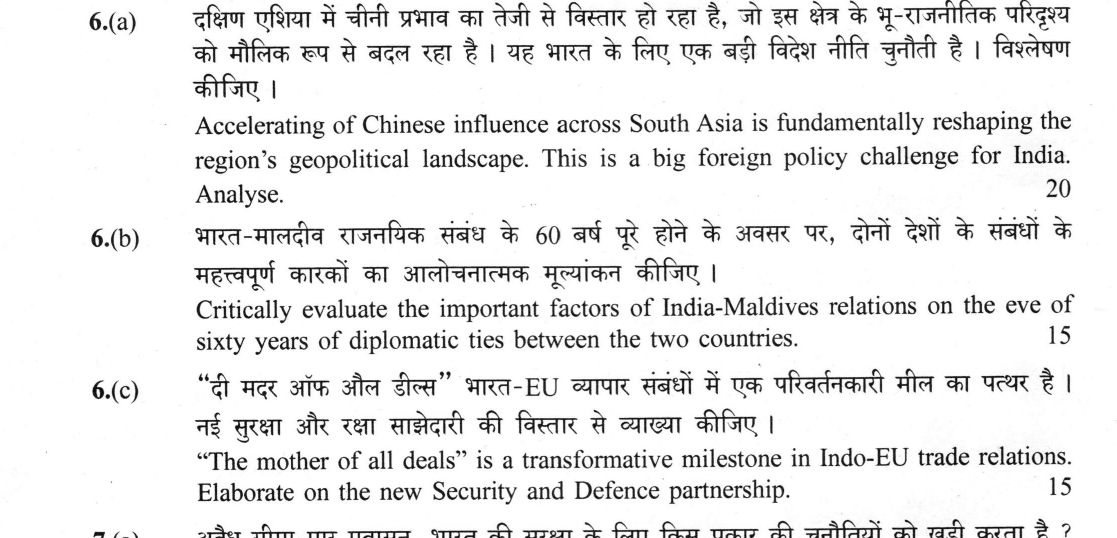
Accelerating of Chinese influence across South Asia is fundamentally reshaping the region's geopolitical landscape. This is a big foreign policy challenge for India. Analyse. 20 marks
Critically evaluate the important factors of India-Maldives relations on the eve of sixty years of diplomatic ties between the two countries. 15 marks
“The mother of all deals” is a transformative milestone in Indo-EU trade relations. Elaborate on the new Security and Defence partnership. 15 marks
हिंदी में प्रश्न पढ़ें
दक्षिण एशिया में चीनी प्रभाव का तेजी से विस्तार हो रहा है, जो इस क्षेत्र के भू-राजनीतिक परिदृश्य को मौलिक रूप से बदल रहा है। यह भारत के लिए एक बड़ी विदेश नीति चुनौती है। विश्लेषण कीजिए। (20 अंक)
भारत-मालदीव राजनयिक संबंध के 60 वर्ष पूरे होने के अवसर पर, दोनों देशों के संबंधों के महत्वपूर्ण कारकों का आलोचनात्मक मूल्यांकन कीजिए। (15 अंक)
“दी मदर ऑफ ऑल डील्स” भारत-EU व्यापार संबंधों में एक परिवर्तनकारी मील का पत्थर है। नई सुरक्षा और रक्षा साझेदारी की विस्तार से व्याख्या कीजिए। (15 अंक)
Model answer
Drafted with AI by UPSC Answer Check against this question's marking rubric, to the expected length. UPSC does not publish answers for Mains — this is one way to score well, not an official key. How we build rubrics and answers.
(a) China's rising influence in South Asia and India's challenge The accelerating expansion of Chinese influence across South Asia is fundamentally reshaping the region’s geopolitical landscape, posing a significant foreign policy challenge for India. This transformation is driven by a systematic deployment of instruments including the Belt and Road Initiative (BRI), infrastructure development, and strategic connectivity.
China’s penetration is evident country by country. In Pakistan, the China-Pakistan Economic Corridor (CPEC), announced in 2015, and the Chinese-operated Gwadar port have deepened strategic ties, and Chinese-origin weaponry featured in Pakistan's arsenal during the May 2025 India-Pakistan conflict. In Sri Lanka, the 99-year lease of the Hambantota port to a Chinese operator in December 2017, the development of the Colombo Port City, and the presence of Chinese survey vessels have raised concerns regarding the "String of Pearls." In Nepal, the BRI framework agreement (2017) and the cooperation framework of December 2024, along with trans-Himalayan connectivity projects, have increased Chinese leverage. In the Maldives, the 2017 Free Trade Agreement and subsequent 2024 agreements have provided a counterweight to India. Furthermore, the China-Myanmar Economic Corridor and the Kyaukphyu port, along with China becoming Bangladesh’s largest arms supplier and Dhaka's outreach to Beijing in 2025, extend this influence. China also conducts boundary talks with Bhutan, despite the lack of formal diplomatic relations.
Structurally, this reshaping is facilitated by dual-use ports, digital infrastructure, and diplomatic cover, such as blocking 1267 Committee listings at the UN Security Council. The Doklam standoff (2017) highlighted the bearing of these activities on the Siliguri corridor.
India’s responses include the "Neighbourhood First" policy, SAGAR (2015) and its 2025 successor MAHASAGAR, BIMSTEC, the Colombo Security Conclave, and the Information Fusion Centre-Indian Ocean Region. The 2022 assistance package to Sri Lanka was a notable intervention. However, the challenge is partly self-inflicted due to India's slow delivery, conditionality, and lack of a concessional-finance instrument. While China faces vulnerabilities like debt distress, South Asian states actively exercise agency, often playing India and China against each other.
(b) India-Maldives relations at sixty On the eve of sixty years of diplomatic ties (established 1 November 1965), India-Maldives relations are defined by a complex interplay of geostrategic, security, economic, and political factors.
The geostrategic location of the Maldives, situated on the Eight Degree and One and a Half Degree Channels, is critical for India’s maritime security. This was underscored by Operation Cactus in November 1988, where India intervened against a coup attempt. Security co-operation has been institutionalized through the 2016 Defence co-operation framework, the Ekuverin bilateral exercise, and the Dosti trilateral coast guard exercise. India has also supported the coastal radar network and the Colombo Security Conclave.
Economic and development dependence is a major factor. India has been a key development partner, contributing to the Greater Male Connectivity Project, Hanimaadhoo airport, the Indira Gandhi Memorial Hospital, and providing essential-commodity quotas, currency swaps, and financial assistance.
However, the relationship faced a significant downturn in 2023-24. The election of President Mohamed Muizzu in 2023 and the "India Out" campaign led to the withdrawal of Indian military personnel, completed in May 2024 and replaced by civilian technicians. This was exacerbated by the January 2024 remarks and the Lakshadweep tourism episode. The "China variable" also plays a role, with the 2017 Maldives-China Free Trade Agreement and 2024 partnership and defence agreements providing an alternative, though constrained by Maldivian external debt distress.
A subsequent reset has occurred, with India providing currency swaps, financial assistance from 2024, and, during Prime Minister Modi's July 2025 visit as guest of honour at the Maldives' 60th Independence Day, extending a new line of credit and launching free trade agreement talks. A critical evaluation suggests that India must de-securitise its footprint, deliver projects on time, and institutionalise co-operation beyond personalities to address non-traditional security challenges like radicalisation, narcotics, and climate vulnerability.
(c) The India-EU FTA and the Security and Defence Partnership The India-EU Free Trade Agreement (FTA), described by the President of the European Commission as "the mother of all deals," represents a transformative milestone in trade relations. Negotiations for the FTA resumed in June 2022, following the lapse of the earlier Broad-based Trade and Investment Agreement negotiations in 2013, and were concluded at the 16th EU-India Summit on 27 January 2026. The EU is India’s largest trading partner in goods.
The negotiation addressed several key issues. The EU sought concessions on automobile, wine, and dairy tariffs, procurement, and a sustainability chapter, while India sought relief from the Carbon Border Adjustment Mechanism (CBAM) and the EU Deforestation Regulation and prioritized Mode 4 movement of professionals and data adequacy; investment protection was carried into a separate parallel negotiation. The agreement also complements the India-EU Trade and Technology Council (2022) and the India-Middle East-Europe Economic Corridor (IMEC), announced at the G20 New Delhi Summit on 9 September 2023.
The new India-EU Security and Defence Partnership, signed on 27 January 2026 at the 16th EU-India Summit (Kallas-Jaishankar), is a crucial component of this relationship. This partnership, building on the EU Indo-Pacific strategy (2021) and the India-EU Connectivity Partnership (2021), elaborates on several areas of co-operation:
- Maritime Security: Co-operation with EU NAVFOR Atalanta and enhancing maritime domain awareness.
- Counter-Terrorism: Joint efforts to combat terrorism.
- Cyber and Hybrid Threats: Addressing emerging security challenges in the digital domain.
- Space Security: Collaboration in the strategic space domain.
- Transnational Crime and Crisis Management: Co-operation against organised crime and closer engagement with EU crisis-management missions.
- Defence-Industrial Co-operation: Strengthening the defence industrial base of both partners.
The first Security and Defence Dialogue was held in New Delhi on 6 March 2026, identifying further work on non-proliferation, disarmament and consular co-operation. This partnership is a framework for strategic co-operation, not a formal alliance, and must navigate frictions such as the EU's stance on Russia and its conditionality on human rights.
How this answer will be evaluated
Evaluation rubric
Each sub-part is marked on its own, against the marks and word limit printed on the paper.
- (a) 'Analyse' a two-part proposition: that accelerating Chinese influence is reshaping South Asia's geopolitics, and that this constitutes a major foreign-policy challenge for India. The answer must map Chinese penetration country by country and instrument by instrument, explain why it is structurally reshaping the region, assess India's responses, and evaluate how far the challenge is externally imposed or self-inflicted. 20 marks
Must cover
- Belt and Road Initiative (2013); China-Pakistan Economic Corridor announced 2015; Gwadar port
- Hambantota port, ninety-nine-year lease to a Chinese operator, December 2017; Colombo Port City; Chinese survey vessels in Sri Lankan waters
- Nepal's BRI framework agreement (2017) and the cooperation framework of December 2024; trans-Himalayan connectivity
- Maldives-China free trade agreement (2017); withdrawal of Indian military personnel completed May 2024; China-Maldives agreements of 2024
- Doklam standoff (2017) and its bearing on the Siliguri corridor; China-Bhutan boundary talks and the 2021 three-step roadmap
- China-Myanmar Economic Corridor and Kyaukphyu port; China as Bangladesh's largest arms supplier
- India's responses: Neighbourhood First; SAGAR (2015) and MAHASAGAR (2025); BIMSTEC and BBIN; Colombo Security Conclave; Information Fusion Centre-Indian Ocean Region; the 2022 assistance package to Sri Lanka
- 'String of Pearls'; blocking of 1267 Committee listings at the UN Security Council
Loses marks
- Producing an alarmist encirclement narrative with no country-specific project, date or figure
- Treating South Asian states as passive objects; the analysis must credit their agency in playing India and China against each other
- Omitting India's own delivery failures and thereby answering only half of an 'analyse' question
- Confusing Gwadar (Pakistan, Chinese-operated) with Chabahar (Iran, Indian-operated), or Hambantota with Colombo Port City
- Claiming Bhutan has diplomatic relations with China - it does not; the two conduct boundary talks without formal relations
- Listing Indian schemes as acronyms without saying what they deliver, or ignoring the maritime and connectivity dimension entirely
- Ignoring Myanmar and Bhutan, which are central to the Siliguri corridor and Bay of Bengal dimension of the challenge
Earns more
- Identifies the instruments of Chinese influence systematically - BRI infrastructure and debt (2013), arms transfers, digital infrastructure, elite and party outreach, dual-use ports and survey vessels, and UNSC diplomatic cover including blocked 1267 listings
- Assesses India's own deficits - slow delivery, conditionality, perceptions of interference, lack of a concessional-finance instrument - so that part of the challenge is self-inflicted
- Notes China's vulnerabilities and the neighbours' agency - debt distress, opaque contracting, reversibility with changes of government, as in the Maldives reset - rather than presenting Chinese advance as inexorable
- (b) 'Critically evaluate the important factors' in India-Maldives relations at the sixty-year mark of diplomatic ties. The answer must identify the structural factors - geostrategic location, security co-operation, economic and development dependence, domestic politics and the China variable - and evaluate them, including the 2023-24 downturn and the subsequent reset, rather than narrating a chronology. 15 marks
Must cover
- Maldives independence 26 July 1965; diplomatic relations established 1 November 1965 - sixty years in 2025
- Operation Cactus, November 1988 - Indian intervention against the coup attempt on President Gayoom
- Defence co-operation framework (2016); Ekuverin bilateral exercise; Dosti trilateral coast guard exercise; Colombo Security Conclave; coastal radar network
- Withdrawal of Indian military personnel completed in May 2024, replaced by civilian technicians
- 'India Out' campaign; election of President Mohamed Muizzu in 2023; the January 2024 remarks and Lakshadweep tourism episode
- Greater Male Connectivity Project; Hanimaadhoo airport; Indira Gandhi Memorial Hospital; currency swap and financial assistance from 2024; July 2025 prime ministerial visit - new line of credit and launch of FTA talks
- Maldives-China free trade agreement (2017) and the 2024 China-Maldives partnership and defence agreements; Maldivian external debt distress
- Geostrategic position on the Eight Degree and One and a Half Degree Channels
Loses marks
- Narrating a chronology of visits instead of identifying and evaluating factors, which is what 'critically evaluate the important factors' demands
- Presenting only the 2023-24 downturn, or only the reset, instead of explaining the structural reason both happened
- Omitting Operation Cactus (1988), the single most cited episode in the security relationship
- Claiming India maintains a military base in the Maldives; the dispute concerned a small number of personnel operating gifted aircraft, withdrawn by May 2024
- Ignoring Maldivian agency and treating the relationship purely as an India-China contest
- Giving no development project by name, so that India's economic weight is asserted rather than shown
Earns more
- Economic and development dependence with concrete projects: essential-commodity quotas, currency swap and budgetary support, the Greater Male Connectivity Project, Hanimaadhoo airport, housing and water schemes, the Indira Gandhi Memorial Hospital, and the 2025 line of credit, trade talks and UPI rollout
- The China variable assessed with limits - Chinese lending, the 2017 FTA and the 2024 partnership and defence agreements, set against Maldivian debt distress that constrains how far the alternative can be used
- Non-traditional security and a critical verdict: radicalisation and foreign fighters, narcotics and maritime crime, climate vulnerability; and the prescription to de-securitise the footprint, deliver on time and institutionalise co-operation beyond personalities
- (c) Two linked demands: treat the India-EU free trade agreement - described by the President of the European Commission as 'the mother of all deals' - as a transformative milestone, and then ELABORATE on the new India-EU Security and Defence Partnership. The defence and security partnership is the explicitly named sub-part and must be developed at length, not mentioned in passing. 15 marks
Must cover
- 'The mother of all deals' - the European Commission President's description of the India-EU free trade agreement
- FTA negotiations resumed June 2022; the earlier Broad-based Trade and Investment Agreement negotiations lapsed in 2013
- The EU is India's largest trading partner in goods
- Issues in the negotiation: CBAM and the EU Deforestation Regulation; Mode 4 movement of professionals; data adequacy; automobile, wine and dairy tariffs; investment protection (carried into a separate parallel negotiation)
- India-EU Trade and Technology Council, established 2022
- India-Middle East-Europe Economic Corridor, announced at the G20 New Delhi Summit, 9 September 2023
- Security and Defence Partnership content: maritime security and EU NAVFOR Atalanta co-operation, counter-terrorism, cyber and hybrid threats, space security, transnational crime and crisis management, maritime domain awareness, defence-industrial co-operation
- EU Indo-Pacific strategy (2021); India-EU Connectivity Partnership (2021)
- India-EU Security and Defence Partnership signed 27 January 2026 at the 16th EU-India Summit (Kallas-Jaishankar); first Security and Defence Dialogue, New Delhi, 6 March 2026
Loses marks
- Writing entirely on trade and leaving the Security and Defence Partnership - the explicitly named sub-part - as a single sentence; this alone halves the marks
- Treating the India-EU partnership as a defence alliance or mutual-security guarantee; it is a framework for co-operation, not collective defence
- Confusing the EU with NATO, or attributing NATO's defence commitments to the EU partnership
- Ignoring CBAM and the Deforestation Regulation, which are India's principal substantive grievances in the trade negotiation
- Dating the FTA negotiations to their 2007 launch without noting the 2013 suspension and the June 2022 relaunch
- Failing to date the conclusion of the agreement (27 January 2026) or confusing conclusion with entry into force
Earns more
- Identifies the substantive issues the negotiation had to resolve, and how they were settled - EU demands on automobile, wine and dairy tariffs, procurement and the sustainability chapter; Indian demands on Mode 4 movement of professionals, data adequacy, CBAM and the Deforestation Regulation; and the phased liberalisation, carve-outs and continuing dialogue mechanisms through which they were bridged
- Places the partnership within the existing architecture: the 2020 Roadmap to 2025, the Connectivity Partnership (2021), the EU Indo-Pacific strategy (2021), the Trade and Technology Council (2022) and IMEC (September 2023)
- Acknowledges frictions: divergence over Russia and sanctions touching Indian refining, human-rights and sustainability conditionality, EU decision-making complexity, and the implementation gap
What "Analyse" is asking you to do
Break the subject into its working parts and show how they act on each other. The marks are in the interconnections — which factor drives which, and what the resulting structure explains — not in the inventory of factors.
Structure that answers it
Define the whole → separate it into its parts → show which part drives which → what that interaction produces → what the structure implies
Where marks are lost
A flat list of causes with no account of which drives which. An answer of neatly separated headings, each self-contained, scores as description.
Practice this exact question
Write your answer and it is marked point by point against the model answer above — what you covered, what you missed, what you got wrong.
Evaluate my answer →More from Political Science & IR 2026 Paper II
- Q3 (a) NATO, the oldest surviving collective security system, is facing challenge of transac…
- Q4 (a) QUAD requires more robust architecture than the summit driven mode to tide over the c…
- Q5 Answer the following questions in about 150 words each : (a) Describe India's objections…
- Q6 (a) Accelerating of Chinese influence across South Asia is fundamentally reshaping the re…
- Q7 (a) How does illegal cross border migration pose challenges to India's security? Discuss…
- Q8 (a) Critically evaluate India-Russia relations in the 21st century. How have both the cou…