Paper II — Q4
(a) QUAD requires more robust architecture than the summit driven mode to tide over the current challenges. Elaborate. (20…
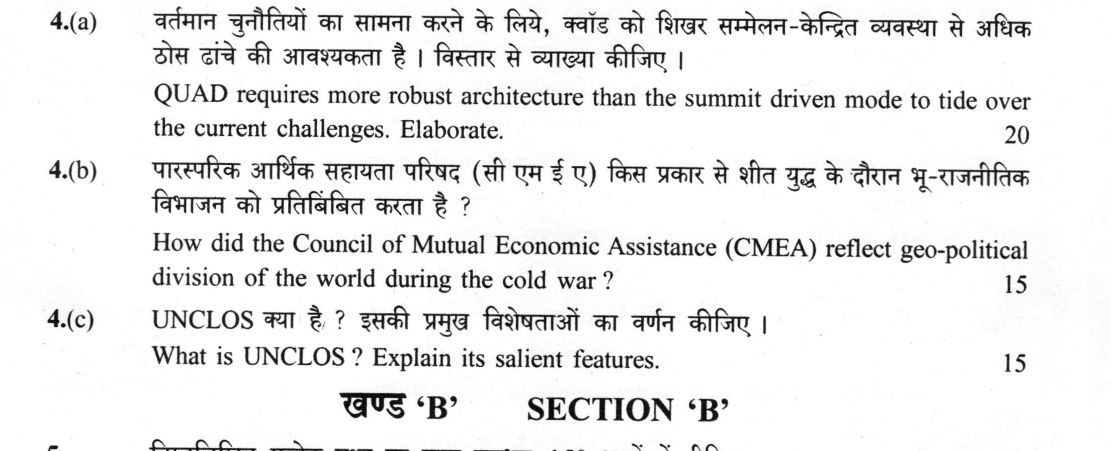
QUAD requires more robust architecture than the summit driven mode to tide over the current challenges. Elaborate. 20 marks
How did the Council of Mutual Economic Assistance (CMEA) reflect geo-political division of the world during the cold war ? 15 marks
What is UNCLOS ? Explain its salient features. 15 marks
हिंदी में प्रश्न पढ़ें
वर्तमान चुनौतियों का सामना करने के लिये, क्वाड को शिखर सम्मेलन-केन्द्रित व्यवस्था से अधिक ठोस ढांचे की आवश्यकता है । विस्तार से व्याख्या कीजिए । (20 अंक)
पारस्परिक आर्थिक सहायता परिषद (सी एम ई ए) किस प्रकार से शीत युद्ध के दौरान भू-राजनीतिक विभाजन को प्रतिबिंबित करता है ? (15 अंक)
UNCLOS क्या है ? इसकी प्रमुख विशेषताओं का वर्णन कीजिए । (15 अंक)
Model answer
Drafted with AI by UPSC Answer Check against this question's marking rubric, to the expected length. UPSC does not publish answers for Mains — this is one way to score well, not an official key. How we build rubrics and answers.
(a) Beyond summitry: a sturdier Quad architecture The evolution of the Quadrilateral Security Dialogue (QUAD) from a 2004 Indian Ocean tsunami response group to a strategic forum necessitates a shift from an informal, summit-driven model to a robust institutional architecture. While the framework was conceptualized by Shinzo Abe in 2007, lapsed after Australia's 2008 withdrawal, revived in Manila in November 2017, and formalized through the first leaders' summit in March 2021, its current "summit-driven" nature is a significant structural weakness. The group lacks a permanent secretariat, a formal charter, a ring-fenced budget, or a treaty basis. This informality, while useful for India to maintain "variable geometry" and avoid the appearance of a military alliance (distinct from AUKUS), results in a lack of continuity. Its current challenges include shifts in US trade and alliance policy (including 2025 tariff frictions with India), China's grey-zone pressure in the South and East China Seas, ASEAN wariness of bloc politics, and the dependence of momentum on leaders' calendars. Its output so far - the Vaccine Partnership (2021), IPMDA (2022), the Critical and Emerging Technology group, the Quad Fellowship and the Critical Minerals Initiative (2025) - shows what steadier institutions could scale.
To tide over current challenges, the QUAD must develop a more robust architecture. This requires the establishment of a permanent secretariat to maintain institutional memory and a standing maritime-domain-awareness (MDA) centre to support initiatives like the Indo-Pacific Partnership for Maritime Domain Awareness (IPMDA). Furthermore, the group needs calendared ministerial meetings that operate independently of the leaders' summits to ensure consistent progress. Concrete institutional design should include a development-finance window and working groups with specific scorecards for critical and emerging technologies. While informality lowers the entry cost for members, the current geopolitical environment demands a more durable, institutionalized framework to effectively counter regional challenges.
(b) CMEA and the Cold War divide The Council for Mutual Economic Assistance (CMEA), founded in Moscow in January 1949, was the primary economic instrument of the Soviet bloc and a direct reflection of the Cold War’s geopolitical division. Established as a response to the Western Marshall Plan (1948) and the OEEC, the CMEA created a parallel economic order that mirrored the political and military split between East and West. Its membership—initially the USSR, Bulgaria, Czechoslovakia, Hungary, Poland, and Romania, later including Albania (1949), East Germany (1950), Mongolia (1962), Cuba (1972) and Vietnam (1978)—mapped the global reach of the Soviet sphere of influence.
The CMEA’s operating principles reinforced this division through an "economic iron curtain." It utilized a non-convertible "transferable rouble" and the International Bank for Economic Co-operation (IBEC, 1963) to facilitate trade only among socialist states, effectively isolating them from the global market. The 1962 "Basic Principles of the International Socialist Division of Labour", resisted by Romania, and the 1971 Comprehensive Programme sought bloc-wide specialisation under Soviet primacy. Infrastructure projects like the Druzhba oil pipeline (1964) were designed to ensure the bloc’s energy self-sufficiency. This economic structure was the twin of the military division, represented by the Warsaw Pact (1955). The CMEA’s dissolution on 28 June 1991 serves as the final proof of its nature; its collapse was not merely an economic failure but a direct consequence of the political end of the bipolar world order.
(c) UNCLOS and its salient features The United Nations Convention on the Law of the Sea (UNCLOS), adopted in Montego Bay on 10 December 1982 and entering into force on 16 November 1994, is the primary international legal framework governing the world's oceans. Its salient features are defined by a precise system of maritime zones and specific legal regimes.
The Convention establishes the following zones:
- Territorial Sea: Extends up to 12 nautical miles (nm) from the baseline (Article 3), where the coastal state exercises full sovereignty, subject to the right of "innocent passage" for foreign vessels.
- Contiguous Zone: Extends up to 24 nm from the baseline (Article 33), allowing the state to exercise control to prevent or punish violations of its customs, fiscal, immigration and sanitary laws.
- Exclusive Economic Zone (EEZ): Extends up to 200 nm (Articles 55-75), where the state has "sovereign rights" for the exploration and exploitation of natural resources.
- Continental Shelf: Extends to 200 nm or to the outer edge of the continental margin, capped at 350 nm or 100 nm beyond the 2,500 m isobath (Article 76), with outer limits set on the basis of recommendations of the Commission on the Limits of the Continental Shelf (CLCS).
Key innovations include the designation of the deep seabed "Area" as the "common heritage of mankind" (Article 136), administered by the International Seabed Authority. Part XV provides for mandatory dispute settlement through the International Tribunal for the Law of the Sea (ITLOS), the ICJ, or Annex VII arbitration, as seen in the 2014 Bangladesh-India Bay of Bengal award and the 2016 South China Sea award. UNCLOS also creates transit passage through international straits (Part III), archipelagic sea-lanes passage (Part IV) and high-seas freedoms (Part VII), and its BBNJ Agreement (2023), in force since 17 January 2026, extends it to marine biodiversity beyond national jurisdiction.
How this answer will be evaluated
Evaluation rubric
Each sub-part is marked on its own, against the marks and word limit printed on the paper.
- (a) 'Elaborate' a prescriptive claim: that the Quad's summit-driven, informal mode is inadequate and a more robust architecture is needed. The answer must trace the Quad's evolution, identify the specific weaknesses of summit-dependence, name the current challenges, and propose concrete institutional design - a diagnosis without proposals is incomplete. 20 marks
Must cover
- 2004 Indian Ocean tsunami core group; Shinzo Abe's 'Confluence of the Two Seas' speech to the Indian Parliament, August 2007
- Australia's withdrawal in 2008; revival at Manila, November 2017; first foreign ministers' meeting 2019
- First leaders' summit (virtual) 12 March 2021; Washington September 2021; Tokyo May 2022; Hiroshima May 2023; Wilmington September 2024
- Indo-Pacific Partnership for Maritime Domain Awareness (IPMDA), announced 2022; Quad Vaccine Partnership (2021); Critical and Emerging Technology working group
- Absence of a secretariat, charter, budget or treaty basis
- India outside AUKUS (2021) and outside the IPEF trade pillar; ASEAN centrality
- Malabar exercise - Australia rejoined in 2020; India's foundational agreements LEMOA (2016), COMCASA (2018), BECA (2020)
Loses marks
- Writing a general 'Quad and China' essay without addressing the specific claim about summit-driven versus robust architecture
- Diagnosing weaknesses but proposing nothing; 'elaborate' on this prescriptive statement requires design proposals
- Calling the Quad an alliance or a military bloc - it has no mutual-defence commitment and all four members deny alliance status
- Confusing the Quad with AUKUS (a trilateral of Australia, the UK and the US, 2021) or with IPEF, or asserting Indian membership of either
- Dating the revival to 2021 rather than November 2017, or missing the 2004 tsunami origin
- Treating institutionalisation as an unqualified good and ignoring why India has preferred informality
Earns more
- Names the Quad's actual working output - Vaccine Partnership, IPMDA (2022), Critical and Emerging Technology and Infrastructure working groups, Quad Fellowship, supply-chain and critical-minerals work - rather than describing it only as an anti-China bloc
- Concrete architectural proposals: permanent secretariat, calendared ministerials independent of summits, ring-fenced funding and a development-finance window, working groups with scorecards, a standing maritime-domain-awareness centre, Quad-Plus outreach
- Concedes the counter-argument that informality lowers India's entry cost, permits variable geometry and avoids provoking a counter-coalition
- (b) 'How did CMEA reflect the geo-political division of the world during the Cold War?' - the demand is not a description of Comecon but an argument that its origin, membership, operating principles, external trade pattern and collapse mapped the bipolar divide. Facts about Comecon must be marshalled as evidence of division. 15 marks
Must cover
- Council for Mutual Economic Assistance (CMEA/Comecon), founded January 1949, Moscow
- Founding members: USSR, Bulgaria, Czechoslovakia, Hungary, Poland, Romania; Albania 1949; East Germany 1950; Mongolia 1962; Cuba 1972; Vietnam 1978
- Response to the Marshall Plan (European Recovery Programme, 1948) and the OEEC; the 1947 refusal of Marshall aid by Poland and Czechoslovakia under Soviet pressure
- Basic Principles of the International Socialist Division of Labour (1962); Romania's resistance; Comprehensive Programme for Socialist Economic Integration (1971)
- Transferable rouble; International Bank for Economic Co-operation (1963); Druzhba oil pipeline (1964)
- Warsaw Pact (1955) as the military counterpart to NATO (1949); Brezhnev Doctrine (1968)
- Dissolution of Comecon, 28 June 1991
Loses marks
- Merely describing Comecon's structure and organs without arguing how it reflected geopolitical division - the question is 'how did it reflect', not 'what was it'
- Confusing Comecon (economic, 1949) with the Warsaw Pact (military, 1955) or the Cominform (political, 1947)
- Dating the founding to 1947 or 1955, or omitting the Marshall Plan as the trigger
- Ignoring the non-European members - Mongolia, Cuba and Vietnam - which are the clearest evidence of a global rather than merely European division
- Claiming Comecon was a supranational common market like the EEC; it was predominantly a framework for bilateral, politically directed trade
- Omitting the dissolution in 1991, which completes the argument
Earns more
- Separate economic order as an economic iron curtain: the transferable rouble, IBEC (1963) and the International Investment Bank (1970), the Druzhba pipeline (1964), the Mir grid, non-convertibility, the Bucharest oil-pricing formula, trade diversion and shortage economics (Kornai)
- Explicit institutional symmetry with the Western bloc (Marshall Plan/OEEC versus Comecon; NATO 1949 versus the Warsaw Pact 1955) and the dissolution of Comecon on 28 June 1991 as confirmation that the economic division was a function of the political one
- (c) Two explicit sub-parts: (i) WHAT is UNCLOS - identify it with its negotiation, adoption and entry into force; and (ii) EXPLAIN its salient features - the maritime zones with their exact limits, the regimes governing each, the Area as common heritage, and dispute settlement. Both parts must appear; the zone limits are the heart of the marks. 15 marks
Must cover
- United Nations Convention on the Law of the Sea, adopted 10 December 1982, Montego Bay; in force 16 November 1994
- Territorial sea 12 nautical miles (Article 3) with innocent passage; contiguous zone 24 nautical miles (Article 33)
- Exclusive Economic Zone 200 nautical miles (Articles 55-75)
- Continental shelf (Article 76) - 200 nm, up to 350 nm or 100 nm beyond the 2,500 m isobath; Commission on the Limits of the Continental Shelf
- The Area as common heritage of mankind (Article 136); International Seabed Authority
- Part XV dispute settlement - ITLOS (Hamburg), ICJ, Annex VII arbitration
- Transit passage through international straits; archipelagic sea lanes passage
- Illustration: Bangladesh v. India Bay of Bengal award, 7 July 2014; South China Sea award, 12 July 2016
Loses marks
- Getting the zone limits wrong - the commonest errors are a 200 nm territorial sea, a 12 nm contiguous zone, or omitting that the contiguous zone is measured from the baseline and not from the outer edge of the territorial sea
- Confusing sovereignty in the territorial sea with the weaker sovereign rights in the EEZ, or asserting that a coastal state may bar foreign warships from its EEZ
- Dating the Convention to 1994 (entry into force) or 1958 (Geneva Conventions) instead of adoption in 1982
- Answering only 'what is UNCLOS' and never reaching the salient features, or listing features without a single article number
- Omitting dispute settlement and the common heritage principle, which are among the Convention's most distinctive innovations
- Confusing innocent passage (territorial sea, suspendable) with transit passage (international straits, non-suspendable)
Earns more
- The Area as the common heritage of mankind (Article 136) under the International Seabed Authority, and the Part VII high-seas freedoms
- Dispute settlement under Part XV - ITLOS, the ICJ and Annex VII arbitration, with an illustration such as the Bangladesh-India Bay of Bengal award (2014) or the South China Sea award (2016)
What "Elaborate" is asking you to do
Give the full detailed account the question has compressed into a line — every dimension of it, with specifics. Elaborate rewards completeness and detail rather than clarification or argument: the examiner is checking whether you can fill out a topic without being told what its parts are.
Structure that answers it
State the proposition → first dimension in detail → second dimension in detail → the part the statement leaves implicit → the consolidated picture
Where marks are lost
Repeating the statement at greater length instead of adding substance. Elaborate also punishes narrowness: omitting a whole dimension costs more here than anywhere else in this family.
Practice this exact question
Write your answer and it is marked point by point against the model answer above — what you covered, what you missed, what you got wrong.
Evaluate my answer →More from Political Science & IR 2026 Paper II
- Q1 Answer the following questions in about 150 words each : (a) Criticism of the institution…
- Q2 (a) Discuss the factors responsible for the changing nature of states in contemporary ind…
- Q3 (a) NATO, the oldest surviving collective security system, is facing challenge of transac…
- Q4 (a) QUAD requires more robust architecture than the summit driven mode to tide over the c…
- Q5 Answer the following questions in about 150 words each : (a) Describe India's objections…
- Q6 (a) Accelerating of Chinese influence across South Asia is fundamentally reshaping the re…
- Q7 (a) How does illegal cross border migration pose challenges to India's security? Discuss…