Paper II — Q2
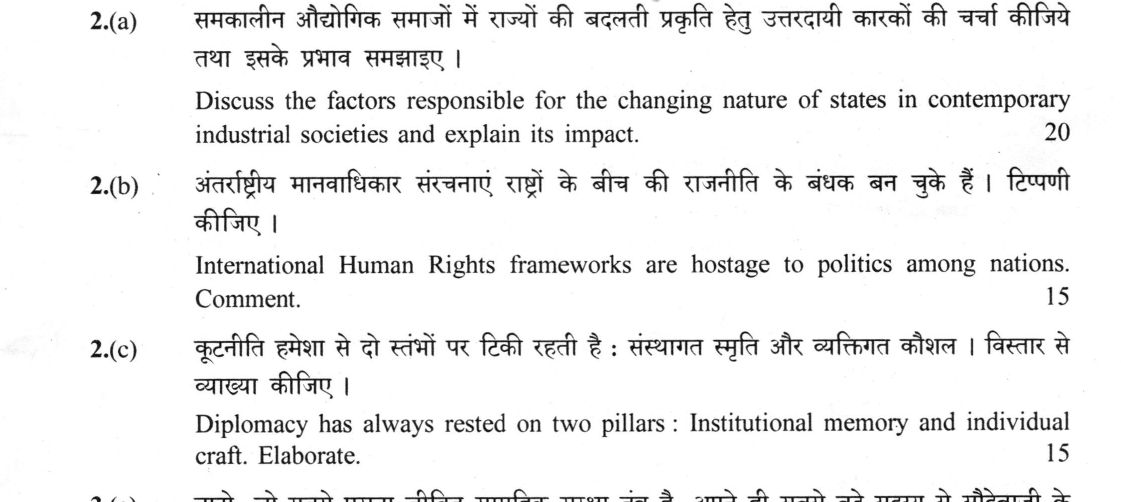
(a) Discuss the factors responsible for the changing nature of states in contemporary industrial societies and explain its…
Discuss the factors responsible for the changing nature of states in contemporary industrial societies and explain its impact. 20 marks
International Human Rights frameworks are hostage to politics among nations. Comment. 15 marks
Diplomacy has always rested on two pillars : Institutional memory and individual craft. Elaborate. 15 marks
हिंदी में प्रश्न पढ़ें
समकालीन औद्योगिक समाजों में राज्यों की बदलती प्रकृति हेतु उत्तरदायी कारकों की चर्चा कीजिये तथा इसके प्रभाव समझाइए । (20 अंक)
अंतर्राष्ट्रीय मानवाधिकार संरचनाएँ राष्ट्रों के बीच की राजनीति के बंधक बन चुके हैं । टिप्पणी कीजिए । (15 अंक)
कूटनीति हमेशा से दो स्तंभों पर टिकी रहती है : संस्थागत स्मृति और व्यक्तिगत कौशल । विस्तार से व्याख्या कीजिए । (15 अंक)
Model answer
Drafted with AI by UPSC Answer Check against this question's marking rubric, to the expected length. UPSC does not publish answers for Mains — this is one way to score well, not an official key. How we build rubrics and answers.
(a) The changing nature of the state in industrial societies
The nature of the state in contemporary industrial societies has shifted from a uniform, monolithic entity to a reconfigured actor, driven by structural and policy factors. Susan Strange’s concept of the "retreat of the state" and R.A.W. Rhodes’s "hollowing out" describe the erosion of state capacity due to globalisation. This is analytically distinct from policy choices like Philip Cerny’s "competition state" or Giandomenico Majone’s "regulatory state." Structural drivers include Daniel Bell’s post-industrial transition and Manuel Castells’s network society, where the platform economy complicates the taxation of intangible capital. Simultaneously, the welfare state faces pressure from demographic change and "new social risks," as mapped by Gosta Esping-Andersen and Paul Pierson. These pressures trigger the "fiscal crisis of the state" and "legitimation crisis" identified by James O'Connor and Jurgen Habermas. The state has also grown in coercive and regulatory directions - post-9/11 securitisation, digital surveillance and data regulation such as the EU's GDPR (2018).
The impact of these changes is the transition from "government" to "governance," involving the rescaling of authority upward to supranational bodies (EU, WTO) and downward through devolution. Colin Crouch’s "post-democracy" suggests a decline in democratic accountability. However, the state has not vanished; Linda Weiss’s "Myth of the Powerless State" argues that states retain the power to shape their own constraints. The post-2008 financial crisis and the pandemic demonstrated a "return of the state," evidenced by the US CHIPS and Science Act and the Inflation Reduction Act. Thus, the state is not ending but is being reconfigured.
(b) Human rights frameworks and inter-state politics
The proposition that international human rights frameworks are "hostage to politics" is largely accurate, as the regime is often subordinated to state interests. The Universal Declaration of Human Rights (1948) was already compromised by eight abstentions from the Soviet bloc and others. The Cold War division was formalized in the 1966 ICCPR and ICESCR, which split civil-political from economic-social rights. This politicization continues in the Human Rights Council (2006) and in the ICC, to which major powers like the US, China, India and Russia are not parties. The "double standards" of the Responsibility to Protect (R2P) are evident in the Security Council’s use of Resolution 1973 for Libya in 2011 versus its vetoes in Syria. Furthermore, the "Asian values" debate (Bangkok Declaration, 1993) highlights the tension between cultural relativism and universality, which the Vienna Declaration (1993) sought to settle by calling rights universal, indivisible and interdependent. In 2025 the United States again withdrew from the Human Rights Council and imposed sanctions on ICC officials.
However, the regime is not entirely a sham. Keck and Sikkink’s "boomerang model" and Risse, Ropp, and Sikkink’s "spiral model" show that international norms can socialize domestic actors. The "justice cascade" and the Universal Periodic Review (UPR) provide mechanisms for independent scrutiny. National Human Rights Institutions (NHRIs) under the Paris Principles also exert pressure. In conclusion, while inter-state politics dictates the enforcement of rights, the normative framework continues to exert a socializing effect on the global order.
(c) Institutional memory and individual craft in diplomacy
Diplomacy is sustained by the interplay of institutional memory and individual craft. Institutional memory refers to the codified practice and professional cadre of the foreign ministry, rooted in the Congress of Vienna (1815) and the Vienna Convention on Diplomatic Relations (1961). Authorities like Ernest Satow in A Guide to Diplomatic Practice provide the "rules of the game," ensuring consistency and continuity in state representation. This pillar provides the legal and procedural architecture of international relations.
Individual craft is the personal skill of the negotiator. Harold Nicolson in Diplomacy (1939) emphasized the diplomat's need for judgement and personal authority. Historical examples include Talleyrand’s maneuvering, Henry Kissinger’s "shuttle diplomacy" (1973-74), and Richard Holbrooke’s role in the Dayton Agreement (1995). These figures used their personal authority to bridge gaps that rigid institutional protocols could not.
The two pillars are interdependent: memory without craft leads to rigidity, while craft without memory leads to inconsistency. Woodrow Wilson's call for "open covenants openly arrived at" (1918) began the shift to a "new diplomacy"; today summitry and digital diplomacy challenge both pillars. While "new diplomacy" is often faster and more public, it risks bypassing the professional cadre. Nevertheless, the core of diplomacy remains a balance between the "old" institutional framework and the "new" demands of a globalized, leader-driven world.
How this answer will be evaluated
Evaluation rubric
Each sub-part is marked on its own, against the marks and word limit printed on the paper.
- (a) Two directives, both compulsory: (i) DISCUSS the factors driving the changing nature of the state in contemporary industrial (advanced capitalist) societies, and (ii) EXPLAIN the impact of that change. An answer that only lists causes, or only describes the welfare state, loses half the paper. 20 marks
Must cover
- Susan Strange, The Retreat of the State (1996); Linda Weiss, The Myth of the Powerless State (1998)
- R.A.W. Rhodes, 'the hollowing out of the state' (1994); government to governance
- Philip Cerny's 'competition state'; Giandomenico Majone's 'regulatory state'
- Gosta Esping-Andersen, The Three Worlds of Welfare Capitalism (1990); Paul Pierson, Dismantling the Welfare State? (1994)
- Daniel Bell, The Coming of Post-Industrial Society (1973); Manuel Castells, network society
- Jurgen Habermas, Legitimation Crisis (1973) and James O'Connor, The Fiscal Crisis of the State (1973)
- Return of the state: 2008 crisis, COVID-19, US CHIPS and Science Act (2022) and Inflation Reduction Act (2022)
- Colin Crouch, Post-Democracy (2004)
Loses marks
- Answering only half the question - cataloguing factors and never reaching 'explain its impact', which is a separately weighted demand
- Asserting the decline or 'end' of the nation-state as settled fact; the examiner expects the Weiss/Hirst-Thompson counter-argument and the post-2008 and post-COVID return of the state
- Writing about developing countries or India throughout; the question specifies contemporary INDUSTRIAL societies, so evidence should be drawn mainly from OECD cases
- Producing a factor list with no theorist attached; at 20 marks the examiner expects six or more named scholars
- Conflating globalisation with neoliberalism and treating them as one factor, losing the analytic distinction between structural constraint and policy choice
- Ignoring the coercive and regulatory expansion of the state (surveillance, securitisation) and portraying change as uniform shrinkage
Earns more
- Rescaling of authority upward to supranational bodies (EU, WTO, IMF) and downward through devolution, plus private and hybrid regulation
- Post-industrial and technological change: Bell (1973), Castells's network society, deindustrialisation, the platform and data economy, and the difficulty of taxing intangible capital
- Welfare-state pressure and demographic change: Esping-Andersen's three worlds (1990), Pierson on retrenchment (1994), ageing, migration, new social risks
- (b) 'Comment' on the proposition that the international human rights regime is captive to inter-state politics. This requires a two-sided treatment: substantiate the claim with the institutional and case evidence of selectivity, veto politics and non-ratification, then qualify it by showing where the regime has independent effect, and reach a judgement. 15 marks
Must cover
- Universal Declaration of Human Rights, 10 December 1948; eight abstentions (Soviet bloc, Saudi Arabia, South Africa)
- ICCPR and ICESCR, 1966 (in force 1976) - the Cold War division of rights
- Vienna Declaration and Programme of Action, 1993 - universal, indivisible, interdependent
- Human Rights Council established 2006, replacing the Commission on Human Rights; Universal Periodic Review
- Rome Statute of the ICC, 1998, in force 1 July 2002; non-parties include the US, China, India and Russia
- Responsibility to Protect - 2005 World Summit Outcome, paragraphs 138-139; UNSC Resolution 1973 (2011) on Libya
- Bangkok Declaration 1993 and the 'Asian values' debate
- Keck and Sikkink's boomerang model; Risse, Ropp and Sikkink's spiral model; Sikkink's justice cascade
Loses marks
- Writing a descriptive account of UN human rights machinery with no argument about politicisation - the directive is 'comment', which requires a stance
- Giving a wholly one-sided denunciation with no counter-evidence; a 15-marker must concede the regime's socialising and litigation effects
- Vague assertions of 'double standards' without a single named instance, resolution number or treaty
- Getting the Covenants wrong - e.g. dating them 1976 (that is entry into force, adoption was 1966) or attributing civil-political rights to the socialist bloc
- Treating R2P as a legal right of intervention rather than the 2005 Outcome Document formulation resting on Security Council authorisation
Earns more
- Normative contestation: Asian values and the Bangkok Declaration (1993), cultural relativism versus universality, sovereignty and 'double standards'
- Counter-argument that the regime has real effect - Keck and Sikkink's boomerang, the Risse-Sikkink spiral model, the 'justice cascade', UPR participation, domestic judicial incorporation, NHRIs under the Paris Principles
- (c) 'Elaborate' a two-pillar proposition about diplomacy: institutional memory (the ministry, archives, codified practice, professional cadre) and individual craft (the negotiator's skill, judgement and personal authority). Both pillars must be developed separately, their interaction shown, and the claim tested against contemporary pressures. 15 marks
Must cover
- Vienna Convention on Diplomatic Relations, 1961 (in force 1964); Vienna Convention on Consular Relations, 1963
- Congress of Vienna, 1815 - codification of diplomatic ranks and practice
- Harold Nicolson, Diplomacy (1939) - qualities of the ideal diplomat
- Ernest Satow, A Guide to Diplomatic Practice (1917)
- A named negotiator as evidence of craft - Talleyrand / Bismarck / Kissinger (shuttle diplomacy 1973-74) / Holbrooke (Dayton 1995)
- Old versus new diplomacy; Wilson's 'open covenants openly arrived at' (Fourteen Points, 1918)
Loses marks
- Writing a general essay on the meaning, types and functions of diplomacy and never engaging the two named pillars
- Developing only one pillar - usually the anecdotal 'great diplomat' half - and leaving institutional memory as a single sentence
- Naming no convention, no article and no text; a 15-mark answer on diplomacy is expected to cite the Vienna Convention of 1961 and a standard authority
- Confusing the Vienna Convention on Diplomatic Relations (1961) with the Vienna Convention on the Law of Treaties (1969) or with the Congress of Vienna (1815)
- Treating summitry and digital diplomacy as wholly destructive without conceding their reach and speed
Earns more
- Shows the interdependence: memory without craft is rigidity, craft without memory is inconsistency; links to the old-versus-new diplomacy debate
- Contemporary stresses on both pillars - summitry and leader-led diplomacy, digital/public diplomacy, cadre size and politicisation, Track II
What "Discuss" is asking you to do
Lay the issue out from more than one side — how it arose, what is claimed for it, what is held against it, and where it now stands. UPSC attaches discuss to broad topics with several live dimensions, so coverage of the dimensions earns more than the strength of your opinion.
Structure that answers it
Set the issue up → the case as it is made → the case against → the dimension both sides leave out → where the balance now lies
Where marks are lost
Listing facts with no thread between them, or arguing one side throughout and calling it a discussion.
Practice this exact question
Write your answer and it is marked point by point against the model answer above — what you covered, what you missed, what you got wrong.
Evaluate my answer →More from Political Science & IR 2026 Paper II
- Q1 Answer the following questions in about 150 words each : (a) Criticism of the institution…
- Q2 (a) Discuss the factors responsible for the changing nature of states in contemporary ind…
- Q3 (a) NATO, the oldest surviving collective security system, is facing challenge of transac…
- Q4 (a) QUAD requires more robust architecture than the summit driven mode to tide over the c…
- Q5 Answer the following questions in about 150 words each : (a) Describe India's objections…