Paper II — Q8
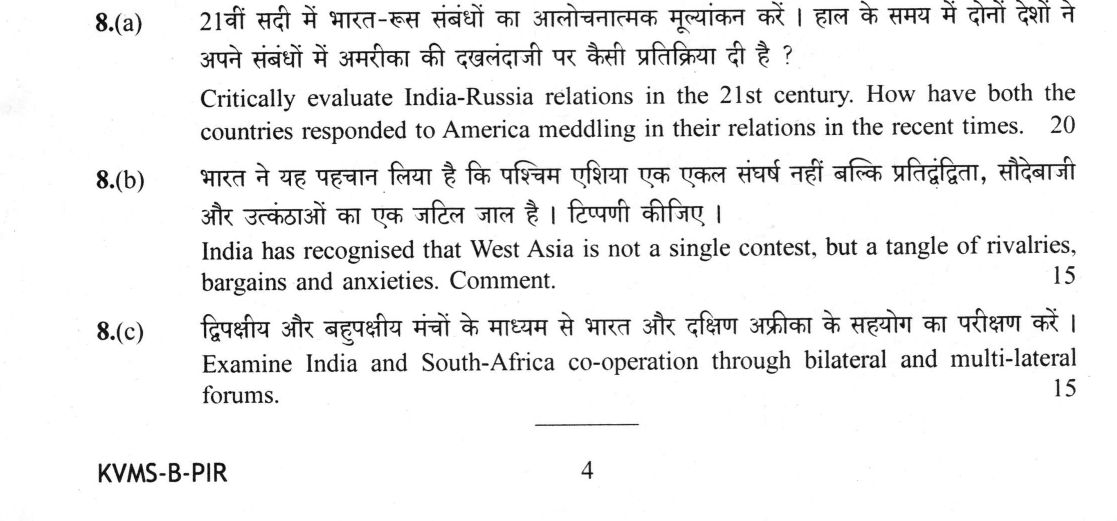
(a) Critically evaluate India-Russia relations in the 21st century. How have both the countries responded to America meddling in…
Critically evaluate India-Russia relations in the 21st century. How have both the countries responded to America meddling in their relations in the recent times. 20 marks
India has recognised that West Asia is not a single contest, but a tangle of rivalries, bargains and anxieties. Comment. 15 marks
Examine India and South-Africa co-operation through bilateral and multi-lateral forums. 15 marks
हिंदी में प्रश्न पढ़ें
21वीं सदी में भारत-रूस संबंधों का आलोचनात्मक मूल्यांकन करें। हाल के समय में दोनों देशों ने अपने संबंधों में अमरीका की दखलंदाजी पर कैसी प्रतिक्रिया दी है? (20 अंक)
भारत ने यह पहचान लिया है कि पश्चिम एशिया एक एकल संघर्ष नहीं बल्कि प्रतिद्वंद्विता, सौदेबाजी और उत्कंठाओं का एक जटिल जाल है। टिप्पणी कीजिए। (15 अंक)
द्विपक्षीय और बहुपक्षीय मंचों के माध्यम से भारत और दक्षिण अफ्रीका के सहयोग का परीक्षण करें। (15 अंक)
Model answer
Drafted with AI by UPSC Answer Check against this question's marking rubric, to the expected length. UPSC does not publish answers for Mains — this is one way to score well, not an official key. How we build rubrics and answers.
(a) India-Russia relations and American pressure India-Russia relations in the 21st century are defined by a "Special and Privileged Strategic Partnership," a framework established by the 2000 Declaration and upgraded in 2010. This relationship is anchored in defense and energy: the S-400 Triumf contract (2018), the BrahMos joint venture, and the Kudankulam nuclear plant. However, a critical evaluation reveals significant erosion. Russia’s post-2022 pivot toward China has created a structural asymmetry; Russia's share of India's arms imports has fallen sharply as India diversifies suppliers and pushes indigenisation; and India faces a severe trade deficit, driven by discounted crude that made Russia its largest oil supplier, along with logistical hurdles in rupee-rouble settlement and vostro accounts. Connectivity projects such as the INSTC and the Chennai-Vladivostok Eastern Maritime Corridor remain works in progress.
Regarding American meddling, both nations have adopted distinct counter-strategies. On the S-400, India has relied on US forbearance regarding CAATSA sanctions rather than a formal waiver, while maintaining its abstentions on UN resolutions concerning Ukraine and declining to join the Western sanctions regime. Pressure peaked in August 2025, when Washington imposed an additional 25 per cent tariff on Indian goods explicitly for India's purchases of Russian oil, and in October 2025 it sanctioned Rosneft and Lukoil. India called the tariff "unfair, unjustified and unreasonable", defended its purchases as driven by energy security and market prices, and asserted its strategic autonomy, even as Indian refiners adjusted their buying to avoid sanctioned entities. In February 2026 an India-US trade framework cut US tariffs on Indian goods to 18 per cent and removed the oil-linked penalty, which Washington tied to an Indian commitment on Russian crude, while New Delhi continues to say that its energy sourcing is guided by national interest. Russia has responded by offering sustained crude discounts, promising uninterrupted supply and setting a US$100 billion trade target for 2030 at the 23rd annual summit in New Delhi (December 2025), and promoting multipolar forums like BRICS and the SCO to insulate the relationship from Western pressure. The outcome is a partnership that survives on shared interest in autonomy rather than on the depth of its economic base.
(b) India and the plural contests of West Asia India’s West Asia policy is a complex web of "rivalries, bargains and anxieties" rather than a single contest. The region’s fault-lines—the Arab-Israeli conflict and the Gaza war, the Israel-Iran confrontation that became open war in June 2025, the Saudi-Iran rivalry (normalised in 2023), the Abraham Accords (2020) bargain and Gulf anxieties about US commitment—require a pluralistic Indian approach. India’s material stakes, including nine million diaspora members and energy security via the Strait of Hormuz, necessitate "de-hyphenation."
This is evident in India’s simultaneous engagement: the 2017 visit to Israel and the 2018 visit to Palestine; the UAE CEPA (2022) and the Saudi Strategic Partnership Council (2019); and the 2024 Chabahar terminal agreement with Iran. India leverages platforms like I2U2 and the IMEC corridor to balance these interests. However, the approach has limits; IMEC has been held back by the Gaza war, and Chabahar remains exposed to sanctions. India’s security role remains limited to maritime security, such as Operation Sankalp in the Gulf of Oman since 2019, and evacuation operations like Operation Raahat (2015), Operation Kaveri (2023), Operation Ajay (2023) and Operation Sindhu (2025, from Iran and Israel), rather than regional military intervention.
(c) India-South Africa co-operation: bilateral and multilateral India-South Africa co-operation is built on a deep historical foundation, from Gandhi’s 1893 arrival and the Natal Indian Congress (1894), through India's severing of trade in 1946 over apartheid, to the Bharat Ratna awarded to Nelson Mandela in 1990 and the restoration of relations in 1993. Bilaterally, the relationship is structured by the 1997 Red Fort Declaration and the 2006 Tshwane Declaration, which reaffirmed the Strategic Partnership; newer bilateral strands include defence and trade ties and the 2023 translocation of cheetahs from South Africa to Kuno National Park.
Multilaterally, the two nations are key pillars of the "Global South." They co-founded IBSA (2003) and jointly proposed the TRIPS waiver at the WTO in 2020. Within BRICS, whose 2023 Johannesburg summit decided the bloc's expansion, South Africa hosts the New Development Bank’s Africa Regional Centre in Johannesburg. India’s 2023 G20 presidency facilitated the admission of the African Union, and South Africa's 2025 presidency, the first in Africa, carried the Global South agenda forward; IBSAMAR (since 2008) and IORA add maritime channels. However, the partnership faces divergences: South Africa adheres to the Ezulwini Consensus on UNSC reform, rejecting India’s G4 model, while trade imbalances and stalled SACU arrangements continue to limit economic convergence.
How this answer will be evaluated
Evaluation rubric
Each sub-part is marked on its own, against the marks and word limit printed on the paper.
- (a) Two compulsory parts: (i) CRITICALLY EVALUATE India-Russia relations in the twenty-first century - strengths, erosion and asymmetries; and (ii) explain HOW BOTH countries have responded to American interference in that relationship in recent times. Part two requires the responses of Delhi AND Moscow, not only India's. 20 marks
Must cover
- Declaration on Strategic Partnership, October 2000; upgraded to 'Special and Privileged Strategic Partnership' in 2010; annual summit mechanism
- S-400 Triumf contract, October 2018; CAATSA (2017) sanctions threat
- BrahMos joint venture (1998); first export order to the Philippines
- Kudankulam nuclear power plant; AK-203 facility at Korwa, Amethi; licensed Su-30MKI and T-90 production
- ONGC Videsh in Sakhalin-1, Vankorneft and Taas-Yuryakh; post-2022 discounted Russian crude making Russia India's largest crude supplier
- Severe bilateral trade imbalance; rupee-rouble and vostro-account settlement problems; INSTC; Chennai-Vladivostok Eastern Maritime Corridor
- Russia's growing dependence on China after February 2022; falling Russian share of Indian arms imports
- Indian abstentions on UN resolutions on Ukraine; refusal to join the sanctions regime; the August 2025 US oil-linked tariff penalty, October 2025 sanctions on Rosneft and Lukoil, and the February 2026 India-US trade framework
Loses marks
- Answering only India's response and omitting Russia's, when the question asks how BOTH countries responded
- Writing a celebratory 'time-tested friendship' answer with no critical evaluation of erosion, dependence or the trade imbalance
- Claiming India received a formal CAATSA waiver; no such waiver has been publicly granted, and the correct description is forbearance
- Giving no figures at all for arms-import share, crude share or trade value, so the evaluation has no evidentiary base
- Ignoring the China factor, which is the single most important structural change in the relationship since 2022
- Treating the relationship as unchanged from the Soviet era, or dating the strategic partnership to 1971 rather than 2000
- Confusing BrahMos (an India-Russia joint venture) with a purely Russian or purely Indian system
Earns more
- Establishes the framework accurately: the Declaration on Strategic Partnership of 2000 with annual summits, upgraded to a Special and Privileged Strategic Partnership in 2010, inheriting the 1971 Indo-Soviet treaty legacy
- Energy, nuclear and trade pillar: Kudankulam; ONGC Videsh in Sakhalin-1, Vankorneft and Taas-Yuryakh; the post-2022 surge in discounted Russian crude making Russia India's largest supplier; the severe trade imbalance and rupee-rouble/vostro settlement problems; INSTC and the Chennai-Vladivostok corridor
- RUSSIA's response to American pressure: sustained discounts and alternative shipping and insurance, acceptance of rupee and third-currency settlement, offers of co-production and technology transfer, and promotion of BRICS, the SCO and a revived RIC as counter-sanctions and multipolar space
- (b) 'Comment' on the claim that India reads West Asia not as a single contest but as overlapping rivalries, bargains and anxieties. The answer must first demonstrate the plurality of the region's fault-lines, then show how Indian policy is correspondingly plural - de-hyphenated, issue-based and simultaneous - with concrete partnerships, and assess the limits of that approach. 15 marks
Must cover
- De-hyphenation of Israel and Palestine; the July 2017 visit to Israel and the separate February 2018 visit to Palestine
- India-UAE Comprehensive Economic Partnership Agreement, signed February 2022, in force May 2022; comprehensive strategic partnership
- India-Saudi Arabia Strategic Partnership Council (2019); long-term LNG contract with Qatar
- Chabahar Shahid Beheshti terminal, ten-year agreement signed May 2024; INSTC; end of Indian crude imports from Iran in 2019 under US sanctions
- Abraham Accords, September 2020 (UAE and Bahrain, later Morocco and Sudan); Saudi-Iran normalisation brokered by China, March 2023
- I2U2 (India, Israel, UAE, United States), launched 2022; India-Middle East-Europe Economic Corridor announced at the G20, September 2023
- Roughly nine million Indians in the Gulf; dependence on West Asian crude and LNG; Hormuz and Bab el-Mandeb sea lanes
- Evacuation operations - Operation Raahat (Yemen, 2015), Operation Kaveri (Sudan, 2023), Operation Ajay (Israel, 2023), Operation Sindhu (Iran and Israel, 2025)
Loses marks
- Reducing West Asia to a single Sunni-Shia or Arab-Israeli axis, which is exactly the reading the question rejects
- Describing India's West Asia policy without naming a single agreement, corridor or partnership
- Claiming India has abandoned the Palestinian cause; the declaratory position on a two-state solution and humanitarian assistance has continued alongside the Israel relationship
- Confusing IMEC (announced at the G20 in September 2023) with the INSTC (the north-south corridor through Iran and Russia)
- Omitting the diaspora and energy stakes, which are the material reasons India cannot afford to take sides
- Presenting India as a regional security actor; its role is limited to shipping protection and evacuation
- Treating the Abraham Accords as involving Saudi Arabia - Saudi normalisation has not occurred
Earns more
- States India's material stakes that require plurality: roughly nine million Indians in the Gulf and their remittances, dependence on West Asian crude and LNG, and the Hormuz and Bab el-Mandeb sea lanes
- Names the instruments of plural engagement - I2U2 (2022), IMEC (September 2023), naval escort and anti-piracy deployments, and evacuation operations from Yemen 2015 to 2023-25
- Assesses the limits: IMEC hostage to Gaza and to Saudi-Israel normalisation, Chabahar's sanctions exposure, India's status as a security consumer, and the constraint that balancing places on declaratory positions
- (c) 'Examine' India-South Africa co-operation through BOTH bilateral and multilateral forums - the structure of the answer is dictated by the question. Each channel must be substantiated with named agreements, institutions and instances, and the examination must include divergences, not only convergences. 15 marks
Must cover
- Gandhi in South Africa from 1893; Natal Indian Congress (1894)
- India severed trade relations with South Africa in 1946 and raised apartheid at the first UN General Assembly; support for the African National Congress; Bharat Ratna to Nelson Mandela (1990); relations restored 1993
- Red Fort Declaration on Strategic Partnership (1997); Tshwane Declaration (2006); Joint Ministerial Commission
- BRICS - South Africa's accession and the 2023 Johannesburg expansion summit; New Development Bank and its Africa Regional Centre in Johannesburg
- IBSA Dialogue Forum - Brasilia Declaration, June 2003; the IBSA Fund
- Joint India-South Africa TRIPS waiver proposal at the WTO (October 2020); the limited MC12 decision (June 2022)
- African Union admitted to the G20 at the New Delhi Summit, September 2023; consecutive Indian, Brazilian and South African G20 presidencies (South Africa 2025, the first in Africa)
- IBSAMAR trilateral naval exercise (since 2008); Indian Ocean Rim Association (founded 1997)
- Divergence: South Africa follows the Ezulwini Consensus on UNSC reform, not the G4 model
Loses marks
- Ignoring the structure the question sets and producing an undifferentiated narrative instead of separating bilateral from multilateral channels
- Assuming South Africa supports India's G4 bid for a permanent Security Council seat; it backs the African Union's Ezulwini Consensus, which is a different model
- Writing only about Gandhi and apartheid solidarity, with no contemporary economic, defence or institutional content
- Omitting the TRIPS waiver initiative, the single most cited instance of joint Indian and South African leadership at the WTO
- Confusing IBSA (India, Brazil, South Africa, founded 2003) with BASIC (Brazil, South Africa, India, China, formed at Copenhagen in 2009) or with BRICS
- Presenting the relationship as free of friction; 'examine' requires the trade imbalance, anti-dumping actions and reform-model divergence
- Dating the restoration of diplomatic relations to 1994 rather than 1993, or claiming India never broke them
Earns more
- Historical and normative foundation: Gandhi in South Africa from 1893 and the Natal Indian Congress (1894); India's severing of trade in 1946 and raising of apartheid at the first UN General Assembly; the Bharat Ratna to Nelson Mandela (1990); restoration of relations in 1993
- Other multilateral channels: consecutive G20 presidencies and India's push for African Union membership of the G20 at the New Delhi Summit (September 2023); BASIC in climate negotiations; IORA founding membership (1997); IBSAMAR naval exercise since 2008
- Examines divergences honestly: South Africa's adherence to the Ezulwini Consensus rather than the G4 model on Security Council reform, the trade imbalance and anti-dumping actions, the stalled India-SACU preferential arrangement, and differing emphases within BRICS
What "Critically evaluate" is asking you to do
Judge how well something has performed against the standard it set for itself — its stated aim, mandate or promise — and commit to a verdict. Name the yardstick before you judge; an unanchored judgement reads as opinion. “Critically” is not a section added at the end: name the yardstick you are judging by — the evidence, the stated objective, a constitutional principle, a rival explanation — and let a verdict close each part of the body. Where the question quotes a claim, that verdict must land on the claim itself, accepted, qualified or rejected, and not on the theme in general.
Structure that answers it
Name the yardstick — stated aim, mandate or benchmark → performance against it → shortfall against it → why the gap exists → verdict
Where marks are lost
Merits in one paragraph, demerits in the next, and a conclusion calling for a balanced and holistic approach. That is a survey with the judgement left out and it holds the answer in the middle band. The opposite error is reading “critically” as permission to attack — and with the odd pairings, critically describe or critically explain, the exposition still carries most of the marks, the judgement being a layer on it rather than a substitute for it.
Practice this exact question
Write your answer and it is marked point by point against the model answer above — what you covered, what you missed, what you got wrong.
Evaluate my answer →More from Political Science & IR 2026 Paper II
- Q5 Answer the following questions in about 150 words each : (a) Describe India's objections…
- Q6 (a) Accelerating of Chinese influence across South Asia is fundamentally reshaping the re…
- Q7 (a) How does illegal cross border migration pose challenges to India's security? Discuss…
- Q8 (a) Critically evaluate India-Russia relations in the 21st century. How have both the cou…