Paper I — Q1
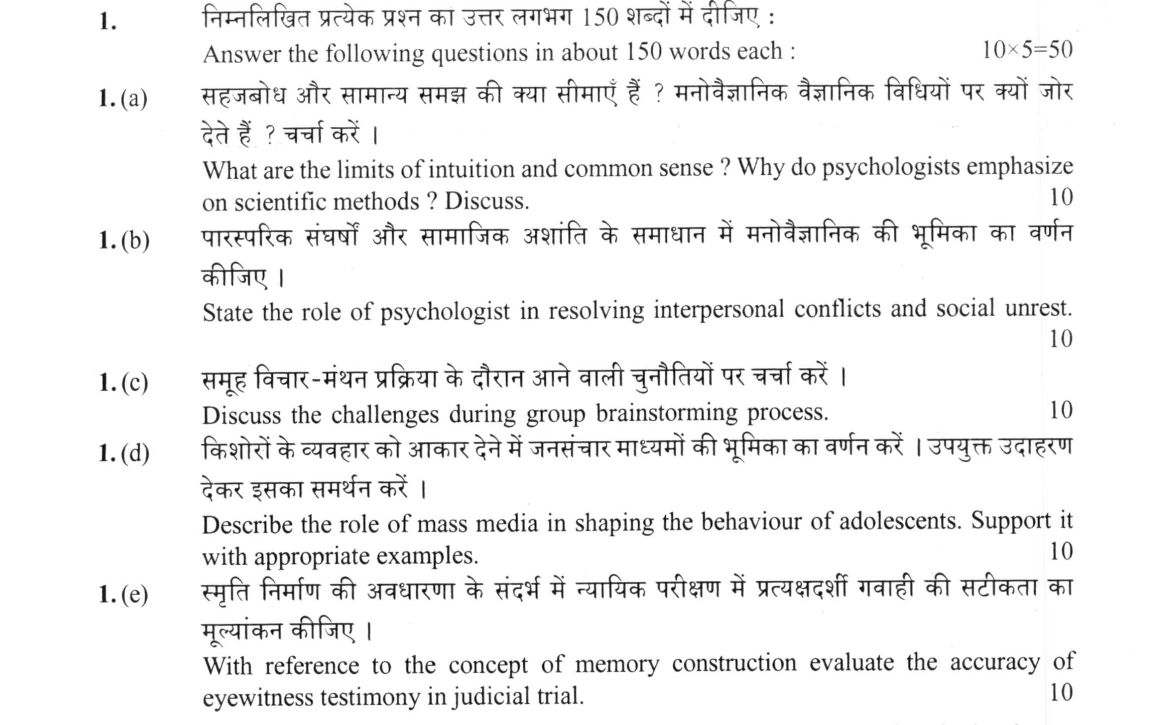
Answer the following questions in about 150 words each: (a) What are the limits of intuition and common sense? Why do…
Answer the following questions in about 150 words each: What are the limits of intuition and common sense? Why do psychologists emphasize on scientific methods? Discuss. 10 marks
State the role of psychologist in resolving interpersonal conflicts and social unrest. 10 marks
Discuss the challenges during group brainstorming process. 10 marks
Describe the role of mass media in shaping the behaviour of adolescents. Support it with appropriate examples. 10 marks
With reference to the concept of memory construction evaluate the accuracy of eyewitness testimony in judicial trial. 10 marks
हिंदी में प्रश्न पढ़ें
निम्नलिखित प्रत्येक प्रश्न का उत्तर लगभग 150 शब्दों में दीजिए : सहजबोध और सामान्य समझ की क्या सीमाएं हैं ? मनोवैज्ञानिक वैज्ञानिक विधियों पर क्यों जोर देते हैं ? चर्चा करें । (10 अंक)
पारस्परिक संघर्षों और सामाजिक अशांति के समाधान में मनोवैज्ञानिक की भूमिका का वर्णन कीजिए । (10 अंक)
समूह विचार-मंथन प्रक्रिया के दौरान आने वाली चुनौतियों पर चर्चा करें । (10 अंक)
किशोरों के व्यवहार को आकार देने में जनसंचार माध्यमों की भूमिका का वर्णन करें । उपयुक्त उदाहरण देकर इसका समर्थन करें । (10 अंक)
स्मृति निर्माण की अवधारणा के संदर्भ में न्यायिक परीक्षण में प्रत्यक्षदर्शी गवाही की सटीकता का मूल्यांकन कीजिए । (10 अंक)
Model answer
Written by UPSC Answer Check against this question's marking rubric, to the 150-word length. UPSC does not publish answers for Mains — this is one way to score well, not an official key.
(a) Intuition and common sense are everyday tools for predicting behaviour, but their limits become clear when they are tested against controlled evidence. Hindsight bias makes past events appear obvious after they occur, so people mistake post-hoc explanations for genuine prediction. Overconfidence leads individuals to trust their gut judgments more than warranted, especially in complex social situations where cues are ambiguous. Confirmation bias further narrows perception, because people seek, notice and remember information that supports their existing beliefs while discounting disconfirming evidence. Common sense is also often contradictory, culturally variable and shaped by personal experience, so it cannot provide stable generalisations. Psychologists therefore emphasise scientific methods because they provide empirical validation, replicability and falsifiability. Systematic observation, measurement and control reduce subjective errors, allow rival explanations to be tested, and make knowledge cumulative rather than dependent on individual impressions.
(b) In interpersonal conflicts, psychologists act as trained facilitators rather than arbiters. Through active listening they help conflicting parties articulate needs, recognise distorted attributions and reduce emotional escalation. Negotiation training equips individuals with skills such as non-violent communication, perspective-taking and problem-solving, which can de-escalate disputes in families, workplaces and neighbourhoods. At a broader level, community psychology interventions enable psychologists to work with local groups, schools and civil society to build trust, address grievances and create supportive networks before tensions harden into social unrest. During unrest, their role shifts to trauma counselling, crisis support and psychosocial first aid for victims, witnesses and affected communities, helping to restore a sense of safety and agency. Psychologists also contribute through policy advocacy by advising authorities on conflict-sensitive communication, mental-health services, rehabilitation and restorative justice. Their contribution is preventive as well as remedial: they help interpret the psychological roots of conflict, reduce harm during crises and support social recovery after violence.
(c) Group brainstorming is expected to generate more and better ideas than individual work, but social and cognitive challenges limit its effectiveness. Production blocking occurs when participants wait for their turn to speak, causing them to lose the thread of an idea or forget it before sharing. Evaluation apprehension makes members cautious, especially if they fear judgement from peers or authority figures, so they suppress unconventional suggestions. Social loafing reduces individual effort when responsibility is diffused across the group, leading some members to contribute less than alone. Conformity pressure further narrows ideas, as participants may align with dominant opinions or avoid challenging the group’s emerging consensus. Nijstad’s research highlights that groups often create an illusion of group productivity: the process feels productive, yet output may be lower than expected because of these inhibiting mechanisms. Thus, the challenge is to design procedures that minimise waiting, reduce fear of evaluation, distribute responsibility and protect cognitive independence.
(d) Mass media shapes adolescent behaviour by providing models and norms that adolescents imitate. Through social learning, repeated exposure to aggressive content in films, games or online videos can normalise hostility and make aggressive responses seem acceptable. Body image concerns are intensified by curated images on social media, where filters, beauty standards and peer comparison can promote dissatisfaction, disordered eating or low self-esteem. Media also shapes identity formation, as adolescents use celebrities, influencers and online communities to explore values, gender roles and group belonging. In India, these effects are visible in everyday media consumption: TikTok trends can spread challenges, fashion styles and consumer habits among teenagers; long-running TV serials present family hierarchies, gender roles and conflict patterns that adolescents may absorb as normal; Bollywood influence can shape aspirations and consumerism, encouraging imitation of celebrity lifestyles. The influence is not deterministic; age, family guidance, peer context and media literacy moderate it.
(e) Eyewitness testimony is often treated as direct evidence, but memory is constructive, not a recording. Loftus’s misinformation effect shows that post-event information, such as leading questions or media reports, can alter what a witness remembers. Source monitoring errors occur when witnesses confuse the origin of information, mistaking a detail seen in a news report for something personally witnessed. Schema-driven reconstruction fills gaps using expectations, stereotypes or prior knowledge, producing coherent but inaccurate accounts. In trials, these processes reduce accuracy, especially when suggestive questioning, biased lineup procedures or repeated interviews are used. In Indian criminal trials, where eyewitness identification can be decisive, such errors have raised concerns about wrongful convictions and the need for corroboration. The Indian Evidence Act, 1872, treats such accounts as oral evidence, but their weight depends on reliability. A way forward is to adopt cognitive interview techniques, double-blind lineups and judicial caution, so testimony is evaluated as reconstructive rather than infallible.
What "Discuss" is asking you to do
Lay the issue out from more than one side — how it arose, what is claimed for it, what is held against it, and where it now stands. UPSC attaches discuss to broad topics with several live dimensions, so coverage of the dimensions earns more than the strength of your opinion.
Structure that answers it
Set the issue up → the case as it is made → the case against → the dimension both sides leave out → where the balance now lies
Where marks are lost
Listing facts with no thread between them, or arguing one side throughout and calling it a discussion.
How this answer will be evaluated
Approach
Framework: Define > Theory or model > Evidence > Application. (a) discuss: intro > 3-4 dimensions > example > balanced close | (b) enumerate: list the items in order > one line each > no commentary | (c) challenges: 3-4 challenges > solutions mapped to them > conclusion | (d) describe: define > structure or process in order > labelled diagram > significance | (e) evaluate: criteria > evidence > balanced judgment Full marks: Comprehensive, well-structured, with specific examples and references to psychological theories/studies.
Key points expected
- Define intuition and common sense
- State specific limits (e.g., hindsight bias, illusion of validity)
- Explain why scientific methods are emphasized
- Provide a balanced conclusion
- Define interpersonal conflict and social unrest
- State specific roles (e.g., mediation, counseling)
- Explain the mechanism of resolution
- Provide a clear conclusion
Evaluation rubric
Each sub-part is marked on its own, against the marks and word limit printed on the paper.
- (a) Limits of intuition/common sense and the necessity of scientific methods. 10 marks · 150 words
discuss— intro → 3-4 dimensions → example → balanced close
Must cover
- Define intuition and common sense
- State specific limits (e.g., hindsight bias, illusion of validity)
- Explain why scientific methods are emphasized
- Provide a balanced conclusion
Loses marks
- Vague generalities without specific examples
- Ignoring the 'limits' aspect
- Failing to link limits to the need for science
Earns more
- Mention specific cognitive biases
- Contrast subjective vs objective data
- Reference to empirical evidence
Extra mark
- Name a specific study on intuition failure
- Reference to a specific scientific method (e.g., double-blind)
- (b) Role of psychologists in resolving interpersonal conflicts and social unrest. 10 marks · 150 words
enumerate— list the items in order → one line each → no commentary
Must cover
- Define interpersonal conflict and social unrest
- State specific roles (e.g., mediation, counseling)
- Explain the mechanism of resolution
- Provide a clear conclusion
Loses marks
- General advice without psychological basis
- Ignoring the 'social unrest' aspect
- Failing to specify the psychologist's role
Earns more
- Mention specific techniques (e.g., CBT, group therapy)
- Reference to social psychology concepts
- Example of a specific intervention
Extra mark
- Name a specific psychological model for conflict resolution
- Reference to a specific social unrest case
- (c) Challenges during group brainstorming process. 10 marks · 150 words
challenges— 3-4 challenges → solutions mapped to them → conclusion
Must cover
- Define group brainstorming
- Identify 3-4 specific challenges (e.g., groupthink, production blocking)
- Explain how these challenges hinder the process
- Provide a conclusion
Loses marks
- Listing challenges without explanation
- Ignoring the 'group' aspect
- Failing to link challenges to the brainstorming process
Earns more
- Mention specific group dynamics
- Reference to social loafing
- Example of a failed brainstorming session
Extra mark
- Name a specific study on groupthink
- Reference to a specific brainstorming technique
- (d) Role of mass media in shaping adolescent behaviour with examples. 10 marks · 150 words
describe— define → structure or process in order → labelled diagram → significance
Must cover
- Define mass media and adolescent behaviour
- Describe specific roles (e.g., socialization, information source)
- Provide appropriate examples
- Explain the impact on behaviour
Loses marks
- General statements without examples
- Ignoring the 'adolescent' aspect
- Failing to link media to behaviour
Earns more
- Mention specific media types (e.g., social media, TV)
- Reference to social learning theory
- Example of a specific media influence
Extra mark
- Name a specific study on media influence
- Reference to a specific media campaign
- (e) Accuracy of eyewitness testimony in judicial trials with reference to memory construction. 10 marks · 150 words
evaluate— criteria → evidence → balanced judgment
Must cover
- Define memory construction
- Explain how memory construction affects eyewitness testimony
- Evaluate the accuracy of eyewitness testimony
- Provide a balanced judgment
Loses marks
- Ignoring the 'memory construction' aspect
- Failing to evaluate accuracy
- General statements without specific examples
Earns more
- Mention specific memory errors (e.g., source monitoring error)
- Reference to Loftus's work on eyewitness testimony
- Example of a specific judicial case
Extra mark
- Name a specific study on memory construction
- Reference to a specific legal reform
Practice this exact question
Write your answer and it is marked point by point against the model answer above — what you covered, what you missed, what you got wrong.
Evaluate my answer →More from Psychology 2021 Paper I
- Q1 Answer the following questions in about 150 words each: (a) What are the limits of intuit…
- Q2 (a) How do basic and applied research differ? Explain how knowledge from basic research h…
- Q3 (a) How much nature (genetic factors) and nurture (environmental factors) contribute to a…
- Q4 (a) Why is selective attention important? Discuss the theories of selective attention. (2…