Paper I — Q4
(a) Why is selective attention important? Discuss the theories of selective attention. (20 marks) (b) Which method is most…
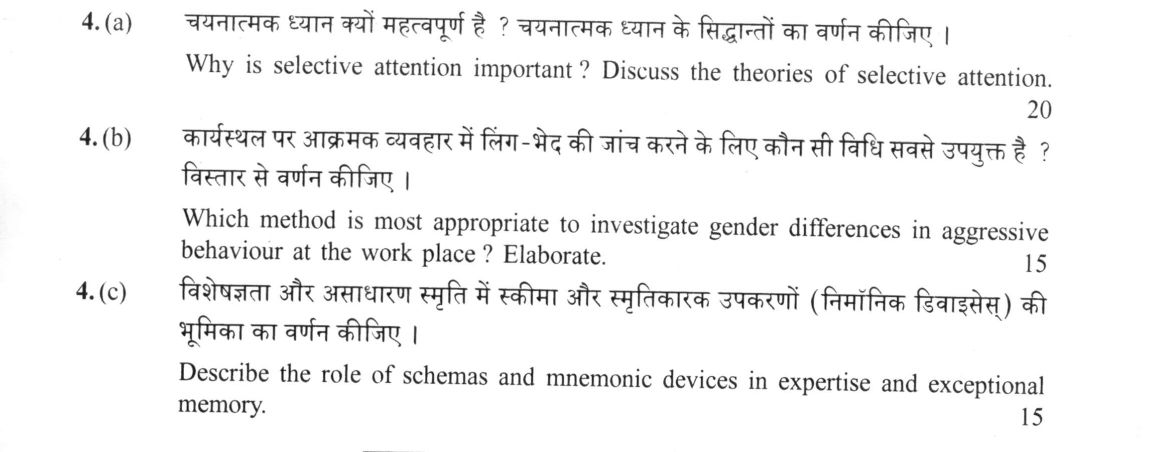
Why is selective attention important? Discuss the theories of selective attention. 20 marks
Which method is most appropriate to investigate gender differences in aggressive behaviour at the work place? Elaborate. 15 marks
Describe the role of schemas and mnemonic devices in expertise and exceptional memory. 15 marks
हिंदी में प्रश्न पढ़ें
चयनात्मक ध्यान क्यों महत्वपूर्ण है ? चयनात्मक ध्यान के सिद्धांतों का वर्णन कीजिए । (20 अंक)
कार्यस्थल पर आक्रमक व्यवहार में लिंग-भेद की जांच करने के लिए कौन सी विधि सबसे उपयुक्त है ? विस्तार से वर्णन कीजिए । (15 अंक)
विशेषज्ञता और असाधारण स्मृति में स्कीमा और स्मृतिकारक उपकरणों (निमोनिक डिवाइसेस) की भूमिका का वर्णन कीजिए । (15 अंक)
Model answer
Written by UPSC Answer Check against this question's marking rubric, to the expected length. UPSC does not publish answers for Mains — this is one way to score well, not an official key.
Selective attention Selective attention is important because sensory input exceeds processing capacity; it filters overload, allocates limited cognitive resources to relevant stimuli, and has survival value by prioritising threats and task-relevant cues. In Indian traffic, a driver must attend to signals while ignoring chatter. Theories explain how this selection occurs. Broadbent’s filter model proposes that all stimuli enter a sensory register/buffer, then a filter selects one channel on physical characteristics such as pitch or location before semantic analysis; unattended information is dropped. Cherry’s cocktail-party problem and dichotic-listening studies showed people can shadow one message, but Moray (1959) found the own name can be detected in the unattended stream, suggesting early selection is not absolute. Treisman’s attenuation model modifies this: the filter attenuates rather than blocks unattended input, allowing meaningful or personally relevant words to reach consciousness; this explains shadowing and own-name effects. Deutsch and Norman’s late-selection model argues that all stimuli are processed physically and semantically, with selection occurring at response selection; McKay’s priming studies, where an unattended word facilitated responding to a related attended word, support late semantic processing. Multimodal integration extends the debate: visual search shows feature-based pop-out and serial search, while the Stroop effect shows automatic semantic processing and response conflict. Early selection is economical but cannot explain meaning; late selection explains meaning but is costly. A balanced view sees attention as a flexible bottleneck shaped by stimulus salience, task demands, and goals.
Workplace aggression To investigate gender differences in aggressive behaviour at the workplace, the most appropriate method is structured naturalistic observation, embedded in a field quasi-experimental design and supplemented by validated self-report and peer/supervisor ratings. Laboratory experiments can establish causality but are artificial and ethically limited; pure meta-analysis is useful but cannot capture context. In a field study, workplaces are matched on size, sector, shift, hierarchy and task conflict; gender is the grouping variable, while aggression is operationalised as physical, verbal, relational and cyber aggression, direct and indirect. Observers code incidents using behavioural anchors, and questionnaires measure frequency, intent and perceived harm. Controls include job role, authority, education, age, caste/class and organisational culture. Ethical safeguards require informed consent, confidentiality, anonymisation, no retaliation, and referral to Internal Complaints Committees under the Sexual Harassment of Women at Workplace (Prevention, Prohibition and Redressal) Act, 2013, where relevant. Gender-sensitive issues are central: Indian workplaces have power asymmetries, caste/class intersectionality, and response bias—women may underreport due to stigma, men may overreport or minimise. Peer ratings and incident logs reduce self-report distortion.
Schemas and mnemonics Schemas are organised knowledge structures that guide perception, recall and problem-solving. Bartlett’s reconstructive memory showed recall is shaped by schemas, not passive storage. Expertise depends on domain-specific schemas: chess masters, studied by Chase and Simon, recognise chunks and patterns rather than memorising moves; medical diagnosis, as in Patel and Groen, relies on illness scripts and diagnostic schemas that compress symptoms into probable causes. Mnemonic devices enhance encoding and retrieval: the method of loci links items to spatial locations, peg-word systems attach words to fixed images, and chunking groups information into meaningful units. Exceptional memory cases illustrate this: Rajan’s large digit span reflects chunking and retrieval practice, while Luria’s study of Shereshevskii showed extraordinary associative memory but also rigidity. Skilled memory theory, proposed by Chase and Ericsson, explains expertise as domain-specific long-term memory structures built through practice; Ericsson and Kintsch’s long-term working memory model shows how retrieval cues and chunking extend working memory in experts. Together, schemas provide the structure and mnemonics provide the retrieval routes.
Attention, schema activation and research method are linked: selective attention determines which cues enter schema-based processing; field methods validate memory theories in real workplaces. Applied relevance in India includes traffic management, competitive-exam preparation through chunking and loci, and workplace DEI policies that use evidence-based observation to reduce gendered aggression.
What "Discuss" is asking you to do
Lay the issue out from more than one side — how it arose, what is claimed for it, what is held against it, and where it now stands. UPSC attaches discuss to broad topics with several live dimensions, so coverage of the dimensions earns more than the strength of your opinion.
Structure that answers it
Set the issue up → the case as it is made → the case against → the dimension both sides leave out → where the balance now lies
Where marks are lost
Listing facts with no thread between them, or arguing one side throughout and calling it a discussion.
How this answer will be evaluated
Approach
Framework: Cognitive Psychology: Attention, Methodology, and Memory. (a) discuss: intro > 3-4 dimensions > example > balanced close | (b) examine: intro > how/why with reasoning > evidence > conclusion | (c) describe: define > structure or process in order > labelled diagram > significance Full marks: Comprehensive coverage of theories/methods with specific examples and critical evaluation.
Key points expected
- Define selective attention and its role in cognitive processing
- Explain Broadbent's Filter Model (Early Selection)
- Explain Treisman's Attenuation Model
- Explain Late Selection theories (Sperling/Deutsch)
- Identify a specific method (e.g., Survey, Case Study, or Experimental)
- Justify the choice based on workplace context
- Address ethical constraints of studying aggression
- Discuss validity and reliability of the chosen method
Evaluation rubric
Each sub-part is marked on its own, against the marks and word limit printed on the paper.
- (a) Explain the functional importance of selective attention and evaluate competing theoretical models. 20 marks
discuss— intro → 3-4 dimensions → example → balanced close
Must cover
- Define selective attention and its role in cognitive processing
- Explain Broadbent's Filter Model (Early Selection)
- Explain Treisman's Attenuation Model
- Explain Late Selection theories (Sperling/Deutsch)
Loses marks
- Confusing selective attention with divided attention
- Describing theories without experimental evidence
- Failing to distinguish between early and late selection
Earns more
- Mention dichotic listening experiments (Cherry)
- Reference the Cocktail Party Effect
- Compare Early vs Late selection mechanisms
- Mention the Stroop effect as evidence
Extra mark
- Diagram of the Filter Model
- Reference to Posner's spotlight model
- (b) Identify and justify the most appropriate research method for studying gender differences in workplace aggression. 15 marks
examine— intro → how/why with reasoning → evidence → conclusion
Must cover
- Identify a specific method (e.g., Survey, Case Study, or Experimental)
- Justify the choice based on workplace context
- Address ethical constraints of studying aggression
- Discuss validity and reliability of the chosen method
Loses marks
- Suggesting purely experimental methods without ethical justification
- Ignoring the specific context of the workplace
- Failing to address the gender variable specifically
Earns more
- Mention specific psychometric tools (e.g., Buss-Perry Aggression Questionnaire)
- Discuss the limitations of self-report in aggression
- Reference organizational behavior studies
- Mention the role of confounding variables
Extra mark
- Reference to a specific workplace aggression study
- Mention mixed-methods approach
- (c) Explain how schemas and mnemonic devices contribute to expertise and exceptional memory performance. 15 marks
describe— define → structure or process in order → labelled diagram → significance
Must cover
- Define schemas and their role in organizing information
- Explain the role of chunking in expert memory
- Describe specific mnemonic devices (e.g., Method of Loci)
- Link these mechanisms to the development of expertise
Loses marks
- Confusing schemas with general knowledge
- Failing to link mnemonics to long-term retention
- Ignoring the role of practice in expertise
Earns more
- Reference to chess player studies (Chase & Simon)
- Mention the role of long-term memory in working memory
- Discuss the difference between novice and expert schemas
- Reference to memory athletes
Extra mark
- Diagram of the Method of Loci
- Reference to specific memory records
Practice this exact question
Write your answer and it is marked point by point against the model answer above — what you covered, what you missed, what you got wrong.
Evaluate my answer →More from Psychology 2021 Paper I
- Q1 Answer the following questions in about 150 words each: (a) What are the limits of intuit…
- Q2 (a) How do basic and applied research differ? Explain how knowledge from basic research h…
- Q3 (a) How much nature (genetic factors) and nurture (environmental factors) contribute to a…
- Q4 (a) Why is selective attention important? Discuss the theories of selective attention. (2…
- Q5 Answer the following questions in about 150 words each: (a) "Some psychological measures…
- Q6 (a) Are we born with personality? Critically evaluate with theoretical interpretation. (2…
- Q7 (a) Which approaches to motivation are more commonly used in an organization? How these a…