Paper I — Q6
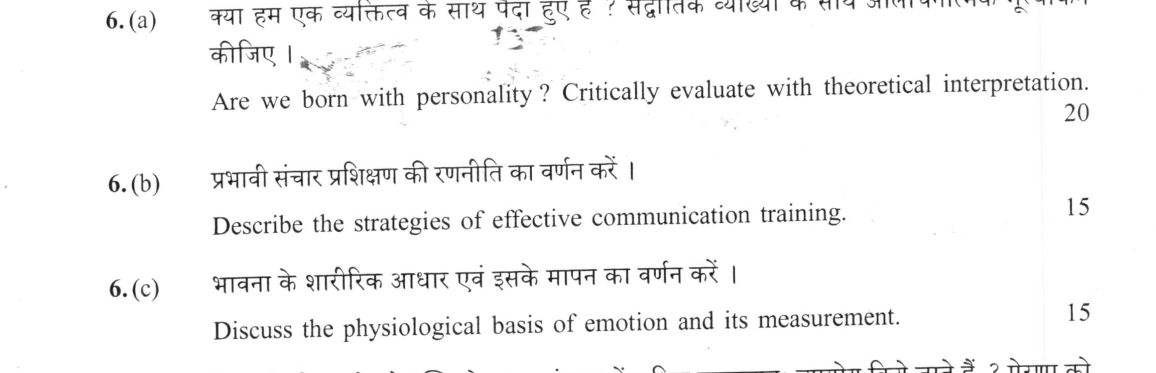
(a) Are we born with personality? Critically evaluate with theoretical interpretation. (20 marks) (b) Describe the strategies of…
Are we born with personality? Critically evaluate with theoretical interpretation. 20 marks
Describe the strategies of effective communication training. 15 marks
Discuss the physiological basis of emotion and its measurement. 15 marks
हिंदी में प्रश्न पढ़ें
क्या हम एक व्यक्तित्व के साथ पैदा हुए हैं ? सैद्धांतिक व्याख्या के साथ आलोचनात्मक मूल्यांकन कीजिए । (20 अंक)
प्रभावी संचार प्रशिक्षण की रणनीति का वर्णन करें । (15 अंक)
भावना के शारीरिक आधार एवं इसके मापन का वर्णन करें । (15 अंक)
Model answer
Written by UPSC Answer Check against this question's marking rubric, to the expected length. UPSC does not publish answers for Mains — this is one way to score well, not an official key.
Part (a) Whether personality is “born with us” cannot be answered by pure genetic determinism. Twin and adoption studies show heritable temperamental differences—activity, negative emotionality, sociability—and Eysenck’s PEN model linked extraversion, neuroticism and psychoticism to cortical arousal, biological reactivity and dopamine systems. Such evidence supports innate predispositions, not fixed traits. Psychodynamic theory adds that unconscious conflicts, early attachment and defences shape personality; humanistic theory stresses self-actualisation and the person’s active construction of meaning; social-cognitive theory, especially Bandura, shows that observation, reinforcement, self-efficacy and reciprocal determinism continually modify behaviour. Adler’s compensation and cultural psychology further show that inferiority, family demands and cultural scripts can redirect development. Indian cross-cultural studies indicate that trait structures are broadly recognisable across castes, languages and family systems, yet their expression is moderated by joint-family roles, gender expectations and local moral vocabularies. The strongest verdict is interactionist: epigenetics, gene-environment correlation and diathesis-stress models show genes load the die, while environment pulls it. A child with high reactivity may become anxious in a punitive home but resilient in a supportive one. Thus we are born with personality tendencies, not a completed personality.
Part (b) Effective communication training is systematic, not merely advice. It begins with a diagnostic audit of listening, message clarity, feedback and non-verbal habits. Assertiveness training, associated with Wolpe, uses role-play, graduated exposure and rehearsal to help trainees express needs without aggression or passivity. Active listening, rooted in Rogers, trains paraphrasing, reflection of feeling and withholding premature advice. Non-verbal communication training addresses eye contact, posture, gesture, tone and proxemics, especially in cross-cultural settings. Feedback and reinforcement are built in: trainers give specific, behaviour-based feedback; trainees practise giving and receiving it; positive reinforcement consolidates change. Empathy development programmes use perspective-taking, case vignettes and reflective journaling to improve understanding of others’ frames. In Indian administration, such strategies are relevant to LBSNAA induction, district-level workshops and administrative reforms aimed at reducing bureaucratic distance. Communication training for civil services should combine language clarity, grievance handling, public speaking and emotional intelligence modules, because officials must translate policy into public trust.
Part (c) Emotion has a physiological basis that theories interpret differently. James-Lange located feeling in awareness of bodily changes; Cannon-Bard argued that visceral and conscious components occur together, not sequentially; Schachter-Singer added cognitive appraisal, saying arousal is labelled by context. Modern physiology locates emotion in the limbic system—amygdala for threat and salience, hippocampus for context and memory—within the Papez circuit, with the hypothalamus coordinating autonomic and endocrine responses. The autonomic nervous system mobilises heart rate, respiration, sweating and digestion; its sympathetic-adrenal-medullary branch is a component, not the whole ANS, while the hypothalamic-pituitary-adrenal axis sustains stress responses. Measurement therefore combines objective and subjective indices. Polygraphy records skin conductance, respiration and pulse, but its limitations are well known: it measures arousal, not deception, and is vulnerable to anxiety, drugs and practice. Facial EMG detects subtle muscle activity, startle response indexes defensive reactivity, and self-report inventories such as PANAS capture positive and negative affect. Neuroimaging adds specificity: fMRI uses BOLD signal to map task-related blood-flow changes, whereas PET measures metabolic or receptor activity. Indian research has applied PANAS and related mood scales in local samples, with translation and cultural adaptation where needed.
Conclusion The three parts converge. Genetic temperamental differences shape emotional reactivity and, through appraisal and learning, communication styles. Training can modify expression without erasing biology. The final verdict is that personality is neither wholly innate nor wholly environmental: it is a biopsychosocial system in which inherited predispositions are continuously organised by culture, relationships and deliberate practice.
What "Critically evaluate" is asking you to do
Judge how well something has performed against the standard it set for itself — its stated aim, mandate or promise — and commit to a verdict. Name the yardstick before you judge; an unanchored judgement reads as opinion. “Critically” is not a section added at the end: name the yardstick you are judging by — the evidence, the stated objective, a constitutional principle, a rival explanation — and let a verdict close each part of the body. Where the question quotes a claim, that verdict must land on the claim itself, accepted, qualified or rejected, and not on the theme in general.
Structure that answers it
Name the yardstick — stated aim, mandate or benchmark → performance against it → shortfall against it → why the gap exists → verdict
Where marks are lost
Merits in one paragraph, demerits in the next, and a conclusion calling for a balanced and holistic approach. That is a survey with the judgement left out and it holds the answer in the middle band. The opposite error is reading “critically” as permission to attack — and with the odd pairings, critically describe or critically explain, the exposition still carries most of the marks, the judgement being a layer on it rather than a substitute for it.
How this answer will be evaluated
Approach
(a) critically evaluate: positives > negatives/limits > conditions/safeguards > conclusion | (b) describe: define > structure or process in order > labelled diagram > significance | (c) discuss: intro > 3-4 dimensions > example > balanced close Full marks: Comprehensive theoretical coverage with named evidence, balanced evaluation, and specific examples.
Key points expected
- Present arguments supporting innate/biological determinism
- Present arguments supporting environmental/social shaping
- Critically evaluate specific theoretical interpretations
- Provide a balanced conclusion on the interaction
- Define effective communication training
- Describe specific strategies or techniques (e.g., role-play, feedback)
- Explain the structure or process of the training
- State the significance or outcome of such training
Evaluation rubric
Each sub-part is marked on its own, against the marks and word limit printed on the paper.
- (a) Assess the nature vs. nurture debate in personality formation using theoretical models. 20 marks
critically evaluate— positives → negatives/limits → conditions/safeguards → conclusion
Must cover
- Present arguments supporting innate/biological determinism
- Present arguments supporting environmental/social shaping
- Critically evaluate specific theoretical interpretations
- Provide a balanced conclusion on the interaction
Loses marks
- Presenting only one side of the debate
- Theory without supporting evidence or examples
- Vague generalizations without theoretical names
Earns more
- Reference to specific theories (e.g., Freud, Allport, Eysenck)
- Mention of twin studies or heritability evidence
- Discussion of temperament vs. character
Extra mark
- Citation of specific named experiments (e.g., Minnesota Twin Study)
- Reference to specific psychometric tools (e.g., 16PF, Big Five)
- (b) Outline the methods and processes used in effective communication training. 15 marks
describe— define → structure or process in order → labelled diagram → significance
Must cover
- Define effective communication training
- Describe specific strategies or techniques (e.g., role-play, feedback)
- Explain the structure or process of the training
- State the significance or outcome of such training
Loses marks
- Providing general advice instead of training strategies
- Failing to describe the process or structure
- Confusing communication skills with communication training
Earns more
- Mention of specific models (e.g., Tannenbaum, Lewin)
- Reference to active listening or non-verbal cues
- Distinction between verbal and non-verbal strategies
Extra mark
- Labelled diagram of a communication training process
- Reference to specific corporate or educational training programs
- (c) Explain the biological mechanisms of emotion and how they are measured. 15 marks
discuss— intro → 3-4 dimensions → example → balanced close
Must cover
- Explain the physiological basis (e.g., autonomic nervous system)
- Discuss specific theories of emotion (e.g., James-Lange, Cannon-Bard)
- Describe methods of measuring physiological responses
- Provide examples of physiological indicators (e.g., heart rate, sweat)
Loses marks
- Focusing only on psychological aspects, ignoring physiology
- Failing to mention specific measurement techniques
- Confusing physiological basis with psychological causes
Earns more
- Reference to specific brain structures (e.g., amygdala, hypothalamus)
- Mention of specific measurement tools (e.g., galvanometer, EEG)
- Discussion of the role of hormones (e.g., adrenaline)
Extra mark
- Labelled diagram of the physiological pathway of emotion
- Reference to specific named experiments (e.g., Schachter-Singer)
Practice this exact question
Write your answer and it is marked point by point against the model answer above — what you covered, what you missed, what you got wrong.
Evaluate my answer →More from Psychology 2021 Paper I
- Q3 (a) How much nature (genetic factors) and nurture (environmental factors) contribute to a…
- Q4 (a) Why is selective attention important? Discuss the theories of selective attention. (2…
- Q5 Answer the following questions in about 150 words each: (a) "Some psychological measures…
- Q6 (a) Are we born with personality? Critically evaluate with theoretical interpretation. (2…
- Q7 (a) Which approaches to motivation are more commonly used in an organization? How these a…
- Q8 (a) Humans strive to assign causes to actions of self and others and fall into traps of b…