Paper I — Q5
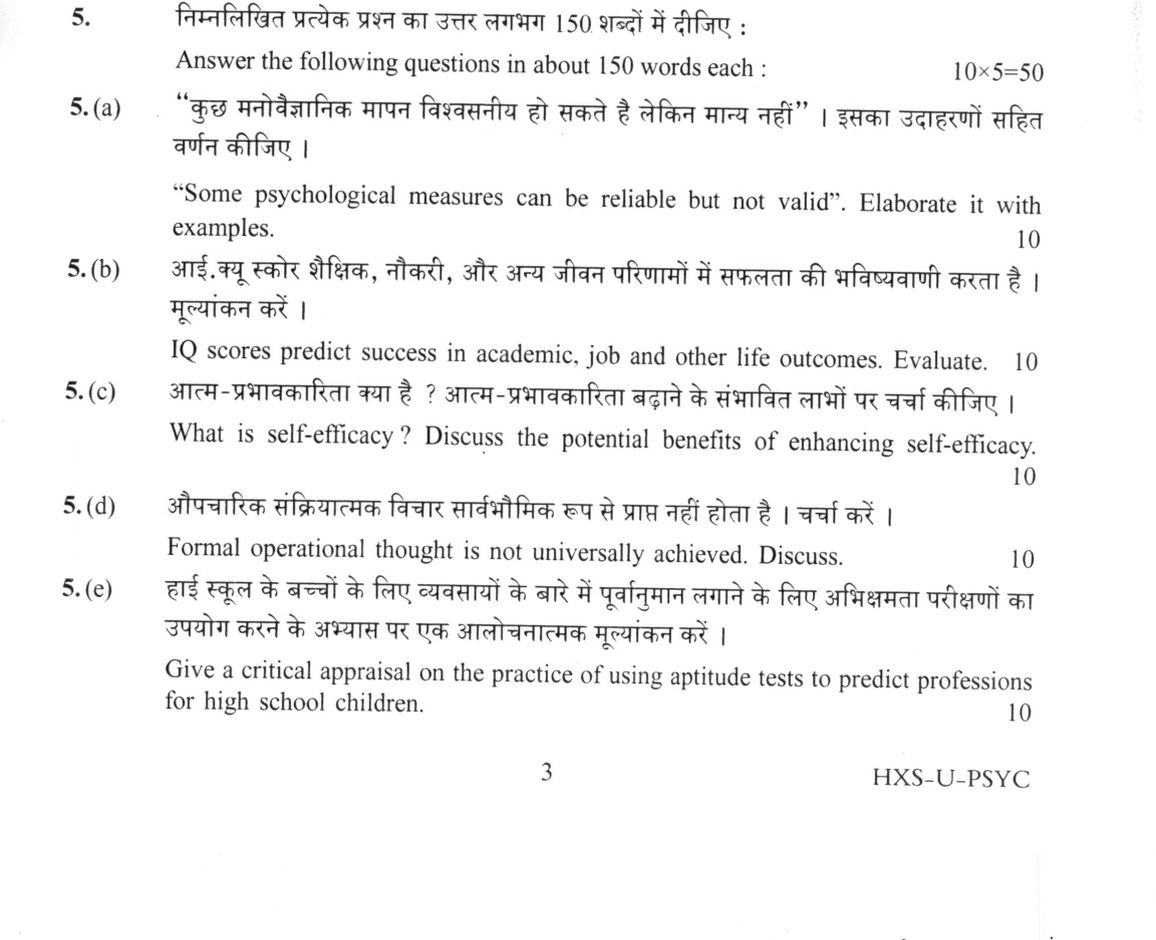
Answer the following questions in about 150 words each: (a) "Some psychological measures can be reliable but not valid"…
Answer the following questions in about 150 words each: "Some psychological measures can be reliable but not valid". Elaborate it with examples. 10 marks
IQ scores predict success in academic, job and other life outcomes. Evaluate. 10 marks
What is self-efficacy? Discuss the potential benefits of enhancing self-efficacy. 10 marks
Formal operational thought is not universally achieved. Discuss. 10 marks
Give a critical appraisal on the practice of using aptitude tests to predict professions for high school children. 10 marks
हिंदी में प्रश्न पढ़ें
निम्नलिखित प्रत्येक प्रश्न का उत्तर लगभग 150 शब्दों में दीजिए : "कुछ मनोवैज्ञानिक मापन विश्वसनीय हो सकते हैं लेकिन मान्य नहीं" । इसका उदाहरणों सहित वर्णन कीजिए । (10 अंक)
आई.क्यू स्कोर शैक्षिक, नौकरी, और अन्य जीवन परिणामों में सफलता की भविष्यवाणी करता है । मूल्यांकन करें । (10 अंक)
आत्म-प्रभावकारिता क्या है ? आत्म-प्रभावकारिता बढ़ाने के संभावित लाभों पर चर्चा कीजिए । (10 अंक)
औपचारिक संक्रियात्मक विचार सार्वभौमिक रूप से प्राप्त नहीं होता है । चर्चा करें । (10 अंक)
हाई स्कूल के बच्चों के लिए व्यवसायों के बारे में पूर्वानुमान लगाने के लिए अभिक्षमता परीक्षणों का उपयोग करने के अभ्यास पर एक आलोचनात्मक मूल्यांकन करें । (10 अंक)
Model answer
Written by UPSC Answer Check against this question's marking rubric, to the 150-word length. UPSC does not publish answers for Mains — this is one way to score well, not an official key.
(a) Reliability without Validity
Reliability refers to the consistency and stability of a psychological measure across repeated administrations, whereas validity denotes its accuracy in measuring the specific construct it claims to assess. A measure can be perfectly consistent without being truthful.
For instance, an uncalibrated bathroom scale that systematically registers five kilograms below an individual's true weight yields identical readings upon repeated trials (high test-retest reliability), yet fails to reflect actual weight (zero validity). In psychometrics, measuring an individual's head circumference to assess general intelligence provides exceptional test-retest and inter-rater reliability, but lacks content, criterion, and construct validity. Similarly, a poorly constructed psychometric inventory might consistently tap into generalized test anxiety rather than subject-matter aptitude, generating high internal consistency while failing criterion-related validation. Thus, while reliability is a mathematical prerequisite for validity, it does not guarantee that a test measures what it purports to measure.
(b) Predictive Validity of IQ Scores
General mental ability, measured via IQ tests, is an established psychometric predictor of real-world outcomes. Meta-analyses by Schmidt and Hunter indicate that IQ correlates strongly with job training performance (r ≈ 0.56) and overall occupational performance (r ≈ 0.51), with predictive validity increasing for high-complexity professions. In academia, IQ consistently predicts scholastic attainment (r ≈ 0.50–0.60), alongside showing positive associations with health literacy and socioeconomic mobility.
However, IQ accounts for only a modest proportion of the total variance in life outcomes. Non-cognitive constructs—such as emotional intelligence (Goleman), divergent thinking and creativity (Guilford), and grit (Duckworth)—frequently explain significant incremental variance in long-term success. Furthermore, IQ scores are heavily confounded by socioeconomic status, structural privilege, and test-taking familiarity. In the Indian context, the widespread prevalence of commercial coaching creates severe test-wiseness bias, artificially inflating scores on standardized tests without reflecting intrinsic cognitive capability.
Verdict: IQ serves as an effective threshold predictor of basic cognitive proficiency, but it is insufficient as a standalone determinant of holistic life and occupational success.
(c) Self-Efficacy: Concept and Benefits
Albert Bandura defined self-efficacy as an individual's belief in their capability to organize and execute the courses of action required to produce given attainments. Operating as a core component of Social Cognitive Theory, it is developed through four primary sources: mastery experiences, vicarious learning, verbal persuasion, and physiological state appraisal.
Enhancing self-efficacy generates substantial psychological and behavioral benefits:
- Persistence and Goal Attainment: High self-efficacy fosters challenging goal-setting and sustained effort in the face of obstacles, directly boosting academic and occupational performance.
- Stress Resilience and Coping: It moderates the stress response by increasing perceived controllability over environmental demands, mitigating anxiety and vulnerability to burnout.
- Health Behaviors: It significantly enhances adherence to lifestyle modifications, substance cessation programs, and chronic disease management.
- Affective Regulation: By altering cognitive appraisals of threat into challenge, self-efficacy buffers against depressive symptoms and cultivates proactive agency.
(d) Non-Universality of Formal Operational Thought
Jean Piaget conceptualized formal operational thought—characterized by hypothetico-deductive reasoning, propositional logic, and abstract problem-solving—as the universal, final stage of cognitive development emerging during early adolescence.
Cross-cultural evidence, however, refutes this universalist claim. Anthropological and psychological investigations, such as Pierre Dasen’s studies in Papua New Guinea and Michael Cole’s research among the Kpelle of Liberia, demonstrate that individuals in non-industrial, traditional societies rarely manifest formal operational logic on standard Piagetian tasks. Instead, their cognitive systems stabilize at concrete operations, which are ecologically adaptive and fully sufficient for navigating daily environmental demands.
Formal operational thinking is heavily mediated by formal schooling, literacy, and exposure to scientific curricula that emphasize decontextualized symbolic manipulation (as emphasized by Vygotsky). Even within technologically advanced societies, many adults utilize formal operations only within familiar domains of expertise, proving that formal thought is a culturally cultivated and domain-specific capacity rather than a universal biological milestone.
(e) Critical Appraisal of Aptitude Testing for High School Students
The widespread practice of utilizing aptitude batteries (such as the DAT or DBDA) to channel high school students into specific career paths requires critical evaluation.
From a developmental perspective, adolescence is marked by neurobiological plasticity, evolving interests, and unstable self-concept. Attempting to lock students into rigid occupational trajectories based on early testing overlooks developmental fluidity. Furthermore, standard aptitude tests frequently carry cultural, urban, and socio-economic biases, disadvantageous to students from marginalized or vernacular backgrounds. Psychologically, assigning deterministic labels can induce a self-fulfilling prophecy (the Rosenthal effect), restricting exploratory opportunities and inducing occupational foreclosure.
This reductionist testing culture contrasts sharply with the Gandhian philosophy of Nai Talim, which advocates for the cultivation of multiple intelligences, experiential learning, and the integration of vocational and intellectual diversity. Aptitude assessments must function purely as non-binding, reflective guides within comprehensive counseling frameworks, rather than as deterministic barriers that constrain career potential.
What "Evaluate" is asking you to do
Judge how well something has performed against the standard it set for itself — its stated aim, mandate or promise — and commit to a verdict. Name the yardstick before you judge; an unanchored judgement reads as opinion.
Structure that answers it
Name the yardstick — stated aim, mandate or benchmark → performance against it → shortfall against it → why the gap exists → verdict
Where marks are lost
Presenting both sides and then declining to decide, or delivering a verdict against a standard you never stated, which makes it look arbitrary.
How this answer will be evaluated
Approach
Framework: Psychometric Properties & Developmental Psychology. (a) explain: definition/context > points in order > small example > short close | (b) evaluate: criteria > evidence > balanced judgment | (c) discuss: intro > 3-4 dimensions > example > balanced close | (d) discuss: intro > 3-4 dimensions > example > balanced close | (e) critique: the claim > its strengths > its weaknesses > your judgment Full marks: Precise definitions, named theories/studies, balanced evaluation, concrete examples.
Key points expected
- Define reliability as consistency of measurement
- Define validity as accuracy of measurement
- Provide example of reliable but invalid measure
- Explain why reliability is necessary but not sufficient for validity
- Acknowledge correlation between IQ and academic performance
- Discuss limitations of IQ in predicting job success
- Mention role of non-cognitive factors (e.g., EQ, grit)
- Provide balanced judgment on predictive validity
Evaluation rubric
Each sub-part is marked on its own, against the marks and word limit printed on the paper.
- (a) Define reliability/validity and distinguish them with a concrete example. 10 marks · 150 words
explain— definition/context → points in order → small example → short close
Must cover
- Define reliability as consistency of measurement
- Define validity as accuracy of measurement
- Provide example of reliable but invalid measure
- Explain why reliability is necessary but not sufficient for validity
Loses marks
- Confusing reliability with validity
- Failing to provide a concrete example
Earns more
- Mention specific psychometric tools (e.g., broken scale)
- Use the 'bullseye' analogy (consistency vs accuracy)
Extra mark
- Reference specific psychometric indices (Cronbach's alpha vs construct validity)
- (b) Assess the predictive power of IQ for academic and job success. 10 marks · 150 words
evaluate— criteria → evidence → balanced judgment
Must cover
- Acknowledge correlation between IQ and academic performance
- Discuss limitations of IQ in predicting job success
- Mention role of non-cognitive factors (e.g., EQ, grit)
- Provide balanced judgment on predictive validity
Loses marks
- Claiming IQ is the sole predictor of success
- Ignoring the role of environmental factors
Earns more
- Reference specific studies (e.g., Hunter & Schmidt)
- Mention specific job types where IQ is less predictive
Extra mark
- Reference specific meta-analyses on IQ and job performance
- (c) Define self-efficacy and list benefits of enhancing it. 10 marks · 150 words
discuss— intro → 3-4 dimensions → example → balanced close
Must cover
- Define self-efficacy (Bandura's concept)
- List at least 3 benefits of high self-efficacy
- Explain how self-efficacy influences behavior
- Mention sources of self-efficacy (mastery, modeling, etc.)
Loses marks
- Confusing self-efficacy with self-esteem
- Failing to link self-efficacy to specific outcomes
Earns more
- Reference Bandura's Social Cognitive Theory
- Give specific examples of self-efficacy in action
Extra mark
- Reference specific interventions to enhance self-efficacy
- (d) Explain why formal operational thought is not universal. 10 marks · 150 words
discuss— intro → 3-4 dimensions → example → balanced close
Must cover
- Define formal operational thought (Piaget)
- Explain factors limiting its achievement (culture, education)
- Mention evidence of non-universality
- Discuss alternative cognitive styles
Loses marks
- Assuming formal operations are universal
- Ignoring cultural and educational influences
Earns more
- Reference cross-cultural studies on Piaget's stages
- Mention specific cultures where formal operations are less common
Extra mark
- Reference specific researchers (e.g., Cole, Scribner)
- (e) Critically appraise using aptitude tests for career prediction. 10 marks · 150 words
critique— the claim → its strengths → its weaknesses → your judgment
Must cover
- Explain the purpose of aptitude tests
- List strengths of aptitude tests for career prediction
- List limitations (cultural bias, narrow focus)
- Provide judgment on their overall utility
Loses marks
- Ignoring the limitations of aptitude tests
- Failing to consider the context of career counseling
Earns more
- Mention specific aptitude tests (e.g., DAT, GATB)
- Discuss the role of interest inventories alongside aptitude
Extra mark
- Reference specific studies on the validity of aptitude tests
Practice this exact question
Write your answer and it is marked point by point against the model answer above — what you covered, what you missed, what you got wrong.
Evaluate my answer →More from Psychology 2021 Paper I
- Q2 (a) How do basic and applied research differ? Explain how knowledge from basic research h…
- Q3 (a) How much nature (genetic factors) and nurture (environmental factors) contribute to a…
- Q4 (a) Why is selective attention important? Discuss the theories of selective attention. (2…
- Q5 Answer the following questions in about 150 words each: (a) "Some psychological measures…
- Q6 (a) Are we born with personality? Critically evaluate with theoretical interpretation. (2…
- Q7 (a) Which approaches to motivation are more commonly used in an organization? How these a…
- Q8 (a) Humans strive to assign causes to actions of self and others and fall into traps of b…