Paper I — Q3
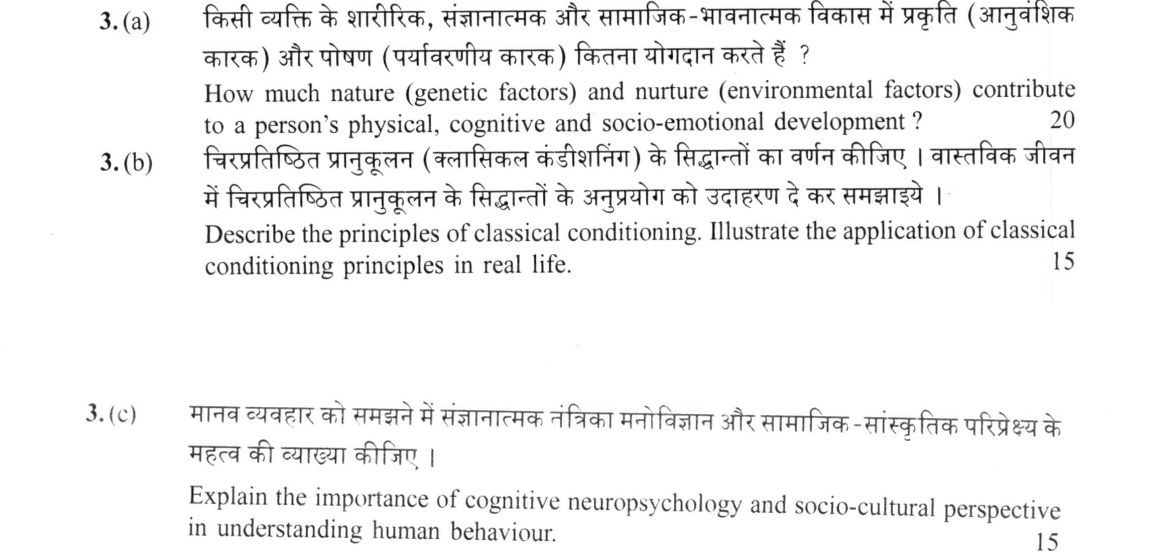
(a) How much nature (genetic factors) and nurture (environmental factors) contribute to a person's physical, cognitive and…
How much nature (genetic factors) and nurture (environmental factors) contribute to a person's physical, cognitive and socio-emotional development? 20 marks
Describe the principles of classical conditioning. Illustrate the application of classical conditioning principles in real life. 15 marks
Explain the importance of cognitive neuropsychology and socio-cultural perspective in understanding human behaviour. 15 marks
हिंदी में प्रश्न पढ़ें
किसी व्यक्ति के शारीरिक, संज्ञानात्मक और सामाजिक-भावनात्मक विकास में प्रकृति (आनुवंशिक कारक) और पोषण (पर्यावरणीय कारक) कितना योगदान करते हैं ? (20 अंक)
चिरप्रतिष्ठित प्रानुकूलन (क्लासिकल कंडीशनिंग) के सिद्धांतों का वर्णन कीजिए । वास्तविक जीवन में चिरप्रतिष्ठित प्रानुकूलन के सिद्धांतों के अनुप्रयोग को उदाहरण दे कर समझाइये । (15 अंक)
मानव व्यवहार को समझने में संज्ञानात्मक तंत्रिका मनोविज्ञान और सामाजिक-सांस्कृतिक परिप्रेक्ष्य के महत्व की व्याख्या कीजिए । (15 अंक)
Model answer
Written by UPSC Answer Check against this question's marking rubric, to the expected length. UPSC does not publish answers for Mains — this is one way to score well, not an official key.
Development is not the product of genes alone or environment alone; it is an ongoing interaction in which biological potentials are expressed, modified, or constrained by experience.
Nature and nurture Physical traits show strong genetic influence, but environment matters. Height has high heritability in stable populations, yet nutrition, disease and socioeconomic deprivation can reduce adult stature; puberty timing is genetically influenced but also affected by nutrition and stress. Epigenetic changes show how environment can alter gene expression without changing DNA. Cognitive development is similarly interactive. Twin studies such as the Minnesota Twin Family Study and TEDS estimate IQ heritability around 0.5 in childhood and higher in adulthood, though their equal-environment assumption and selection limits require caution; adoption studies show that home environment, schooling and socioeconomic status shape language and reasoning. The Flynn effect, where IQ scores rise across generations, demonstrates that environmental improvements can change cognitive performance. Socio-emotional development also reflects both: temperament shows heritability around 0.4–0.6, but attachment security depends on caregiving responsiveness. Gene-environment interaction means the same genotype may produce different outcomes in different environments. Gene-environment correlations further complicate estimates: passive correlations occur when parents provide both genes and environment; evocative correlations occur when a child’s temperament elicits specific responses; active or niche-picking occurs when individuals seek environments matching their predispositions. Thus heritability is a population statistic, not a fixed individual destiny.
Classical conditioning Pavlov’s procedure identifies the unconditioned stimulus (US), such as food, that naturally produces an unconditioned response (UR), salivation. When a neutral stimulus, such as a bell, is repeatedly paired with the US, it becomes a conditioned stimulus (CS) that elicits a conditioned response (CR), salivation. Acquisition is the learning process; extinction occurs when the CS is presented without the US; spontaneous recovery is the return of the CR after a rest period. Generalization means similar stimuli elicit the CR, while discrimination means the organism learns to respond only to the specific CS. Watson’s Little Albert experiment paired a white rat with a loud noise, producing fear of the rat and similar furry objects; it remains an ethical caution and an applied illustration of emotional learning. In real life, aversion therapy for alcohol use pairs drinking with an unpleasant response. In treating classroom phobia, repeated safe exposure to the feared situation without the expected threat can lead to extinction, while systematic desensitization uses counterconditioning, or reciprocal inhibition, by pairing the feared stimulus with relaxation. Advertising links products with attractive people or music, and taste aversion in Indian households can occur when a child becomes ill after eating a particular food and later rejects it.
Cognitive neuropsychology and socio-cultural perspective Cognitive neuropsychology explains behaviour by linking mental functions to brain mechanisms. Lesion studies such as Phineas Gage, patient HM and split-brain patients reveal executive control, memory systems and hemispheric specialization. Neuroimaging methods such as fMRI and PET allow living brains to be studied, supporting both localization of function and plasticity, as damaged brains can reorganize. The modularity of mind suggests specialized cognitive systems, but their operation depends on neural networks and development. The socio-cultural perspective adds that cognition is shaped by social interaction and culture. Vygotsky’s zone of proximal development, scaffolding and more knowledgeable other show how learning occurs through guided participation. Bronfenbrenner’s ecological systems theory places the individual within micro, meso, exo and macro systems. Cross-cultural psychology highlights cultural variation. In India, joint family life influences cognition through shared language, roles and interdependence, while caste socialization shapes identity, expectations and social behaviour.
Together, these perspectives explain human behaviour as neither purely biological nor purely environmental. Genes set ranges, conditioning creates learned associations, and neurocultural contexts determine how capacities are expressed.
What "Explain" is asking you to do
Make the working of something clear — what sets it off, what follows from what, and what it produces. Explain is the Commission's mechanism word: it dominates the technical papers and the “explain why” stems, where the marks sit in the causal chain and not in the label.
Structure that answers it
State what it is → the initiating condition → the chain of cause, step by step → an instance where it plays out → what the chain produces
Where marks are lost
Describing what something looks like instead of why it works that way. Naming the stages without linking them reads as description too.
How this answer will be evaluated
Approach
Framework: Nature vs. Nurture; Classical Conditioning; Cognitive Neuropsychology & Socio-cultural Perspective. (a) discuss: intro > 3-4 dimensions > example > balanced close | (b) describe: define > structure or process in order > labelled diagram > significance | (c) explain: definition/context > points in order > small example > short close Full marks: Comprehensive coverage of all sub-parts with specific examples, named studies, and clear integration of concepts.
Key points expected
- Define nature (genetic) and nurture (environmental) factors
- Discuss contribution to physical development (e.g., height, health)
- Discuss contribution to cognitive development (e.g., intelligence, learning)
- Discuss contribution to socio-emotional development (e.g., personality, temperament)
- Define Classical Conditioning (Pavlovian)
- Identify and define US, UR, CS, CR
- Describe the process of acquisition, extinction, and spontaneous recovery
- Provide a clear real-life example (e.g., phobias, advertising, food aversion)
Evaluation rubric
Each sub-part is marked on its own, against the marks and word limit printed on the paper.
- (a) Analyze the relative contribution of genetic and environmental factors to physical, cognitive, and socio-emotional development. 20 marks
discuss— intro → 3-4 dimensions → example → balanced close
Must cover
- Define nature (genetic) and nurture (environmental) factors
- Discuss contribution to physical development (e.g., height, health)
- Discuss contribution to cognitive development (e.g., intelligence, learning)
- Discuss contribution to socio-emotional development (e.g., personality, temperament)
Loses marks
- Treating nature and nurture as mutually exclusive
- Ignoring one of the three development domains
- Vague generalities without specific examples
Earns more
- Reference to twin studies (e.g., Minnesota Twin Study)
- Reference to adoption studies
- Mention of epigenetics or gene-environment interaction
- Balanced conclusion on interaction rather than isolation
Extra mark
- Specific statistic on heritability of IQ
- Reference to specific researcher (e.g., Plomin, Belsky)
- (b) Explain the principles of classical conditioning and illustrate its application in real life. 15 marks
describe— define → structure or process in order → labelled diagram → significance
Must cover
- Define Classical Conditioning (Pavlovian)
- Identify and define US, UR, CS, CR
- Describe the process of acquisition, extinction, and spontaneous recovery
- Provide a clear real-life example (e.g., phobias, advertising, food aversion)
Loses marks
- Confusing classical with operant conditioning
- Failing to define the four key components (US, UR, CS, CR)
- Example that does not fit the principles described
Earns more
- Reference to Pavlov's dog experiment
- Mention of higher-order conditioning
- Distinction between classical and operant conditioning
- Application to therapeutic techniques (e.g., systematic desensitization)
Extra mark
- Reference to Little Albert experiment (Watson & Rayner)
- Reference to Garcia effect (taste aversion)
- (c) Explain the importance of cognitive neuropsychology and socio-cultural perspective in understanding human behaviour. 15 marks
explain— definition/context → points in order → small example → short close
Must cover
- Define Cognitive Neuropsychology (brain-behaviour relationship)
- Explain how cognitive neuropsychology aids understanding (e.g., case studies, brain imaging)
- Define Socio-cultural perspective (Vygotsky, culture's role)
- Explain how socio-cultural factors shape behaviour (e.g., language, norms, socialization)
Loses marks
- Treating the two perspectives as unrelated
- Vague description of 'brain' without specific cognitive functions
- Ignoring the 'socio-cultural' aspect or treating it as minor
Earns more
- Reference to specific neuropsychological cases (e.g., Phineas Gage, H.M.)
- Reference to Vygotsky's Zone of Proximal Development
- Mention of cross-cultural psychology examples
- Integration of biological and social factors
Extra mark
- Reference to specific brain regions (e.g., prefrontal cortex, hippocampus)
- Reference to specific cultural studies (e.g., Hofstede's dimensions)
Practice this exact question
Write your answer and it is marked point by point against the model answer above — what you covered, what you missed, what you got wrong.
Evaluate my answer →More from Psychology 2021 Paper I
- Q1 Answer the following questions in about 150 words each: (a) What are the limits of intuit…
- Q2 (a) How do basic and applied research differ? Explain how knowledge from basic research h…
- Q3 (a) How much nature (genetic factors) and nurture (environmental factors) contribute to a…
- Q4 (a) Why is selective attention important? Discuss the theories of selective attention. (2…
- Q5 Answer the following questions in about 150 words each: (a) "Some psychological measures…
- Q6 (a) Are we born with personality? Critically evaluate with theoretical interpretation. (2…