Paper I — Q7
(a) Which approaches to motivation are more commonly used in an organization? How these approaches might help to sustain or…
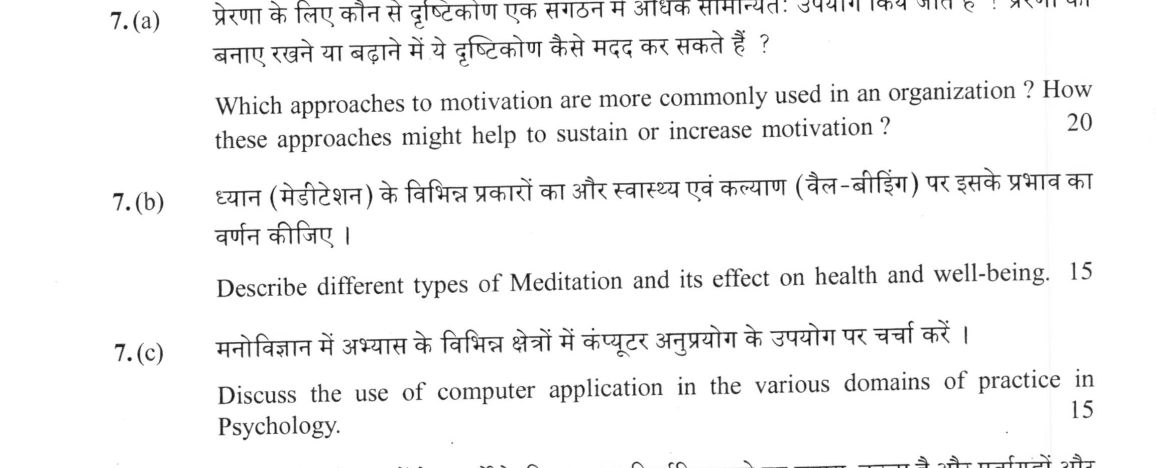
Which approaches to motivation are more commonly used in an organization? How these approaches might help to sustain or increase motivation? 20 marks
Describe different types of Meditation and its effect on health and well-being. 15 marks
Discuss the use of computer application in the various domains of practice in Psychology. 15 marks
हिंदी में प्रश्न पढ़ें
प्रेरणा के लिए कौन से दृष्टिकोण एक संगठन में अधिक सामान्यतः उपयोग किये जाते हैं ? प्रेरणा को बनाए रखने या बढ़ाने में ये दृष्टिकोण कैसे मदद कर सकते हैं ? (20 अंक)
ध्यान (मेडिटेशन) के विभिन्न प्रकारों का और स्वास्थ्य एवं कल्याण (वेल-बीइंग) पर इसके प्रभाव का वर्णन कीजिए । (15 अंक)
मनोविज्ञान में अभ्यास के विभिन्न क्षेत्रों में कंप्यूटर अनुप्रयोग के उपयोग पर चर्चा करें । (15 अंक)
Model answer
Written by UPSC Answer Check against this question's marking rubric, to the expected length. UPSC does not publish answers for Mains — this is one way to score well, not an official key.
Applied psychology bridges fundamental psychological principles with real-world human functioning, spanning organizational performance, holistic health interventions, and technological advancements in assessment and care.
Approaches to Motivation in Organizations
Organizations deploy content, process, and contemporary frameworks to understand and direct employee behavior. Content models like Maslow’s Hierarchy, Herzberg’s Two-Factor Theory, and McClelland’s Acquired Needs Theory identify fundamental drives, distinguishing basic hygiene factors from motivators such as achievement, affiliation, and power. Process theories explain cognitive mechanisms: Vroom’s Expectancy Theory emphasizes the expectancy-instrumentality-valence chain; Adams’ Equity Theory underscores perceived fairness in input-output ratios relative to peers; and Locke’s Goal-Setting Theory establishes the efficacy of specific, challenging goals coupled with feedback. Contemporary frameworks like Ryan and Deci’s Self-Determination Theory (SDT) and Hackman and Oldham’s Job Characteristics Model emphasize intrinsic drivers—autonomy, competence, relatedness, and meaningful task variety.
Sustaining and Increasing Motivation
These approaches sustain motivation by balancing extrinsic incentives with intrinsic psychological needs. Goal-setting and expectancy frameworks translate into structured Key Performance Indicators (KPIs), regular appraisal feedback, and transparent reward systems. SDT and Job Characteristics inform autonomy-supportive leadership, job enrichment, and skill development, preventing burnout and elevating engagement. In India, Tata’s employee welfare and social security policies operationalize Maslow and Herzberg’s hygiene-to-growth progression; Infosys pioneered employee stock ownership plans (ESOPs) leveraging equity and expectancy principles; while BHEL utilizes participative management forums to fulfill higher-order affiliation and empowerment needs.
Types of Meditation and Health Effects
Meditation comprises diverse self-regulatory mental practices classified into: concentrative meditation (focused attention on a single object, mantra, or Transcendental Meditation); mindfulness practices (open monitoring, Vipassana, Zen, and Kabat-Zinn’s Mindfulness-Based Stress Reduction [MBSR]); loving-kindness or compassion meditation (Metta); movement-based traditions (Yoga, Tai Chi, Qigong); and analytical contemplative practices.
Meditation exerts profound physiological, psychological, and neurobiological benefits. Neuroimaging studies by Sara Lazar demonstrate increased gray matter density in the hippocampus and prefrontal cortex alongside reduced amygdala volume, fostering enhanced executive control and emotional regulation. Meditation regulates the hypothalamic-pituitary-adrenal (HPA) axis, attenuating cortisol release, systemic inflammation, and sympathetic reactivity, which improves cardiovascular health and lowers blood pressure. It reduces relapses in anxiety and depressive disorders. In India, research at NIMHANS confirms Vipassana's efficacy in stabilizing neuroelectric activity and treating substance use disorders, while studies by S-VYASA establish yoga and cyclic meditation's restorative effects on autonomic balance and immune competence.
Computer Applications in Psychological Practice
Technological integration has transformed psychological science across multiple practice domains. In clinical psychology, telepsychology, digital diagnostics, and AI-driven conversational agents like Wysa deliver scalable Cognitive Behavioral Therapy (CBT) and early triage. In cognitive and neuropsychological domains, computerized test batteries (such as CANTAB) provide millisecond-precision reaction-time and executive function profiling. Educational psychology employs adaptive learning platforms and intelligent tutoring systems tailored to individual cognitive paces. In industrial-organizational psychology, HR analytics, algorithmic talent acquisition, and gamified simulations optimize recruitment and training. In research, statistical suites (SPSS, R, Python) and neuroimaging packages (SPM, FSL for fMRI) handle complex computational modeling. However, practice must navigate critical ethical challenges, including algorithmic bias, data confidentiality, dilution of the therapeutic alliance, and the socioeconomic digital divide.
The convergence of organizational motivational systems, evidence-based contemplative practices, and digital psychological tools highlights the multidisciplinary trajectory of modern psychology. Moving forward, an integrated approach that harmonizes humanistic workplace design, psycho-spiritual well-being interventions, and ethically regulated technological deployment is essential for fostering individual resilience and organizational effectiveness.
What "Discuss" is asking you to do
Lay the issue out from more than one side — how it arose, what is claimed for it, what is held against it, and where it now stands. UPSC attaches discuss to broad topics with several live dimensions, so coverage of the dimensions earns more than the strength of your opinion.
Structure that answers it
Set the issue up → the case as it is made → the case against → the dimension both sides leave out → where the balance now lies
Where marks are lost
Listing facts with no thread between them, or arguing one side throughout and calling it a discussion.
How this answer will be evaluated
Approach
Framework: UPSC Psychology Paper 1. (a) discuss: intro > 3-4 dimensions > example > balanced close | (b) describe: define > structure or process in order > labelled diagram > significance | (c) discuss: intro > 3-4 dimensions > example > balanced close Full marks: Comprehensive coverage of all parts with named theories/studies, clear application to context, and balanced evaluation.
Key points expected
- Identify 3-4 common approaches (e.g., Maslow, Herzberg, Equity, Goal-setting)
- Explain how each approach sustains or increases motivation
- Apply to organizational context (workplace, management)
- Balanced evaluation of effectiveness
- Define meditation
- Describe 3-4 distinct types (e.g., Mindfulness, Transcendental, Yoga)
- State specific effects on health (physical/mental)
- State specific effects on well-being
Evaluation rubric
Each sub-part is marked on its own, against the marks and word limit printed on the paper.
- (a) Identify common organizational motivation approaches and evaluate their role in sustaining/increasing motivation. 20 marks
discuss— intro → 3-4 dimensions → example → balanced close
Must cover
- Identify 3-4 common approaches (e.g., Maslow, Herzberg, Equity, Goal-setting)
- Explain how each approach sustains or increases motivation
- Apply to organizational context (workplace, management)
- Balanced evaluation of effectiveness
Loses marks
- Everyday advice without theoretical grounding
- Theory without evidence or application
- Listing approaches without explaining 'how' they help
Earns more
- Tabulate competing theories
- Name specific studies (e.g., Herzberg's two-factor study)
- Link to Indian organizational practices
- Diagram of motivation hierarchy
Extra mark
- Named psychometric tool (e.g., Job Satisfaction Survey)
- Specific statistic on motivation outcomes
- (b) Define meditation types and describe their specific effects on health and well-being. 15 marks
describe— define → structure or process in order → labelled diagram → significance
Must cover
- Define meditation
- Describe 3-4 distinct types (e.g., Mindfulness, Transcendental, Yoga)
- State specific effects on health (physical/mental)
- State specific effects on well-being
Loses marks
- Vague generalities without specific types
- Effects listed without linking to specific type
- Everyday advice without scientific basis
Earns more
- Labelled diagram of meditation process
- Name specific study (e.g., Kabat-Zinn MBSR)
- Link to Indian context (Yoga tradition)
- Distinguish between types clearly
Extra mark
- Named psychometric tool (e.g., Perceived Stress Scale)
- Specific physiological marker (e.g., cortisol levels)
- (c) Discuss computer applications across various domains of psychological practice. 15 marks
discuss— intro → 3-4 dimensions → example → balanced close
Must cover
- Identify 3-4 domains (e.g., Clinical, Research, Educational, Industrial)
- Give specific computer application for each domain
- Explain utility/benefit in that domain
- Balanced discussion of scope
Loses marks
- General talk about 'technology' without specific applications
- Listing domains without explaining applications
- Ignoring 'practice' aspect (focusing only on research)
Earns more
- Name specific software (e.g., SPSS, E-therapy platforms)
- Link to Indian context (e.g., Tele-mental health)
- Diagram of computer-assisted process
- Mention AI applications
Extra mark
- Named specific study on computer applications
- Specific statistic on efficacy
Practice this exact question
Write your answer and it is marked point by point against the model answer above — what you covered, what you missed, what you got wrong.
Evaluate my answer →More from Psychology 2021 Paper I
- Q4 (a) Why is selective attention important? Discuss the theories of selective attention. (2…
- Q5 Answer the following questions in about 150 words each: (a) "Some psychological measures…
- Q6 (a) Are we born with personality? Critically evaluate with theoretical interpretation. (2…
- Q7 (a) Which approaches to motivation are more commonly used in an organization? How these a…
- Q8 (a) Humans strive to assign causes to actions of self and others and fall into traps of b…