Paper I — Q2
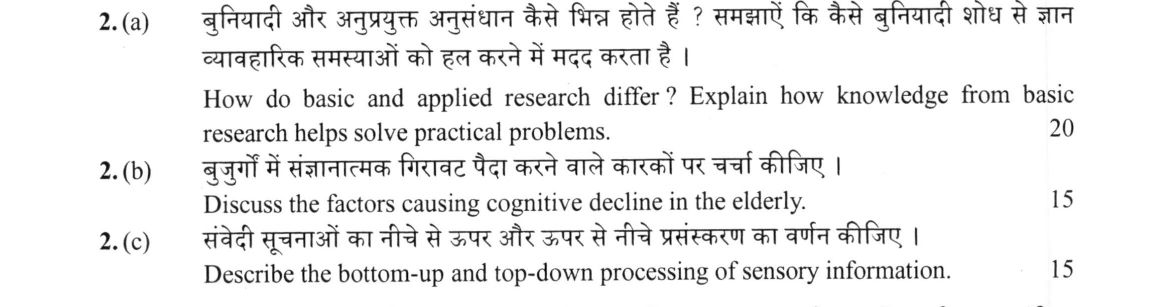
(a) How do basic and applied research differ? Explain how knowledge from basic research helps solve practical problems. (20…
How do basic and applied research differ? Explain how knowledge from basic research helps solve practical problems. 20 marks
Discuss the factors causing cognitive decline in the elderly. 15 marks
Describe the bottom-up and top-down processing of sensory information. 15 marks
हिंदी में प्रश्न पढ़ें
बुनियादी और अनुप्रयुक्त अनुसंधान कैसे भिन्न होते हैं ? समझाएं कि कैसे बुनियादी शोध से ज्ञान व्यावहारिक समस्याओं को हल करने में मदद करता है । (20 अंक)
बुजुर्गों में संज्ञानात्मक गिरावट पैदा करने वाले कारकों पर चर्चा कीजिए । (15 अंक)
संवेदी सूचनाओं का नीचे से ऊपर और ऊपर से नीचे प्रसंस्करण का वर्णन कीजिए । (15 अंक)
Model answer
Written by UPSC Answer Check against this question's marking rubric, to the expected length. UPSC does not publish answers for Mains — this is one way to score well, not an official key.
Psychological science advances through a continuous interplay between theoretical discovery and practical utility, explaining how fundamental cognitive processes operate and how they can be optimized across the lifespan.
Distinction Between Basic and Applied Research
Basic research is curiosity-driven and seeks to expand fundamental knowledge and develop theoretical frameworks without immediate concern for practical application. For example, basic cognitive neuroscience investigates the neural architecture of memory consolidation or synaptic plasticity in the hippocampus. In contrast, applied research is problem-driven, utilizing existing psychological principles to resolve specific real-world challenges, such as organizational psychologists designing ergonomic workflows or stress-reduction interventions to mitigate workplace burnout.
Knowledge from basic research solves practical problems through a translational research pathway. Basic science uncovers the underlying causal mechanisms—establishing what happens and why—which applied researchers translate into practical interventions. For example, basic experimental research established that slow-wave sleep facilitates memory consolidation by transferring information from temporary hippocampal storage to long-term neocortical networks. Applied psychologists leveraged this mechanistic understanding to design evidence-based sleep hygiene protocols and circadian scheduling programs for students and industrial shift workers, directly improving learning retention and operational safety.
Factors Causing Cognitive Decline in the Elderly
Cognitive decline in late adulthood results from a multi-factorial nexus of biological, psychosocial, and lifestyle influences:
Biological factors include progressive neurodegenerative changes such as prefrontal and hippocampal atrophy, synaptic pruning, reduced neuroplasticity, and neurotransmitter depletion (notably acetylcholine and dopamine). Cerebrovascular conditions, including hypertension and micro-strokes, further restrict cerebral blood flow, accelerating neural damage.
Psychosocial factors such as social isolation, retirement-induced loss of role and cognitive stimulation, and bereavement induce chronic psychological stress, elevating glucocorticoid levels that impair hippocampal function.
Lifestyle factors including physical inactivity, sleep disturbances, and cognitive disengagement ("use it or lose it") accelerate functional deterioration.
A critical distinction exists between normal cognitive aging and pathological decline. Normal aging involves a normative reduction in fluid intelligence (processing speed, executive control, working memory) while crystallized intelligence (accumulated knowledge, vocabulary) remains stable or improves. Conversely, pathological decline involves irreversible neurodegenerative conditions such as Mild Cognitive Impairment (MCI) and dementia. As highlighted by the ICMR’s Dementia India Report, pathological decline stems from specific disease etiologies—such as amyloid-beta plaques in Alzheimer's disease and multi-infarct vascular pathology—imposing severe functional dependency rather than benign age-related slowing.
Bottom-Up and Top-Down Processing of Sensory Information
Sensory perception operates through two complementary information-processing systems:
Bottom-up processing is data-driven, initiating at the sensory receptors and proceeding hierarchically to higher-level brain areas for feature analysis. Physical properties of the stimulus—such as lines, color, and frequency—are extracted without prior conceptual influence. An example is an individual attempting to decipher an entirely unfamiliar foreign script or novel geometric pattern, where comprehension depends entirely on the sensory input.
Top-down processing is concept-driven, wherein perception is actively constructed using prior knowledge, expectations, contextual cues, and cognitive schemas. For instance, an individual can effortlessly read a sentence containing partially degraded, blurred, or misspelled words in a familiar language because top-down semantic expectations fill in the missing sensory information.
Interactive models demonstrate that natural perception is bidirectional. In speech perception within noisy environments, bottom-up acoustic signals combine with top-down linguistic context to reconstruct obscured sounds (the phonemic restoration effect). Perceptual illusions similarly exploit top-down structural assumptions against bottom-up inputs. In clinical neuropsychology, conditions such as visual agnosia demonstrate the dissociation between these processes: patients maintain intact bottom-up feature extraction but cannot access top-down semantic associations to recognize familiar objects.
Conclusion
Translating basic findings on sensory processing and neuroplasticity into applied cognitive interventions provides a clear way forward for geriatric care. Establishing evidence-based cognitive reserve programs and structured mental engagement helps mitigate fluid cognitive decline, fostering healthy aging across demographic cohorts.
What "Explain" is asking you to do
Make the working of something clear — what sets it off, what follows from what, and what it produces. Explain is the Commission's mechanism word: it dominates the technical papers and the “explain why” stems, where the marks sit in the causal chain and not in the label.
Structure that answers it
State what it is → the initiating condition → the chain of cause, step by step → an instance where it plays out → what the chain produces
Where marks are lost
Describing what something looks like instead of why it works that way. Naming the stages without linking them reads as description too.
How this answer will be evaluated
Approach
Framework: Basic vs Applied Research; Cognitive Aging; Sensory Processing. (a) compare: paired headings or table > key differences > significance > conclusion | (b) discuss: intro > 3-4 dimensions > example > balanced close | (c) describe: define > structure or process in order > labelled diagram > significance Full marks: Precise definitions, clear tabulation of differences, specific named examples/studies, and logical flow.
Key points expected
- Define basic (pure) and applied research
- Tabulate key differences (purpose, funding, outcome)
- Explain the 'trickle-down' of basic knowledge
- Provide a specific example of basic-to-applied transfer
- Identify biological factors (neurodegeneration, vascular)
- Identify psychological factors (depression, stress)
- Identify social/lifestyle factors (isolation, inactivity)
- Distinguish between normal aging and pathological decline
Evaluation rubric
Each sub-part is marked on its own, against the marks and word limit printed on the paper.
- (a) Distinguish basic/applied research and explain the transfer of basic knowledge to practical solutions. 20 marks
compare— paired headings or table → key differences → significance → conclusion
Must cover
- Define basic (pure) and applied research
- Tabulate key differences (purpose, funding, outcome)
- Explain the 'trickle-down' of basic knowledge
- Provide a specific example of basic-to-applied transfer
Loses marks
- Confusing 'basic' with 'fundamental' in a non-scientific sense
- Listing differences without explaining the link to practical problems
Earns more
- Mention 'basic' vs 'applied' funding sources
- Reference specific scientific discovery (e.g., penicillin, MRI)
- Discuss the 'dual-use' nature of research
Extra mark
- Reference specific research funding bodies (e.g., CSIR, DST)
- Mention specific Indian research initiatives
- (b) Analyze the biological, psychological, and social factors contributing to cognitive decline in the elderly. 15 marks
discuss— intro → 3-4 dimensions → example → balanced close
Must cover
- Identify biological factors (neurodegeneration, vascular)
- Identify psychological factors (depression, stress)
- Identify social/lifestyle factors (isolation, inactivity)
- Distinguish between normal aging and pathological decline
Loses marks
- Treating all cognitive decline as pathological (ignoring normal aging)
- Focusing only on medical causes, ignoring psychosocial factors
Earns more
- Mention specific conditions (Alzheimer's, Dementia)
- Reference the 'use it or lose it' hypothesis
- Discuss the role of chronic diseases (diabetes, hypertension)
Extra mark
- Reference specific cognitive tests (MMSE, MoCA)
- Mention specific neurochemical changes (acetylcholine)
- (c) Explain the mechanisms of bottom-up (data-driven) and top-down (conceptually-driven) sensory processing. 15 marks
describe— define → structure or process in order → labelled diagram → significance
Must cover
- Define bottom-up processing (stimulus-driven)
- Define top-down processing (expectation-driven)
- Describe the flow of information in each
- Provide an example of each (e.g., visual illusions)
Loses marks
- Confusing 'bottom-up' with 'top-down' definitions
- Failing to distinguish between the two processes
Earns more
- Mention 'Gestalt principles' for bottom-up
- Mention 'schema' or 'context' for top-down
- Discuss the interaction of both processes
Extra mark
- Reference specific visual illusions (e.g., Müller-Lyer)
- Mention specific brain areas (V1 vs Prefrontal cortex)
Practice this exact question
Write your answer and it is marked point by point against the model answer above — what you covered, what you missed, what you got wrong.
Evaluate my answer →More from Psychology 2021 Paper I
- Q1 Answer the following questions in about 150 words each: (a) What are the limits of intuit…
- Q2 (a) How do basic and applied research differ? Explain how knowledge from basic research h…
- Q3 (a) How much nature (genetic factors) and nurture (environmental factors) contribute to a…
- Q4 (a) Why is selective attention important? Discuss the theories of selective attention. (2…
- Q5 Answer the following questions in about 150 words each: (a) "Some psychological measures…