Paper I — Q8
(a) Humans strive to assign causes to actions of self and others and fall into traps of biases and errors. Critically discuss…
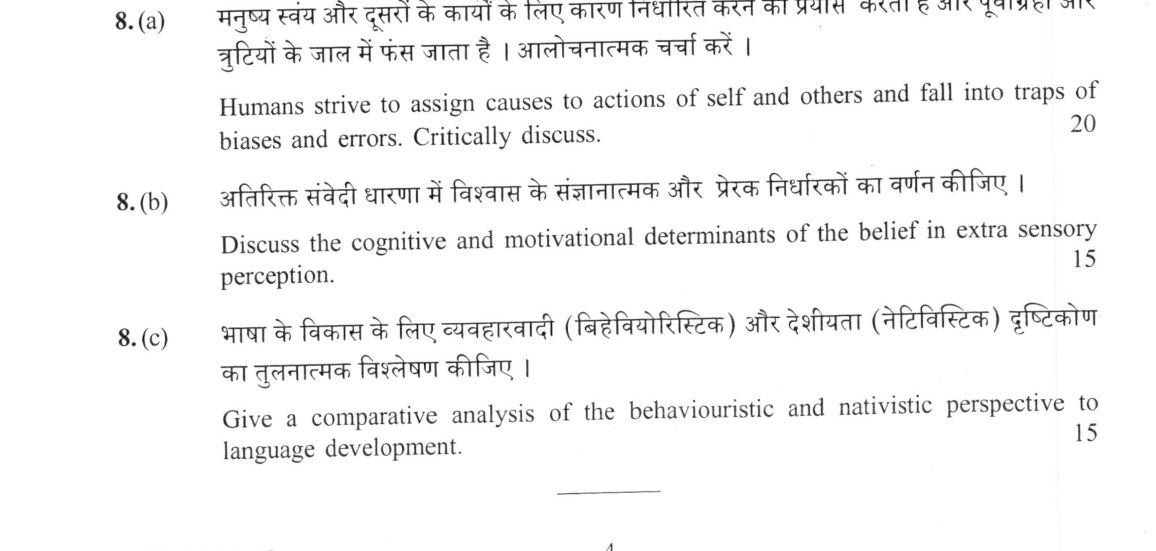
Humans strive to assign causes to actions of self and others and fall into traps of biases and errors. Critically discuss. 20 marks
Discuss the cognitive and motivational determinants of the belief in extra sensory perception. 15 marks
Give a comparative analysis of the behaviouristic and nativistic perspective to language development. 15 marks
हिंदी में प्रश्न पढ़ें
मनुष्य स्वयं और दूसरों के कार्यों के लिए कारण निर्धारित करने का प्रयास करता है और पूर्वाग्रहों और त्रुटियों के जाल में फंस जाता है । आलोचनात्मक चर्चा करें । (20 अंक)
अतिरिक्त संवेदी धारणा में विश्वास के संज्ञानात्मक और प्रेरक निर्धारकों का वर्णन कीजिए । (15 अंक)
भाषा के विकास के लिए व्यवहारवादी (बिहेवियरिस्टिक) और देशीयता (नेटिविस्टिक) दृष्टिकोण का तुलनात्मक विश्लेषण कीजिए । (15 अंक)
Model answer
Written by UPSC Answer Check against this question's marking rubric, to the expected length. UPSC does not publish answers for Mains — this is one way to score well, not an official key.
Attribution Processes and Systematic Biases
Human social cognition relies fundamentally on causal attribution to make the social world predictable. Fritz Heider’s naive psychology framed individuals as intuitive scientists seeking invariant properties behind behavior. Edward Jones and Keith Davis elaborated this through Correspondent Inference Theory, positing that observers infer dispositional traits based on choice, intentionality, and non-common effects. Harold Kelley’s Covariation Model systematized this further, arguing that causal attributions depend on assessing consensus, distinctiveness, and consistency across time and situations.
However, intuitive causal attribution regularly departs from normative logic. The Fundamental Attribution Error (FAE) reflects the pervasive tendency to overestimate internal dispositional factors and underestimate situational constraints when explaining others' behaviors. The Actor-Observer Bias demonstrates an asymmetry: individuals attribute their own actions to situational demands due to outward perceptual focus, but attribute others' actions to internal traits. Additionally, the Self-Serving Bias distorts attribution to protect ego, attributing personal successes internally and failures externally.
Critically, these biases are not fixed biological flaws but are moderated by cultural and cognitive variables. Joan Miller’s cross-cultural research demonstrated that while American adults exhibit a pronounced FAE, Hindu Indian adults progressively develop contextual and situational attributions, reflecting collectivist socialization. Furthermore, Daniel Gilbert showed that attribution is a dual-stage process: automatic dispositional characterization occurs first, and only under low cognitive load does effortful situational correction take place. While Francis Irwin and social constructivists critique attribution theories as mere post-hoc verbal rationalizations rather than real-time causal computing, evidence confirms that these heuristics serve functional, rapid decision-making needs, even if prone to systematic distortion.
Cognitive and Motivational Determinants of ESP Beliefs
Belief in Extra Sensory Perception (ESP), such as telepathy and clairvoyance, persists despite a lack of empirical replicability, driven by distinct cognitive and motivational mechanisms.
Cognitively, subjective validation relies on the availability heuristic, where rare, vivid coincidences are readily recalled while non-occurrences are neglected, fostering confirmation bias. Illusory correlation leads individuals to perceive causal contingencies between unrelated internal thoughts and external events. Furthermore, when confronted with disconfirming scientific evidence, cognitive dissonance reduction operates to rationalize anomalies, often through ad-hoc hypotheses such as the "experimenter effect."
Motivationally, ESP beliefs satisfy the psychological need for control and illusory predictability in uncertain environments. According to Terror Management Theory, paranormal beliefs buffer existential anxiety by affirming non-physical, transcendental existence beyond biological death. Endorsing psychic phenomena also aids self-esteem maintenance, allowing individuals to feel uniquely intuitive or connected to privileged dimensions of reality.
Behaviouristic versus Nativist Perspectives on Language Development
The behaviourist perspective, formulated by B.F. Skinner, posits that language is verbal behavior acquired entirely through operant conditioning, imitation, and selective reinforcement. Albert Bandura expanded this through observational learning. However, behaviourism fails to explain language generativity—the human capacity to produce infinite novel sentences—or the systematic overregularization errors (such as "feets" or "goed") produced by children despite never hearing them reinforced.
Conversely, Noam Chomsky’s nativist perspective asserts an innate biological predisposition for language, mediated by the Language Acquisition Device (LAD) and Universal Grammar (UG). Chomsky’s "poverty of the stimulus" argument demonstrates that children master intricate syntactic rules with minimal explicit instruction. Eric Lenneberg’s Critical Period Hypothesis supports this, evidenced by extreme isolation cases like Genie and feral children, who failed to acquire full grammatical competence after puberty despite intensive post-rescue training.
`` BEHAVIOURISTIC NATIVISTIC (Skinner, Bandura) (Chomsky, Lenneberg) Nature: Nurture / Tabula Rasa Nature / Biological Pre-wiring Process: Operant conditioning, Imitation LAD, Universal Grammar, Maturation Deficit: Cannot explain generativity Underestimates socio-environmental role ``
Contemporary psychology integrates both through the Interactionist paradigm (Jean Piaget’s cognitive readiness, Lev Vygotsky’s socio-cultural scaffolding, and Jerome Bruner’s Language Acquisition Support System). In the Indian context, this synthesis underpins the National Education Policy (NEP) 2020, which promotes early multilingual education by leveraging innate linguistic capacity through culturally grounded social interaction.
Ultimately, mitigating attributional distortions, dispelling pseudoscientific beliefs, and understanding cognitive development are essential for nurturing the scientific temper (Article 51A(h)) and building an objective, cohesive society.
What "Critically discuss" is asking you to do
Lay the issue out from more than one side — how it arose, what is claimed for it, what is held against it, and where it now stands. UPSC attaches discuss to broad topics with several live dimensions, so coverage of the dimensions earns more than the strength of your opinion. “Critically” is not a section added at the end: name the yardstick you are judging by — the evidence, the stated objective, a constitutional principle, a rival explanation — and let a verdict close each part of the body. Where the question quotes a claim, that verdict must land on the claim itself, accepted, qualified or rejected, and not on the theme in general.
Structure that answers it
Set the issue up → the case as it is made → the case against → the dimension both sides leave out → where the balance now lies
Where marks are lost
Merits in one paragraph, demerits in the next, and a conclusion calling for a balanced and holistic approach. That is a survey with the judgement left out and it holds the answer in the middle band. The opposite error is reading “critically” as permission to attack — and with the odd pairings, critically describe or critically explain, the exposition still carries most of the marks, the judgement being a layer on it rather than a substitute for it.
How this answer will be evaluated
Approach
Framework: Attribution Theory (Heider, Kelley, Jones & Davis). (a) discuss: intro > 3-4 dimensions > example > balanced close | (b) discuss: intro > 3-4 dimensions > example > balanced close | (c) compare: paired headings or table > key differences > significance > conclusion Full marks: Precise definitions, named theories (Kelley, Chomsky, Skinner), and critical evaluation of evidence.
Key points expected
- Define attribution theory and the fundamental attribution error (FAE)
- Explain the actor-observer bias and self-serving bias
- Discuss the correspondence inference and covariation model (Kelley)
- Critically evaluate the cultural universality of these biases
- Identify cognitive determinants (e.g., pattern seeking, confirmation bias)
- Identify motivational determinants (e.g., need for control, anxiety reduction)
- Explain the role of 'illusory correlation' in ESP belief
- Discuss the 'need for closure' or 'need for meaning'
Evaluation rubric
Each sub-part is marked on its own, against the marks and word limit printed on the paper.
- (a) Analyze the cognitive mechanisms of causal attribution and the resulting systematic errors in self and other perception. 20 marks
discuss— intro → 3-4 dimensions → example → balanced close
Must cover
- Define attribution theory and the fundamental attribution error (FAE)
- Explain the actor-observer bias and self-serving bias
- Discuss the correspondence inference and covariation model (Kelley)
- Critically evaluate the cultural universality of these biases
Loses marks
- Confusing attribution with social comparison
- Ignoring the distinction between self and other attribution
- Listing biases without explaining the underlying mechanism
Earns more
- Reference to Jones & Davis (1965) correspondence inference
- Reference to Ross (1977) FAE experiment
- Mention of self-serving bias in academic performance
- Discussion of 'just world' hypothesis
Extra mark
- Reference to Nisbett & Ross (1980) 'Human Inference'
- Mention of 'fundamental attribution error' in legal contexts
- (b) Explain the psychological factors (cognitive and motivational) that sustain belief in ESP despite lack of evidence. 15 marks
discuss— intro → 3-4 dimensions → example → balanced close
Must cover
- Identify cognitive determinants (e.g., pattern seeking, confirmation bias)
- Identify motivational determinants (e.g., need for control, anxiety reduction)
- Explain the role of 'illusory correlation' in ESP belief
- Discuss the 'need for closure' or 'need for meaning'
Loses marks
- Treating ESP as a valid phenomenon rather than a belief
- Ignoring the motivational aspect (focusing only on cognitive)
- Vague generalizations about 'human nature'
Earns more
- Reference to 'illusory correlation' (Chapman & Chapman)
- Mention of 'need for control' in stressful situations
- Discussion of 'confirmation bias' in interpreting hits/misses
- Reference to 'superstitious behavior' (Skinner)
Extra mark
- Reference to 'paranormal belief' scales (e.g., STS)
- Mention of 'cognitive miser' concept
- (c) Contrast the behaviorist and nativist views on the origin and acquisition of language. 15 marks
compare— paired headings or table → key differences → significance → conclusion
Must cover
- Define behaviorist perspective (Skinner, reinforcement, imitation)
- Define nativist perspective (Chomsky, LAD, UG)
- Compare the role of environment vs. innate structure
- Evaluate the 'poverty of the stimulus' argument
Loses marks
- Conflating behaviorism with social interactionism
- Ignoring the 'poverty of the stimulus' argument
- Failing to contrast the two perspectives clearly
Earns more
- Reference to Skinner's 'Verbal Behavior'
- Reference to Chomsky's 'Language and Mind'
- Mention of 'critical period' hypothesis
- Discussion of 'creole' languages as evidence for nativism
Extra mark
- Reference to 'LAD' (Language Acquisition Device)
- Mention of 'universal grammar' (UG)
Practice this exact question
Write your answer and it is marked point by point against the model answer above — what you covered, what you missed, what you got wrong.
Evaluate my answer →More from Psychology 2021 Paper I
- Q5 Answer the following questions in about 150 words each: (a) "Some psychological measures…
- Q6 (a) Are we born with personality? Critically evaluate with theoretical interpretation. (2…
- Q7 (a) Which approaches to motivation are more commonly used in an organization? How these a…
- Q8 (a) Humans strive to assign causes to actions of self and others and fall into traps of b…