Paper II — Q1
Answer the following questions in about 150 words each: (a) Discuss the psychological tests used for the selection of defence…
Answer the following questions in about 150 words each:
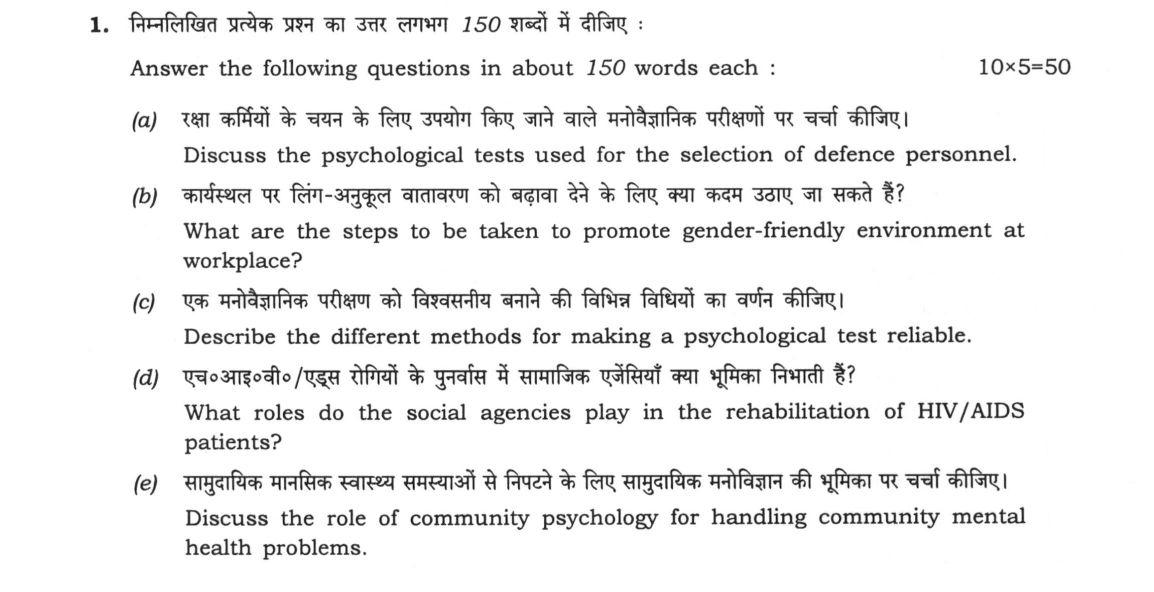
Discuss the psychological tests used for the selection of defence personnel. 10 marks
What are the steps to be taken to promote gender-friendly environment at workplace? 10 marks
Describe the different methods for making a psychological test reliable. 10 marks
What roles do the social agencies play in the rehabilitation of HIV/AIDS patients? 10 marks
Discuss the role of community psychology for handling community mental health problems. 10 marks
हिंदी में प्रश्न पढ़ें
निम्नलिखित प्रत्येक प्रश्न का उत्तर लगभग 150 शब्दों में दीजिए :
रक्षा कर्मियों के चयन के लिए उपयोग किए जाने वाले मनोवैज्ञानिक परीक्षणों पर चर्चा कीजिए। (10 अंक)
कार्यस्थल पर लिंग-अनुकूल वातावरण को बढ़ावा देने के लिए क्या कदम उठाए जा सकते हैं? (10 अंक)
एक मनोवैज्ञानिक परीक्षण को विश्वसनीय बनाने की विभिन्न विधियों का वर्णन कीजिए। (10 अंक)
एच०आई०वी०/एड्स रोगियों के पुनर्वास में सामाजिक एजेंसियाँ क्या भूमिका निभाती हैं? (10 अंक)
सामुदायिक मानसिक स्वास्थ्य समस्याओं से निपटने के लिए सामुदायिक मनोविज्ञान की भूमिका पर चर्चा कीजिए। (10 अंक)
Model answer
Written by UPSC Answer Check against this question's marking rubric, to the 150-word length. UPSC does not publish answers for Mains — this is one way to score well, not an official key.
(a) Defence personnel selection. In India, officer selection is conducted through Services Selection Boards (SSBs), with Air Force and Naval selection boards where applicable, rather than a single generic board. The SSB process is multi-stage: screening, psychological testing, Group Testing Officer (GTO) tasks, interview and conference. Psychological tests include the Thematic Apperception Test (TAT), Word Association Test (WAT), Situation Reaction Test (SRT) and Self Description Questionnaire (SDQ), supplemented by structured self-report inventories such as OPI where used. GTO tasks—group discussion, group planning, progressive group task, command task, discussion and individual obstacles—assess teamwork, initiative, leadership and stress tolerance. The conference integrates evidence to judge officer-like qualities: effective intelligence, reasoning, social adaptability, cooperation, determination and integrity. This battery is valued because it samples behaviour under uncertainty, but it must be periodically revalidated to prevent stereotype-driven scoring and ensure fairness across castes, regions and educational backgrounds.
(b) Gender-friendly workplace. A gender-friendly workplace requires legal compliance, institutional design and cultural change. The Sexual Harassment of Women at Workplace (Prevention, Prohibition and Redressal) Act, 2013 mandates an Internal Complaints Committee (ICC), an external member, a written policy, inquiring committee, conciliation, disciplinary action and annual reporting. Beyond POSH, organisations should conduct gender-sensitization training, adopt flexible work and parental-care policies, provide safe transport, childcare and grievance mechanisms, and ensure transparent recruitment, promotion and pay equity. Equal-opportunity frameworks and mentorship help break the glass ceiling by creating pipelines for women into leadership. State and sectoral bodies can monitor compliance through audits, helpdesk systems and periodic workplace surveys. Workplace design should also address language, dress codes, performance appraisal bias, and access to senior roles for women and other marginalised groups. The evaluative point is that legal redressal alone is insufficient; a supportive climate, accountability, safe physical design and representation in decision-making are needed to make the workplace genuinely gender-friendly.
(c) Making a psychological test reliable. Reliability means consistent measurement. The test-retest method administers the same test to the same group after a time interval and correlates scores; it shows stability but is vulnerable to practice and maturation. Parallel or equivalent forms use two comparable versions to reduce practice effects, though they must be matched in difficulty and content. Split-half reliability divides items into odd and even sets and applies the Spearman-Brown prophecy formula; for dichotomous items the Kuder-Richardson formula is used, while Cronbach’s alpha estimates internal consistency for multi-item scales. Inter-rater reliability is essential for projective tests and behavioural ratings, using Cohen’s kappa or intraclass correlation. The standard error of measurement quantifies how much an observed score may deviate from the true score. A good test also needs clear instructions, standardised administration and objective scoring; reliability is a precondition for validity, not a substitute for it. Norms and item analysis further support stable scoring.
(d) Social agencies in HIV/AIDS rehabilitation. Rehabilitation of people living with HIV/AIDS is not only medical; it is psychosocial, economic and legal. The National AIDS Control Organisation (NACO), State AIDS Control Societies and district-level agencies provide counselling and testing, antiretroviral therapy (ART) adherence counselling, referral pathways and surveillance. NACO’s 95-95-95 targets require diagnosis, treatment and viral suppression, all of which depend on social support. NGO networks such as the India HIV/AIDS Alliance, community-based organisations and peer-support groups help reduce stigma, support disclosure decisions, provide home-based care, and connect patients with family and community resources. Livelihood support—skill training, microcredit, job linkage and income security—reduces vulnerability and improves treatment adherence. Legal aid agencies address discrimination, property and custody issues, while media and school-based campaigns normalise prevention and testing. The key evaluative note is that rehabilitation succeeds when agencies coordinate around the patient, protect confidentiality and sustain long-term support beyond clinical care, social inclusion and dignity.
(e) Community psychology and community mental health. Community psychology treats mental health as a collective, ecological issue rather than only an individual disorder. Community mental health problems include depression, anxiety, substance use, psychosis and suicide risk. Its role is to prevent distress, build resilience and connect people with services. In India, the District Mental Health Programme (DMHP) operationalises this by integrating mental health care into primary health centres, training gatekeepers such as ASHA workers, ANMs, teachers and local volunteers, and providing referral pathways to district hospitals. The NIMHANS model, and district-level examples such as Bellary, illustrate how specialist institutions and local adaptations can support district-level care, training, tele-mentoring and crisis response. Community-based interventions—psychoeducation, peer support, family therapy, livelihood-linked counselling and anti-stigma campaigns—address social determinants such as poverty, alcohol use, domestic violence and unemployment. Such programmes must be culturally sensitive, low-cost, locally owned and continuously evaluated. The way forward is prevention over cure: early detection, PHC integration, community ownership and sustained funding.
What "Discuss" is asking you to do
Lay the issue out from more than one side — how it arose, what is claimed for it, what is held against it, and where it now stands. UPSC attaches discuss to broad topics with several live dimensions, so coverage of the dimensions earns more than the strength of your opinion.
Structure that answers it
Set the issue up → the case as it is made → the case against → the dimension both sides leave out → where the balance now lies
Where marks are lost
Listing facts with no thread between them, or arguing one side throughout and calling it a discussion.
How this answer will be evaluated
Approach
Framework: Psychology Paper II: Applied Psychology (Work, Health, Community). (a) discuss: intro > 3-4 dimensions > example > balanced close | (b) suggest: the problem in one line > implementable measures > who acts > conclusion | (c) describe: define > structure or process in order > labelled diagram > significance | (d) explain: definition/context > points in order > small example > short close | (e) discuss: intro > 3-4 dimensions > example > balanced close Full marks: Precise, specific, and applied to the Indian context.
Key points expected
- Mention specific tests (e.g., OIR, TAT, SRT)
- Link tests to specific traits (e.g., leadership, integrity)
- Reference the SSB or UPSC selection process
- Explain the purpose of the tests (screening vs. assessment)
- Mention policy changes (e.g., anti-harassment, leave)
- Mention infrastructure (e.g., creche, safety)
- Mention cultural change (e.g., training, sensitization)
- Mention legal compliance (e.g., POSH Act)
Evaluation rubric
Each sub-part is marked on its own, against the marks and word limit printed on the paper.
- (a) Overview of psychometric tools used in defence recruitment (e.g., SSB). · 150 words
discuss— intro → 3-4 dimensions → example → balanced close
Must cover
- Mention specific tests (e.g., OIR, TAT, SRT)
- Link tests to specific traits (e.g., leadership, integrity)
- Reference the SSB or UPSC selection process
- Explain the purpose of the tests (screening vs. assessment)
Loses marks
- Generic list of tests without defence context
- Confusing 'selection' with 'training' tests
- No mention of specific traits being measured
Earns more
- Mention the 'Officer-like qualities' (OLQs)
- Reference the 'Psychological Test Battery' (PTB)
- Mention the 'Group Testing' (GT) phase
- Reference the 'Personal Interview' (PI) as a test
Extra mark
- Mention the 'SSB' (Services Selection Board) specifically
- Mention the 'UPSC' (Union Public Service Commission) role
- (b) Implementable measures for a gender-friendly workplace. · 150 words
suggest— the problem in one line → implementable measures → who acts → conclusion
Must cover
- Mention policy changes (e.g., anti-harassment, leave)
- Mention infrastructure (e.g., creche, safety)
- Mention cultural change (e.g., training, sensitization)
- Mention legal compliance (e.g., POSH Act)
Loses marks
- Vague advice (e.g., 'be nice')
- Ignoring legal frameworks
- Focusing only on women, not 'gender-friendly'
Earns more
- Mention 'flexible working hours'
- Mention 'mentorship programs'
- Mention 'gender-neutral language'
- Mention 'equal pay for equal work'
Extra mark
- Mention the 'POSH Act' (Prevention of Sexual Harassment) specifically
- Mention 'Equal Opportunity Policy'
- (c) Methods to ensure test reliability (consistency). · 150 words
describe— define → structure or process in order → labelled diagram → significance
Must cover
- Define reliability (consistency of scores)
- Mention 'Test-Retest' method
- Mention 'Parallel Forms' (Equivalent) method
- Mention 'Split-Half' method
Loses marks
- Confusing reliability with validity
- Listing methods without explaining them
- No definition of reliability
Earns more
- Mention 'Inter-rater' reliability
- Mention 'Internal Consistency' (Cronbach's alpha)
- Mention 'Standard Error of Measurement' (SEM)
- Mention 'Kuder-Richardson' formula
Extra mark
- Mention 'Cronbach's alpha' specifically
- Mention 'Standard Error of Measurement' (SEM)
- (d) Roles of social agencies in HIV/AIDS rehabilitation. · 150 words
explain— definition/context → points in order → small example → short close
Must cover
- Mention 'counseling' (psychological support)
- Mention 'medical' support (ART, testing)
- Mention 'social' support (stigma reduction, legal aid)
- Mention 'economic' support (livelihood, insurance)
Loses marks
- Focusing only on medical treatment
- Ignoring 'rehabilitation' (social reintegration)
- No mention of specific agencies
Earns more
- Mention 'NGOs' (e.g., NACO, Red Cross)
- Mention 'peer support groups'
- Mention 'family counseling'
- Mention 'legal aid' (e.g., employment rights)
Extra mark
- Mention 'NACO' (National AIDS Control Organisation) specifically
- Mention 'Red Cross' specifically
- (e) Role of community psychology in mental health. · 150 words
discuss— intro → 3-4 dimensions → example → balanced close
Must cover
- Mention 'prevention' (primary, secondary, tertiary)
- Mention 'empowerment' (community participation)
- Mention 'advocacy' (policy change, rights)
- Mention 'cultural' context (local solutions)
Loses marks
- Focusing only on clinical treatment
- Ignoring 'community' aspect
- No mention of prevention or advocacy
Earns more
- Mention 'mental health literacy'
- Mention 'stigma reduction' campaigns
- Mention 'community-based rehabilitation' (CBR)
- Mention 'interdisciplinary' approach
Extra mark
- Mention 'Community-Based Rehabilitation' (CBR) specifically
- Mention 'Mental Health Act' (2017) specifically
Practice this exact question
Write your answer and it is marked point by point against the model answer above — what you covered, what you missed, what you got wrong.
Evaluate my answer →More from Psychology 2021 Paper II
- Q1 Answer the following questions in about 150 words each: (a) Discuss the psychological tes…
- Q2 (a) Explain the major steps to be taken for the training of children with learning disabi…
- Q3 (a) What are the different types of psychological tests for personality assessment? (15 m…
- Q4 (a) How does power in organizations tend to concentrate in the hands of a few persons? Di…