Paper II — Q4
(a) How does power in organizations tend to concentrate in the hands of a few persons? Discuss the tactics used to gain power…
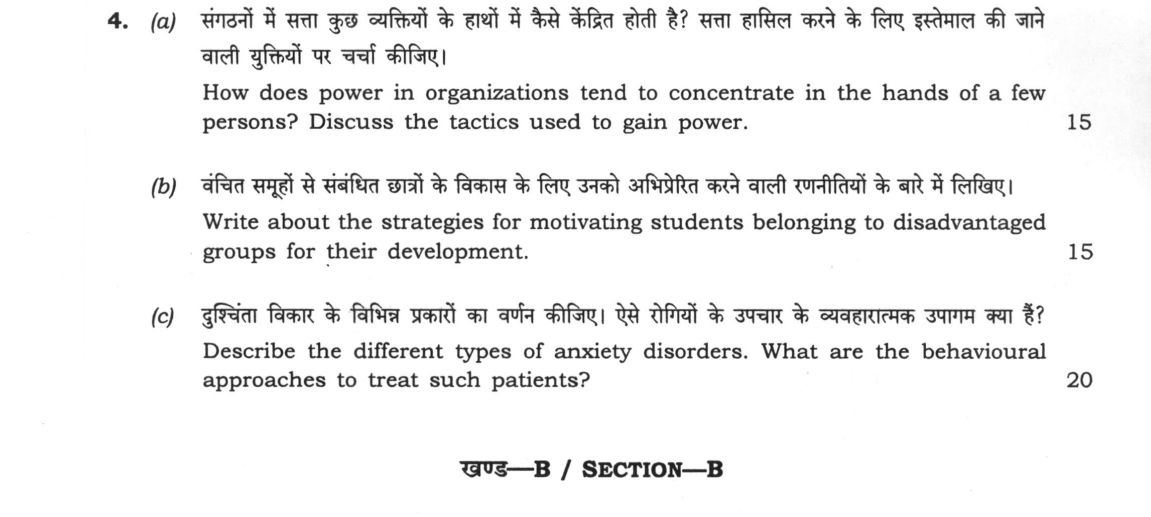
How does power in organizations tend to concentrate in the hands of a few persons? Discuss the tactics used to gain power. 15 marks
Write about the strategies for motivating students belonging to disadvantaged groups for their development. 15 marks
Describe the different types of anxiety disorders. What are the behavioural approaches to treat such patients? 20 marks
हिंदी में प्रश्न पढ़ें
संगठनों में सत्ता कुछ व्यक्तियों के हाथों में कैसे केंद्रित होती है? सत्ता हासिल करने के लिए इस्तेमाल की जाने वाली युक्तियों पर चर्चा कीजिए। (15 अंक)
वंचित समूहों से संबंधित छात्रों के विकास के लिए उनको अभिप्रेरित करने वाली रणनीतियों के बारे में लिखिए। (15 अंक)
दुश्चिंता विकार के विभिन्न प्रकारों का वर्णन कीजिए। ऐसे रोगियों के उपचार के व्यवहारात्मक उपागम क्या हैं? (20 अंक)
Model answer
Written by UPSC Answer Check against this question's marking rubric, to the expected length. UPSC does not publish answers for Mains — this is one way to score well, not an official key.
Power Concentration and Tactics in Organizations
Power within organizations frequently centralizes due to structural and social-psychological dynamics. Robert Michels’ Iron Law of Oligarchy posits that large formal organizations inevitably concentrate authority among an administrative elite because of the necessity for coordination, specialized knowledge, and control over communication channels. Complementing this, Hickson’s Strategic Contingencies Theory demonstrates that organizational subunits acquire power by reducing critical uncertainties, occupying non-substitutable roles, and gaining centrality within operational workflows.
Individuals and coalitions employ distinct political tactics to acquire and retain power. These include controlling information and decision premises, selectively filtering data to shape outcomes; building strategic internal and external networks; forming coalitions with influential peers; and co-opting potential opposition by integrating dissenters into advisory bodies. Additionally, leaders utilize impression management (such as self-promotion and ingratiation) to project competence and authority. In hierarchical Indian organizations characterized by high power distance, these tactics often entrench paternalistic leadership, occasionally stifling innovation and horizontal communication if unchecked by participatory governance mechanisms.
Motivating Students from Disadvantaged Groups
Motivating students from socially and economically marginalized backgrounds (SC, ST, OBC, and first-generation learners) requires integrating psychological interventions with affirmative structural support. Applying Albert Bandura’s self-efficacy theory, educators can create structured mastery experiences and provide relatable role models to enhance vicarious learning. Implementing Carol Dweck’s growth mindset framework alongside values-affirmation exercises actively mitigates stereotype threat (Steele & Aronson), reducing the fear of conforming to negative socio-academic stereotypes.
Pedagogically, culturally responsive teaching that incorporates indigenous knowledge and regional contexts validates students’ lived experiences. Mentorship programmes pairing disadvantaged students with senior peers foster academic belongingness. These psychological strategies gain practical efficacy when integrated with structural welfare measures, such as constitutional reservation policies, scholarships, and the PM POSHAN (Mid-Day Meal) Scheme, which addresses fundamental nutritional needs. However, motivating first-generation learners often faces hurdles such as language barriers, digital divides, and low parental academic literacy, necessitating deep community-school partnerships and parental sensitization.
Anxiety Disorders and Behavioural Interventions
Anxiety disorders, classified under DSM-5 and ICD-11, involve excessive, distressing fear and maladaptive avoidance behaviours. Major subtypes include Generalized Anxiety Disorder (GAD), characterized by persistent, uncontrollable worry; Panic Disorder, marked by recurrent unexpected panic attacks; Specific Phobias and Agoraphobia, involving irrational fears of circumscribed stimuli or inescapable public spaces; Social Anxiety Disorder, rooted in fear of negative social evaluation; Separation Anxiety Disorder; and Selective Mutism, marked by consistent failure to speak in specific social situations despite speaking normally in other contexts.
Behavioural approaches, grounded in classical and operant conditioning principles, are highly effective in treating anxiety:
Systematic Desensitization: Developed by Joseph Wolpe, this counter-conditioning technique constructs an anxiety hierarchy and gradually pairs feared stimuli with relaxation training (such as Jacobson’s Progressive Muscle Relaxation) based on the principle of reciprocal inhibition.
Exposure Therapies: These include graded in-vivo exposure, imaginal exposure, and modern Virtual Reality Exposure Therapy (VRET), which facilitate habituation and extinction of conditioned fear responses without avoidance. Flooding involves rapid, prolonged exposure to the most feared stimulus until anxiety diminishes.
Participant Modeling: Based on Bandura’s observational learning, patients observe non-anxious models interacting with the feared object before attempting guided interaction themselves.
Cognitive Behavioural Therapy (CBT): Blends behavioural exposure and behavioural experiments with cognitive restructuring to identify and challenge catastrophizing and overestimation of threat.
In the Indian public health framework, these psychotherapeutic modalities are increasingly delivered through the District Mental Health Programme (DMHP), National Mental Health Programme (NMHP), and the Tele-MANAS initiative. While pharmacotherapy (SSRIs and anxiolytics) provides acute biological symptom stabilization, behavioural approaches demonstrate superior long-term efficacy, sustainable coping skills, and lower relapse rates without pharmacological dependence.
A unified approach that democratizes organizational power structures, fosters inclusive and trauma-informed educational environments, and expands accessible mental health interventions is essential to building an equitable and psychologically resilient society.
What "Discuss" is asking you to do
Lay the issue out from more than one side — how it arose, what is claimed for it, what is held against it, and where it now stands. UPSC attaches discuss to broad topics with several live dimensions, so coverage of the dimensions earns more than the strength of your opinion.
Structure that answers it
Set the issue up → the case as it is made → the case against → the dimension both sides leave out → where the balance now lies
Where marks are lost
Listing facts with no thread between them, or arguing one side throughout and calling it a discussion.
How this answer will be evaluated
Approach
Framework: Organizational Power Dynamics, Educational Psychology (Equity), Clinical Psychology (Anxiety). (a) discuss: intro > 3-4 dimensions > example > balanced close | (b) explain: definition/context > points in order > small example > short close | (c) describe: define > structure or process in order > labelled diagram > significance Full marks: Comprehensive coverage of all parts with named theories, specific examples, and clear application to the context.
Key points expected
- Define power and its sources (French & Raven)
- Explain mechanisms of concentration (e.g., centralization, gatekeeping)
- List and explain tactics to gain power (e.g., coalition, exchange)
- Provide an organizational example of power dynamics
- Identify barriers specific to disadvantaged groups (economic, social)
- Discuss Self-Efficacy (Bandura) in this context
- Propose specific motivational strategies (e.g., mentoring, scholarships)
- Link strategies to student development outcomes
Evaluation rubric
Each sub-part is marked on its own, against the marks and word limit printed on the paper.
- (a) Explain the concentration of power in organizations and the tactics used to gain it. 15 marks
discuss— intro → 3-4 dimensions → example → balanced close
Must cover
- Define power and its sources (French & Raven)
- Explain mechanisms of concentration (e.g., centralization, gatekeeping)
- List and explain tactics to gain power (e.g., coalition, exchange)
- Provide an organizational example of power dynamics
Loses marks
- Confusing power with authority
- Listing tactics without explaining how they work
- Ignoring the 'concentration' aspect of the question
Earns more
- Reference to Machiavelli or Weber
- Distinction between formal and informal power
- Mention of 'Power Distance' in culture
Extra mark
- Diagram of power sources
- Reference to specific organizational case study
- (b) Outline strategies for motivating students from disadvantaged groups. 15 marks
explain— definition/context → points in order → small example → short close
Must cover
- Identify barriers specific to disadvantaged groups (economic, social)
- Discuss Self-Efficacy (Bandura) in this context
- Propose specific motivational strategies (e.g., mentoring, scholarships)
- Link strategies to student development outcomes
Loses marks
- Generic advice not specific to disadvantaged groups
- Ignoring the 'development' aspect
- Focusing only on financial aid without psychological strategies
Earns more
- Reference to Maslow's Hierarchy of Needs
- Mention of 'Growth Mindset' (Dweck)
- Reference to Indian schemes (e.g., PM-SY)
Extra mark
- Data on dropout rates in disadvantaged groups
- Specific case study of a successful intervention
- (c) Describe types of anxiety disorders and their behavioural treatments. 20 marks
describe— define → structure or process in order → labelled diagram → significance
Must cover
- List and describe major anxiety disorders (GAD, Panic, Phobia)
- Explain the behavioural model of anxiety (conditioning)
- Detail behavioural treatments (e.g., Systematic Desensitization)
- Explain the mechanism of action for the treatments
Loses marks
- Confusing anxiety with depression
- Listing disorders without describing symptoms
- Focusing only on medication (not behavioural approaches)
Earns more
- Reference to Wolpe's Systematic Desensitization
- Mention of 'Flooding' or 'Exposure Therapy'
- Distinction between behavioural and cognitive-behavioural therapy
Extra mark
- Diagram of the hierarchy of fears
- Reference to specific clinical trials or success rates
Practice this exact question
Write your answer and it is marked point by point against the model answer above — what you covered, what you missed, what you got wrong.
Evaluate my answer →More from Psychology 2021 Paper II
- Q1 Answer the following questions in about 150 words each: (a) Discuss the psychological tes…
- Q2 (a) Explain the major steps to be taken for the training of children with learning disabi…
- Q3 (a) What are the different types of psychological tests for personality assessment? (15 m…
- Q4 (a) How does power in organizations tend to concentrate in the hands of a few persons? Di…
- Q5 Answer the following questions in about 150 words each: (a) Explain the factors affecting…
- Q6 (a) How does a self-fulfilling prophecy work? Describe how the gender bias is an example…
- Q7 (a) Highlight the psychological consequences of living in high population density area. (…