Paper II — Q6
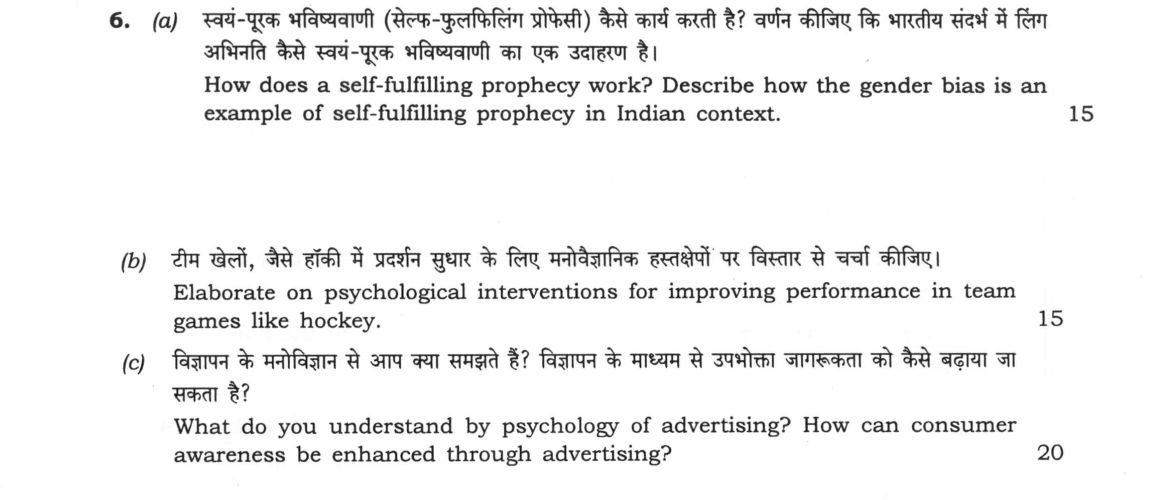
(a) How does a self-fulfilling prophecy work? Describe how the gender bias is an example of self-fulfilling prophecy in Indian…
How does a self-fulfilling prophecy work? Describe how the gender bias is an example of self-fulfilling prophecy in Indian context. 15 marks
Elaborate on psychological interventions for improving performance in team games like hockey. 15 marks
What do you understand by psychology of advertising? How can consumer awareness be enhanced through advertising? 20 marks
हिंदी में प्रश्न पढ़ें
स्वयं-पूरक भविष्यवाणी (सेल्फ-फुलफिलिंग प्रोफेसी) कैसे कार्य करती है? वर्णन कीजिए कि भारतीय संदर्भ में लिंग अभिमति कैसे स्वयं-पूरक भविष्यवाणी का एक उदाहरण है। (15 अंक)
टीम खेलों, जैसे हॉकी में प्रदर्शन सुधार के लिए मनोवैज्ञानिक हस्तक्षेपों पर विस्तार से चर्चा कीजिए। (15 अंक)
विज्ञापन के मनोविज्ञान से आप क्या समझते हैं? विज्ञापन के माध्यम से उपभोक्ता जागरूकता को कैसे बढ़ाया जा सकता है? (20 अंक)
Model answer
Written by UPSC Answer Check against this question's marking rubric, to the expected length. UPSC does not publish answers for Mains — this is one way to score well, not an official key.
Robert K. Merton conceptualized the self-fulfilling prophecy as a false definition of a situation that evokes new behavior, ultimately making the originally false conception come true. The underlying psychological mechanism operates as a cyclical feedback loop: an initial societal expectation guides interpersonal behavior toward an individual, which elicits complementary behavioral confirmation from that individual, thereby validating and reinforcing the baseline bias.
Gender Bias as a Self-Fulfilling Prophecy in India
In the Indian socio-cultural matrix, deeply entrenched patriarchal expectations shape gendered socialization. Rooted in traditional son preference, girls are frequently perceived through the lens of transitory familial affiliation (paraya dhan), leading parents to lower investments in their nutrition, healthcare, and higher education.
In educational settings, classroom teachers often hold implicit gender stereotypes, presuming boys possess natural aptitude for mathematics while girls are suited for domesticity or humanities. This differential expectation manifests in subtle cues, reduced encouragement, and stereotype threat, inducing math anxiety in female students. Consequently, their performance in quantitative domains declines, reinforcing the initial bias and depressing female enrollment in STEM disciplines. Similarly, in organizational contexts, leadership traits are stereotypically associated with masculine agency. Women are preemptively assumed to lack long-term career commitment due to domestic roles, which restricts their access to high-visibility assignments and mentorship. Denied developmental opportunities, their underrepresentation in executive boards is subsequently cited as "proof" of their lack of leadership drive.
Psychological Interventions in Team Sports: Hockey
Field hockey is a high-speed, open-skill sport characterized by high tactical interdependence, rapid transitions, and intense temporal pressure. Enhancing team performance requires structured, multi-level sports psychology interventions:
Team Cohesion and Dynamics: Using Carron’s Conceptual Model of Team Cohesion, interventions systematically foster both task cohesion (alignment on match strategies) and social cohesion (interpersonal bonds). Experiential team-building workshops, shared debriefs, and collective norm-setting reduce social loafing and unify team orientation.
Role Clarity and Collective Efficacy: Ambiguity regarding tactical responsibilities degrades coordination under match stress. Establishing clear role expectations enhances performance in specialized phases such as penalty corner (PC) execution—where drag-flickers, stoppers, and injecters must operate with split-second synchronization. Building Bandura’s collective efficacy through past mastery experiences and verbal persuasion reinforces shared confidence during deficits, as demonstrated by the Indian Men's and Women's hockey teams during the Tokyo 2020 Olympics.
Cognitive-Behavioral Skills: Interventions employ SMART and LOFT (Logical, Observable, Feasible, Timed) goal-setting to redirect focus from uncontrollable match outcomes to actionable process goals. Imagery and visualization techniques (PETTLEP model) enable players to mentally rehearse rapid counter-attacks, defensive positioning, and one-on-one shootouts.
Stress Inoculation and Communication: Stress Inoculation Training (SIT) exposes players to simulated high-arousal conditions (e.g., hostile crowds, video-referee delays) while training diaphragmatic breathing and cognitive reframing to maintain attentional focus. Communication training optimizes brief verbal and non-verbal signaling under intense match pace. Finally, developing distributed transformational leadership across on-field captains and senior players ensures emotional stability during critical match phases.
Psychology of Advertising and Enhancing Consumer Awareness
The psychology of advertising applies cognitive and social psychological principles to analyze how commercial stimuli alter perception, memory, attitudes, and purchasing decisions. Persuasion largely operates through Petty and Cacioppo’s Elaboration Likelihood Model (ELM):
- Central Route: High-involvement processing where consumers systematically evaluate factual claims, technical specifications, and utility (informative advertising).
- Peripheral Route: Low-involvement processing relying on heuristic cues, emotional branding, classical conditioning (pairing products with desirable lifestyles), and celebrity endorsements.
Manipulative advertising exploits cognitive heuristics through artificial scarcity, status anxiety, and subliminal messaging to provoke impulsive buying rather than utility-driven choices.
To counter manipulative persuasion and enhance consumer awareness, psychological principles can be applied through distinct strategies:
Public Counter-Advertising and Social Marketing: Leveraging cognitive dissonance and calibrated fear appeals to challenge harmful consumer habits and deceptive marketing narratives (e.g., anti-tobacco campaigns and the Jago Grahak Jago initiative).
Regulatory Disclosures and Institutional Frameworks: Alleviating information asymmetry through clear, front-of-pack labeling, mandatory standardized pricing disclosures, and stringent monitoring of misleading claims through statutory bodies like the Central Consumer Protection Authority (CCPA) and self-regulatory mechanisms like the Advertising Standards Council of India (ASCI).
Ad Literacy and Behavioral Nudges: Implementing media literacy programs that educate consumers on persuasive intent, deceptive framing, and cognitive biases. In parallel, structuring choice architectures with transparent defaults, cooling-off periods, and standardized comparisons empowers consumers to make rational, self-directed market decisions.
Across societal gender norms, elite athletic performance, and market behavior, psychological mechanisms dictate whether human potential is constrained or optimized. Unpacking these cognitive and group dynamics provides actionable pathways to dismantle self-limiting biases, build high-performing collectives, and cultivate an informed, empowered public.
What "Elaborate" is asking you to do
Give the full detailed account the question has compressed into a line — every dimension of it, with specifics. Elaborate rewards completeness and detail rather than clarification or argument: the examiner is checking whether you can fill out a topic without being told what its parts are.
Structure that answers it
State the proposition → first dimension in detail → second dimension in detail → the part the statement leaves implicit → the consolidated picture
Where marks are lost
Repeating the statement at greater length instead of adding substance. Elaborate also punishes narrowness: omitting a whole dimension costs more here than anywhere else in this family.
How this answer will be evaluated
Approach
Framework: Define > Theory or model > Evidence > Application. (a) describe: define > structure or process in order > labelled diagram > significance | (b) explain: definition/context > points in order > small example > short close | (c) explain: definition/context > points in order > small example > short close Full marks: Comprehensive, well-structured, with specific examples and theoretical grounding.
Key points expected
- Define self-fulfilling prophecy (expectation -> behavior -> confirmation)
- Explain the feedback loop mechanism
- Link gender bias to the prophecy cycle
- Provide specific Indian context examples (e.g., education, workplace)
- Define psychological interventions in sports
- List specific techniques (e.g., visualization, goal-setting)
- Explain how these apply to team dynamics
- Connect to performance improvement in hockey
Evaluation rubric
Each sub-part is marked on its own, against the marks and word limit printed on the paper.
- (a) Mechanism of self-fulfilling prophecy and its application to gender bias in India. 15 marks
describe— define → structure or process in order → labelled diagram → significance
Must cover
- Define self-fulfilling prophecy (expectation -> behavior -> confirmation)
- Explain the feedback loop mechanism
- Link gender bias to the prophecy cycle
- Provide specific Indian context examples (e.g., education, workplace)
Loses marks
- Generalizing without specific Indian examples
- Confusing self-fulfilling with self-defeating prophecy
Earns more
- Reference to Rosenthal & Jacobson (Pygmalion effect)
- Mention of specific societal stereotypes (e.g., 'girls are weak in math')
Extra mark
- Citation of specific Indian study on gender bias
- Diagram of the prophecy cycle
- (b) Detailed explanation of psychological interventions for team sports performance. 15 marks
explain— definition/context → points in order → small example → short close
Must cover
- Define psychological interventions in sports
- List specific techniques (e.g., visualization, goal-setting)
- Explain how these apply to team dynamics
- Connect to performance improvement in hockey
Loses marks
- Focusing only on physical training
- Vague advice without specific psychological techniques
Earns more
- Mention of 'Mental Skills Training' (MST)
- Reference to specific team sport studies
Extra mark
- Citation of a specific hockey player/team case study
- Table comparing individual vs team interventions
- (c) Definition of advertising psychology and methods to enhance consumer awareness. 20 marks
explain— definition/context → points in order → small example → short close
Must cover
- Define psychology of advertising
- Explain consumer behavior principles (e.g., perception, memory)
- Describe how advertising enhances awareness
- Provide examples of effective advertising strategies
Loses marks
- Confusing advertising with marketing
- Ignoring the psychological aspect of consumer behavior
Earns more
- Reference to AIDA model (Attention, Interest, Desire, Action)
- Mention of specific advertising techniques (e.g., repetition, emotional appeal)
Extra mark
- Citation of a specific successful Indian ad campaign
- Diagram of the consumer decision process
Practice this exact question
Write your answer and it is marked point by point against the model answer above — what you covered, what you missed, what you got wrong.
Evaluate my answer →More from Psychology 2021 Paper II
- Q3 (a) What are the different types of psychological tests for personality assessment? (15 m…
- Q4 (a) How does power in organizations tend to concentrate in the hands of a few persons? Di…
- Q5 Answer the following questions in about 150 words each: (a) Explain the factors affecting…
- Q6 (a) How does a self-fulfilling prophecy work? Describe how the gender bias is an example…
- Q7 (a) Highlight the psychological consequences of living in high population density area. (…
- Q8 (a) What are the forms of social conflicts? Explain the methods of resolution of social c…