Paper II — Q3
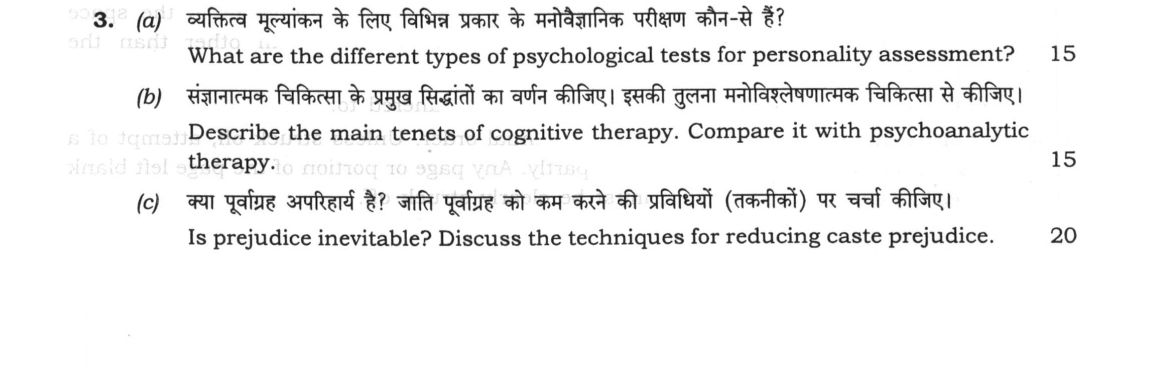
(a) What are the different types of psychological tests for personality assessment? (15 marks) (b) Describe the main tenets of…
What are the different types of psychological tests for personality assessment? 15 marks
Describe the main tenets of cognitive therapy. Compare it with psychoanalytic therapy. 15 marks
Is prejudice inevitable? Discuss the techniques for reducing caste prejudice. 20 marks
हिंदी में प्रश्न पढ़ें
व्यक्तित्व मूल्यांकन के लिए विभिन्न प्रकार के मनोवैज्ञानिक परीक्षण कौन-से हैं? (15 अंक)
संज्ञानात्मक चिकित्सा के प्रमुख सिद्धांतों का वर्णन कीजिए। इसकी तुलना मनोविश्लेषणात्मक चिकित्सा से कीजिए। (15 अंक)
क्या पूर्वाग्रह अपरिहार्य है? जाति पूर्वाग्रह को कम करने की प्रविधियों (तकनीकों) पर चर्चा कीजिए। (20 अंक)
Model answer
Written by UPSC Answer Check against this question's marking rubric, to the expected length. UPSC does not publish answers for Mains — this is one way to score well, not an official key.
Personality assessment, therapy and caste prejudice all turn on how people classify self and others.
Personality tests. Psychological tests for personality may be divided into self-report inventories, projective tests, behavioural assessment, and newer digital/AI-based tools. Self-report inventories are structured, objective, and scored against norms; examples are the MMPI and NEO-PI, with Indian adaptations such as the Jodhpur Multiphasic Personality Inventory. They are economical for screening and research. Projective tests, such as the Rorschach Inkblot and Thematic Apperception Test, are less structured and more subjective, relying on interpretation of ambiguous stimuli; they may access unconscious material but often have lower reliability and require trained scorers. Behavioural assessment observes actions in natural or analogue settings, while digital tools use app-based questionnaires, sentiment analysis, or machine-learning patterns. The key distinctions are structured versus unstructured administration, objective versus subjective scoring, and the psychometric properties of reliability, validity, and standardisation, especially with Indian norms.
Cognitive therapy and psychoanalysis. Cognitive therapy, associated with Beck, holds that emotional disturbance is maintained by distorted thinking. Its tenets include the cognitive triad of negative views of self, world, and future; automatic thoughts; cognitive distortions such as overgeneralisation; collaborative empiricism; and Socratic questioning. Ellis’s ABC model extends this by linking activating events, beliefs, and consequences. Psychoanalytic therapy, by contrast, focuses on unconscious conflicts, defence mechanisms, and early relational patterns. Comparison is clearest on duration: cognitive therapy is brief, present-focused and problem-focused, psychoanalysis is long-term, past-focused and exploratory. The therapist in cognitive therapy is a collaborative teacher; in psychoanalysis, an interpreter of transference. Techniques differ: cognitive therapy uses thought records, behavioural experiments, and homework; psychoanalysis uses free association and interpretation. Outcomes: cognitive therapy has stronger evidence for specific disorders, while psychoanalysis claims deeper personality change. Brief psychodynamic therapy acts as a bridge, retaining unconscious focus but with time limits.
Caste prejudice: inevitability and reduction. Whether prejudice is inevitable is contested. Evolutionary accounts argue tribal coalitional psychology predisposes us to favour in-groups. Tajfel’s social identity theory and minimal-group paradigm show that even minimal categorisation can produce in-group favouritism, though not necessarily automatic out-group hostility. System justification theory adds that people defend existing hierarchies. Against this, social constructionists argue prejudice is learned through language, institutions, and contact, and can be unlearned. Indian studies, such as Ghosh and Kumar on caste attitudes, show prejudice varies with education, contact, and regional context, suggesting it is not fixed.
Reduction techniques must operate at individual, institutional, and structural levels. Intergroup contact, applying Allport’s conditions of equal status, common goals, cooperation, and institutional support, can reduce caste prejudice when upper and lower caste students or workers interact in schools, colleges, and workplaces. Contact must be sustained, not tokenistic, and should include cooperative projects in colleges, Panchayats, and public-sector workplaces. Sarvodaya-inspired experiments, rooted in Gandhi and Vinoba Bhave and echoed by reformers such as Jai Prakash Narayan, used shared meals and collective labour to break ritual barriers; shared-meal practices, historically associated with Sikh Sangat, were also adopted by some reform movements. Educational interventions teach caste history, constitutional values, and critical thinking. Legislative measures—Article 17, reservation under Articles 15(4) and 16(4), and the Scheduled Castes and Scheduled Tribes (Prevention of Atrocities) Act, 1989—create formal equality and deter public discrimination. Media representation can humanise lower-caste lives and challenge stereotypes.
Yet limitations remain. Caste prejudice is institutionalised in land, marriage, occupation, and local power; individual attitude change may not alter structural exclusion. Intersectionality with class and gender means Dalit women, Adivasis, and poor castes face compounded disadvantage. Without land reform, criminal justice, and political representation, attitudinal gains may remain fragile. Assessment identifies attitudes, therapy changes cognition, and social policy changes structures; together they can reduce caste prejudice through structural reform, affirmative action, and accountable institutions.
What "Discuss" is asking you to do
Lay the issue out from more than one side — how it arose, what is claimed for it, what is held against it, and where it now stands. UPSC attaches discuss to broad topics with several live dimensions, so coverage of the dimensions earns more than the strength of your opinion.
Structure that answers it
Set the issue up → the case as it is made → the case against → the dimension both sides leave out → where the balance now lies
Where marks are lost
Listing facts with no thread between them, or arguing one side throughout and calling it a discussion.
How this answer will be evaluated
Approach
Framework: Psychology Paper 2: Define > Theory/Model > Evidence > Application. (a) enumerate: list the items in order > one line each > no commentary | (b) compare: paired headings or table > key differences > significance > conclusion | (c) discuss: intro > 3-4 dimensions > example > balanced close Full marks: Comprehensive coverage of all parts with named theories, specific examples, and clear structure.
Key points expected
- Objective tests (e.g., MMPI, 16PF, Eysenck)
- Projective tests (e.g., Rorschach, TAT)
- Interviews and observation methods
- Self-report inventories
- Tenets of Cognitive Therapy (Beck, cognitive distortions)
- Tenets of Psychoanalytic Therapy (Freud, unconscious)
- Comparison of focus (present vs past)
- Comparison of duration (short-term vs long-term)
Evaluation rubric
Each sub-part is marked on its own, against the marks and word limit printed on the paper.
- (a) List and briefly describe the major categories of personality assessment tools. 15 marks
enumerate— list the items in order → one line each → no commentary
Must cover
- Objective tests (e.g., MMPI, 16PF, Eysenck)
- Projective tests (e.g., Rorschach, TAT)
- Interviews and observation methods
- Self-report inventories
Loses marks
- Listing without description
- Confusing clinical diagnosis with personality traits
Earns more
- Mention of specific psychometric tools
- Distinction between objective and projective
- Reference to validity/reliability
Extra mark
- Specific named test (e.g., MMPI-2)
- (b) Outline core principles of Cognitive Therapy and contrast with Psychoanalytic Therapy. 15 marks
compare— paired headings or table → key differences → significance → conclusion
Must cover
- Tenets of Cognitive Therapy (Beck, cognitive distortions)
- Tenets of Psychoanalytic Therapy (Freud, unconscious)
- Comparison of focus (present vs past)
- Comparison of duration (short-term vs long-term)
Loses marks
- Describing one without the other
- Vague generalities without specific tenets
Earns more
- Mention of Beck's cognitive triad
- Mention of Freud's structural model
- Table format for comparison
Extra mark
- Specific technique (e.g., Socratic questioning)
- (c) Evaluate the inevitability of prejudice and detail techniques to reduce caste prejudice. 20 marks
discuss— intro → 3-4 dimensions → example → balanced close
Must cover
- Argument on whether prejudice is innate or learned
- Technique: Contact Hypothesis (Allport)
- Technique: Education and awareness
- Technique: Legal/structural interventions
Loses marks
- Ignoring the 'inevitable' part of the question
- General advice without psychological theory
Earns more
- Reference to Tajfel's Social Identity Theory
- Specific Indian context examples
- Balanced conclusion on inevitability
Extra mark
- Named study on caste prejudice
Practice this exact question
Write your answer and it is marked point by point against the model answer above — what you covered, what you missed, what you got wrong.
Evaluate my answer →More from Psychology 2021 Paper II
- Q1 Answer the following questions in about 150 words each: (a) Discuss the psychological tes…
- Q2 (a) Explain the major steps to be taken for the training of children with learning disabi…
- Q3 (a) What are the different types of psychological tests for personality assessment? (15 m…
- Q4 (a) How does power in organizations tend to concentrate in the hands of a few persons? Di…
- Q5 Answer the following questions in about 150 words each: (a) Explain the factors affecting…
- Q6 (a) How does a self-fulfilling prophecy work? Describe how the gender bias is an example…