Paper II — Q8
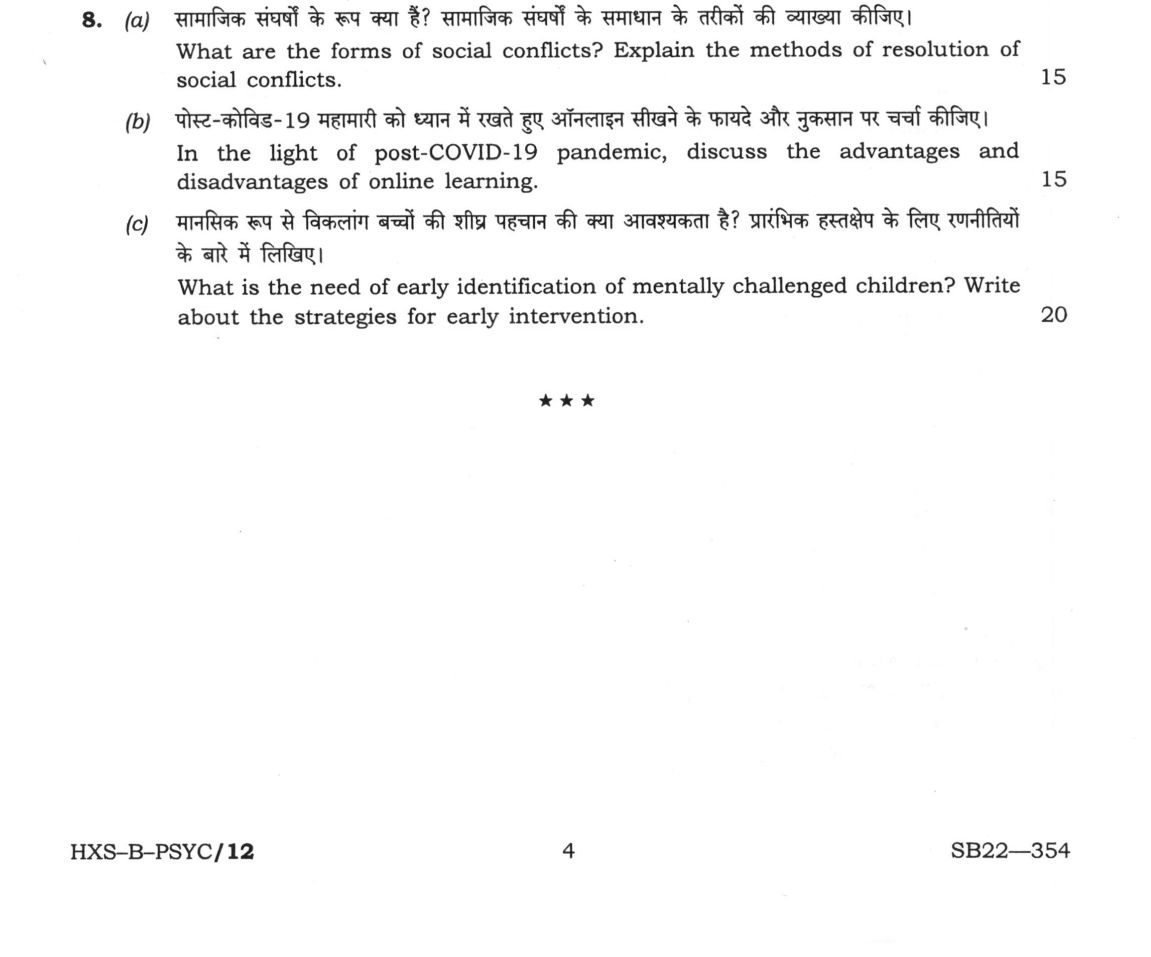
(a) What are the forms of social conflicts? Explain the methods of resolution of social conflicts. (15 marks) (b) In the light of…
What are the forms of social conflicts? Explain the methods of resolution of social conflicts. 15 marks
In the light of post-COVID-19 pandemic, discuss the advantages and disadvantages of online learning. 15 marks
What is the need of early identification of mentally challenged children? Write about the strategies for early intervention. 20 marks
हिंदी में प्रश्न पढ़ें
सामाजिक संघर्षों के रूप क्या हैं? सामाजिक संघर्षों के समाधान के तरीकों की व्याख्या कीजिए। (15 अंक)
पोस्ट-कोविड-19 महामारी को ध्यान में रखते हुए ऑनलाइन सीखने के फायदे और नुकसान पर चर्चा कीजिए। (15 अंक)
मानसिक रूप से विकलांग बच्चों की शीघ्र पहचान की क्या आवश्यकता है? प्रारंभिक हस्तक्षेप के लिए रणनीतियों के बारे में लिखिए। (20 अंक)
Model answer
Written by UPSC Answer Check against this question's marking rubric, to the expected length. UPSC does not publish answers for Mains — this is one way to score well, not an official key.
Forms and Resolution of Social Conflicts
Social conflicts manifest across systemic and psychological dimensions, primarily categorized as interpersonal (dyadic friction), intragroup (factionalism within a collective), intergroup (caste, communal, or class tensions in India), and institutional (structural inequities between marginalized groups and state apparatuses). Theoretically, Muzafer Sherif’s Realistic Group Conflict Theory explains these discords as zero-sum competition over scarce material or political resources. John Burton’s Human Needs Theory views intractable identity-based strife as the systemic deprivation of non-negotiable psychological needs like security and recognition, while Morton Deutsch’s Cooperation-Competition Theory illustrates how competitive orientations foster destructive escalations.
Resolving social conflicts necessitates shifting parties from zero-sum confrontation to integrative problem-solving. Standard methods encompass bilateral negotiation, third-party mediation to facilitate communication, and binding arbitration. In India, institutional mechanisms like Lok Adalats operationalize participatory conciliation to reduce adversarial litigation. Furthermore, transformative paradigms rooted in Gandhian conflict resolution (Satyagraha and Sarvodaya) emphasize reforming underlying relational dynamics and addressing structural violence to achieve lasting, harmonious coexistence.
Online Learning in the Post-COVID-19 Era
The post-COVID-19 educational landscape accelerated the institutionalization of digital pedagogy, offering distinct benefits alongside psychological and systemic liabilities. On the positive side, platforms like NCERT’s DIKSHA and the SWAYAM portal democratized curriculum access, enabling self-paced study and fostering self-regulated learning frameworks (Zimmerman).
Conversely, online education heightened cognitive vulnerabilities. In line with Sweller’s Cognitive Load Theory, prolonged virtual engagement induced split-attention effects, screen fatigue, and diminished attentional stamina. Psychosocially, extended isolation deprived learners of peer socialization and socio-emotional scaffolding. In India, this shift accentuated the digital divide across rural-urban, socioeconomic, and gender lines, where unequal device access disproportionately excluded female and underprivileged students. Crucially, findings from the ASER (2021-22) reports highlighted substantial learning loss in foundational literacy and numeracy, indicating that while digital modalities offer pedagogical flexibility, they cannot replace the rich interpersonal dynamics and holistic development provided by physical classrooms.
Early Identification and Intervention for Mentally Challenged Children
The imperative for early identification of intellectual disabilities is grounded in the critical neuroplasticity window of 0 to 6 years, during which developing neural circuits exhibit optimal receptivity to environmental stimulation and targeted learning. Timely diagnosis mitigates secondary developmental delays, prevents the crystallization of maladaptive behaviors, and optimizes adaptive functioning. In the Indian context, systematic early screening utilizes standardized developmental screening tools such as the Denver Developmental Screening Test (DDST) and the INCLEN Diagnostic Tools for Intellectual Disability (INDT-ID), operationalized through grassroots integration with the Integrated Child Development Services (ICDS) and Anganwadi networks.
Early intervention strategies require a comprehensive, multidisciplinary, and family-centered approach:
First, home-based stimulation programs, notably the Portage Model, empower caregivers through task analysis, structured behavioral reinforcement, and daily living skills training. Second, preparing children for inclusive education involves sensory-motor integration, speech therapy, and the creation of Individualized Educational Programs (IEPs) tailored to cognitive baselines. Third, policy frameworks reinforce these interventions; the Rights of Persons with Disabilities (RPwD) Act, 2016 mandates inclusive schooling and early developmental support, complemented by National Trust schemes like Disha (early intervention centers) and Niramaya (health insurance support).
Conclusion
Adaptive human functioning spans a continuum from individual neurodevelopmental potential to macro-level social cohesion. Addressing systemic challenges—whether mitigating developmental vulnerabilities in early childhood, bridging digital pedagogical inequalities, or transforming structural social conflicts—requires evidence-based psychological frameworks combined with inclusive, contextually grounded institutional interventions.
What "Discuss" is asking you to do
Lay the issue out from more than one side — how it arose, what is claimed for it, what is held against it, and where it now stands. UPSC attaches discuss to broad topics with several live dimensions, so coverage of the dimensions earns more than the strength of your opinion.
Structure that answers it
Set the issue up → the case as it is made → the case against → the dimension both sides leave out → where the balance now lies
Where marks are lost
Listing facts with no thread between them, or arguing one side throughout and calling it a discussion.
How this answer will be evaluated
Approach
Framework: null. (a) explain: definition/context > points in order > small example > short close | (b) discuss: intro > 3-4 dimensions > example > balanced close | (c) explain: definition/context > points in order > small example > short close Full marks: Comprehensive, well-structured, with specific examples and references to theories/tools.
Key points expected
- Define social conflict (e.g., conflict of interests)
- List forms: inter-group, inter-personal, intra-group
- Explain resolution methods: negotiation, mediation, arbitration
- Provide a small example of a resolved conflict
- Contextualize with post-COVID-19 pandemic impact
- List advantages: flexibility, accessibility, resource availability
- List disadvantages: digital divide, lack of social interaction
- Balanced conclusion on the future of online learning
Evaluation rubric
Each sub-part is marked on its own, against the marks and word limit printed on the paper.
- (a) Define social conflict, list its forms, and detail resolution methods. 15 marks
explain— definition/context → points in order → small example → short close
Must cover
- Define social conflict (e.g., conflict of interests)
- List forms: inter-group, inter-personal, intra-group
- Explain resolution methods: negotiation, mediation, arbitration
- Provide a small example of a resolved conflict
Loses marks
- Listing forms without defining them
- Confusing conflict with mere disagreement
- Vague generalities on resolution without specific methods
Earns more
- Reference to conflict theories (e.g., Coser, Galtung)
- Distinction between constructive and destructive conflict
- Mention of legal vs. informal resolution mechanisms
Extra mark
- Reference to specific Indian conflict resolution bodies (e.g., Lok Adalat)
- Diagram of the conflict resolution process
- (b) Analyze pros and cons of online learning in the post-COVID-19 context. 15 marks
discuss— intro → 3-4 dimensions → example → balanced close
Must cover
- Contextualize with post-COVID-19 pandemic impact
- List advantages: flexibility, accessibility, resource availability
- List disadvantages: digital divide, lack of social interaction
- Balanced conclusion on the future of online learning
Loses marks
- Generic list of pros/cons without pandemic context
- Ignoring the 'post-COVID-19' specific angle
- One-sided argument without balanced discussion
Earns more
- Mention of specific technologies (e.g., LMS, Zoom)
- Reference to psychological impacts (e.g., isolation, screen fatigue)
- Comparison with traditional classroom learning
Extra mark
- Citation of specific studies on online learning efficacy
- Reference to government initiatives (e.g., SWAYAM, DIKSHA)
- (c) Justify early identification of mentally challenged children and detail intervention strategies. 20 marks
explain— definition/context → points in order → small example → short close
Must cover
- Define 'mentally challenged' (e.g., intellectual disability)
- Explain the need for early identification (plasticity, prevention)
- List strategies for early intervention (e.g., screening, therapy)
- Mention specific tools or programs (e.g., RDI, ABA)
Loses marks
- Confusing 'mental challenge' with 'mental illness'
- Vague strategies without specific examples
- Ignoring the 'early' aspect of identification
Earns more
- Reference to specific psychometric tools (e.g., WISC, Vineland)
- Discussion of the role of parents and teachers
- Mention of specific Indian programs (e.g., RDI, NIPED)
Extra mark
- Reference to specific legislation (e.g., Rights of Persons with Disabilities Act)
- Diagram of the early intervention process
Practice this exact question
Write your answer and it is marked point by point against the model answer above — what you covered, what you missed, what you got wrong.
Evaluate my answer →More from Psychology 2021 Paper II
- Q5 Answer the following questions in about 150 words each: (a) Explain the factors affecting…
- Q6 (a) How does a self-fulfilling prophecy work? Describe how the gender bias is an example…
- Q7 (a) Highlight the psychological consequences of living in high population density area. (…
- Q8 (a) What are the forms of social conflicts? Explain the methods of resolution of social c…