Paper II — Q7
(a) Highlight the psychological consequences of living in high population density area. (15 marks) (b) Illustrate the…
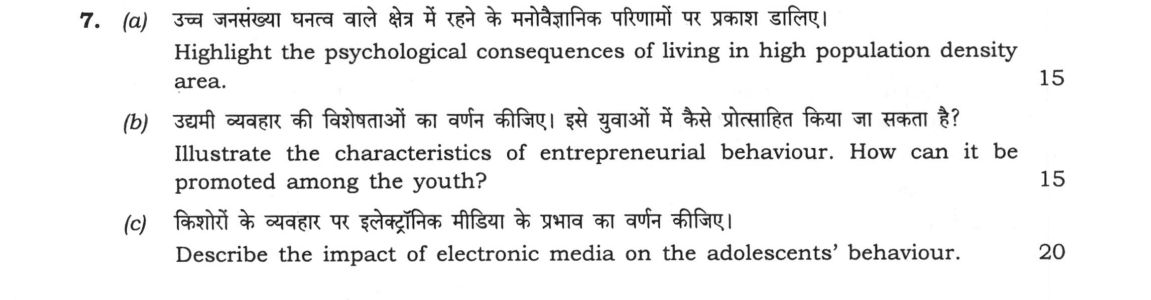
Highlight the psychological consequences of living in high population density area. 15 marks
Illustrate the characteristics of entrepreneurial behaviour. How can it be promoted among the youth? 15 marks
Describe the impact of electronic media on the adolescents' behaviour. 20 marks
हिंदी में प्रश्न पढ़ें
उच्च जनसंख्या घनत्व वाले क्षेत्र में रहने के मनोवैज्ञानिक परिणामों पर प्रकाश डालिए। (15 अंक)
उद्यमी व्यवहार की विशेषताओं का वर्णन कीजिए। इसे युवाओं में कैसे प्रोत्साहित किया जा सकता है? (15 अंक)
किशोरों के व्यवहार पर इलेक्ट्रॉनिक मीडिया के प्रभाव का वर्णन कीजिए। (20 अंक)
Model answer
Written by UPSC Answer Check against this question's marking rubric, to the expected length. UPSC does not publish answers for Mains — this is one way to score well, not an official key.
Psychological Consequences of High Population Density
Population density represents an objective physical measure of spatial limitation, whereas crowding denotes the subjective psychological experience of spatial restriction and stress. According to Milgram’s urban overload model, high density overwhelms an individual's cognitive processing capacity, forcing sensory filtering that manifests in social withdrawal, reduced prosocial behaviour, and indifference to others. Primary effects of density involve immediate physiological arousal, sensory restriction, and spatial constraint, while secondary effects encompass prolonged psychological adaptations such as learned helplessness, elevated chronic stress, and defensive hostility. John Calhoun’s classic rodent studies demonstrated that spatial overconcentration leads to a "behavioural sink" marked by pathological withdrawal and aggression. In human contexts, studies in Indian urban slums (such as Dharavi) demonstrate similar chronic stress, diminished perceived personal control, heightened irritability, and domestic friction. To adapt, residents employ coping mechanisms including cognitive re-evaluation, developing selective social barriers, establishing architectural territoriality, and utilizing environmental modification strategies like zoning personal spaces and scheduling off-peak routines to restore perceived control.
Characteristics and Promotion of Entrepreneurial Behaviour
Entrepreneurial behaviour is primarily driven by an exceptionally high Need for Achievement (n-Ach), as identified by David McClelland, along with a calculated risk-taking propensity, an internal locus of control, proactive innovativeness, and a high tolerance for ambiguity. Unlike conventional managerial orientation—which focuses on resource optimization, established role execution, stability, and risk aversion within structured hierarchies—entrepreneurial orientation centers on opportunity recognition, disruptive value creation, and operating under extreme uncertainty.
Promoting entrepreneurial behaviour among youth requires multi-tiered systemic interventions. Entrepreneurship education and experiential learning, exemplified by institutional initiatives like NITI Aayog’s Atal Innovation Mission and Atal Tinkering Labs, foster foundational problem-solving and innovation skills early. Establishing structured mentorship networks connects aspiring youth with experienced founders, while seamless institutional access to seed capital and incubation (via schemes such as Startup India) lowers systemic barriers. At the psychological level, training in the cognitive restructuring of failure—reframing setbacks as iterative feedback rather than personal deficit—combined with family and cultural value reinforcement that destigmatizes unconventional career pathways, builds an enduring entrepreneurial ecosystem.
Impact of Electronic Media on Adolescent Behaviour
Electronic media exerts profound developmental, social, and psychological impacts on adolescents. Positively, digital channels facilitate rapid information access, interactive learning through digital educational platforms, and peer connectivity that supports positive identity exploration, social support, and civic engagement.
Conversely, excessive exposure engenders substantial negative behavioural outcomes. As conceptualized by the General Aggression Model (GAM), violent interactive media primes aggressive cognitions, desensitizes emotional responsiveness, and increases physiological arousal, translating into real-world aggressive behaviour. Constant exposure to idealized peer representations on visual platforms triggers upward social comparison, driving body image dissatisfaction, lowered self-esteem, and mood disturbances. Furthermore, variable-reward design algorithms foster compulsive, addictive media consumption, leading to sleep disruption, cognitive fatigue, and diminished attention spans. The lack of social gatekeeping also amplifies cyberbullying, exposing adolescents to peer victimization, anxiety, and depressive symptoms.
These outcomes are critically moderated by mediating variables such as active parental mediation, the individual’s level of digital literacy, and platform algorithms optimized for engagement over well-being. In India, where rapid smartphone penetration and cheap data have dramatically expanded digital access among youth, rising screen time is closely linked to escalating mental health vulnerabilities and sedentary lifestyles.
Addressing these intersecting environmental, occupational, and digital challenges necessitates cohesive youth policies. Aligning urban planning, institutional skill frameworks, and proactive digital literacy programs will be essential to foster psychological resilience, economic agency, and healthy adolescent development across India.
What "Describe" is asking you to do
Give a full, ordered account of the thing named — its parts, stages or mechanism — in the sequence in which it actually exists or occurs. Most describe questions come from the science optionals, where the marks sit in correct technical detail and, where the stem says so, a labelled diagram.
Structure that answers it
One-line identification of the subject → the parts or stages in their real order, each with its defining detail → labelled diagram where the subject is structural → closing line on function or significance
Where marks are lost
Loose general prose where the examiner is ticking named parts, correct terminology and their sequence; and in the General Studies papers, turning to evaluation before the description is finished.
How this answer will be evaluated
Approach
Framework: Social Psychology & Developmental Psychology. (a) highlight: name the salient points > one line of substance each > close | (b) explain: definition/context > points in order > small example > short close | (c) describe: define > structure or process in order > labelled diagram > significance Full marks: Precise psychological terminology, named theories/studies, and balanced application to the specific context.
Key points expected
- Define high population density context
- Link crowding to stress/anxiety
- Mention social withdrawal or aggression
- Reference a relevant study or model
- List 3-4 key entrepreneurial traits
- Explain 'risk-taking' or 'innovation'
- Suggest 2-3 promotion strategies
- Link traits to youth development
Evaluation rubric
Each sub-part is marked on its own, against the marks and word limit printed on the paper.
- (a) Identify and explain the specific psychological effects of high population density. 15 marks
highlight— name the salient points → one line of substance each → close
Must cover
- Define high population density context
- Link crowding to stress/anxiety
- Mention social withdrawal or aggression
- Reference a relevant study or model
Loses marks
- Confusing density with poverty
- Generalizing without psychological terms
- Ignoring the 'high density' constraint
Earns more
- Distinguish density from crowding
- Mention 'depersonalization' or 'anomie'
- Reference Indian urban context
- Mention 'sensory overload'
Extra mark
- Name specific researcher (e.g., Altman)
- Cite specific statistic on urban stress
- (b) Explain the traits of entrepreneurial behavior and methods to foster them in youth. 15 marks
explain— definition/context → points in order → small example → short close
Must cover
- List 3-4 key entrepreneurial traits
- Explain 'risk-taking' or 'innovation'
- Suggest 2-3 promotion strategies
- Link traits to youth development
Loses marks
- Listing traits without explanation
- Promotion strategies that are generic
- Ignoring the 'youth' demographic
Earns more
- Mention 'locus of control'
- Reference 'need for achievement' (McClelland)
- Suggest 'incubation centers' or 'mentorship'
- Mention 'self-efficacy'
Extra mark
- Name a specific Indian startup scheme
- Reference a specific psychological scale
- (c) Detail the effects of electronic media on adolescent behavior. 20 marks
describe— define → structure or process in order → labelled diagram → significance
Must cover
- Define electronic media scope
- Explain impact on social interaction
- Discuss impact on aggression or violence
- Mention impact on attention or cognition
Loses marks
- Focusing only on physical health
- Ignoring the 'adolescent' developmental stage
- One-sided view (only positive or negative)
Earns more
- Reference 'social learning theory' (Bandura)
- Mention 'cyberbullying' or 'addiction'
- Discuss 'displacement of activities'
- Reference 'desensitization' to violence
Extra mark
- Name a specific longitudinal study
- Cite a specific statistic on screen time
Practice this exact question
Write your answer and it is marked point by point against the model answer above — what you covered, what you missed, what you got wrong.
Evaluate my answer →More from Psychology 2021 Paper II
- Q4 (a) How does power in organizations tend to concentrate in the hands of a few persons? Di…
- Q5 Answer the following questions in about 150 words each: (a) Explain the factors affecting…
- Q6 (a) How does a self-fulfilling prophecy work? Describe how the gender bias is an example…
- Q7 (a) Highlight the psychological consequences of living in high population density area. (…
- Q8 (a) What are the forms of social conflicts? Explain the methods of resolution of social c…