Paper II — Q2
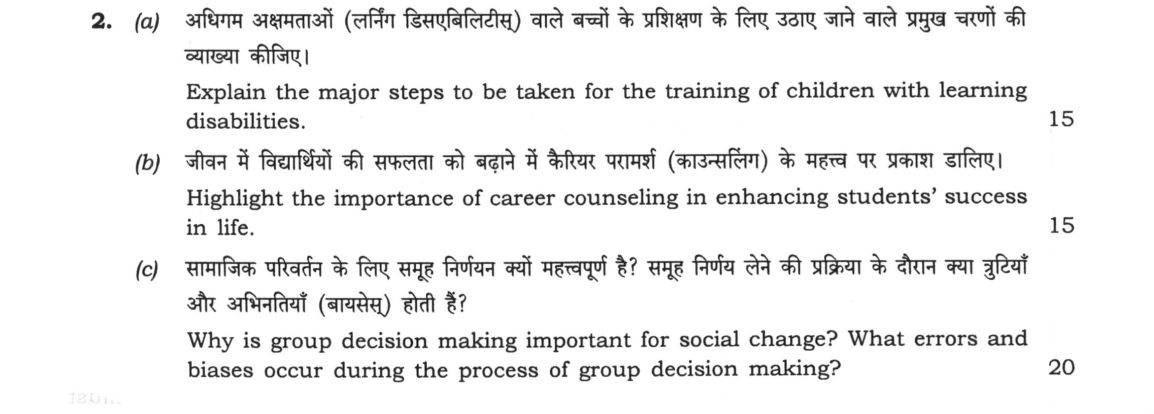
(a) Explain the major steps to be taken for the training of children with learning disabilities. (15 marks) (b) Highlight the…
Explain the major steps to be taken for the training of children with learning disabilities. 15 marks
Highlight the importance of career counseling in enhancing students' success in life. 15 marks
Why is group decision making important for social change? What errors and biases occur during the process of group decision making? 20 marks
हिंदी में प्रश्न पढ़ें
अधिगम अक्षमताओं (लर्निंग डिसएबिलिटीज) वाले बच्चों के प्रशिक्षण के लिए उठाए जाने वाले प्रमुख चरणों की व्याख्या कीजिए। (15 अंक)
जीवन में विद्यार्थियों की सफलता को बढ़ाने में कैरियर परामर्श (काउंसलिंग) के महत्व पर प्रकाश डालिए। (15 अंक)
सामाजिक परिवर्तन के लिए समूह निर्णय क्यों महत्वपूर्ण है? समूह निर्णय लेने की प्रक्रिया के दौरान क्या त्रुटियाँ और अभिनतियाँ (बायसेस) होती हैं? (20 अंक)
Model answer
Written by UPSC Answer Check against this question's marking rubric, to the expected length. UPSC does not publish answers for Mains — this is one way to score well, not an official key.
Training Children with Learning Disabilities
Learning disabilities (LD) such as dyslexia, dyscalculia, and comorbid conditions like ADHD stem from neurodevelopmental variations in information processing. Training requires a systematic, multi-tiered intervention framework. Early identification through standardized screening tools enables timely diagnosis before academic failure compounds emotional distress. Following assessment, an Individualized Education Plan (IEP) is formulated to tailor pedagogical objectives and pace to the child's specific cognitive profile.
Remedial instruction relies fundamentally on multisensory techniques, notably the Orton-Gillingham approach, which simultaneously activates visual, auditory, and kinesthetic-tactile neural pathways to strengthen phonological awareness and numerical encoding. Alongside this, Cognitive Behavior Modification (CBM), incorporating self-instructional training, builds metacognitive monitoring and impulse control in children with ADHD. Assistive technologies, such as text-to-speech software and digital arithmetic manipulatives, bypass processing deficits, while social skills training addresses peer alienation. Crucially, structured family-school collaboration reinforces behavioral gains across settings, aligning with inclusive education mandates under the RPwD Act 2016 and Samagra Shiksha provisions.
Career Counseling and Student Success
Career counseling serves as a vital psychological intervention that enhances life success by clarifying self-concept and fostering vocational maturity, as highlighted in Donald Super’s Life-Span, Life-Space theory. By assessing aptitudes, interests, and values, counseling operationalizes Holland’s RIASEC model to achieve an optimal person-environment fit. This congruent matching prevents vocational maladjustment, minimizes academic dropout rates, and enhances long-term job satisfaction and psychological well-being.
Beyond psychometric matching, career guidance equips students with structured decision-making skills, dispelling irrational career myths and mitigating parental or socio-cultural conformity pressures. In India, institutional mechanisms like the National Career Service (NCS) portal and CBSE career guidance initiatives expand occupational horizons and cultivate career self-efficacy, enabling students to navigate complex labor markets effectively.
Group Decision Making for Social Change, Errors, and Biases
Group decision-making is indispensable for driving sustainable social change because it aggregates distributed knowledge, mobilizes communal resources, and fosters collective efficacy. Grassroots platforms such as the Gram Sabha and Jan Bhagidari initiatives demonstrate that inclusive deliberation builds normative legitimacy and collective ownership over developmental reforms.
However, group dynamics are vulnerable to systematic dysfunctions. Irving Janis identified Groupthink, wherein strong desires for consensus in cohesive groups lead to illusions of invulnerability, self-censorship, and suppression of critical dissent. Furthermore, group polarization causes collectives to adopt more extreme positions than the average of individual members' pre-deliberation leanings (risky shift or cautious shift), driven by persuasive arguments and social comparison. Social loafing also reduces individual effort when accountability is diffused across the group.
Cognitively, collective deliberation is distorted by confirmation bias, where groups selectively process data supporting prevailing beliefs, the availability heuristic, which overweights emotionally salient recent events, and in-group favoritism, which breeds out-group derogation and hinders broader social coalition-building.
To counter these biases, structured decision protocols must be institutionalized. Appointing a formal devil’s advocate forces the interrogation of hidden assumptions. The Nominal Group Technique (NGT) restricts unreflective conformism by requiring independent idea generation before structured aggregation, while the Delphi method utilizes anonymous, iterative expert consensus to insulate strategic policy decisions from hierarchical and socio-emotional pressures.
Translating psychological principles into structured educational frameworks, career development programs, and participatory governance models ensures that individual potential is fully realized while collective decision-making remains rational, democratic, and socially transformative.
What "Explain" is asking you to do
Make the working of something clear — what sets it off, what follows from what, and what it produces. Explain is the Commission's mechanism word: it dominates the technical papers and the “explain why” stems, where the marks sit in the causal chain and not in the label.
Structure that answers it
State what it is → the initiating condition → the chain of cause, step by step → an instance where it plays out → what the chain produces
Where marks are lost
Describing what something looks like instead of why it works that way. Naming the stages without linking them reads as description too.
How this answer will be evaluated
Approach
Framework: Define > Theory or model > Evidence > Application. (a) explain: definition/context > points in order > small example > short close | (b) highlight: name the salient points > one line of substance each > close | (c) explain: definition/context > points in order > small example > short close Full marks: Precise definitions, named theories/models, specific examples, and clear structure.
Key points expected
- Definition of Learning Disabilities (LD)
- Identification and diagnostic assessment
- Individualized Education Program (IEP) formulation
- Instructional strategies (e.g., multisensory, structured)
- Self-exploration and personality assessment
- Matching aptitude with career options
- Reducing vocational indecision and anxiety
- Enhancing academic and professional motivation
Evaluation rubric
Each sub-part is marked on its own, against the marks and word limit printed on the paper.
- (a) Sequential steps for training children with learning disabilities. 15 marks
explain— definition/context → points in order → small example → short close
Must cover
- Definition of Learning Disabilities (LD)
- Identification and diagnostic assessment
- Individualized Education Program (IEP) formulation
- Instructional strategies (e.g., multisensory, structured)
Loses marks
- Generic advice without specific LD context
- Confusing LD with general intellectual disability
- Lack of structured/sequential steps
Earns more
- Role of assistive technology
- Parent and teacher training
- Behavioral modification techniques
- Transition to mainstreaming
Extra mark
- Reference to specific LD typology (e.g., dyslexia)
- Mention of specific psychometric tools (e.g., WISC)
- (b) Salient points on career counseling's role in student success. 15 marks
highlight— name the salient points → one line of substance each → close
Must cover
- Self-exploration and personality assessment
- Matching aptitude with career options
- Reducing vocational indecision and anxiety
- Enhancing academic and professional motivation
Loses marks
- Vague statements without specific benefits
- Ignoring the 'counseling' aspect (just listing careers)
- No link to 'success in life'
Earns more
- Use of psychometric tools (e.g., Holland codes)
- Impact on mental health and well-being
- Guidance on higher education pathways
- Skill development and employability
Extra mark
- Reference to specific counseling models (e.g., Super's theory)
- Mention of specific Indian career counseling initiatives
- (c) Importance of group decision making for social change and its errors. 20 marks
explain— definition/context → points in order → small example → short close
Must cover
- Importance: Pooling diverse perspectives and resources
- Importance: Legitimacy and collective buy-in
- Errors: Groupthink (conformity pressure)
- Errors: Social loafing or polarization
Loses marks
- Ignoring the 'errors and biases' part
- Ignoring the 'social change' context
- Listing errors without explaining them
Earns more
- Importance: Reducing individual bias
- Errors: Dominance by strong personalities
- Errors: Ambiguity of responsibility (diffusion)
- Application to Indian social movements
Extra mark
- Reference to specific social change examples (e.g., Green Revolution)
- Mention of specific bias names (e.g., confirmation bias)
Practice this exact question
Write your answer and it is marked point by point against the model answer above — what you covered, what you missed, what you got wrong.
Evaluate my answer →More from Psychology 2021 Paper II
- Q1 Answer the following questions in about 150 words each: (a) Discuss the psychological tes…
- Q2 (a) Explain the major steps to be taken for the training of children with learning disabi…
- Q3 (a) What are the different types of psychological tests for personality assessment? (15 m…
- Q4 (a) How does power in organizations tend to concentrate in the hands of a few persons? Di…
- Q5 Answer the following questions in about 150 words each: (a) Explain the factors affecting…