Paper II — Q5
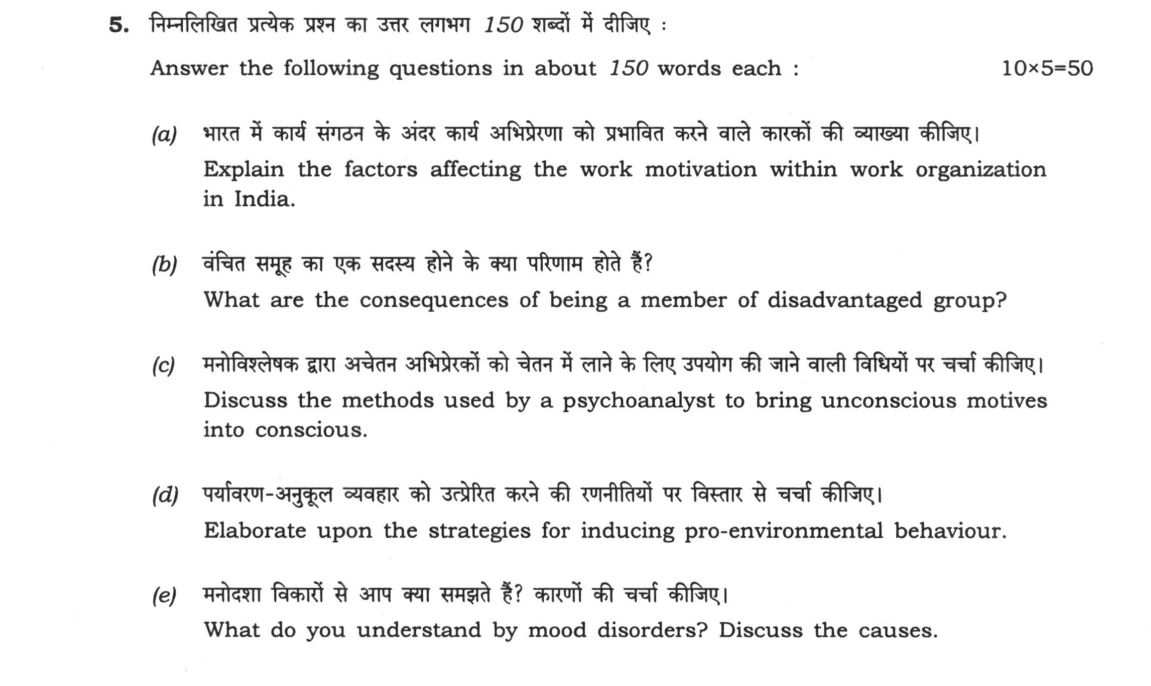
Answer the following questions in about 150 words each: (a) Explain the factors affecting the work motivation within work…
Answer the following questions in about 150 words each:
Explain the factors affecting the work motivation within work organization in India. 10 marks
What are the consequences of being a member of disadvantaged group? 10 marks
Discuss the methods used by a psychoanalyst to bring unconscious motives into conscious. 10 marks
Elaborate upon the strategies for inducing pro-environmental behaviour. 10 marks
What do you understand by mood disorders? Discuss the causes. 10 marks
हिंदी में प्रश्न पढ़ें
निम्नलिखित प्रत्येक प्रश्न का उत्तर लगभग 150 शब्दों में दीजिए :
भारत में कार्य संगठन के अंदर कार्य अभिप्रेरणा को प्रभावित करने वाले कारकों की व्याख्या कीजिए। (10 अंक)
वंचित समूह का एक सदस्य होने के क्या परिणाम होते हैं? (10 अंक)
मनोविश्लेषक द्वारा अचेतन अभिप्रेरकों को चेतन में लाने के लिए उपयोग की जाने वाली विधियों पर चर्चा कीजिए। (10 अंक)
पर्यावरण-अनुकूल व्यवहार को उत्प्रेरित करने की रणनीतियों पर विस्तार से चर्चा कीजिए। (10 अंक)
मनोदशा विकारों से आप क्या समझते हैं? कारणों की चर्चा कीजिए। (10 अंक)
Model answer
Written by UPSC Answer Check against this question's marking rubric, to the 150-word length. UPSC does not publish answers for Mains — this is one way to score well, not an official key.
(a) Work Motivation within Work Organizations in India
Work motivation in Indian organizations is driven by an interaction of individual, organizational, and sociocultural factors. At the individual level, motivational drives reflect Maslow's need hierarchy, where economic security needs often operate concurrently with social affiliation and esteem needs. An employee's locus of control further mediates motivation: internals exhibit high task persistence, whereas externals rely more heavily on managerial guidance.
Organizationally, leadership styles and reward structures are decisive. J.B.P. Sinha’s Nurturant-Task (NT) leadership model highlights that Indian subordinates respond with higher motivation when leaders combine task orientation with emotional nurturance and clear authority. Transparent reward systems that balance merit with equity reinforce this drive.
Culturally, India’s high power distance and collectivist orientation mean that personalized relationships (apnapana) and familial workplace climates heighten engagement, whereas rigid depersonalization dampens it. Furthermore, caste and gender dynamics continue to influence perceived organizational justice; workplace inclusion and psychological safety directly counteract historical inequities to foster sustained organizational citizenship.
(b) Consequences of Being a Member of a Disadvantaged Group
Membership in a disadvantaged group produces systemic, reinforcing vulnerabilities across multiple domains. Psychologically, persistent stigmatization fosters low self-efficacy and learned helplessness, wherein individuals perceive outcomes as independent of their actions. Stereotype threat exacerbates this vulnerability, causing anxiety that impairs cognitive performance in evaluative settings.
Socially, disadvantaged individuals endure persistent social stigma, systemic discrimination, and institutional marginalization. This leads to reduced social capital and pervasive social exclusion, which restricts collective mobility.
Economically, institutional bias and unequal access to quality education, credit, and formal networks lock individuals into structural poverty traps. Restricted occupational opportunities and glass ceilings limit upward mobility across generations.
Health-wise, chronic exposure to social adversity dysregulates the stress response system. Elevated allostatic load increases vulnerability to hypertension, chronic fatigue, anxiety disorders, and depression, creating a cycle where poor physical and psychological health further reinforces socioeconomic marginalization.
(c) Psychoanalytic Methods to Access the Unconscious
Psychoanalysis aims to bring repressed unconscious conflicts, impulses, and defenses into conscious awareness through structured clinical methods. It begins with establishing a secure therapeutic alliance, which provides the emotional safety required for deep exploration.
In free association, the patient verbalizes thoughts without conscious censorship, allowing repressed material to bypass defense mechanisms. Dream analysis interprets the manifest content (the remembered dream) using the principles of dream work (condensation, displacement) to reveal its latent content (repressed desires).
The analyst also conducts an analysis of resistance, identifying moments when the patient avoids specific topics or falls silent, which pinpoints active psychological defenses. Through the analysis of transference, patients project unconscious relational schemas, unresolved conflicts, and attitudes toward childhood figures onto the analyst. Finally, the interpretation of parapraxes (Freudian slips and accidental acts) exposes moments where repressed motives inadvertently breach conscious control, allowing the analyst to make systematic interpretations that foster cognitive and emotional insight.
(d) Strategies for Inducing Pro-Environmental Behaviour
Inducing pro-environmental behavior requires combining psychological interventions with structural changes. Informational strategies focus on raising awareness through tailored environmental education and real-time feedback mechanisms, such as smart energy meters, which make resource consumption visible and salient.
Structural strategies alter the decision environment. Economic incentives (subsidies for solar adoption) and disincentives (carbon taxes, single-use plastic fines) adjust perceived costs, while enhancing convenience—such as placing segregated waste bins at eye level—reduces behavioral friction.
Community-based social marketing leverages social norms and behavioral modeling. Demonstrating descriptive norms (showing that neighbors actively recycle) and injunctive norms (communicating shared moral values) leverages peer influence to guide action.
Commitment techniques further consolidate behavioral changes. Securing public pledges, utilizing implementation intentions ("if-then" plans), and applying the foot-in-the-door technique (starting with small ecological actions) foster self-consistency and solidify enduring pro-environmental identities.
(e) Mood Disorders: Definition and Causes
Mood disorders are psychiatric conditions defined in the DSM-5 by severe, prolonged disturbances in affect, energy, and behavior that impair daily functioning. They primarily comprise Depressive Disorders (such as Major Depressive Disorder, marked by persistent sadness and anhedonia) and Bipolar and Related Disorders (characterized by alternating episodes of mania/hypomania and depression).
The etiology of mood disorders is multifactorial. Biologically, they are linked to genetic heritability, monoamine neurotransmitter dysregulation (deficits in serotonin, norepinephrine, and dopamine), and hyperactivation of the hypothalamic-pituitary-adrenal (HPA) axis, leading to elevated cortisol levels.
Psychologically, Beck’s cognitive theory highlights negative cognitive triads (pessimistic views of self, world, and future) and cognitive distortions, while Seligman’s learned helplessness models depressive despair following uncontrollable negative events. Insecure early attachment styles also increase vulnerability.
Socio-culturally, chronic stressors, traumatic life events, economic instability, and deficits in social support systems trigger and sustain mood episodes, demonstrating that biological vulnerabilities interact directly with psychosocial stressors.
What "Explain" is asking you to do
Make the working of something clear — what sets it off, what follows from what, and what it produces. Explain is the Commission's mechanism word: it dominates the technical papers and the “explain why” stems, where the marks sit in the causal chain and not in the label.
Structure that answers it
State what it is → the initiating condition → the chain of cause, step by step → an instance where it plays out → what the chain produces
Where marks are lost
Describing what something looks like instead of why it works that way. Naming the stages without linking them reads as description too.
How this answer will be evaluated
Approach
Framework: UPSC Psychology Paper II (Organizational, Social, Clinical, Environmental). (a) explain: definition/context > points in order > small example > short close | (b) explain: definition/context > points in order > small example > short close | (c) discuss: intro > 3-4 dimensions > example > balanced close | (d) explain: definition/context > points in order > small example > short close | (e) explain: definition/context > points in order > small example > short close Full marks: Precise definitions, specific theories/studies, clear Indian context where relevant, logical flow.
Key points expected
- Define work motivation in organizational context
- Identify 3-4 specific Indian factors (e.g., hierarchy, job security)
- Link factors to motivation theories (e.g., Maslow, Herzberg)
- Provide a brief Indian workplace example
- Define 'disadvantaged group' (e.g., caste, gender, disability)
- Explain psychological consequences (e.g., low self-esteem, stress)
- Explain social consequences (e.g., discrimination, exclusion)
- Mention specific mechanisms (e.g., stereotype threat)
Evaluation rubric
Each sub-part is marked on its own, against the marks and word limit printed on the paper.
- (a) Contextualize work motivation factors specific to Indian organizational culture. · 150 words
explain— definition/context → points in order → small example → short close
Must cover
- Define work motivation in organizational context
- Identify 3-4 specific Indian factors (e.g., hierarchy, job security)
- Link factors to motivation theories (e.g., Maslow, Herzberg)
- Provide a brief Indian workplace example
Loses marks
- Generic Western theories without Indian context
- Listing factors without explaining their effect
- Ignoring the 'within work organization' constraint
Earns more
- Mention of 'Jugaad' or 'Sambandhi' culture
- Reference to Indian management studies
- Distinction between intrinsic/extrinsic in India
Extra mark
- Citing a specific Indian study on motivation
- Mentioning specific Indian corporate examples
- (b) Detail the psychological and social consequences of group disadvantage. · 150 words
explain— definition/context → points in order → small example → short close
Must cover
- Define 'disadvantaged group' (e.g., caste, gender, disability)
- Explain psychological consequences (e.g., low self-esteem, stress)
- Explain social consequences (e.g., discrimination, exclusion)
- Mention specific mechanisms (e.g., stereotype threat)
Loses marks
- Focusing only on economic consequences
- Ignoring the psychological impact
- Vague generalizations without specific mechanisms
Earns more
- Reference to Tajfel's Social Identity Theory
- Mention of 'Othering' or 'Out-group bias'
- Link to Indian context (e.g., caste discrimination)
Extra mark
- Citing a specific study on stereotype threat
- Mentioning specific social indicators of disadvantage
- (c) Describe psychoanalytic techniques for accessing the unconscious. · 150 words
discuss— intro → 3-4 dimensions → example → balanced close
Must cover
- Define the goal: bringing unconscious to conscious
- Explain Free Association (method and purpose)
- Explain Dream Analysis (manifest vs latent content)
- Explain Transference (role in therapy)
Loses marks
- Confusing psychoanalysis with CBT or other therapies
- Describing techniques without explaining their purpose
- Ignoring the 'unconscious' aspect of the question
Earns more
- Mention of 'Resistance' and how it is handled
- Reference to Freud's specific case studies
- Distinction between conscious and preconscious
Extra mark
- Mentioning 'Projective Techniques' (e.g., Rorschach)
- Brief mention of modern psychoanalytic adaptations
- (d) Detail strategies to induce pro-environmental behavior. · 150 words
explain— definition/context → points in order → small example → short close
Must cover
- Define pro-environmental behavior
- Explain 3-4 specific strategies (e.g., education, incentives)
- Link strategies to psychological principles (e.g., social norms)
- Provide a brief example of a successful strategy
Loses marks
- Focusing only on technical solutions (e.g., solar panels)
- Ignoring the psychological/behavioral aspect
- Vague strategies without specific mechanisms
Earns more
- Mention of 'Nudge Theory' or behavioral economics
- Reference to 'Planetary Boundaries' or 'Sustainability'
- Distinction between individual and collective action
Extra mark
- Citing a specific environmental campaign
- Mentioning specific policy interventions
- (e) Define mood disorders and discuss their causes. · 150 words
explain— definition/context → points in order → small example → short close
Must cover
- Define mood disorders (e.g., depression, bipolar)
- Explain biological causes (e.g., neurotransmitters, genetics)
- Explain psychological causes (e.g., cognitive distortions)
- Explain social/environmental causes (e.g., stress, trauma)
Loses marks
- Confusing mood disorders with personality disorders
- Focusing only on one type of cause (e.g., only biological)
- Vague definitions without specific examples
Earns more
- Mention of 'Diathesis-Stress Model'
- Reference to specific neurotransmitters (e.g., serotonin)
- Distinction between unipolar and bipolar disorders
Extra mark
- Citing specific genetic markers
- Mentioning specific therapeutic interventions
Practice this exact question
Write your answer and it is marked point by point against the model answer above — what you covered, what you missed, what you got wrong.
Evaluate my answer →More from Psychology 2021 Paper II
- Q2 (a) Explain the major steps to be taken for the training of children with learning disabi…
- Q3 (a) What are the different types of psychological tests for personality assessment? (15 m…
- Q4 (a) How does power in organizations tend to concentrate in the hands of a few persons? Di…
- Q5 Answer the following questions in about 150 words each: (a) Explain the factors affecting…
- Q6 (a) How does a self-fulfilling prophecy work? Describe how the gender bias is an example…
- Q7 (a) Highlight the psychological consequences of living in high population density area. (…
- Q8 (a) What are the forms of social conflicts? Explain the methods of resolution of social c…