Paper I — Q1
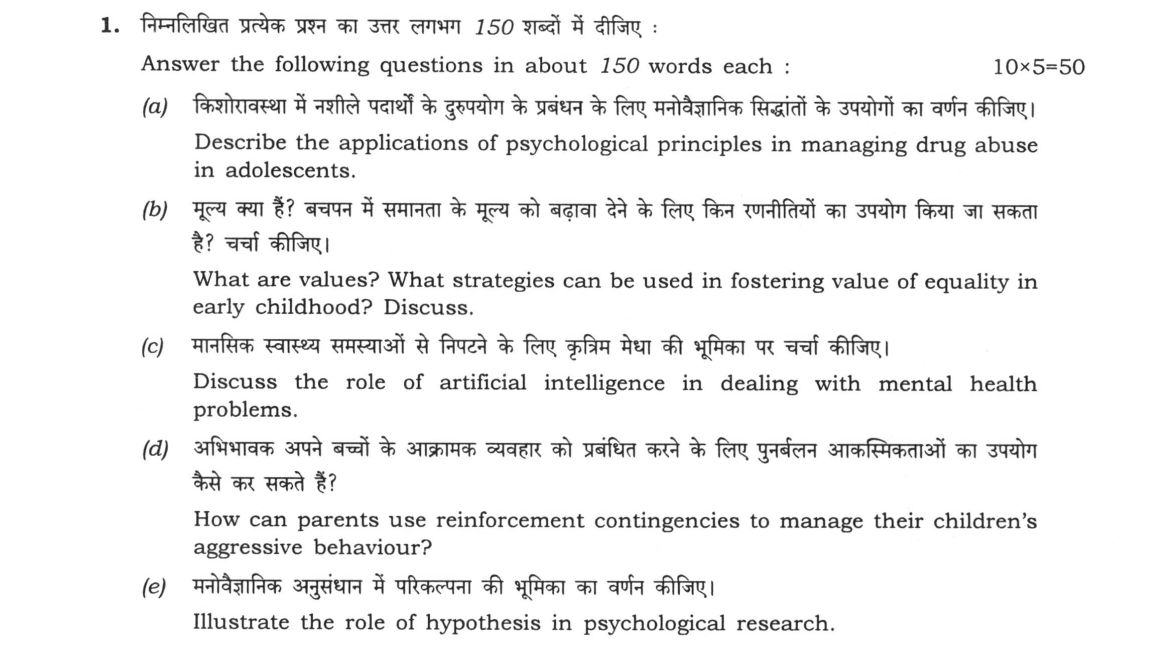
Answer the following questions in about 150 words each: (a) Describe the applications of psychological principles in managing…
Answer the following questions in about 150 words each:
Describe the applications of psychological principles in managing drug abuse in adolescents. 10 marks
What are values? What strategies can be used in fostering value of equality in early childhood? Discuss. 10 marks
Discuss the role of artificial intelligence in dealing with mental health problems. 10 marks
How can parents use reinforcement contingencies to manage their children's aggressive behaviour? 10 marks
Illustrate the role of hypothesis in psychological research. 10 marks
हिंदी में प्रश्न पढ़ें
निम्नलिखित प्रत्येक प्रश्न का उत्तर लगभग 150 शब्दों में दीजिए :
किशोरावस्था में नशीले पदार्थों के दुरुपयोग के प्रबंधन के लिए मनोवैज्ञानिक सिद्धांतों के उपयोगों का वर्णन कीजिए। (10 अंक)
मूल्य क्या हैं? बचपन में समानता के मूल्य को बढ़ावा देने के लिए किन रणनीतियों का उपयोग किया जा सकता है? चर्चा कीजिए। (10 अंक)
मानसिक स्वास्थ्य समस्याओं से निपटने के लिए कृत्रिम मेधा की भूमिका पर चर्चा कीजिए। (10 अंक)
अभिभावक अपने बच्चों के आक्रामक व्यवहार को प्रबंधित करने के लिए पुनर्बलन आकस्मिकताओं का उपयोग कैसे कर सकते हैं? (10 अंक)
मनोवैज्ञानिक अनुसंधान में परिकल्पना की भूमिका का वर्णन कीजिए। (10 अंक)
Model answer
Written by UPSC Answer Check against this question's marking rubric, to the 150-word length. UPSC does not publish answers for Mains — this is one way to score well, not an official key.
(a) Psychological Principles in Managing Adolescent Drug Abuse
Adolescent vulnerability to substance abuse is rooted in neurodevelopmental asymmetry: the socio-emotional limbic system matures faster than the prefrontal cortex, predisposing youth to heightened impulsivity and sensation-seeking. Psychological interventions address this developmental reality through targeted behavioral and cognitive frameworks.
Cognitive Behavioral Therapy (CBT) helps adolescents identify environmental triggers, challenge maladaptive outcome expectancies, and construct cognitive restructuring mechanisms to manage cravings. Motivational Interviewing (Miller and Rollnick) resolves ambivalence regarding substance use by fostering intrinsic motivation and self-efficacy. At the interpersonal level, peer resistance training—central to interventions like the Drug Abuse Resistance Education (DARE) and Life Skills Training models—equips youth with assertiveness skills to counter peer pressure.
Furthermore, Multidimensional Family Therapy (MDFT) integrates systemic principles by restructuring family reinforcement patterns and enhancing parental monitoring. By combining cognitive restructuring, resistance skills, and systemic family support, psychological strategies create a comprehensive bio-psycho-social buffer against adolescent substance dependence.
(b) Values and Fostering Equality in Early Childhood
Values, as conceptualized by Milton Rokeach, are enduring beliefs that specific modes of conduct (instrumental values) or end-states of existence (terminal values) are personally or socially preferable. Shalom Schwartz expands this by defining values as trans-situational, desirable goals that serve as guiding principles in people's lives.
Fostering the value of equality in early childhood requires active, developmentally appropriate socialization strategies:
Cooperative Learning: Utilizing structured interdependence models, such as Elliot Aronson's Jigsaw classroom technique, encourages children to view peers of diverse gender, caste, and socio-economic backgrounds as essential partners.
Inclusive Storytelling and Counter-Stereotyping: Introducing narratives that portray non-traditional gender roles and multicultural protagonists dismantles implicit biases before they crystallize.
Role-Playing and Perspective-Taking: Guided socio-dramatic play allows children to step into others' perspectives, building empathy and egalitarian attitudes.
Adult Modeling: According to Albert Bandura’s social learning theory, consistent modeling of fairness and non-discriminatory behavior by educators and caregivers provides the primary observational blueprint for internalizing equality as a core value.
(c) Artificial Intelligence in Mental Health
Artificial Intelligence (AI) plays an increasingly transformative role in mental health through screening, diagnostic precision, and therapeutic delivery. Conversational agents such as Woebot and Wysa utilize natural language processing (NLP) to deliver automated, evidence-based Cognitive Behavioral Therapy (CBT) micro-interventions, offering accessible, stigma-free support for mild-to-moderate anxiety and depression. Furthermore, machine learning models analyze behavioral biomarkers, linguistic patterns, and digital footprints to facilitate predictive analytics for early detection of psychiatric relapse and suicide risk.
However, significant limitations accompany AI integration. Algorithms lack genuine affective empathy, therapeutic alliance, and cultural sensitivity, which are vital for treating complex trauma. Moreover, risks involving algorithmic bias, data privacy breaches, and inadequate crisis management during acute psychiatric emergencies underscore these challenges. Moving forward, AI should serve as an adjunctive, triaging, and scaling tool integrated within human-supervised stepped-care models, rather than an autonomous replacement for clinical practitioners.
(d) Reinforcement Contingencies for Managing Aggressive Behavior
Operant conditioning principles offer parents systematic, non-punitive methods to reduce childhood aggression by restructuring environmental contingencies:
Differential Reinforcement of Incompatible Behavior (DRI): Parents reinforce positive behaviors that are physically incompatible with aggression. For instance, praising and rewarding a child for using verbal negotiation or deep breathing directly displaces physical striking.
Extinction of Attention-Seeking Aggression: Aggressive outbursts are frequently maintained by accidental positive reinforcement in the form of parental attention. Withholding social engagement during minor tantrums eliminates the functional reward maintaining the behavior.
Token Economies: Setting up contingency contracts where children earn tokens for prosocial conflict resolution—exchangeable for reinforcing privileges—provides structured, tangible incentives for non-violent conduct.
Time-Out Procedures: When aggressive acts occur, brief, non-punitive isolation from all reinforcing stimuli serves as effective negative punishment.
Consistency, immediacy of reinforcement, and clear behavioral criteria ensure these contingencies alter aggressive patterns without escalating familial conflict.
(e) Role of Hypothesis in Psychological Research
A hypothesis is a tentative, testable proposition regarding the relationship between two or more operationalized variables. It serves as the bridge connecting abstract psychological theory with empirical observation, guiding research design and data collection.
Hypotheses are formulated as null (H₀, predicting no significant difference or relationship) and alternative (H₁, predicting a true effect). Alternative hypotheses can be directional (specifying the direction of an outcome) or non-directional. In accordance with Karl Popper’s criterion of falsifiability, a scientific hypothesis must be structured such that empirical evidence can potentially refute it.
For instance, in Philip Zimbardo’s Stanford Prison Experiment, the hypothesis posited that systemic situational roles, rather than internal dispositional traits, primarily drive aggressive and submissive behaviors. By explicitly predicting the outcome, hypotheses prevent aimless empiricism, direct statistical significance testing, and facilitate the systematic verification, refinement, or rejection of psychological theories.
What "Discuss" is asking you to do
Lay the issue out from more than one side — how it arose, what is claimed for it, what is held against it, and where it now stands. UPSC attaches discuss to broad topics with several live dimensions, so coverage of the dimensions earns more than the strength of your opinion.
Structure that answers it
Set the issue up → the case as it is made → the case against → the dimension both sides leave out → where the balance now lies
Where marks are lost
Listing facts with no thread between them, or arguing one side throughout and calling it a discussion.
How this answer will be evaluated
Approach
Framework: Define > Theory or model > Evidence > Application. (a) describe: define > structure or process in order > labelled diagram > significance | (b) discuss: intro > 3-4 dimensions > example > balanced close | (c) discuss: intro > 3-4 dimensions > example > balanced close | (d) explain: definition/context > points in order > small example > short close | (e) explain: definition/context > points in order > small example > short close Full marks: Precise definitions, specific theories/studies, clear application to context, well-structured.
Key points expected
- Define adolescent drug abuse
- Identify specific psychological principles (e.g., CBT, social learning)
- Explain application of principles in management
- Mention specific intervention strategies
- Define 'values' in psychological context
- Define 'equality' as a value
- List strategies for early childhood
- Explain how strategies foster equality
Evaluation rubric
Each sub-part is marked on its own, against the marks and word limit printed on the paper.
- (a) Define drug abuse in adolescents and list psychological principles applied to its management. · 150 words
describe— define → structure or process in order → labelled diagram → significance
Must cover
- Define adolescent drug abuse
- Identify specific psychological principles (e.g., CBT, social learning)
- Explain application of principles in management
- Mention specific intervention strategies
Loses marks
- General advice without psychological basis
- Ignoring the 'adolescent' specific context
Earns more
- Reference to specific therapy models
- Mention of prevention vs treatment
- Link to adolescent developmental factors
Extra mark
- Named study on adolescent drug abuse
- Specific psychometric tool for assessment
- (b) Define values and discuss strategies for fostering equality in early childhood. · 150 words
discuss— intro → 3-4 dimensions → example → balanced close
Must cover
- Define 'values' in psychological context
- Define 'equality' as a value
- List strategies for early childhood
- Explain how strategies foster equality
Loses marks
- Abstract definition without practical strategies
- Ignoring the 'early childhood' age group
Earns more
- Reference to social learning theory
- Examples of classroom/home strategies
- Mention of role modeling
Extra mark
- Named study on early childhood values
- Specific educational framework reference
- (c) Discuss the role of artificial intelligence in dealing with mental health problems. · 150 words
discuss— intro → 3-4 dimensions → example → balanced close
Must cover
- Define AI in mental health context
- Identify specific roles (e.g., diagnosis, therapy)
- Explain how AI aids in these roles
- Mention benefits or limitations
Loses marks
- Vague generalities about technology
- Ignoring the 'mental health' specific application
Earns more
- Reference to specific AI tools (e.g., chatbots)
- Mention of data analysis in diagnosis
- Discussion of accessibility
Extra mark
- Named AI platform or study
- Specific statistic on AI efficacy
- (d) Explain how parents can use reinforcement contingencies to manage aggressive behaviour. · 150 words
explain— definition/context → points in order → small example → short close
Must cover
- Define reinforcement contingencies
- Identify types (positive/negative, punishment)
- Explain application to aggressive behaviour
- Provide specific parental strategies
Loses marks
- General parenting advice without psychological terms
- Confusing reinforcement with punishment
Earns more
- Reference to operant conditioning
- Examples of positive reinforcement
- Mention of extinction procedures
Extra mark
- Named study on child behaviour management
- Specific parenting program reference
- (e) Illustrate the role of hypothesis in psychological research. · 150 words
explain— definition/context → points in order → small example → short close
Must cover
- Define hypothesis
- Explain its role in research design
- Illustrate with a specific example
- Mention null vs alternative hypothesis
Loses marks
- Vague definition without example
- Ignoring the 'illustrate' command
Earns more
- Reference to specific research study
- Explanation of hypothesis testing
- Mention of variables (IV/DV)
Extra mark
- Named classic study with clear hypothesis
- Specific statistical test reference
Practice this exact question
Write your answer and it is marked point by point against the model answer above — what you covered, what you missed, what you got wrong.
Evaluate my answer →More from Psychology 2022 Paper I
- Q1 Answer the following questions in about 150 words each: (a) Describe the applications of…
- Q2 (a) State the assumptions and merits of two-way ANOVA. Explain the applications of the sa…
- Q3 (a) Is problem solving a psychological process? Illustrate your answer with the steps and…
- Q4 (a) Can human beings be fully functioning and self-actualized? Evaluate it from humanisti…