Paper I — Q2
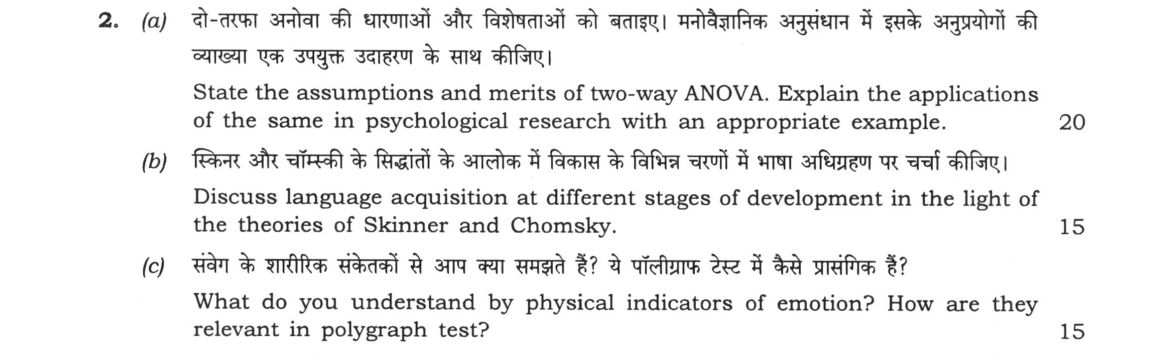
(a) State the assumptions and merits of two-way ANOVA. Explain the applications of the same in psychological research with an…
State the assumptions and merits of two-way ANOVA. Explain the applications of the same in psychological research with an appropriate example. 20 marks
Discuss language acquisition at different stages of development in the light of the theories of Skinner and Chomsky. 15 marks
What do you understand by physical indicators of emotion? How are they relevant in polygraph test? 15 marks
हिंदी में प्रश्न पढ़ें
दो-तरफा अनोवा की धारणाओं और विशेषताओं को बताइए। मनोवैज्ञानिक अनुसंधान में इसके अनुप्रयोगों की व्याख्या एक उपयुक्त उदाहरण के साथ कीजिए। (20 अंक)
स्किनर और चॉम्स्की के सिद्धांतों के आलोक में विकास के विभिन्न चरणों में भाषा अधिग्रहण पर चर्चा कीजिए। (15 अंक)
संवेग के शारीरिक संकेतकों से आप क्या समझते हैं? ये पॉलीग्राफ टेस्ट में कैसे प्रासंगिक हैं? (15 अंक)
Model answer
Written by UPSC Answer Check against this question's marking rubric, to the expected length. UPSC does not publish answers for Mains — this is one way to score well, not an official key.
Two-Way ANOVA: Assumptions, Merits, and Applications
Two-way Analysis of Variance (ANOVA) tests the effects of two categorical independent variables on a continuous dependent variable. Its valid application rests on the assumptions of normality of dependent variable distributions across all factor combinations, homogeneity of variances across cells (homoscedasticity, evaluated via Levene’s test), and independence of observations. The dependent measure must also be recorded on an interval or ratio scale.
The primary merit of two-way ANOVA is its ability to assess interaction effects—determining whether the effect of one independent variable depends on the level of the other—which one-way designs cannot capture. Additionally, it enhances statistical efficiency by testing two main effects and an interaction within a single sample, controls the family-wise Type I error rate that inflates during multiple t-tests, and reduces unexplained error variance, thereby elevating statistical power.
In psychological research, it is applied in factorial designs. For instance, an experimental psychologist may examine the effects of Teaching Method (Mnemonics vs. Rote Learning) and Anxiety Level (Low vs. High) on Verbal Memory Recall. The total variance in recall scores is mathematically partitioned into between-group variance (Main effect of Method, Main effect of Anxiety, and Method × Anxiety interaction) and within-group error variance. An identified interaction might reveal that Mnemonics substantially improves recall only under Low Anxiety conditions, providing granular insights into cognitive interventions.
Language Acquisition: Skinner versus Chomsky
Language development progresses through systematic stages: pre-linguistic babbling (around 6 months), the holophrastic or one-word stage (around 12 months), and the telegraphic or two-word stage (18–24 months), culminating in adult-like syntax.
B.F. Skinner conceptualized language as operant verbal behavior acquired through environmental mechanisms. In the babbling stage, random vocalizations are selectively reinforced by caregivers. During the holophrastic and telegraphic stages, language expands through imitation, parental modeling, and shaping via successive approximations, where grammatically correct utterances receive positive reinforcement (such as social praise or fulfilled requests).
Conversely, Noam Chomsky proposed a nativist paradigm, arguing that environmental conditioning cannot account for the rapid, uniform acquisition of complex syntax across cultures. Chomsky highlighted the "poverty of the stimulus," noting that children generate novel, rule-governed sentences they have never heard. Phenomena such as overregularization errors (e.g., saying "goed" or "mouses") demonstrate the active application of internal rules rather than imitation. Chomsky posits an innate Language Acquisition Device (LAD) containing Universal Grammar, operating optimally within a biologically determined Critical Period. While Skinner explains vocabulary acquisition and pragmatic usage, Chomsky's framework robustly accounts for the generative mastery of syntax.
Physical Indicators of Emotion and Polygraph Testing
Emotional arousal triggers the sympathetic branch of the Autonomic Nervous System (ANS), mobilizing the fight-or-flight response. Measurable physical indicators include electrodermal activity or Galvanic Skin Response (GSR, driven by eccrine sweat gland secretion), elevated blood pressure, increased heart rate, altered respiration patterns, and pupillary dilation.
In polygraphy, these physiological indices are monitored to infer deception. Protocols such as the Control Question Technique (CQT) and the Concealed Information Test (Guilty Knowledge Test) assume that deceptive individuals experience heightened fear of detection when confronted with relevant or critical items, producing distinct autonomic spikes relative to control questions.
However, physical indicators reflect general emotional and physiological arousal rather than deception uniquely; anxiety, guilt, or anger produce indistinguishable ANS profiles, leading to elevated false-positive rates. Suspects can also deploy physical or mental countermeasures. Consequently, the legal and psychological reliability of the polygraph remains constrained. In India, the Supreme Court ruled in Selvi v. State of Karnataka (2010) that involuntary polygraph testing violates Article 20(3) (self-incrimination) and Article 21 (privacy), permitting voluntary test outcomes strictly as corroborative evidence rather than substantive proof. Psychological inquiry thus necessitates integrating robust experimental controls, bio-cognitive frameworks, and empirical safeguards across research and applied assessments.
What "Explain" is asking you to do
Make the working of something clear — what sets it off, what follows from what, and what it produces. Explain is the Commission's mechanism word: it dominates the technical papers and the “explain why” stems, where the marks sit in the causal chain and not in the label.
Structure that answers it
State what it is → the initiating condition → the chain of cause, step by step → an instance where it plays out → what the chain produces
Where marks are lost
Describing what something looks like instead of why it works that way. Naming the stages without linking them reads as description too.
How this answer will be evaluated
Approach
Framework: UPSC Psychology Paper 1. (a) explain: definition/context > points in order > small example > short close | (b) discuss: intro > 3-4 dimensions > example > balanced close | (c) explain: definition/context > points in order > small example > short close Full marks: Precise definitions, named theories/studies, clear application to examples, balanced evaluation.
Key points expected
- List assumptions: normality, homogeneity of variance, independence
- State merits: efficiency, interaction effect detection
- Provide a specific psychological research example
- Explain the application of the test in that example
- Outline Skinner's behaviorist view (reinforcement)
- Outline Chomsky's nativist view (LAD/UG)
- Apply theories to specific developmental stages (e.g., babbling, syntax)
- Provide a balanced evaluation of both theories
Evaluation rubric
Each sub-part is marked on its own, against the marks and word limit printed on the paper.
- (a) Define 2-way ANOVA, list assumptions/merits, and apply to a psych research example. 20 marks
explain— definition/context → points in order → small example → short close
Must cover
- List assumptions: normality, homogeneity of variance, independence
- State merits: efficiency, interaction effect detection
- Provide a specific psychological research example
- Explain the application of the test in that example
Loses marks
- Confusing 1-way and 2-way ANOVA
- Listing assumptions without explaining their significance
Earns more
- Mention specific F-ratio calculation or ANOVA table
- Distinguish between main effects and interaction effects
Extra mark
- Include a labelled diagram of interaction effects
- Cite a specific named study using 2-way ANOVA
- (b) Compare Skinner and Chomsky on language acquisition across developmental stages. 15 marks
discuss— intro → 3-4 dimensions → example → balanced close
Must cover
- Outline Skinner's behaviorist view (reinforcement)
- Outline Chomsky's nativist view (LAD/UG)
- Apply theories to specific developmental stages (e.g., babbling, syntax)
- Provide a balanced evaluation of both theories
Loses marks
- Describing theories without linking to developmental stages
- Presenting only one theory without comparison
Earns more
- Mention Chomsky's critique of Skinner's 'Verbal Behavior'
- Reference specific linguistic milestones (e.g., telegraphic speech)
Extra mark
- Mention the 'poverty of the stimulus' argument
- Reference specific experiments (e.g., operant conditioning studies)
- (c) Define physical indicators of emotion and explain their role in polygraph testing. 15 marks
explain— definition/context → points in order → small example → short close
Must cover
- Define physical indicators (autonomic nervous system responses)
- List specific indicators: GSR, respiration, blood pressure
- Explain the mechanism of the polygraph test
- Link indicators to the detection of deception
Loses marks
- Confusing physical indicators with facial expressions
- Failing to explain the physiological basis of the test
Earns more
- Mention the 'arousal' hypothesis of deception
- Discuss the limitations of polygraph reliability
Extra mark
- Mention specific psychometric validity of polygraph
- Reference specific legal admissibility issues
Practice this exact question
Write your answer and it is marked point by point against the model answer above — what you covered, what you missed, what you got wrong.
Evaluate my answer →More from Psychology 2022 Paper I
- Q1 Answer the following questions in about 150 words each: (a) Describe the applications of…
- Q2 (a) State the assumptions and merits of two-way ANOVA. Explain the applications of the sa…
- Q3 (a) Is problem solving a psychological process? Illustrate your answer with the steps and…
- Q4 (a) Can human beings be fully functioning and self-actualized? Evaluate it from humanisti…
- Q5 Answer the following questions in about 150 words each: (a) Discuss the significance of s…