Paper I — Q3
(a) Is problem solving a psychological process? Illustrate your answer with the steps and methods involved in problem solving…
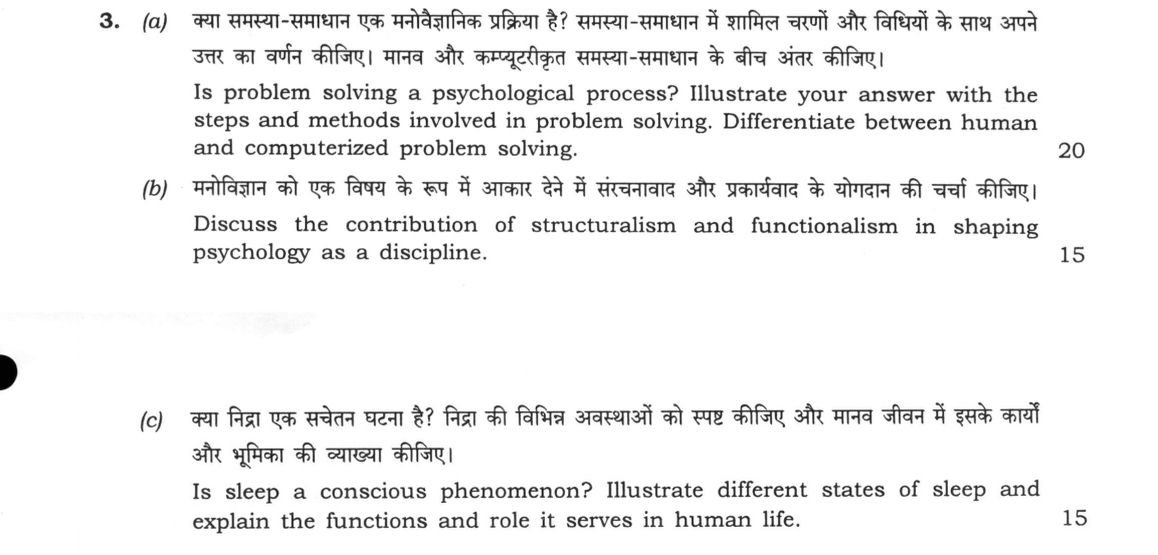
Is problem solving a psychological process? Illustrate your answer with the steps and methods involved in problem solving. Differentiate between human and computerized problem solving. 20 marks
Discuss the contribution of structuralism and functionalism in shaping psychology as a discipline. 15 marks
Is sleep a conscious phenomenon? Illustrate different states of sleep and explain the functions and role it serves in human life. 15 marks
हिंदी में प्रश्न पढ़ें
क्या समस्या-समाधान एक मनोवैज्ञानिक प्रक्रिया है? समस्या-समाधान में शामिल चरणों और विधियों के साथ अपने उत्तर का वर्णन कीजिए। मानव और कम्प्यूटरीकृत समस्या-समाधान के बीच अंतर कीजिए। (20 अंक)
मनोविज्ञान को एक विषय के रूप में आकार देने में संरचनावाद और प्रकार्यवाद के योगदान की चर्चा कीजिए। (15 अंक)
क्या निद्रा एक सचेतन घटना है? निद्रा की विभिन्न अवस्थाओं को स्पष्ट कीजिए और मानव जीवन में इसके कार्यों और भूमिका की व्याख्या कीजिए। (15 अंक)
Model answer
Written by UPSC Answer Check against this question's marking rubric, to the expected length. UPSC does not publish answers for Mains — this is one way to score well, not an official key.
Problem Solving as a Psychological Process
Problem solving is a higher-order cognitive process directed toward achieving a goal when the solution is not immediately apparent. It requires mental representations of the initial state, goal state, and intermediate operators. The process follows five systematic steps: problem identification (recognizing a failure in an automobile engine), mental representation (constructing a cognitive problem space), strategy selection (choosing an algorithm or heuristic), strategy execution, and evaluation (verifying whether the engine runs). Core psychological methods include means-ends analysis (breaking goals into subgoals, as seen in the Tower of Hanoi task), working backward (planning a train route from the final destination back to the source), and analogical reasoning (using Rutherford’s solar system model to comprehend atomic structure).
Human and computerized problem solving differ fundamentally. Computers employ algorithmic brute-force searches and serial matrix operations, executing millions of calculations per second (as demonstrated by IBM’s Deep Blue evaluating chess positions). In contrast, human problem solving relies on semantic understanding, cognitive heuristics, and Gestalt insight—a sudden restructuring of the perceptual field (exemplified by Wolfgang Köhler’s apes). While human cognition is susceptible to emotional interference, stress, and functional fixedness, it excels in ill-defined, ambiguous real-world contexts where computerized information-processing models fail due to their lack of common-sense knowledge, qualitative intuition, and embodied context.
Contributions of Structuralism and Functionalism
Structuralism, founded by Wilhelm Wundt and formalized by Edward Titchener, established psychology as an independent, laboratory-based science. Structuralism sought to decompose conscious experience into its basic elements—sensations, images, and affective states—using analytical introspection under controlled conditions. Although structuralism declined because introspection was subjective, unreplicable, and unable to investigate unconscious or animal processes, it gifted psychology its foundational experimental methodology, precise measurement standards, and institutional laboratory tradition.
In contrast, functionalism, pioneered by William James, John Dewey, and James Rowland Angell, rejected elementism to examine the adaptive utility of mental processes in line with Darwinian evolutionary theory. James conceptualized mind not as discrete structures, but as a continuous "stream of consciousness." Functionalism expanded psychological inquiry to include developmental, animal, and abnormal populations, and shifted the discipline's focus toward pragmatic utility. This directly gave birth to applied branches such as educational psychology (Dewey’s progressive learning), psychometrics, and industrial-organizational psychology, paving the way for behaviorism and cognitive science.
Sleep: Consciousness, States, and Functions
Sleep is not an absence of consciousness or passive neural cessation, but a dynamic, active, and reversible altered state of consciousness. Polysomnography reveals two distinct architectures across 90-minute ultradian cycles:
Non-Rapid Eye Movement (NREM) Sleep encompasses three stages: Stage N1 (transitional light sleep marked by alpha-to-theta wave shifts and hypnagogic imagery); Stage N2 (true sleep marked by sleep spindles and K-complexes on electroencephalograms, serving sensory gating); and Stage N3 (Slow-Wave Sleep, dominated by high-voltage, low-frequency delta waves, during which tissue repair, metabolic clearance, and growth hormone release occur).
Rapid Eye Movement (REM) Sleep, termed paradoxical sleep, exhibits desynchronized, low-amplitude beta-like EEG patterns identical to wakefulness, accompanied by rapid eye movements, autonomic arousal, muscle atonia, and vivid narrative dreaming.
Sleep serves critical adaptive functions: the restorative theory emphasizes cellular repair and glymphatic clearance of neurotoxic metabolic waste; the synaptic homeostasis hypothesis posits that Slow-Wave Sleep downscales overall synaptic strength to preserve neural energy and consolidate declarative memories, while REM consolidates procedural learning; emotional regulation models show sleep restores functional connectivity between the prefrontal cortex and amygdala; and evolutionary theory highlights energy conservation. Neuropsychological research at institutions like the National Institute of Mental Health and Neurosciences (NIMHANS) demonstrates that chronic sleep deprivation causes acute breakdowns in executive control, sustained vigilance, and working memory capacity.
Psychology's trajectory—from structuralist decomposition of conscious states to functionalist analysis of adaptive behavior—unifies in contemporary cognitive neuroscience, which demonstrates that higher-order problem-solving capacities fundamentally depend on the biological homeostasis, memory consolidation, and neural restructuring provided during sleep.
What "Illustrate" is asking you to do
Carry the point with concrete cases rather than assert it, so the examples do the work of proving it. In the technical papers illustrate is often literal — a labelled diagram, a map, a graph — and an answer without the figure has not complied with the instruction.
Structure that answers it
The point stated → example 1 with the feature it demonstrates → example 2 → example 3 or the required diagram → what the set of examples establishes
Where marks are lost
Examples named and then abandoned. A case listed without the sentence showing what it demonstrates is marked as recall of information, not as illustration.
How this answer will be evaluated
Approach
Framework: UPSC Psychology Paper 1. (a) discuss: intro > 3-4 dimensions > example > balanced close | (b) discuss: intro > 3-4 dimensions > example > balanced close | (c) explain: definition/context > points in order > small example > short close Full marks: Precise definitions, clear differentiation of schools/states, and strong evidence-based reasoning.
Key points expected
- Define problem solving as a psychological process
- List steps: definition, representation, search, evaluation
- Differentiate human vs computerized problem solving
- Mention methods: trial-and-error, heuristics, algorithms
- Identify Wundt/Titchener (Structuralism) and James/Dewey (Functionalism)
- Explain Structuralism's focus on elements of consciousness
- Explain Functionalism's focus on adaptation and utility
- State how these shaped psychology as a distinct discipline
Evaluation rubric
Each sub-part is marked on its own, against the marks and word limit printed on the paper.
- (a) Define problem solving, detail steps/methods, and compare human vs computerized approaches. 20 marks
discuss— intro → 3-4 dimensions → example → balanced close
Must cover
- Define problem solving as a psychological process
- List steps: definition, representation, search, evaluation
- Differentiate human vs computerized problem solving
- Mention methods: trial-and-error, heuristics, algorithms
Loses marks
- Confusing problem solving with general intelligence
- Ignoring the 'computerized' comparison aspect
- Vague description of steps without specific terms
Earns more
- Reference to Newell & Simon's GPS
- Mention of functional fixedness or mental set
- Comparison of serial vs parallel processing
- Reference to Polya's problem solving steps
Extra mark
- Diagram of problem space
- Reference to specific AI models (e.g., Turing)
- (b) Evaluate the specific contributions of structuralism and functionalism to the discipline. 15 marks
discuss— intro → 3-4 dimensions → example → balanced close
Must cover
- Identify Wundt/Titchener (Structuralism) and James/Dewey (Functionalism)
- Explain Structuralism's focus on elements of consciousness
- Explain Functionalism's focus on adaptation and utility
- State how these shaped psychology as a distinct discipline
Loses marks
- Confusing structuralism with behaviorism
- Failing to link contributions to the 'shaping of the discipline'
- Lack of specific names associated with the schools
Earns more
- Mention of Introspection vs. Stream of Consciousness
- Reference to the Chicago School
- Mention of the shift from 'what' to 'why' of behavior
Extra mark
- Reference to specific journals (e.g., Psychological Review)
- Mention of specific experiments (e.g., Titchener's lab)
- (c) Address the consciousness of sleep, detail sleep states, and explain biological functions. 15 marks
explain— definition/context → points in order → small example → short close
Must cover
- Address if sleep is a conscious phenomenon (state of reduced consciousness)
- Illustrate different states: NREM (Stages 1-4) and REM
- Explain functions: restoration, memory consolidation, growth
- Mention role in human life (health, cognition)
Loses marks
- Treating sleep as a purely passive state without function
- Failing to distinguish NREM and REM
- Ignoring the 'conscious phenomenon' aspect of the question
Earns more
- Mention of EEG patterns (Delta, Theta, Spindles)
- Reference to circadian rhythm
- Mention of specific theories (Restorative vs. Evolutionary)
Extra mark
- Diagram of sleep cycle architecture
- Reference to specific sleep disorders (e.g., Narcolepsy)
Practice this exact question
Write your answer and it is marked point by point against the model answer above — what you covered, what you missed, what you got wrong.
Evaluate my answer →More from Psychology 2022 Paper I
- Q1 Answer the following questions in about 150 words each: (a) Describe the applications of…
- Q2 (a) State the assumptions and merits of two-way ANOVA. Explain the applications of the sa…
- Q3 (a) Is problem solving a psychological process? Illustrate your answer with the steps and…
- Q4 (a) Can human beings be fully functioning and self-actualized? Evaluate it from humanisti…
- Q5 Answer the following questions in about 150 words each: (a) Discuss the significance of s…
- Q6 (a) Explain the nature of human attitudes. How is the knowledge of attitude change proces…