Paper I — Q7
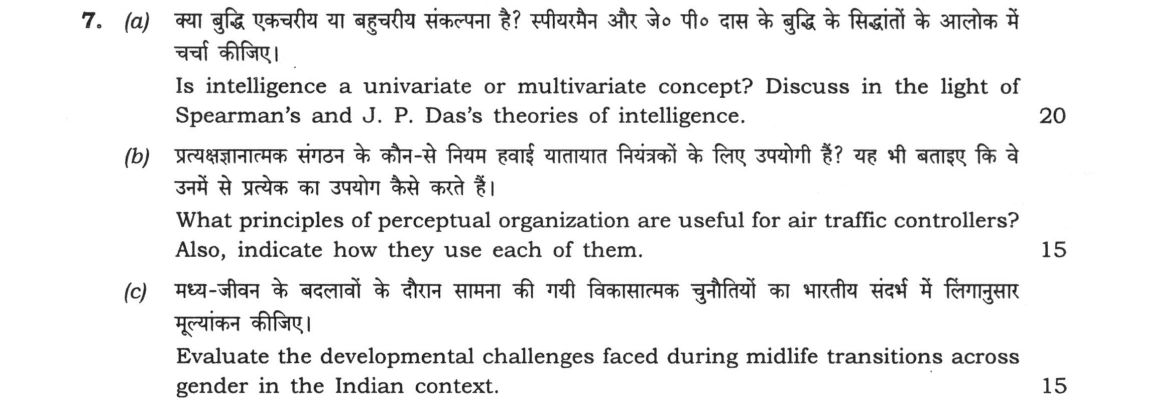
(a) Is intelligence a univariate or multivariate concept? Discuss in the light of Spearman's and J. P. Das's theories of…
Is intelligence a univariate or multivariate concept? Discuss in the light of Spearman's and J. P. Das's theories of intelligence. 20 marks
What principles of perceptual organization are useful for air traffic controllers? Also, indicate how they use each of them. 15 marks
Evaluate the developmental challenges faced during midlife transitions across gender in the Indian context. 15 marks
हिंदी में प्रश्न पढ़ें
क्या बुद्धि एकवरिय या बहुवरिय संकल्पना है? स्पीयरमैन और जे पी० दास के बुद्धि के सिद्धांतों के आलोक में चर्चा कीजिए। (20 अंक)
प्रत्यक्षज्ञानात्मक संगठन के कौन-से नियम हवाई यातायात नियंत्रकों के लिए उपयोगी हैं? यह भी बताइए कि वे उनमें से प्रत्येक का उपयोग कैसे करते हैं। (15 अंक)
मध्य-जीवन के बदलावों के दौरान सामना की गयी विकासात्मक चुनौतियों का भारतीय संदर्भ में लिंगानुसार मूल्यांकन कीजिए। (15 अंक)
Model answer
Written by UPSC Answer Check against this question's marking rubric, to the expected length. UPSC does not publish answers for Mains — this is one way to score well, not an official key.
Intelligence is conceptualized either as a univariate construct—a unitary, general capacity (g)—or as a multivariate phenomenon comprising distinct, interdependent cognitive and neurobiological processes.
Intelligence: Spearman’s Univariate vs. J. P. Das’s Multivariate Paradigm
Charles Spearman (1904) proposed the Two-Factor Theory using factor analysis of mental tests. He posited a general factor (g), representing universal mental energy shared across all intellectual tasks, alongside specific factors (s) unique to particular capabilities. Because variance across diverse cognitive tests is predominantly accounted for by g, Spearman’s approach fundamentally treats intelligence as a univariate core with task-specific peripheral manifestations. However, this classical psychometric approach overemphasizes g at the expense of distinct information-processing mechanisms and assumes cultural universality based primarily on Western academic tasks.
In contrast, J. P. Das, along with Jack Naglieri and John Kirby (1994), formulated the PASS Theory of Intelligence, a genuinely multivariate, neurocognitive framework grounded in A. R. Luria’s neuropsychological model. The model conceptualizes intelligence through four distinct yet interactive processes across three functional brain units:
- Planning (Unit III, prefrontal cortex): Goal setting, strategy selection, self-monitoring, and impulse control.
- Attention-Arousal (Unit I, reticular formation and brainstem): Maintaining optimal cortical arousal and selective focus while inhibiting distractions.
- Simultaneous Processing (Unit II, occipito-parietal cortex): Integrating separate stimuli into unified spatial or conceptual wholes (e.g., Raven’s matrices, reading maps).
- Successive Processing (Unit II, fronto-temporal regions): Organizing stimuli into linear, sequential, and temporal orders (e.g., serial recall, syntax).
Operationalized through the Cognitive Assessment System (CAS), the PASS model was standardized and validated on cross-cultural and Indian samples, demonstrating that intelligence is multidimensional, dynamic, and process-oriented rather than a static univariate score. While Spearman’s model offers computational simplicity, it lacks diagnostic specificity; conversely, Das’s multivariate paradigm offers rich remedial applications for learning disabilities, though administering the CAS presents greater logistical complexity.
Perceptual Organization in Air Traffic Control
Air Traffic Controllers (ATCs) operate in high-stakes environments where Gestalt principles of perceptual organization and depth cues are essential for decoding dynamic visual data on radar screens and runway monitors:
Figure-Ground Segregation allows ATCs to instantly distinguish critical targets (aircraft blips and transponder callouts) as the primary "figure" against the background "ground" of map grids, weather clutter, and sector boundaries.
The Principle of Proximity groups spatially adjacent blips, enabling controllers to instantly detect loss of minimum horizontal separation and identify congested flight corridors.
The Principle of Similarity aids visual parsing by utilizing standardized screen symbology, such that aircraft sharing flight levels, commercial classifications, or emergency states are coded with identical colors or geometric shapes.
The Principle of Good Continuation and Direction allows controllers to project linear velocity vectors of intersecting aircraft trajectories, predicting potential collisions well before paths cross.
The Principle of Closure enables ATCs to mentally complete flight paths when radar blips experience momentary signal latency or pass through radar shadow zones.
Depth and Motion Cues, such as relative size, synthetic 3D perspective, and motion parallax on advanced synthetic displays, assist in differentiating vertical altitude assignments. However, under high cognitive load, fatigue, or spatial disorientation, top-down perceptual biases can cause perceptual narrowing, impairing these automated Gestalt interpretations.
Midlife Transitions Across Gender in the Indian Context
Midlife transition (ages 40–60), framed by Erik Erikson as the struggle between Generativity and Stagnation, involves profound biological, psychological, and social recalibrations. In India, this transition is mediated by changing kinship structures, filial expectations, and shifting gender roles, as highlighted in studies by Sudhir Kakar and T. S. Saraswathi.
For Indian men, midlife typically brings career plateaus, heightened economic pressure as primary providers funding children’s higher education or marriages, and the onset of somatic decline. Men often encounter stagnation when corporate or administrative ceilings conflict with societal benchmarks of success.
For Indian women, midlife entails biological markers like menopause alongside psychosocial stressors such as empty-nest syndrome as adult children migrate. Concurrently, women bear the brunt of the "sandwich generation" crisis, managing intensive caregiving burdens for aging parents-in-law while supporting adolescent children. Conversely, in traditional joint households, midlife often elevates a woman’s domestic authority (e.g., transition to the mother-in-law role), providing a cultural buffer against the loss of identity often observed in Western nuclear contexts.
Sociocultural transformations, particularly rapid urbanization and the breakdown of joint families, increasingly leave midlife adults without traditional filial safety nets. While midlife has biological components, its experience in India demonstrates that psychological distress and generativity are heavily shaped by familial systems, caregiving norms, and evolving socioeconomic realities.
Understanding human functioning thus necessitates integrating univariate and multivariate cognitive models, rigorous perceptual mechanisms under operational pressure, and culturally grounded lifespan developmental trajectories.
What "Discuss" is asking you to do
Lay the issue out from more than one side — how it arose, what is claimed for it, what is held against it, and where it now stands. UPSC attaches discuss to broad topics with several live dimensions, so coverage of the dimensions earns more than the strength of your opinion.
Structure that answers it
Set the issue up → the case as it is made → the case against → the dimension both sides leave out → where the balance now lies
Where marks are lost
Listing facts with no thread between them, or arguing one side throughout and calling it a discussion.
How this answer will be evaluated
Approach
Framework: UPSC Psychology Paper 1. (a) discuss: intro > 3-4 dimensions > example > balanced close | (b) explain: definition/context > points in order > small example > short close | (c) evaluate: criteria > evidence > balanced judgment Full marks: Comprehensive, well-structured, specific examples, strong analysis.
Key points expected
- Define univariate (g-factor) and multivariate (multiple factors) concepts.
- Explain Spearman's two-factor theory (g and s factors).
- Explain J.P. Das's theory of intelligence (e.g., information processing).
- Compare the two theories to resolve the univariate/multivariate debate.
- Name specific principles (e.g., proximity, similarity, closure).
- Explain how each principle aids in organizing radar displays.
- Link principles to specific tasks (e.g., tracking, separation).
- Provide a clear example of application for each principle.
Evaluation rubric
Each sub-part is marked on its own, against the marks and word limit printed on the paper.
- (a) Compare univariate vs multivariate intelligence using Spearman and J.P. Das. 20 marks
discuss— intro → 3-4 dimensions → example → balanced close
Must cover
- Define univariate (g-factor) and multivariate (multiple factors) concepts.
- Explain Spearman's two-factor theory (g and s factors).
- Explain J.P. Das's theory of intelligence (e.g., information processing).
- Compare the two theories to resolve the univariate/multivariate debate.
Loses marks
- Confusing Spearman's g with general ability without definition.
- Describing theories without linking them to the univariate/multivariate question.
- Lack of comparison between the two specific theorists.
Earns more
- Mention specific factors in Das's model (e.g., attention, memory).
- Reference specific psychometric evidence or studies.
- Provide a balanced conclusion on the nature of intelligence.
Extra mark
- Name a specific psychometric tool (e.g., WAIS, Raven's).
- Include a diagram of the factor structure.
- (b) Identify perceptual organization principles and their application in air traffic control. 15 marks
explain— definition/context → points in order → small example → short close
Must cover
- Name specific principles (e.g., proximity, similarity, closure).
- Explain how each principle aids in organizing radar displays.
- Link principles to specific tasks (e.g., tracking, separation).
- Provide a clear example of application for each principle.
Loses marks
- Listing principles without explaining their specific use in ATC.
- Vague application (e.g., 'helps them see better').
- Confusing perceptual principles with general cognitive processes.
Earns more
- Mention Gestalt principles by name.
- Discuss the role of pattern recognition in ATC.
- Reference specific ATC challenges (e.g., high traffic density).
Extra mark
- Include a diagram of a radar display with principles labelled.
- Mention specific ATC software or interface features.
- (c) Assess midlife developmental challenges for men and women in India. 15 marks
evaluate— criteria → evidence → balanced judgment
Must cover
- Define midlife transitions (e.g., 40-60 years).
- Identify specific challenges for men in the Indian context.
- Identify specific challenges for women in the Indian context.
- Compare and contrast the gender-specific challenges.
Loses marks
- Generalizing without specific Indian context.
- Treating men and women identically without gender analysis.
- Lack of evaluation (just listing challenges without assessment).
Earns more
- Mention specific Indian cultural factors (e.g., joint family, career).
- Reference specific developmental theories (e.g., Erikson).
- Discuss health-related challenges (e.g., menopause, andropause).
Extra mark
- Cite specific Indian studies or data on midlife issues.
- Mention specific support systems or interventions.
Practice this exact question
Write your answer and it is marked point by point against the model answer above — what you covered, what you missed, what you got wrong.
Evaluate my answer →More from Psychology 2022 Paper I
- Q4 (a) Can human beings be fully functioning and self-actualized? Evaluate it from humanisti…
- Q5 Answer the following questions in about 150 words each: (a) Discuss the significance of s…
- Q6 (a) Explain the nature of human attitudes. How is the knowledge of attitude change proces…
- Q7 (a) Is intelligence a univariate or multivariate concept? Discuss in the light of Spearma…
- Q8 (a) "Learning occurs not only through conditioning but also from our observations of othe…