Paper I — Q4
(a) Can human beings be fully functioning and self-actualized? Evaluate it from humanistic and psychoanalytic perspectives of…
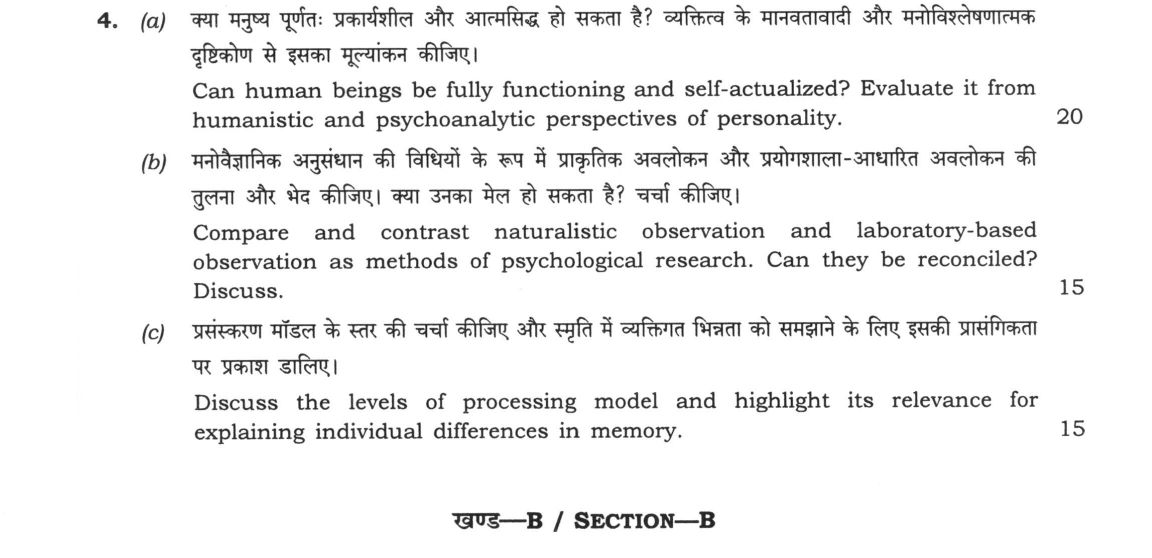
Can human beings be fully functioning and self-actualized? Evaluate it from humanistic and psychoanalytic perspectives of personality. 20 marks
Compare and contrast naturalistic observation and laboratory-based observation as methods of psychological research. Can they be reconciled? Discuss. 15 marks
Discuss the levels of processing model and highlight its relevance for explaining individual differences in memory. 15 marks
हिंदी में प्रश्न पढ़ें
क्या मनुष्य पूर्णतः प्रकार्यशील और आत्मसिद्ध हो सकता है? व्यक्तित्व के मानवतावादी और मनोविश्लेषणात्मक दृष्टिकोण से इसका मूल्यांकन कीजिए। (20 अंक)
मनोवैज्ञानिक अनुसंधान की विधियों के रूप में प्राकृतिक अवलोकन और प्रयोगशाला-आधारित अवलोकन की तुलना और भेद कीजिए। क्या उनका मेल हो सकता है? चर्चा कीजिए। (15 अंक)
प्रसंस्करण मॉडल के स्तर की चर्चा कीजिए और स्मृति में व्यक्तिगत भिन्नता को समझाने के लिए इसकी प्रासंगिकता पर प्रकाश डालिए। (15 अंक)
Model answer
Written by UPSC Answer Check against this question's marking rubric, to the expected length. UPSC does not publish answers for Mains — this is one way to score well, not an official key.
The debate over whether human beings can achieve self-actualization and become fully functioning divides the major paradigms of personality, reflecting fundamentally divergent views of human nature.
Humanistic versus Psychoanalytic Perspectives
Carl Rogers conceptualized the "fully functioning person" as an individual displaying high congruence between the phenomenal self and the ideal self. Such individuals exhibit openness to experience, existential living (living fully in the moment), organismic trusting, and creative freedom. Similarly, Abraham Maslow posited self-actualization at the pinnacle of his hierarchy of prepotent needs, characterized by the pursuit of Being-values (B-values such as truth, beauty, and justice), autonomy, and the frequent occurrence of peak experiences. Humanism maintains that actualization is an innate teleological drive that flourishes under conditions of unconditional positive regard.
Conversely, Sigmund Freud’s classical psychoanalysis presents a deterministic critique, arguing that absolute self-actualization is impossible. Freud framed personality as a perpetual psychic battlefield among the id, ego, and superego. Because civilizational living demands the chronic repression of primal sexual and aggressive instincts (Eros and Thanatos), a baseline of neurosis and defensive compromise is inevitable. Erik Erikson modified this pessimism through his psychosocial theory, positing that personality develops across eight epigenetic stages. For Erikson, healthy functioning is not an absolute end-state but a relative, dynamic balance achieved by resolving stage-specific crises (e.g., generativity versus stagnation).
Evaluation: While humanism provides a normative, growth-oriented ideal, psychoanalysis offers a realistic framework rooted in biological and social constraints. Human beings cannot attain a permanent, conflict-free state of actualization; rather, full functioning represents a continuous, lifelong effort to integrate unconscious conflicts while pursuing personal growth.
Naturalistic versus Laboratory Observation and Reconciliation
Naturalistic observation investigates spontaneous behavior in real-world ecologies, offering high ecological validity and minimizing demand characteristics. However, it lacks experimental control, cannot establish causal relationships, and is vulnerable to observer bias and ethical constraints regarding informed consent. Laboratory observation, by contrast, maximizes control over extraneous variables, ensures standardized measurement, and allows high replicability, but suffers from artificiality, low mundane realism, and participant reactivity (Hawthorne effect).
These methods can be reconciled through methodological triangulation, quasi-experimental designs, and field experiments that introduce controlled interventions into natural contexts. In Indian psychological research, Sudhir Kakar successfully reconciled clinical observational depth with naturalistic field studies to analyze healing traditions, while T.S. Saraswathi combined naturalistic observation of child development with structured assessments to capture socialization processes across diverse cultural contexts.
Levels of Processing and Individual Differences in Memory
Fergus Craik and Robert Lockhart’s Levels of Processing (LoP) framework rejects structural multi-store models, proposing that memory durability is a direct function of the depth of cognitive analysis. Processing progresses from shallow structural encoding (physical characteristics) and intermediate phonemic encoding (sound patterns) to deep semantic encoding (meaning and conceptual relations). Craik and Tulving (1975) empirically verified that semantic processing produces significantly higher recognition and recall performance.
The LoP model explains individual differences in memory through variations in processing strategies:
- Elaboration: Individuals who construct rich associative networks around new information encode deeper traces.
- Distinctiveness: The capacity to highlight unique features of a stimulus minimizes retroactive and proactive interference.
- Self-Reference Effect: Rogers and colleagues demonstrated that information processed in relation to one’s self-concept achieves the deepest level of encoding.
In applied contexts, particularly within the Indian education system, the model explains why learners relying on rote rehearsal (ratta) struggle with conceptual transfer, whereas those employing semantic elaboration and self-referential schemas achieve superior long-term retention and higher-order problem-solving.
Ultimately, personality, research methodology, and cognitive functioning are interdependent: understanding human potential requires both the rigorous methodological triangulation of observation and the cognitive mechanisms that govern how individuals process and internalize their experiences.
What "Evaluate" is asking you to do
Judge how well something has performed against the standard it set for itself — its stated aim, mandate or promise — and commit to a verdict. Name the yardstick before you judge; an unanchored judgement reads as opinion.
Structure that answers it
Name the yardstick — stated aim, mandate or benchmark → performance against it → shortfall against it → why the gap exists → verdict
Where marks are lost
Presenting both sides and then declining to decide, or delivering a verdict against a standard you never stated, which makes it look arbitrary.
How this answer will be evaluated
Approach
Framework: Psychology Paper 1 (UPSC). (a) evaluate: criteria > evidence > balanced judgment | (b) compare: paired headings or table > key differences > significance > conclusion | (c) discuss: intro > 3-4 dimensions > example > balanced close Full marks: Comprehensive, well-structured, with specific examples and balanced judgment.
Key points expected
- Define Maslow's hierarchy and self-actualization
- Explain Freud's structural model (Id, Ego, Superego)
- Contrast Humanistic optimism vs Psychoanalytic determinism
- Provide balanced judgment on the feasibility of full functioning
- Define naturalistic observation (field setting)
- Define laboratory-based observation (controlled setting)
- Compare validity (ecological vs internal)
- Discuss the possibility of reconciling the two methods
Evaluation rubric
Each sub-part is marked on its own, against the marks and word limit printed on the paper.
- (a) Assess the possibility of self-actualization by contrasting Humanistic and Psychoanalytic views. 20 marks
evaluate— criteria → evidence → balanced judgment
Must cover
- Define Maslow's hierarchy and self-actualization
- Explain Freud's structural model (Id, Ego, Superego)
- Contrast Humanistic optimism vs Psychoanalytic determinism
- Provide balanced judgment on the feasibility of full functioning
Loses marks
- Treating the two perspectives as identical
- Defining self-actualization without theoretical context
- Lack of comparative analysis
Earns more
- Mention Rogers' 'fully functioning person'
- Reference specific defense mechanisms
- Cite specific theorists (e.g., Maslow, Freud, Rogers)
Extra mark
- Reference specific studies (e.g., Maslow's research on peak experiences)
- (b) Contrast naturalistic and laboratory observation methods and discuss their reconciliation. 15 marks
compare— paired headings or table → key differences → significance → conclusion
Must cover
- Define naturalistic observation (field setting)
- Define laboratory-based observation (controlled setting)
- Compare validity (ecological vs internal)
- Discuss the possibility of reconciling the two methods
Loses marks
- Confusing observation with survey methods
- Ignoring the 'reconciliation' aspect of the question
- Vague definitions of the two methods
Earns more
- Mention specific examples of each method
- Discuss ethical considerations in both
- Reference specific researchers (e.g., Bandura, Watson)
Extra mark
- Reference specific studies (e.g., Bandura's Bobo doll, Watson's Little Albert)
- (c) Explain the Levels of Processing model and its application to individual memory differences. 15 marks
discuss— intro → 3-4 dimensions → example → balanced close
Must cover
- Define Craik and Lockhart's Levels of Processing model
- Distinguish shallow (structural) vs deep (semantic) processing
- Explain how processing depth affects memory retention
- Apply the model to explain individual differences in memory
Loses marks
- Confusing levels of processing with stages of memory
- Failing to link the model to individual differences
- Lack of specific examples of processing types
Earns more
- Mention specific examples of shallow vs deep processing
- Reference specific studies (e.g., Craik & Lockhart 1972)
- Discuss the role of attention in processing
Extra mark
- Reference specific studies (e.g., Craik & Lockhart 1972)
Practice this exact question
Write your answer and it is marked point by point against the model answer above — what you covered, what you missed, what you got wrong.
Evaluate my answer →More from Psychology 2022 Paper I
- Q1 Answer the following questions in about 150 words each: (a) Describe the applications of…
- Q2 (a) State the assumptions and merits of two-way ANOVA. Explain the applications of the sa…
- Q3 (a) Is problem solving a psychological process? Illustrate your answer with the steps and…
- Q4 (a) Can human beings be fully functioning and self-actualized? Evaluate it from humanisti…
- Q5 Answer the following questions in about 150 words each: (a) Discuss the significance of s…
- Q6 (a) Explain the nature of human attitudes. How is the knowledge of attitude change proces…
- Q7 (a) Is intelligence a univariate or multivariate concept? Discuss in the light of Spearma…