Paper I — Q5
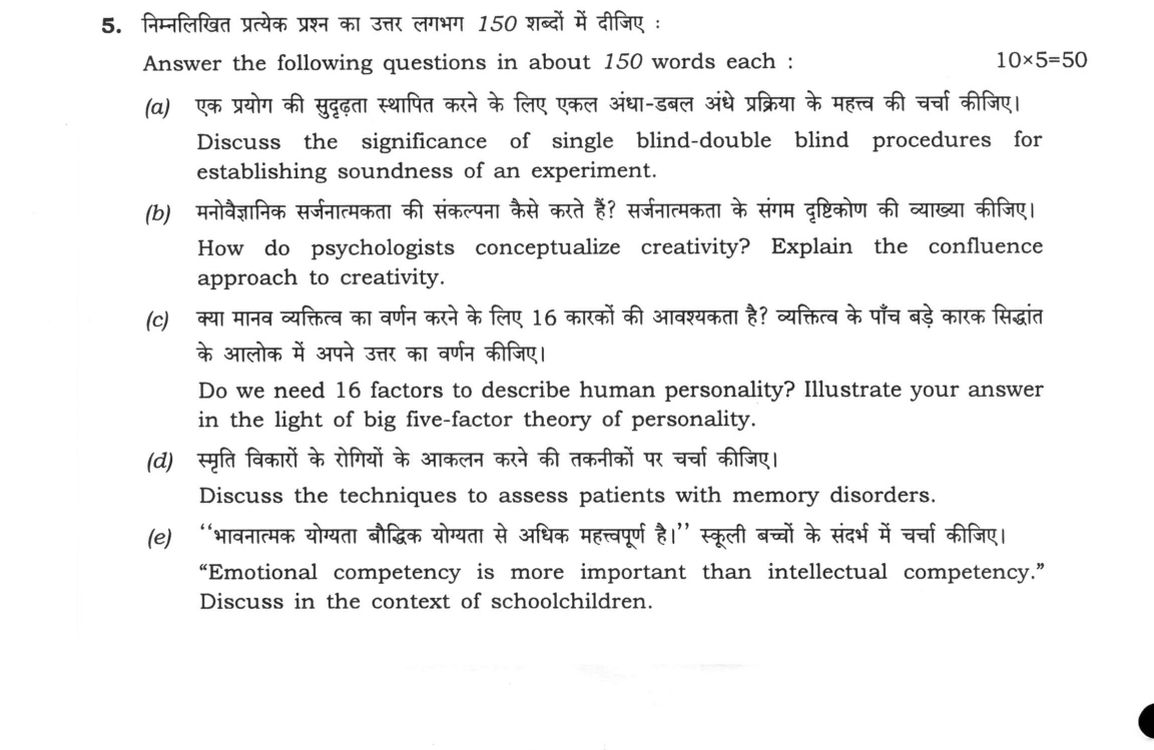
Answer the following questions in about 150 words each: (a) Discuss the significance of single blind-double blind procedures for…
Answer the following questions in about 150 words each:
Discuss the significance of single blind-double blind procedures for establishing soundness of an experiment. 10 marks
How do psychologists conceptualize creativity? Explain the confluence approach to creativity. 10 marks
Do we need 16 factors to describe human personality? Illustrate your answer in the light of big five-factor theory of personality. 10 marks
Discuss the techniques to assess patients with memory disorders. 10 marks
"Emotional competency is more important than intellectual competency." Discuss in the context of schoolchildren. 10 marks
हिंदी में प्रश्न पढ़ें
निम्नलिखित प्रत्येक प्रश्न का उत्तर लगभग 150 शब्दों में दीजिए :
एक प्रयोग की सुदृढ़ता स्थापित करने के लिए एकल अंधा-द्वैत अंधे प्रक्रिया के महत्व की चर्चा कीजिए। (10 अंक)
मनोवैज्ञानिक सर्जनात्मकता की संकल्पना कैसे करते हैं? सर्जनात्मकता के संगम दृष्टिकोण की व्याख्या कीजिए। (10 अंक)
क्या मानव व्यक्तित्व का वर्णन करने के लिए 16 कारकों की आवश्यकता है? व्यक्तित्व के पाँच बड़े कारक सिद्धांत के आलोक में अपने उत्तर का वर्णन कीजिए। (10 अंक)
स्मृति विकारों के रोगियों के आकलन करने की तकनीकों पर चर्चा कीजिए। (10 अंक)
"भावनात्मक योग्यता बौद्धिक योग्यता से अधिक महत्वपूर्ण है।" स्कूली बच्चों के संदर्भ में चर्चा कीजिए। (10 अंक)
Model answer
Written by UPSC Answer Check against this question's marking rubric, to the 150-word length. UPSC does not publish answers for Mains — this is one way to score well, not an official key.
(a) Significance of Single-Blind and Double-Blind Procedures
Experimental soundness relies on establishing internal validity by eliminating extraneous variables and systematic biases. In a single-blind procedure, participants are kept unaware of whether they belong to the experimental or control group. This design effectively controls for demand characteristics, subject expectancy effects, and evaluation apprehension, ensuring that behavioural changes stem purely from the independent variable rather than the psychological awareness of receiving a treatment, such as a placebo effect.
However, single-blind studies remain vulnerable to experimenter expectancy effects (Rosenthal effect), where researchers unintentionally influence participant responses through non-verbal cues or biased recording. The double-blind procedure resolves this by ensuring that neither the participants nor the experimenters interacting with them know the group assignments. Widely regarded as the gold standard in psychopharmacological and clinical research, double-blind trials isolate true therapeutic efficacy from both experimenter bias and placebo reactivity, thereby securing internal validity and replicability.
(b) Conceptualization and Confluence Approach to Creativity
Psychologists conceptualize creativity as the capacity to produce ideas, insights, or products that are both novel (original, unexpected) and appropriate (useful, adaptive, task-relevant). Historical research approached creativity from distinct focal points: the creative person (traits like openness and tolerance for ambiguity), the creative process (Wallas’s stages of preparation, incubation, illumination, and verification), and the creative product (measurable outcomes).
To integrate these disparate views, Sternberg and Lubart proposed the Confluence (or Investment) Model of creativity. This approach asserts that creativity requires a convergence of multiple distinct yet interacting resources: intellectual abilities (synthetic, analytical, and practical skills), domain-relevant knowledge, creative thinking styles (a preference for thinking in novel ways), personality attributes (self-efficacy, willingness to take sensible risks), intrinsic task motivation, and a supportive environmental context. Creativity is not a single trait but an emergent property that arises when these cognitive, personal, and contextual components intersect.
(c) Personality Structure: 16PF versus the Big Five Factors
Raymond Cattell utilized factor analysis on lexical descriptors to identify 16 primary source traits (16PF), arguing that human personality requires this degree of granularity to predict specific behavioural outcomes. However, contemporary trait psychology favours the principle of parsimony. Extensive cross-cultural research demonstrates that Cattell’s 16 factors exhibit significant inter-correlations, allowing them to be condensed into the robust Big Five framework developed by Costa and McCrae: Openness to Experience, Conscientiousness, Extraversion, Agreeableness, and Neuroticism (OCEAN).
While Cattell’s 16PF offers fine-grained clinical profiling, the Big Five captures the fundamental variance of human personality without redundant overlap. In the Indian context, the Big Five effectively maps both broad cultural shifts—such as higher Openness in urbanizing populations and distinct Collectivist-oriented Agreeableness in rural communities—and individual differences. Thus, while 16 factors provide descriptive detail, five higher-order domains suffice to establish a universal, robust structural architecture of personality.
(d) Techniques to Assess Patients with Memory Disorders
Clinical assessment of memory disorders requires differentiating between anterograde amnesia (inability to encode or consolidate new information) and retrograde amnesia (loss of pre-existing episodic memories), while determining whether deficits stem from encoding, storage, or retrieval failures.
Clinicians employ comprehensive neuropsychological batteries alongside targeted tools. The Wechsler Memory Scale (WMS-IV) assesses auditory, visual, visual working, immediate, and delayed memory indices. For specific verbal learning dynamics, the Rey Auditory Verbal Learning Test (RAVLT) evaluates proactive/retroactive interference, learning curves, and recognition versus free recall. To evaluate retrograde memory gradients (Ribot's law), the Autobiographical Memory Interview (AMI) examines personal episodic events across distinct life periods. Finally, ecological validity is evaluated using tools like the Rivermead Behavioural Memory Test (RBMT) and everyday memory questionnaires, which capture real-world functional impairments in prospective and spatial memory tasks.
(e) Emotional versus Intellectual Competency in Schoolchildren
Intellectual competency—encompassing cognitive abilities, logical reasoning, and academic mastery—has traditionally served as the primary benchmark of scholastic success. However, Daniel Goleman’s framework of Emotional Competency (comprising self-awareness, emotional regulation, empathy, and social skills) demonstrates that high intellectual aptitude alone does not guarantee adaptive functioning, psychological well-being, or long-term life success.
In school settings, emotional competency plays a foundational role. Children proficient in emotional regulation cope more effectively with academic stress, exhibit lower conduct problems, and build prosocial peer networks. In India, policy interventions such as the National Education Policy (NEP) 2020 and the Right to Education (RTE) framework increasingly institutionalize Social and Emotional Learning (SEL) alongside cognitive curricula. Ultimately, these competencies should not be viewed hierarchically; rather, emotional competency provides the self-regulatory and relational scaffold that enables intellectual potential to be actualized in a healthy, productive manner.
What "Discuss" is asking you to do
Lay the issue out from more than one side — how it arose, what is claimed for it, what is held against it, and where it now stands. UPSC attaches discuss to broad topics with several live dimensions, so coverage of the dimensions earns more than the strength of your opinion.
Structure that answers it
Set the issue up → the case as it is made → the case against → the dimension both sides leave out → where the balance now lies
Where marks are lost
Listing facts with no thread between them, or arguing one side throughout and calling it a discussion.
How this answer will be evaluated
Approach
Framework: null. (a) discuss: intro > 3-4 dimensions > example > balanced close | (b) explain: definition/context > points in order > small example > short close | (c) discuss: intro > 3-4 dimensions > example > balanced close | (d) discuss: intro > 3-4 dimensions > example > balanced close | (e) discuss: intro > 3-4 dimensions > example > balanced close Full marks: Precise definitions, named theories/tests, balanced argument, clear structure.
Key points expected
- Define single-blind and double-blind procedures
- Identify experimenter and participant bias
- Link blinding to internal validity
- Mention placebo effect control
- Define creativity (novelty + utility)
- Identify the 4 components of confluence
- Explain the interaction of components
- Mention the role of personality/motivation
Evaluation rubric
Each sub-part is marked on its own, against the marks and word limit printed on the paper.
- (a) Explain how blinding controls bias to ensure experimental validity. · 150 words
discuss— intro → 3-4 dimensions → example → balanced close
Must cover
- Define single-blind and double-blind procedures
- Identify experimenter and participant bias
- Link blinding to internal validity
- Mention placebo effect control
Loses marks
- Confusing blinding with randomization
- Ignoring the role of the experimenter
Earns more
- Reference to Hawthorne effect
- Example of drug trial design
- Mention of double-dummy technique
Extra mark
- Reference to specific landmark study (e.g., Salk vaccine)
- (b) Define creativity and detail the components of the confluence model. · 150 words
explain— definition/context → points in order → small example → short close
Must cover
- Define creativity (novelty + utility)
- Identify the 4 components of confluence
- Explain the interaction of components
- Mention the role of personality/motivation
Loses marks
- Treating creativity as a single trait
- Omitting the 'confluence' (interaction) aspect
Earns more
- Reference to Sternberg's model
- Distinction between divergent and convergent thinking
- Mention of domain-specific knowledge
Extra mark
- Reference to specific creativity test (e.g., Torrance)
- (c) Compare 16PF and Big Five to argue for the 5-factor model. · 150 words
discuss— intro → 3-4 dimensions → example → balanced close
Must cover
- Mention Cattell's 16PF theory
- List the Big Five (OCEAN) traits
- Explain factor analysis reduction
- Argue for the 5-factor model's validity
Loses marks
- Failing to name the Big Five traits
- Ignoring the statistical basis (factor analysis)
Earns more
- Reference to lexical hypothesis
- Mention of cross-cultural validation
- Comparison of predictive validity
Extra mark
- Reference to specific study (e.g., Costa & McCrae)
- (d) List and describe psychometric tools for assessing memory disorders. · 150 words
discuss— intro → 3-4 dimensions → example → balanced close
Must cover
- Distinguish short-term vs long-term memory
- Name specific tests (e.g., Rey, WMS)
- Explain the procedure of one test
- Mention clinical significance of scores
Loses marks
- Listing only general IQ tests
- Failing to distinguish memory types
Earns more
- Reference to Wechsler Memory Scale (WMS)
- Mention of Rey Auditory Verbal Learning Test
- Distinction between amnesia and dementia
Extra mark
- Reference to specific neurological condition (e.g., H.M. case)
- (e) Evaluate the relative importance of EQ vs IQ in schoolchildren. · 150 words
discuss— intro → 3-4 dimensions → example → balanced close
Must cover
- Define emotional competency (EQ)
- Define intellectual competency (IQ)
- Provide arguments for EQ's importance
- Provide arguments for IQ's importance
Loses marks
- Taking an extreme view (EQ is everything)
- Ignoring the role of IQ in academic tasks
Earns more
- Reference to Goleman's work
- Mention of social skills and empathy
- Link to academic success vs social success
Extra mark
- Reference to specific study on EQ and school performance
Practice this exact question
Write your answer and it is marked point by point against the model answer above — what you covered, what you missed, what you got wrong.
Evaluate my answer →More from Psychology 2022 Paper I
- Q2 (a) State the assumptions and merits of two-way ANOVA. Explain the applications of the sa…
- Q3 (a) Is problem solving a psychological process? Illustrate your answer with the steps and…
- Q4 (a) Can human beings be fully functioning and self-actualized? Evaluate it from humanisti…
- Q5 Answer the following questions in about 150 words each: (a) Discuss the significance of s…
- Q6 (a) Explain the nature of human attitudes. How is the knowledge of attitude change proces…
- Q7 (a) Is intelligence a univariate or multivariate concept? Discuss in the light of Spearma…
- Q8 (a) "Learning occurs not only through conditioning but also from our observations of othe…