Paper I — Q8
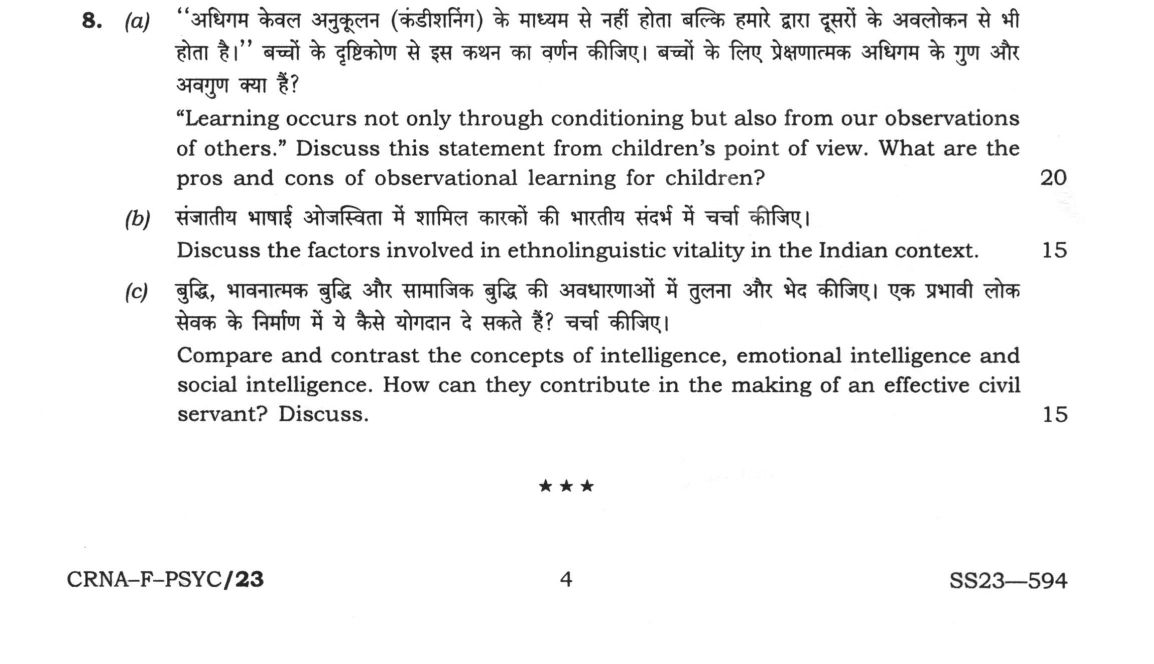
(a) "Learning occurs not only through conditioning but also from our observations of others." Discuss this statement from…
"Learning occurs not only through conditioning but also from our observations of others." Discuss this statement from children's point of view. What are the pros and cons of observational learning for children? 20 marks
Discuss the factors involved in ethnolinguistic vitality in the Indian context. 15 marks
Compare and contrast the concepts of intelligence, emotional intelligence and social intelligence. How can they contribute in the making of an effective civil servant? Discuss. 15 marks
हिंदी में प्रश्न पढ़ें
"अधिगम केवल अनुकूलन (कंडीशनिंग) के माध्यम से नहीं होता बल्कि हमारे द्वारा दूसरों के अवलोकन से भी होता है।" बच्चों के दृष्टिकोण से इस कथन का वर्णन कीजिए। बच्चों के लिए प्रेक्षणात्मक अधिगम के गुण और अवगुण क्या हैं? (20 अंक)
संजातीय भाषाई ओजस्विता में शामिल कारकों की भारतीय संदर्भ में चर्चा कीजिए। (15 अंक)
बुद्धि, भावनात्मक बुद्धि और सामाजिक बुद्धि की अवधारणाओं में तुलना और भेद कीजिए। एक प्रभावी लोक सेवक के निर्माण में ये कैसे योगदान दे सकते हैं? चर्चा कीजिए। (15 अंक)
Model answer
Written by UPSC Answer Check against this question's marking rubric, to the expected length. UPSC does not publish answers for Mains — this is one way to score well, not an official key.
Observational learning in children Learning is not limited to conditioning. Classical conditioning pairs a stimulus with a reflex, while operant conditioning shapes behaviour through reward and punishment; observational learning, in Bandura’s social learning theory, occurs when children watch models and internalise behaviour without direct reinforcement. The process has four links: attention to the model, retention of the observed act, motor reproduction, and motivation to imitate. For children, this is efficient because it transmits language, manners, safety habits and cultural norms faster than trial and error. It also supports moral and academic development when parents, teachers and media model cooperation, reading and discipline. This is why role models in schools and homes matter. The cons are equally serious. Children may imitate aggression, cruelty or violence from peers, family members or screens, and may absorb gender stereotyping when they see women confined to domestic roles or men as dominant. If the observed behaviour is rewarded, the child is more likely to reproduce it.
Ethnolinguistic vitality in India Ethnolinguistic vitality, as discussed by Giles and Johnson, refers to a language group’s ability to maintain its language as a symbol of identity and to transmit it to the next generation. In India, vitality depends on demographic factors such as population size, birth rates, geographic concentration and intermarriage; a large, dense community with high birth rates is more likely to sustain its language. Institutional support is decisive: official status, use in courts, administration, education and media. The Hindi-English tension illustrates competing institutional claims, while the Eighth Schedule and state language policies show how recognition can strengthen or weaken vitality. Status factors matter too: economic power, social prestige, urban mobility and access to employment. For example, a language with official status and media use gains prestige, while a small tribal language may lose speakers if children are not taught it at home or school. Tribal language revitalisation efforts, such as documentation, mother-tongue schooling and digital resources, can raise vitality, but migration and pressure to learn dominant languages can erode it.
Intelligences and civil service Intelligence, emotional intelligence and social intelligence are related but distinct. All are capacities to process information, adapt to situations and improve performance, and all can be developed through experience. They differ in object and basis: general intelligence, linked to Spearman’s g and IQ tests, concerns abstract reasoning, memory and problem solving; emotional intelligence, in Salovey-Mayer and Goleman’s terms, concerns self-awareness, self-regulation, empathy and motivation; social intelligence, from Thorndike and later Cantor and Kihlstrom, concerns social awareness, relationship management and reading group dynamics. General intelligence is more cognitive and individually measurable; EI is more intrapersonal and affective; SI is more interpersonal and contextual. Unlike general intelligence, EI and SI are not fully captured by IQ tests; unlike EI, SI is directed outward to others and groups. Thus, the three are complementary: cognition identifies options, EI manages self and others’ feelings, SI translates that into collective action.
For an effective civil servant, these intelligences work together. General intelligence supports policy analysis, budgeting and evidence-based decision making. EI helps in stress management during field postings, disaster response and high-pressure negotiations. SI enables community mobilisation, conflict resolution and trust building, as when IAS officers mediate communal tensions or coordinate relief with local leaders. A rational officer may design a sound policy, but without EI and SI it may fail in implementation.
Way forward Observational learning in childhood builds the cognitive, emotional and social foundations on which these intelligences later operate. In India’s ethnolinguistic context, an officer must understand language, identity and community power to govern fairly. The way forward is to strengthen child-friendly observational environments, protect linguistic vitality through balanced education and official support, and train civil servants to combine analytical, emotional and social intelligence for inclusive administration.
What "Discuss" is asking you to do
Lay the issue out from more than one side — how it arose, what is claimed for it, what is held against it, and where it now stands. UPSC attaches discuss to broad topics with several live dimensions, so coverage of the dimensions earns more than the strength of your opinion.
Structure that answers it
Set the issue up → the case as it is made → the case against → the dimension both sides leave out → where the balance now lies
Where marks are lost
Listing facts with no thread between them, or arguing one side throughout and calling it a discussion.
How this answer will be evaluated
Approach
Framework: Observational Learning (Social Learning Theory). (a) discuss: intro > 3-4 dimensions > example > balanced close | (b) discuss: intro > 3-4 dimensions > example > balanced close | (c) compare: paired headings or table > key differences > significance > conclusion Full marks: Comprehensive definitions, clear distinctions, specific examples, and strong application to the context.
Key points expected
- Define observational learning (vicarious learning)
- Explain the 4 sub-processes (Attention, Retention, Reproduction, Motivation)
- List at least 3 pros (e.g., rapid skill acquisition, safety)
- List at least 3 cons (e.g., imitation of aggression, passivity)
- Define ethnolinguistic vitality
- Discuss institutional support (education, media, government)
- Discuss demographic factors (size, concentration, intermarriage)
- Discuss sociopolitical status and prestige of the language
Evaluation rubric
Each sub-part is marked on its own, against the marks and word limit printed on the paper.
- (a) Explain observational learning in children and evaluate its pros and cons. 20 marks
discuss— intro → 3-4 dimensions → example → balanced close
Must cover
- Define observational learning (vicarious learning)
- Explain the 4 sub-processes (Attention, Retention, Reproduction, Motivation)
- List at least 3 pros (e.g., rapid skill acquisition, safety)
- List at least 3 cons (e.g., imitation of aggression, passivity)
Loses marks
- Confusing observational learning with classical conditioning
- Listing pros/cons without specific examples
- Ignoring the 'children's point of view' aspect
Earns more
- Mention Bandura's Bobo doll experiment
- Discuss the role of reinforcement (vicarious)
- Link to child development stages
Extra mark
- Reference to specific modern studies on media influence
- Diagram of the 4 sub-processes
- (b) Identify and discuss factors affecting ethnolinguistic vitality in India. 15 marks
discuss— intro → 3-4 dimensions → example → balanced close
Must cover
- Define ethnolinguistic vitality
- Discuss institutional support (education, media, government)
- Discuss demographic factors (size, concentration, intermarriage)
- Discuss sociopolitical status and prestige of the language
Loses marks
- Confusing vitality with mere 'existence' of a language
- Ignoring the 'Indian context' requirement
- Vague generalities without specific factors
Earns more
- Reference to specific Indian languages (e.g., Hindi, Tamil, tribal languages)
- Mention the 8th Schedule of the Constitution
- Discuss the impact of globalization/English
Extra mark
- Reference to Fishman's GIDS (Graded Intergenerational Disruption Scale)
- Specific data on language decline in India
- (c) Compare intelligence, EI, and SI, and explain their role in civil service. 15 marks
compare— paired headings or table → key differences → significance → conclusion
Must cover
- Define Intelligence (IQ/Cognitive)
- Define Emotional Intelligence (EI)
- Define Social Intelligence (SI)
- Explain contribution of each to an effective civil servant
Loses marks
- Failing to distinguish between EI and SI
- Ignoring the 'civil servant' application part
- Defining terms without comparing them
Earns more
- Mention specific models (e.g., Goleman for EI, Sternberg for Intelligence)
- Use a table or clear headings for comparison
- Give specific examples of civil service scenarios
Extra mark
- Reference to specific psychometric tools (e.g., MSCEIT for EI)
- Mention specific civil service challenges (e.g., disaster management)
Practice this exact question
Write your answer and it is marked point by point against the model answer above — what you covered, what you missed, what you got wrong.
Evaluate my answer →More from Psychology 2022 Paper I
- Q5 Answer the following questions in about 150 words each: (a) Discuss the significance of s…
- Q6 (a) Explain the nature of human attitudes. How is the knowledge of attitude change proces…
- Q7 (a) Is intelligence a univariate or multivariate concept? Discuss in the light of Spearma…
- Q8 (a) "Learning occurs not only through conditioning but also from our observations of othe…